
These are the eggs that Carol dyed last night, and which we brought to church this morning to be eaten during the annual Easter egg hunt.
Yet Another Unitarian Universalist
A postmodern heretic's spiritual journey.
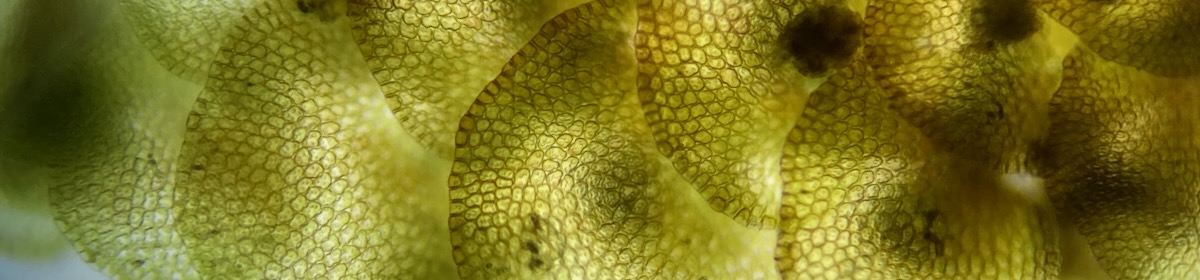
These are the eggs that Carol dyed last night, and which we brought to church this morning to be eaten during the annual Easter egg hunt.
Revised version, 15 April 2016
Documenting a Local Faith Community, pt. 1
Our local faith community, the Unitarian Universalist Church of Palo Alto (UUCPA), is a congregation affiliated with the Unitarian Universalist Association (UUA), the merger of the American Unitarian Association and the Universalist Church of America. Both the Unitarians and the Universalists started out by rejecting standard Christian doctrines and creeds, and by the late nineteenth century they had become “post-Christian” religious groups. (7) Today, most Christians would not consider UUCPA to be a Christian church: we affirm neither the Nicene Creed, nor Jesus Christ as Lord and Savior; the majority of the congregation are atheists; some of our congregants assert multiple religious identities including non-Christian religious identities such as humanism, Buddhism, etc. Yet to non-Christians, we look like Christians: we meet on Sunday mornings; our religious services resemble standard U.S. Protestant Christian worship services; and our official name is the “Unitarian Universalist Church of Palo Alto.” So the most convenient term for us remains “post-Christian.”
Most Sunday mornings, you will see me standing outside the door to the Main Hall on the campus of UUCPA, greeting families and individuals as they come up the covered walkway from the parking lot and the bike racks, or in the other direction from the front garden. On one particular Sunday morning, Reva, age 12, and her father wave at me as they walk up from their electric car. Reva is looking forward to “Pi Day,” March 14; she has memorized pi to over a hundred digits. When I comment that Pi Day is less fun this year than last, because last year was 3/14/15, Reva’s father points out that if you round up pi to four digits after the decimal point, you have 3.1416. Reva’s family is committed to fighting climate change, and they purchased an electric Nissan Leaf soon after the car came on the market. This family is typical of many Silicon Valley families in the congregation: they celebrate Pi Day, the children are well-versed in STEM (science, technology, engineering, and math) learning, and they all show their commitment to the global environmental crisis by embracing new technological solutions.
Inside the Main Hall, the senior minister, Amy Morgenstern, has started the service. Three sixth grade girls, Zoe, Becky, and Eva, say “Hi!” to me as they race through the door to take up their usual places in the back corner of the Main Hall. All our children and teens spend the first fifteen minutes of every service in the Main Hall before they go off to Sunday school. While some children prefer to sit with their parents and pay attention to the service, these sixth graders sit quietly in a corner and pay attention to each other.
I finish greeting latecomers, slipping into the Main Hall as Beverly, the lay worship associate, reads this week’s centering words. “With our centering words each week,” says Beverly, “we draw on the many sources of our living tradition.” She reads a short excerpt from a contemporary poem; then she rings a bell, inviting everyone “to follow the sound of the bell into silence.” I’m standing next to where Zoe, Becky, and Maria are sitting. They are still interacting through gestures and facial expressions, and though they are not making any noise I would not say that they are spiritually silent; and I’m pretty sure they didn’t heard the centering words Beverly just read.
Everybody stands to sing the first hymn together. Most of the children know this hymn by heart, a contemporary spiritual song called “Come Sing a Song with Me.” One fifth grader stands on her chair, holding on to a parent, leaning her head back, her whole body involved in singing this, her favorite song. At the beginning of the last verse, I open the side door to the Main Hall, and forty or so children run pell-mell out the door and across the patio towards their Sunday school classrooms. Two generations ago, the children going off to Sunday school would have been almost entirely white, reflecting both a deep racial divide in American religious life, and the fact that the city of Palo Alto was over 90% white. Today, the city of Palo Alto is about 65% white while the surrounding county is now white-minority; nearly a third of the population of Palo Alto is foreign-born. (8) On this Sunday, the children going off to Sunday school are about 75% white; the non-white children at UUCPA are mostly of East and South Asian descent, but also of African descent, Latino/a, Middle Eastern, etc.
While the children race each other to see who will be first in their classrooms (not necessarily because they love class; in some classrooms there are a few couches, and the first ones in the classroom will get a seat on a couch), I reflect on the invisible economic differences between them. The median household income in Santa Clara County is close to $95,000, the highest median household income of any county in the U.S.; at the same time only 13.3% of households have an income in the range of $50,000-75,000, showing that “the middle class is being hollowed out.” (9) Many of the families who are affiliated with UUCPA have annual household incomes well over $100,000, but others are struggling to get by, especially given the exceedingly high cost of housing in Silicon Valley. (10) The majority of the regular attendees of UUCPA have incomes that place them in the middle class and upper middle class, but some regular attendees receive federal assistance for rental housing (so-called “Section 8 housing”). (11)
When I arrive in the classroom, Lorraine, my co-teacher for the sixth grade Ecojustice class, is already there. Of the seven children present today, five are white and two are non-white; six are girls and one is a boy. I take attendance while Lorraine asks one of the children to light a candle in a chalice (a flaming chalice is a common symbol for Unitarian Universalism). The children all say our usual opening words together: “We light this chalice in honor of Unitarian Universalism, the church of the open minds, helping hands, and loving hearts,” (12) and we all do the hand motions that go with each phrase. Next we everyone gets to tell about one good thing and one bad thing that happened to them in the past week; Becky is the only one who doesn’t participate in this; she never participates except when there are only one or two children in class.
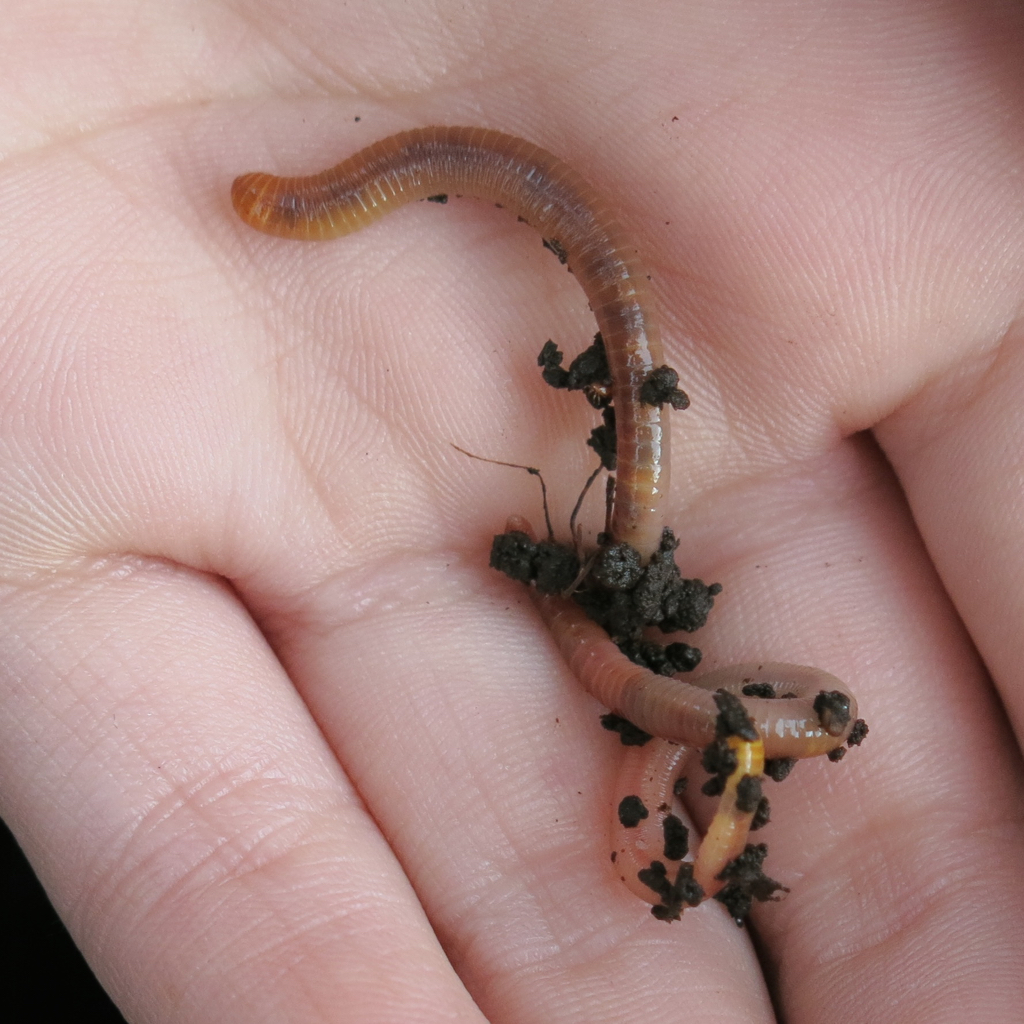
Today we’re going to work on making nesting boxes for the Violet-green Swallows that fly over the creek that flows along the edge of the church campus. But first the children want to check on their worm composter and their “recycled container garden” which they made from a worn-out automobile tire and discarded wood pallets. On our way to the composter and the garden, we stop at the church kitchen to pick up some vegetable scraps that the worms would like. As the children dump the scraps into the composter, Lorraine reminds them that we should add dry plant waste to the composter. Two of the children drag over a large yard waste bin and add handfuls of dead leaves along with the vegetable scraps. Aiofe reaches into the composter and finds some worms, which she holds in her hand to show the others. Next we check the container garden, made of a discarded tire. (13) The squirrels have dug holes in the dirt and disrupted the seeds we planted, so I promise to make a wire cage to keep out the squirrels.
Notes:
(7) Historian of religion Gary Dorrien writes that “the implicitly post-Christian religious humanism” of Ralph Waldo Emerson and Theodore Parker, two theological giants of mid-nineteenth century Unitarianism, had “reconfigured” the Unitarians by the late nineteenth century into a post-Christian denomination (The Making of American Liberal Theology, 1805-1900 [Louisville, Kentucky: Westminster John Knox Press, 2001], pp. 105-109). The Universalists became post-Christian somewhat later, but were post-Christian by the time of the merger with Unitarians in 1961.
(8) The U.S. Census Bureau provides the following data for the city of Palo Alto on “Race and Hispanic Origin” from the 2010 Census (as of April 1, 2020): White alone, 64.2%; Black of African American alone, 1.9%; American Indian and Alaska Native alone, 0.2%; Asian alone, 27.1%; Native Hawaiian and Other Pacific Islander alone, 0.2%; Two or More Races, 4.2%; Hispanic or Latino, 6.2%; White alone, not Hispanic or Latino, 60.6%. 32.3% of the population in Palo Alto in 2010 was foreign-born. United States Census Bureau, QuickFacts, Palo Alto city, California, accessed March 26, 2016: link.
The immediate neighborhood of the Unitarian Universalist Church of Palo Alto (UUCPA) is slightly more diverse than the city as a whole. The racial and ethnic composition of census tract 510803, where UUCPA is located: 59% White, 1% Black, 5% Hispanic, 32% Asian, 2% Other. Neighboring census tract 5107 is white minority, at 47% white. “Mapping America: Every City, Every Block,” New York Times, accessed March 26, 2016: link.
(9) Data are from a 2014 study prepared by IHS Economics, and reported by George Avalos, “Santa Clara County has highest median household income in nation, but wealth gap widens,” San Jose Mercury News, August 11, 2014, accessed March 19, 2016: link.
(10) The 2010 U.S. Census found the median household income in Palo Alto, 2010-2014 (in 2014 dollars), was $126,771; the per capita income in the same period was $75,257; and the poverty rate was 5.3%. United States Census Bureau, QuickFacts, Palo Alto city, California, accessed March 26, 2016: link.
The poverty rate of 5.3% may include a higher proportion of families with children. For example, at Gunn High School, one of the two high schools in Palo Alto, 158 students, or 8.2% of students, received federally-funded free and reduced price meals in the 2010-2011 school year, the latest year for which I could find information. Palo Alto Unified School District, Henry M. Gunn High School Midterm Progress Report (Date of Midterm Visit March 22, 2012), Accrediting Commission for Schools, Western Association of Schools and Colleges, 8, accessed March 26, 2016: link. To put this into perspective, a household with four persons would qualify for subsidized meals if the household income is $44,863 or less. Palo Alto Unified School District School Nutrition Program Pricing Letter to Household (June, 2015), 2, accessed March 26, 2016: link.
(11) According to Fred Buelow, Treasurer of UUCPA, the congregation appears to have representation in each of the five quintiles of income distribution, with the smallest number in the lowest quintile. Personal communication, March 28, 2016.
(12) Words by Rev. Ginger Luke, a Unitarian Universalist minister of religious education.
(13) Haiti’s Papaye Peasant Movement (MPP) developed tire gardens to promote food security: “The concept of personal home gardens—in the city and in the countryside—carries great significance in a country where food security is hard to find.” Jessica L. Atcheson, “Ending Food Insecurity, One Urban Tire Garden at a time,” Rights Now: The Newsletter of the Unitarian Universalist Service Committee (Summer/Fall, 2013), 6-8.
Revised version, 15 April 2016
Introduction and Methodology
Since at least the 1970s and the birth of the modern environmental movement, theologians and scholars of religion have paid a good deal of attention to how religion can support environmentalism and environmental justice. An important part of this scholarly attention has been directed at interpreting sacred texts and narratives to support environmentalism and environmental justice. (1) Both I, and the local faith community I serve, sometimes use this scholarly work to help inform and shape our response to the environmental crisis.
As much as I appreciate the scholarly work that has been done on this topic, I find a gap between this scholarly work and the work we do in our local congregation. Most people in our congregation have little time for reading sacred texts, let alone reading scholarly works. Our lives are filled with family and personal matters—raising children, going to school or working at jobs or coping with unemployment, caring for aging parents or declining spouses, etc. Many of us are also active in social justice work—our congregation is particularly concerned with homelessness and affordable housing, peacemaking, and managing the global environmental crisis, but we also are fighting racism, working to end modern slavery, dealing with the immigration problem, etc. As a minister of religious education, I myself have little time to read scholarly work, given the demands of teaching children’s classes, advising youth groups, managing volunteers, administering programs, fundraising, counseling people in crisis, etc.
Teaching, managing, administering, and counseling; caring, coping, working, and handling family responsibilities—these leave little time for reading or study. From one point of view, these mundane human relationships crowd out the divine. From another point of view, this is where the divine thrives, growing in the midst of mundane relationships. The poet Marge Piercy, in a poem we sometimes read in our worship services, says:
Weave real connections, create real nodes, build real houses.
Live a life you can endure: Make love that is loving.
Keep tangling and interweaving and taking more in,
a thicket and bramble wilderness to the outside but to us
interconnected with rabbit runs and burrows and lairs. (2)
We could try to clear a straight path through the thickets and brambles of ordinary life, to cut through the thickets that lie between sacred text and our lives. I have attempted to do just this in conducting religious education classes for children and teens: to try to develop straight-line connections between sacred texts and young people’s lives. But trying to make direct connections in religious education has never worked as well as “tangling and interweaving and taking more in.” With that in mind, I decided to document the existing “rabbit runs and burrows and lairs” of our congregation’s religious education program, with its interconnections spreading like tangled rhizomes of plants—to document how a real-world congregation resists “an artificial unity” and instead celebrates “the messiness of becoming.” (3)
Those of us who do documentary work don’t really fit into the scholarly world. Documentarians tend to use language that is “too subjective” for scholarly articles; we tend to write in the first person singular, not in the scholarly passive voice. (4) We are writers, and also photographers and filmmakers, attempting “to ascertain what is, what can be noted, recorded, pictured,” and we try to figure out “how to elicit the interest of others, and how to provide a context, so that an incident, for instance, is connected to the conditions that informed and prompted its occurrence.” (5) Documentary work may seem wordy, non-linear, and overly passionate; documentarians have been accused of avoiding firm conclusions. But documentarians prefer to work this way in order to preserve the tangled messiness of what they have witnessed.
In documenting religious education programs in my congregation, I have protected the privacy of those whom I document, except where I asked for permission to quote someone directly. I have changed names and personal details, and sometimes combined identities to provide additional privacy.
Notes:
(1) One notable example: Mary Evelyn Tucker and John Grim, series ed., Religions of the World and Ecology Series (Cambridge, Mass.: Harvard University Press, 1998-2004). Our congregation has the complete ten volume series in our library, though it appears to be little used.
(2) Marge Piercy, “The Seven of Pentacles,” Circles on the Water: Selected Poems (New York: Knopf, 1982), 128.
(3) Michael Mikulak, “The Rhizomatics of Domination: From Darwin to Biotechnology,” Rhizomes: Cultural Studies in Emerging Knowledge 15: Deleuze and Guattarri’s Ecophilosophy (2007): 17, accessed April 1, 2016 http://www.rhizomes.net/issue15/mikulak.html.
(4) Robert Coles, Doing Documentary Work (Oxford: Oxford University Press, 1997), 28-30.
(5) Ibid., 20.
(6) Footnote 6 was moved to the main body of the text.
Is the famous song “This Little Light of Mine” an African American spiritual? Or was it composed by Harry Dixon Loes and Avis B. Christiansen around 1920?
Attributions to the African American tradition
Many hymnals and songbooks attribute “This Little Light of Mine” to “African American Spiritual,” or more generally to “Traditional.”
An influential source: Lift Every Voice and Sing II: An African American Hymnal, ed. Horace Clarence Boyer (New York: Church Publishing, 1993), has the following attribution: “Words: Traditional. Music: Negro spiritual, adapt. William Farley Smith (b. 1941)”. The melody of this version resembles the melody collected in 1939 by Alan Lomax, as sung by Doris McMurray of Huntsville, Texas.; this recording is available online here.
An equally influential source is Sing for Freedom: The Story of the Civil Rights Movement Through Its Songs by Guy and Candie Carawan (Montgomery, Ala.: NewSouth Books, 1963/2007). The Carawans give a somewhat different melody, and attribute this as “Traditional song” (p. 21). They provide documentary evidence that indicates the song was included in the “Highlander Song Book” (p. 25), a songbook that would date from the 1930s. Incidentally, the Carawans provide a bridge that is not included in the hymnals I’ve consulted.
In addition to the audio recording by folklorist Alan Lomax in 1939 (see above), “Let hit shine” was collected by Ruby Pickens Tartt, and published in “Honey in the Rock”: The Ruby Pickens Tartt Collection of Religious Folk Songs from Sumter County, Alabama (Mercer University Press, 1991, p. 5; words only). Note that like the Lomax version, this version was probably collected in the 1930s. The editors do not provide any guidance as to when Tartt collected this particular song, but they provide the following editorial comment, without documentation: “Widely performed by choirs and gospel groups during the 1930s, a favorite on gospel radio shows, ‘Let hit shine’ is now also in white folk tradition.”
Note that “This Little Light” is NOT found in the following influential nineteenth century collections of African American songs: Slave Songs of the United States ed. William Francis Allen et al.; The Story of the Jubilee Singers; with their Songs (6th ed., 1872); Cabin and Plantation Songs as Sung by the Hampton Students (1876).
Attributions to composer Harry Dixon Loes
The words to “This Little Light” are collected by Steven Gould Axelrod, Camille Roman, and Thomas J. Travisano, in their book The New Anthology of American Poetry: Modernisms, 1900-1950 (Rutgers University Press, 2005), on p. 605. The editors add the following editorial comment: “Harry Dixon Loes (1892-1965) wrote and composed this song with Avis B. Christiansen (b. 1895). The pair also wrote the hymns ‘Blessed Redeemer’ and ‘Love Found a Way’.” This attribution, coming as it does from a well-regarded university press, carries some weight; however, the attribution is not documented.
Typical of the stories told about the song is that told by Ace Collins, in his book Music for Your Heart: Reflections from Your Favorite Songs (Nashville: Abingdon Press, 2013), p. 191: “During his studies [at the Moody Bible Institute], Loes was struck by the significance of three different references to light in the New Testament…. Using light as an inspiration and coupling it to a melody that carried the feel of a spiritual, Loes wrote ‘This Little Light of Mine.’ Yet the song, which is today almost universally known, took a while to take off. Although written in 1920, it would be in the days just before World War II that churches began to adopt ‘This Little Light of Mine’ as a part of Sunday school programs. Within a decade, Loes’s song was translated into scores of languages and sung all over the globe.” Collins provides no documentation whatsoever for any of these assertions.
Although the song was supposedly composed c. 1920, I was unable to find a reference to it in the Catalog for Copyright Entries for the years 1920 and 1921; however, Loes might have copyrighted the song later than 1920.
Hymnary.org shows no publications in hymnals prior to about the late 1930s; see graph here. However, Hymnary.org does not include every single U.S. hymnal from the twentieth century.
Wikipedia attributes the song to Loes, but does not document the source for this attribution. The Wikipedia page was created July 26, 2007, and many online sources (and probably many print sources) unquestioningly accept the Wikipedia attribution in spite of the lack of documentation; therefore, be wary of any source published 2007 and later that attributes the song to Loes.
The Web site Hymntime.com does NOT list “This Little Light” as one of Loes’s compositions. Note that Hymntime.com gives Loes’s dates as October 20, 1892 to February 9, 1965; the birth year is different from the birth year given by Wikipedia.
Conclusion and questions
The fact that folklorists collected the song after Dixon’s purported composition date of circa 1920 indicates that the song could have passed quickly into the folk repertoire soon after composition. However, assuming Loes did indeed write the song (or if Loes co-wrote it with Christiansen), where and when was it first published?
If Loes wrote the melody, what was his original version? Similarly, if the melody is an African American spiritual, what is the earliest recorded version of the melody?
Loes was white, so if he wrote the song, how did it become associated with the African American tradition?
In the absence of firm answers to these and other questions about the origins of this tune, the most careful attribution for this song would be “Unknown.”
Carol and I are experimenting with low-water irrigation systems for the garden. I’ve been using porous hose irrigation for years, purchasing porous hose made from recycled rubber tires, and burying the hose a few unches under the surface of the soil. David Bainbridge’s book Gardening with Less Water: Low-Cost, Low-Tech Techniques shows other highly efficient irrigation systems, including buried clay pots.
A buried clay pot is about as simple as an irrigation system can get: take a terracotta pot, put a cork in the hole in the bottom, bury it almost all the way in the soil, fill with water, then cover with a terracotta saucer.
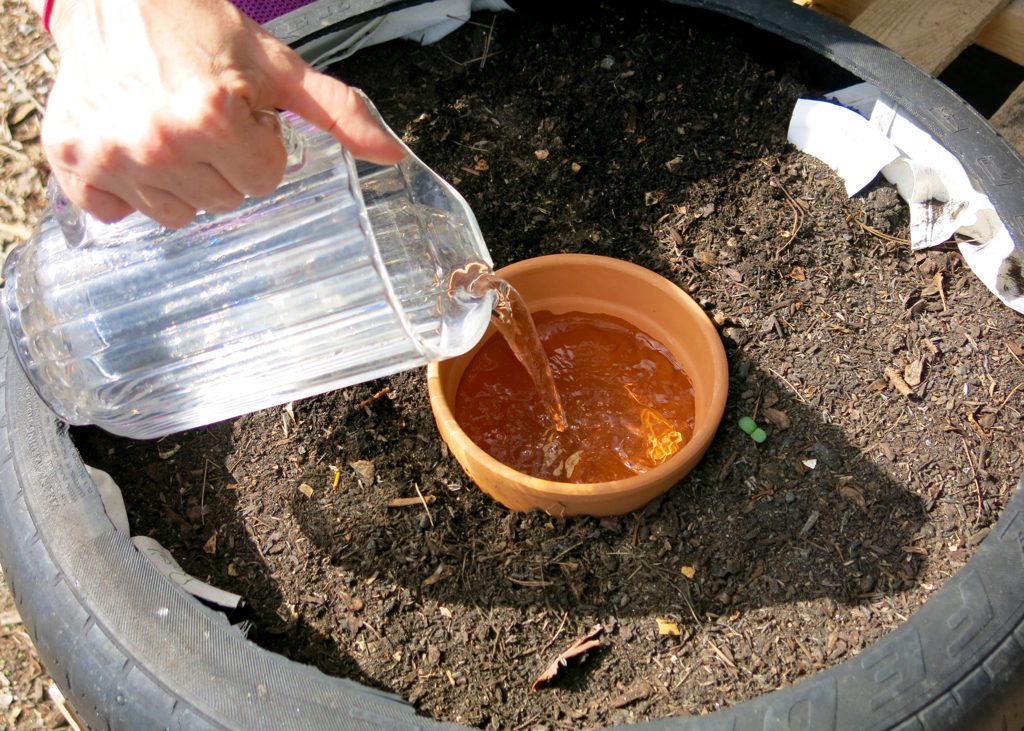
In the photo above, we’ve buried a clay pot in the tire garden built by our congregation’s ecojustice class, and Carol is filling it with water. In the next photo, Carol is about to put a lid on the buried clay pot; you can see the cork down in the bottom of the pot.
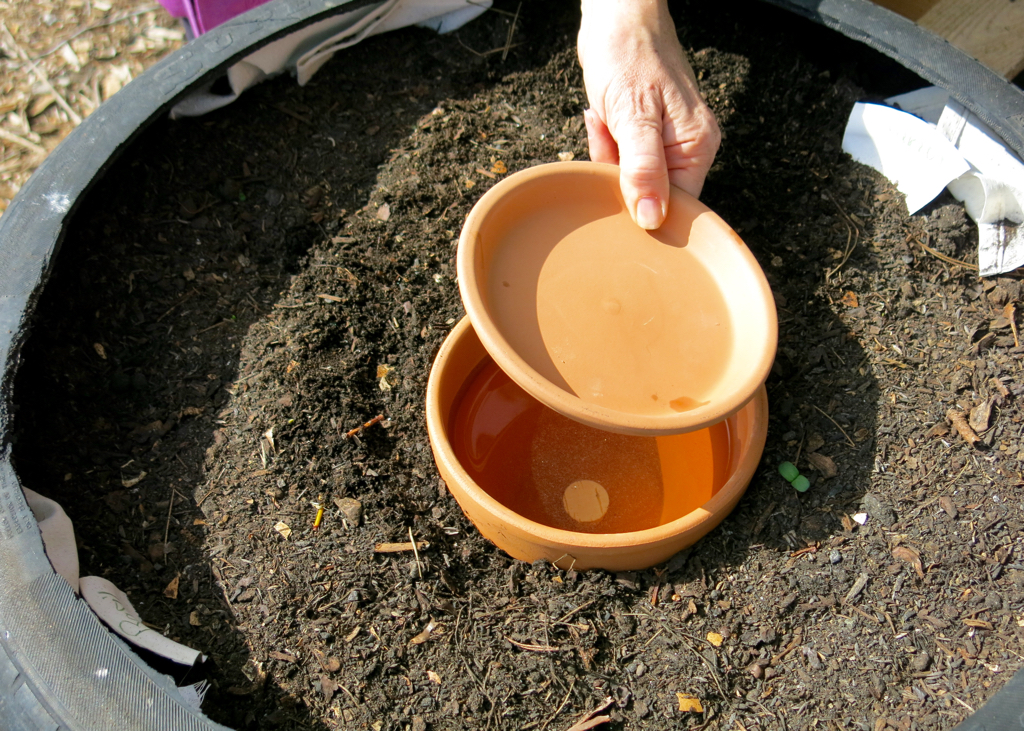
Bainbridge suggests placing buried clay pots about every 24-36 inches in a standard garden. So we figure that one buried clay pot is probably enough for one tire garden. It will be interesting to see how often we have to fill the clay pot.
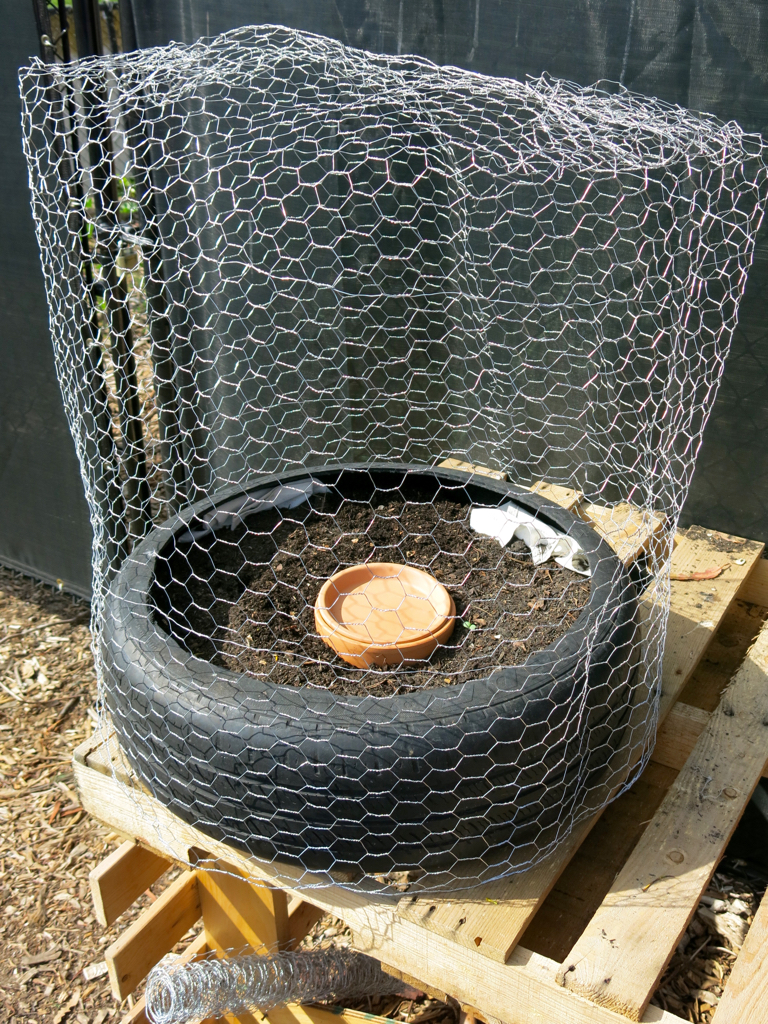
In our garden at home, we’re planning to try a somewhat more complicated version of this system: a porous terracotta capsule, fed by a hose. Until we get that to work, here’s a photo of the tire garden with the buried clay pot in the middle, and the squirrel-proof cage in place:
In the fall of 2014, the ecojustice class (gr. 6-8) at our congregation made “bee houses” to provide potential nesting sites for Mason Bees. We kept watch on the bee houses through spring of 2015, but neither I nor the teens observed any nesting activity. (Mason Bees are solitary, and do not nest in hives like the more familiar Western Honeybee.)
But when this year’s ecojustice class checked on the bee houses last Sunday, it looked like some of the holes are now or had recently been occupied by insects:
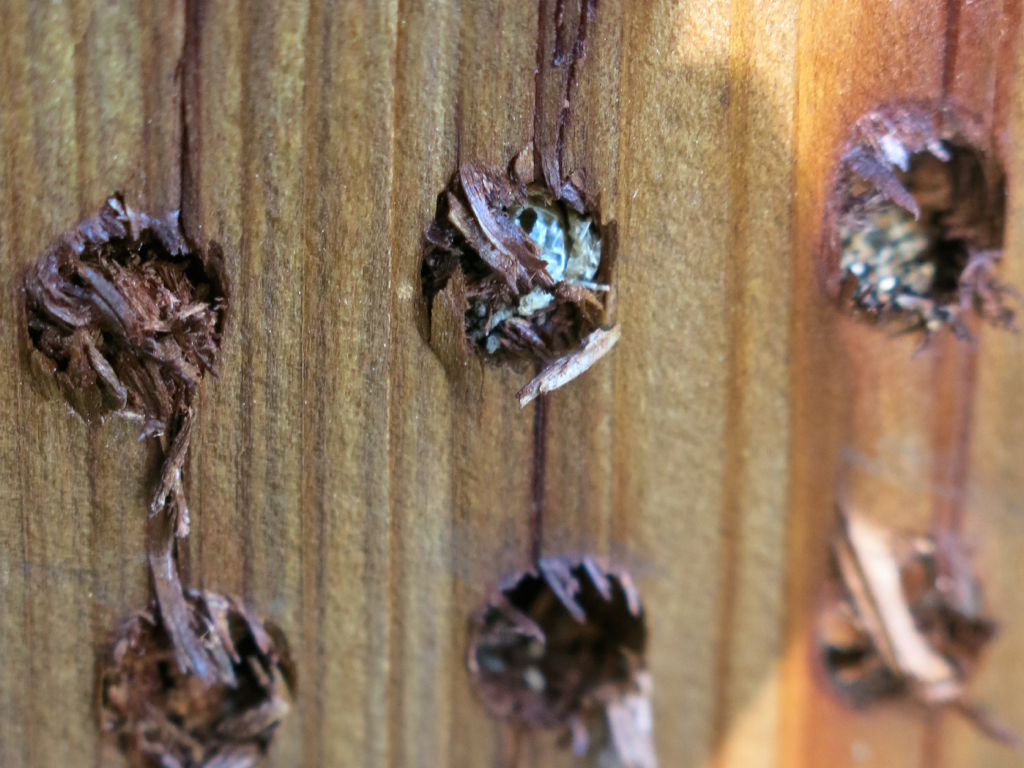
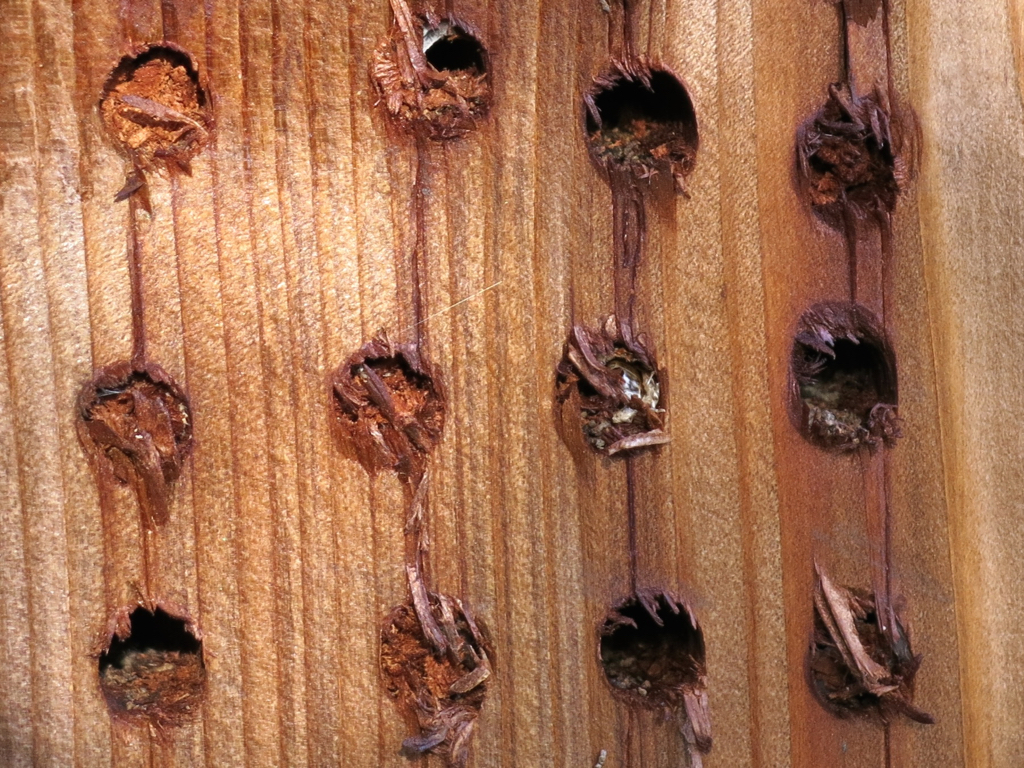
Since Mason Bees use mud and soils to plug up their nesting holes, and these holes do not look like they have mud in them — the color of the plugs is not the color of any of the nearby soils — I’m not convinced that Mason Bees are nesting here. Nevertheless, some organism has definitely moved in to these holes; perhaps further observation will reveal what that organism might be.
One of the best things about being part of a typical UU congregation is that you get to hear other people’s stories. If you join a men’s group or women’s group, if you become a Sunday school teacher, if you simply open yourself to others during social hour, you will hear people’s stories: “When I first met my life partner…” someone will say; or, “When I was in eighth grade…”; or, “When I lived in Virginia….” So begin the little stories about someone else’s life.
No one is going to publish a big fat biography of an ordinary person’s life. Usually, the only time we get to hear the story of someone’s whole life is after they die, at their memorial service. Mostly we hear little pieces of other people’s lives; but if you listen long enough, over the course of years, you will hear enough to piece together — not a biography, but a sort of patchwork quilt of that person’s life.
We can also piece together something of the lives of ordinary people of the past: people who are not powerful, famous, male, white, and highly educated all at the same time. With such ordinary people, we mostly can know only pieces of their stories. But we can fill in the holes between the pieces with questions, and stitch it together, like a quilt, into a whole.
This, then, the story of Nathan Johnson, a Black Universalist who lived from 1795 to 1880.
About Nathan Johnson’s early life, we can only ask questions. Who were his parents? Was he born free, or did he emancipate himself from slavery? How did he learn to read? How did he get to the north? He was born about 1795, perhaps in Virginia; [1] or perhaps in Philadelphia, either enslaved or free. [2] The first real fact we know about Nathan Johnson’s life is in 1819, when he was in his twenties, he got married in New Bedford, Massachusetts.
New Bedford in that time was a city with a surprisingly enlightened racial outlook. The Quaker residents of the city had been helping enslaved persons run to freedom since at least the 1790s. [3] The city was a terminus for the Underground Railroad. And in New Bedford, a person of color could do quite well financially: by about 1800, one black man, Paul Cuffee, of African and Wampanoag descent, had amassed a small fortune through shipping and international trade. [4] Continue reading “A Black Universalist in the 1830s”
I’ll be presenting a paper at the “Sacred Texts and Human Contexts” conference on May 23-25. This year, the conference topic is “Nature and Environment in World Religions,” and I’ll be presenting on “Environmental Crisis, Religious Education, and the Local Faith Community.”
Here’s where you come in:
Read over my proposal below, and let me know if you have any comments, ideas, or suggestions. I’d be particularly interested in hearing about recent books or papers on feminist theology that might pertain to this presentation — I’ll be using Rosemary Radford Reuther (of course), but would appreciate pointers to any other relevant works that have been published since Reuther’s Goddesses and the Divine Feminine (2005).
Now here’s the proposal that was accepted by the conference committee:
“When examining organized religion’s response to the contemporary environmental crisis, to what extent should we focus on sacred texts? Speaking as a religious educator based in a local faith community, I find that sacred texts may be less important in a given local faith community than other factors such as institutional traditions, the influence of the surrounding social milieu, economic forces, the material and social dimensions of religion, etc. This is particularly true when engaging in religious education with children.
“This paper provides a narrative account of one local faith community’s education of its 10-15 year olds. I examine the explicit curriculum of formal classes in ecojustice, sexuality education, peacemaking, and religious literacy; I also examine the implicit curriculum of adult behavior and adult role modeling; finally, I examine the “null curriculum,” those topics that are ignored and unexamined. The paper tells of “ah-ha” moments when children realize that their faith provides important messages about, and resources for addressing, the global environmental crisis. The paper also points out missed and botched opportunities, where the faith community has oversimplified or failed to confront certain aspects of the environmental crisis.
“The paper then turns to analyzing the narrative, from a religious education perspective. What a child learns in a local faith community will be influenced by foundational sacred texts, but also by the faith community’s educational philosophy and practice; by all the various community initiatives in which the faith community engages; by the economic situation of the faith community and its members; etc. In this specific local faith community, I find that religious attitudes towards the environmental crisis cannot be fully understood by neat examinations of sacred texts, but that they are messy, embodied, and constantly growing and changing; and I find that the perspectives of feminist theologies can provide a useful theoretical framework for fuller understanding.
“In closing, I draw on my narrative account to suggest how religious education might provide helpful insights for linking theoretical accounts of religion and the environment, with praxis or pragmatic engagement with the global environmental crisis.”
Ma-ku is a Taoist deity of longevity. In the image below, she can be identified by her hoe and a basket of the fungus of immortality. This Ching dynasty porcelain presentation dish was made sometime in the eighteenth century, and is now in the Asian Art Museum in San Francisco (accession no. B60P376):
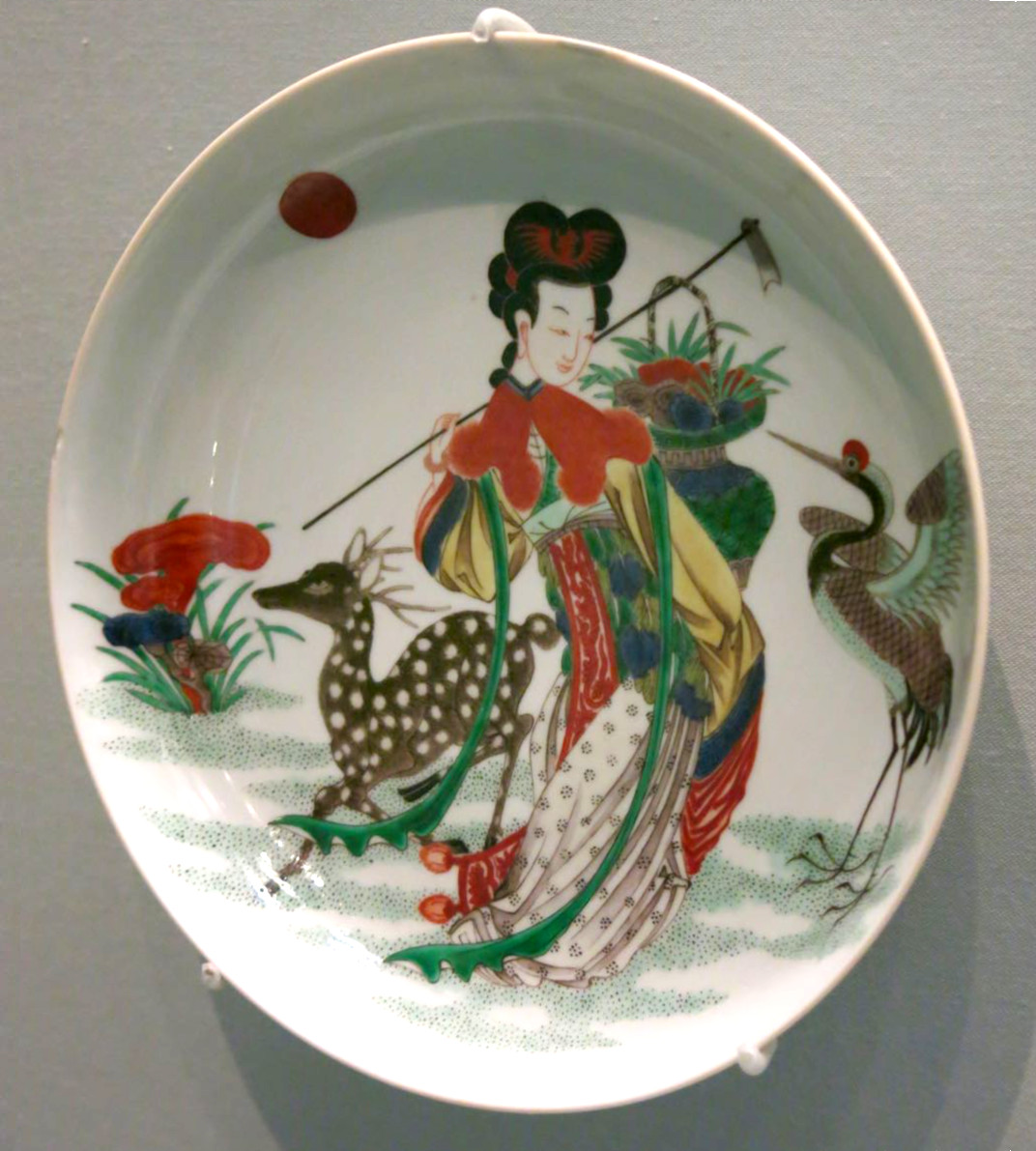
Today in the West, Ma-ku’s name is sometimes translated as “Hemp Maiden,” which has led a number of Westerners to misappropriate her as the patron deity of pot smokers; you can find plenty of Web sites that state this as an absolute fact. Note, however, the iconography of Ma-ku often shows her, not with marijuana, but with a basket of the fungus of immortality. And so, not surprisingly, other Western writers have jumped to the conclusion that Ma-ku is not the goddess of marijuana, but rather the goddess of psychoactive mushrooms. Obviously, psychoactive mushrooms do not produce longevity, but we Westerners do love to superimpose our own meanings on the gods and goddesses of other times and other cultures.
Rather than imposing Western values on Ma-ku, I’m more interested in learning her role and place in Chinese culture. I found it difficult to locate good solid information about Ma-ku in English. But Mesny’s Chinese Miscellany (1899), though not a scholarly work and probably biased by a colonial outlook, has a useful entry on Ma-ku under the general heading of Gods and Goddesses:
MA KU
Ma Ku: A Taoist immortalised female saint or Hsien Nu; a portrait of Ma Ku is very popular as an emblem of longevity, and is one of the very best presents a person can make to his superiors on the occasion of a birthday feast.
During my stay in Kuei-chou, I received several such presents, in the form of a portrait of Ma Ku with a pilgrim’s staff and a basket of flowers over her shoulder, the whole embroidered in fancy coloured silk floss, on a scarlet satin tablet some 8 or 10 feet long by about 3 feet wide.
Mayers writing of Ma Ku says that she is “One of the female celebrities of Taoist fable. She is said to have been a sister of the immortalized soothsayer Wang Feng-ping (see Wang Yuan), and like him to have been admitted into the ranks of the genii [i.e., the immortals]. It is related that once when Fang-ping revealed himself in the presence of Ts’ai Ching, whom he chose as his disciple and taught, by corporeal sublimation, to free himself from the bonds of death, the genii was accompanied by his sister Ma Ku, who appeared in the semblance of a damsel of eighteen or twenty, arrayed in gorgeous apparel, and who waited on her brother and his pupil with strange viands served in platters of gold and chrysoprase.
“The wife of Ts’ai Ching was newly delivered of a child, seeing which Ma Ku took some grains of rice and threw them on the ground, where they at once became transformed into cinnabar (the magic of the alchemists). Fang-ping seeing this exclaimed with a smile, ‘Sister, do you still indulge in child’s play?’ to which the damsel replied: ‘Since I have been our handmaid, thrice has the eastern sea become fields where the mulberry grows!’…
“Hence the Tsang Sang Chih Pien, signifying the cyclic revolutions of nature and cataclysms occurring upon the earth’s surface such as beings of immeasurable longevity alone are priveleged to witness more than once.” It is on this account that the image or portrait of Ma Ku is so highly prized by the Chinese as an emblem of extreme long life and happiness.
— William Mesny, ed., Mesny’s Chinese Miscellany: A Text Book of Notes on China and the Chinese, vol. III, (Shanghai: Shanghai Mercury, 1899), p. 286.
Recently, a new mosque opened in Palo Alto, which is affiliated with a specific group of Shia Muslims known as Dahwoodi Bohra. I’ve been looking into Dahwoodi Bohra, and have found that it challenges some of my notions of Islam.
Dahwoodi Bohra is a branch of Isma’ili Islam, along with the better-known Druze; and Isma’ili is a branch of Shi’a Islam. Isma’ilism has Seven Pillars, instead of the more familiar Five Pillars of Islam. The Isma’ili consider the Shahadah — “There is no God but Allah and Muhammad is his prophet” — to be the grounding statement of all Seven Pillars, and therefore not a pillar in itself. The Seven Pillars of the Isma’ili include the familiar Salat (prayer), Zakat (charity), Sawm (fasting), and Hajj (pilgrimage). The three additional pillars are Jihad (struggle), Walayah (guardianship of the faith), and Taharah (purity). Although I usually think of Muslims performing Salat, prayer, five times a day, the Dahwoodi Bohra pray three times a day, since they perform some of the prayers at the same time.
The Dahwoodi Bohra have characteristic clothing which they may wear at religious ceremonies. The men wear a white tunic and coat, with a hat known as a topi (on Youtube, I found instructions on how to properly starch a topi here). Women typically wear head scarves, but rather than the subdued fabric I usually see Muslim women wearing, Dahwoodi Bohra headscarves tend towards the bright and spangly.
In common with other Shi’a Muslims, a major ritual is the Mourning of Muharram, which is observed in the first Islamic month; this observance is generally not performed by Sunnis. And there is much more to learn about the Dahwoodi Bohra: they have their own language; the largest number live in Gujarat, India, and Karachi, Pakistan; the women sometimes perform genital mutilation of girls, yet the men may be unaware of this; etc.
Yet learning even this little bit about the Dahwoodi Bohra has shown me the extent to which I have assumed that Sunni Muslims are normative. I should know better: every religious tradition I have started investigating has proved to be far more diverse than my original assumptions allowed for.
And here are some links to news stories on the local Dahwoodi Bohra mosque: here, here, and here. There’s not much about the congregation on Salatomatic, but for reference, their listing is here. Finally, the “official” Dahwoodi Bohra Youtube channel, which appears to be mostly audio files, is here.