List of faith communities near Palo Alto

I’ve been compiling a list of religious organizations mostly in Silicon Valley, from San Jose to San Francisco. The middle school class of our congregation visits other faith communities, and this list is designed to be used as a resource to help the class find places to visit.

Even though I was familiar with the work of Harvard’s Pluralism Project, even though I expected a wide diversity of religious traditions, I was still astonished at the religious diversity I found: there are hundreds of faith communities, ranging from Anabaptists to Zoroastrians, within an hour’s drive of our congregation.

Most of the research I did was online. It proved difficult to research some faith communities online, as quite a few do not have Web sites, or they have Web sites that are so outdated you don’t trust them. Yelp proved to an excellent source of information about many faith communities, especially when there were recent reviews (search for “Religious organizations” in a given locale). Youtube also proved a good source of information in a few cases; sometimes faith communities have inadequate Web sites but their members may post videos that provide useful information. One or two congregations had Facebook pages that provided the most recent information.

This list also relies on some real-world research. Our middle school class has visited some of these congregations, as noted on the list below. I also relied a lot on word-of-mouth information — people telling me about some faith community that they knew about, or had friends in, or belonged to.

Perhaps the most difficult part of making this list was figuring out a reasonable way to organize it. I started with the eight major world religions identified in Stephen Prothero’s book God Is Not One; added Zoroastrian, Sikh, Baha’i, and Jain to the list; then finished off with a list of New Religious Movements organized according to the categories in the book New Religious Movements, ed. Christopher Partridge. That takes care of the major divisions. It was more difficult to know how to categorize sub-groups within Christianity and Islam. Christianity is arguably the most diverse of the major world religions, and I did the best I could based on various scholarly reference works. Islam was also challenging to categorize, and I finally decided to use the categories from the Salatomatic Web site.

If you live in Silicon Valley, I’d love it if you looked over the list — then let me know if you see any errors or obvious omissions.

And now: the list! Continue reading “List of faith communities near Palo Alto”
Rules for prayer

Even though I’m the guy who wrote the essay “Why I Don’t Pray” in the pamphlet “UU Views of Prayer,” I’ve been thinking a lot about prayer recently. Not because I’ve started praying (I haven’t), but more because I’m sick of hearing about the alleged virtues of meditation and mindfulness. You see, meditation and mindfulness are being coopted by consumer capitalism: Meditation will improve worker productivity! Mindfulness will help your children get better grades! And if you work more, or get good grades and go to college, you will be able to buy more!

These are fairly recent developments for meditation and mindfulness. Prayer, on the other hand, got coopted by consumer capitalism a few decades ago. Prayer is an integral part of the “Prosperity Gospel,” a mutant offspring of Christianity and consumer capitalism which holds that if you believe in God and pray and give generously to your church then you will get rich. While I try to be tolerant of other people’s religious beliefs, the Prosperity Gospel is bullshit. And it’s clear clear to me that meditation and mindfulness are on track to being coopted in the same way prayer was: soon we will faced with the spectre of the Prosperity Dharma.

Unitarian Universalists have developed some standards and best practices that have tended to insulate us from the worst excesses of the Prosperity Gospel. It is worth reviewing what those are:

1. Prayer is not going to make you rich; some people who pray might get rich, but that’s random chance. (In fact, the same can be said of religion in general.)

2. If prayer works for you, go for it. If prayer doesn’t work for you, then don’t — AND don’t be an asshole and make fun of people who find that prayer works for them.

3. Unitarian Universalists generally agree with Jesus when he says in the Bible, “When you pray, do not be like the hypocrites, for they love to pray on the street corners to be seen by others” (Matt. 6:5). In other words, it’s fine if you pray but don’t be a show-off. In fact, don’t be a show-off with any spiritual practice.

4. We do not have to bow our heads during prayer (see previous point). If you want to, that’s fine, but you don’t have to.

Why is it worth reviewing these standards and best practices? Because they can also be applied to meditation and mindfulness. And meditation and mindfulness are coming ever closer to breeding their own mutant offspring with consumer capitalism. And the last thing we need is to be taken over by the Prosperity Dharma.

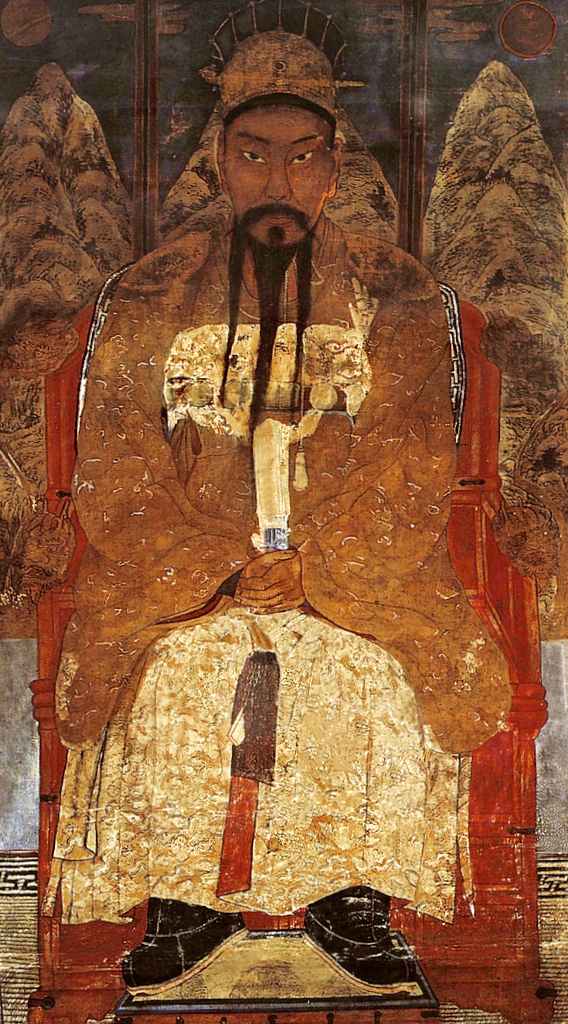
Tan’gun

Taejonggyo, a new religious movement in Korea, worships Tan’gun, the legendary founder of the first Korean kingdom. The contemporary expression of Taejonggyo was founded in 1909 by Nach’ol, a Korean nationalist who was resisting the Japanese occupation of Korea. Nach’ol said that Taejonggyo had been the religion of Korea for some three thousand years before the importation from China of the foreign religions of Buddhism, Taoism, and Confucianism during the Mongol invasions of the 13th century (Don Baker, Korean Spirituality [University of Hawai’i: 2007], pp. 118-119).

“Taejonggyo (The Religion of the Great God) … claims that Tan’gun, the legendary founder of Korea, is the original founder of Taejonggyo, which was revived by Nach’ol in 1909. It claims that it embodies the national spirit and philosophy. Tan’gun is believed to be the god-man and the founder of Korea, and he is the object of worship in Taejonggyo. Taejonggyo was at the forefront of the anti-Japan independence movement during Japnese colonialism in Korea. As a result, its followers were persecuted severely by the Japanese authorities.” Oliver Leaman, Encyclopedia of Asian Philosophy (Routledge: 2006), p. 383.

Tan’gun is linked to National Foundation Day, or Gaechenonjeol, in South Korea: “Gaecheonjeol was made an official South Korean national holiday in 1909. The day is typically celebrated with public ceremonies, performances and speeches; government offices and many schools and private businesses are closed. … Ceremonies are held to honor Dangun [Tan’gun] at an altar of rocks he built at Chamseongdan, located at the top of Mount Mani…” (Korea Ye Web site). According to historian Don Baker, National Foundation Day was originally established by the Taejonggyo religion as a day to venerate Tan’gun (Baker, pp. 90-91).

Tan'gun, legendary founder of the first Korean kingdom

The image above is a public domain image of Tan’gun from Wikimedia Commons (I edited this image for legibility). Unfortunately, Wikimedia Commons does not tell us what painting this image comes from. If you search for additional images of Tan’gun on the Web, note that his name is sometimes transliterated as Dangun.

Conference on religion and the environment

I just received a call for papers for the third annual conference “Sacred Texts and Human Contexts: Nature and Environment in the Sacred Texts of World Religions,” sponsored by Nazareth College in collaboration with Hobart William-Smith College. The conference poster asks the following “foundational questions”:

“How do religions integrate the discoveries of science with the teachings of tradition with respect to environmental
issues?
“How do environmental scientists look into contemporary environmental issues?
“What roles have been and can be played by faith communities in enhancing protection of nature and environment?
“How do women in faith communities respond to the contemporary environmental catastrophe?
“Do our sacred texts declare any actions to be immoral regarding dealing with nature and environment?”

Sounds like a pretty interesting conference, and I’m going to think seriously about attending. More information on submitting proposals, and on conference registration, online here.

Sacred Texts and Human Contexts conference poster

William R. Jones writing retreat

Hassahan Batts writes: “Practitioners Research and Scholarship Institute (www.prasi.org) is having another writing retreat where we are bringing together students of Dr. Jones in Allentown, Pennsylvania. If interested please email justequality@yahoo.com .”

No date given, so if you’re interested I’d suggest writing to the above email address right away.

Religion in the public square

In the United States, all too often the phrase “religion in the public square” means someone accosting you and telling you that you should join their religion; so the meaning of the phrase becomes, “our religion is right and yours is wrong.” Or that same phrase can be used pejoratively to imply that all religious practice shouldb e kept out of public view; so the meaning of the phrase becomes, “all religion is wrong.” Either way, someone is imposing their own views on the rest of a democratic society.

But if ours is a truly multicultural democracy, we should allow space in the public square for a variety of worldviews, without letting any one worldview dominance over the others. This becomes a delicate balancing act. Literal or metaphorical shouting matches between religious worldviews don’t promote tolerance; mind you, sometimes you have to get into shouting matches to preserve the openness of the public square, as when we have to fight to limit Christmas displays on public property, but no one imagines that these shouting matches increase tolerance. So given that public religious expression is a delicate balancing act, what does it look like when you have an appropriate expression of a religious worldview in the public square?

Sukkah at the JLISF, Columbus and Lombard, San Francisco

Today I saw such an expression of a religious worldview in the public square, and it looked like a rented flatbed trailer with a sukkah built on top of it. The trailer was parked in front of the Jewish Learning Institute of San Francisco (JLISF), on Lombard Ave. right off busy Columbus Ave in the North Beach neighborhood. Carol and I walked by just as some people from JLISF were cleaning up from lunch. They were polite and friendly, and ready to explain that they were celebrating Sukkot, and what a sukkah was, and so on.

This is a good display of religion in the public square: present, but not intrusive; with friendly people who are ready to explain, but not berate.

Sukkah through a bus window

(Posted the next day, and backdated.)

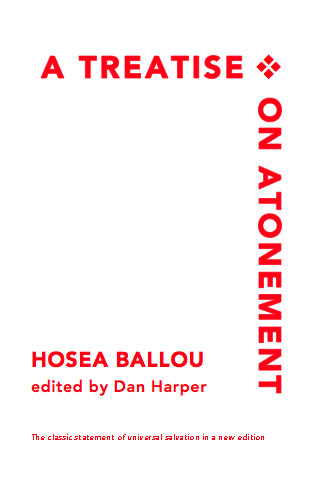
New edition of “A Treatise on Atonement”

Now in print: a new reader’s edition of Hosea Ballou’s classic statement of universal salvation, A Treatise on Atonement.

This new edition has been edited for clarity and ease of reading. I broke up long paragraphs, modernized punctuation, and added section breaks where there was a logical break in the text. I also added an extensive general index that references names, topics, etc., and also references Ballou’s entertaining illustrations and parables. Scriptural references have been added in the text where missing, and there is a full scriptural index. An appendix has a brief biography of Ballou, written by Thomas Whittemore a year before Ballou’s death.

This project started almost a decade ago, when I couldn’t find an adequate online edition of Ballou’s Treatise. Scott Wells, Russell Allen, and Steve Rowe all helped produce the Web edition, which went online in 2011. This new print version represents a complete revision of the online edition, with added indices and appendix.

Why bother with a new print edition when the classic Ernest Cassara edition, published by the Unitarian Universalist Association, is still in print? Most importantly, the text of the Cassara edition retains the crazy-long paragraphs of the early nineteenth century editions; adding new paragraph breaks makes the book much easier to read. Then too, I’ve long felt that the index to the Cassara edition was inadequate. Finally, after Cassara’s death earlier this year, there was no longer any hope that he might revise his edition.

The new 2015 edition of A Treatise on Atonement is available now through Lulu.com for $12.99 plus about $3.99 for shipping. In approximately 8 weeks, it will also be available direct through major online booksellers, as well as through bookstores via Ingram distributors, at a retail price of about $12.99 (the minimum price I can set that allows such wide distribution).

Treatise on Atonement, thumbnail of cover

What’s a deity?

This week I’ve been posting images of deities. But what is a deity, anyway?

Here in the United States, popular culture has been heavily influenced by Protestant Christian culture, and so when we are asked to define a deity, we default to the concept of a monotheistic transcendent deity. If we have to draw a picture of this deity, we might either draw a picture of a man with a white beard sitting on a cloud, or say that this deity is transcendent and can’t be pictured.

However, most of the human race, for most of human history, has had a far more complex and nuanced understanding of deities. In our own Western cultural tradition, which extends back to the civilizations of Rome, Greece, and the ancient Near East more generally, we can find a great diversity of deities. Here’s a list of some of the categories of deity we can identify in the Western religious traditions:

• a single transcendent deity, e.g., the transcendent god of Xenophanes and other early Greek philosophers; God for some Jews; God the Father for some Christian sects
• a most powerful deity among other deities, e.g., Zeus in ancient Greece
• greater deities, e.g., the more powerful ancient Egyptian deities such as Horus, Osiris, and Ra
• lesser deities, e.g., the Titans in ancient Greece
• local deities, e.g., river gods, deities of a grove or forest, etc.
• household deities, e.g., the household gods of ancient Rome, etc.
• deified humans, e.g., the ancient Egyptian Pharaoh, Roman emperors deified after death, etc. (some might argue that the Virgin Mary of some Christian sects fits into this category)
• humans that are more than mortal but slightly less than gods, e.g., Herakles for the ancient Greeks, Jesus for the Christian followers of Arius, etc.
• humans with special powers who are worthy of veneration, e.g., canonized saints, sports figures and celebrities, etc.
• abstract concepts as deities, e.g., god as the unmoved mover in Aristotle, scientific method, financial success, etc.

These are just the first examples from the Western religious traditions that come to my mind. Then we can add in all the deities which are current in our increasingly multicultural world, such as the vast hierarchy of Hindu deities, the several Buddhas (who may appear as humans with special powers, but who may also appear as transcendent deities), ancestors who are venerated (as in some African traditions), deities as part of nature or tied to natural places (as with some Navajo deities), etc., etc.

I don’t believe we should accept without question the U.S. Protestant Christian definition of deity as a single transcendent god in whom one either believes or doesn’t believe. Humans in the U.S. today venerate a variety of deities, many of which look nothing like the U.S. Protestant transcendent God. And that veneration can take a variety of forms, from overt public worship to more covert forms of veneration. Given that, don’t you think that there is a lot more religion in the U.S. today than is captured by polls which ask whether people believe in “God” and attend “church”?

Easy face painting

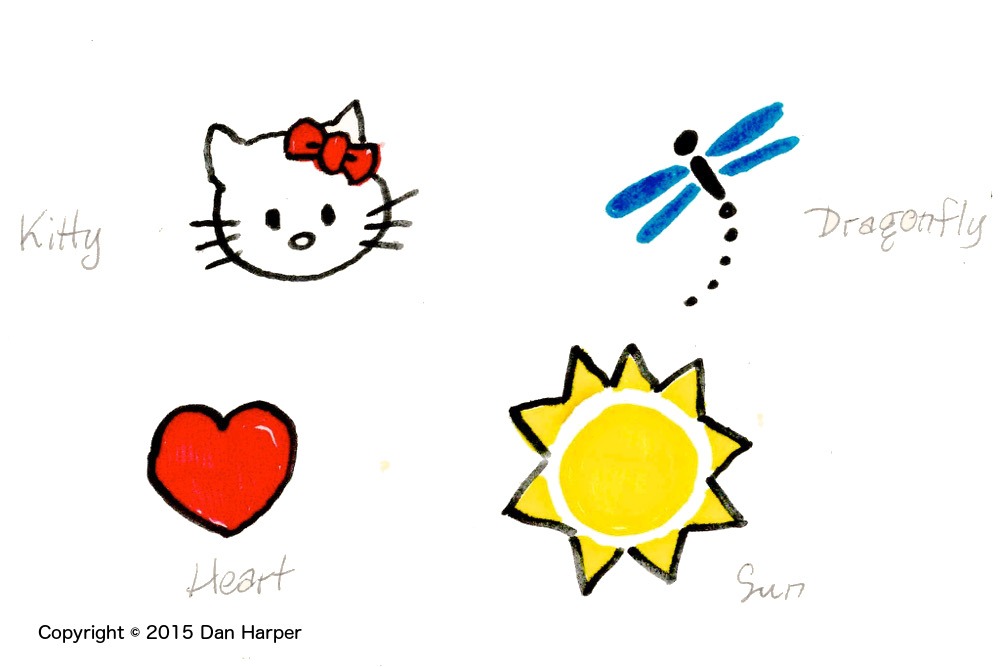
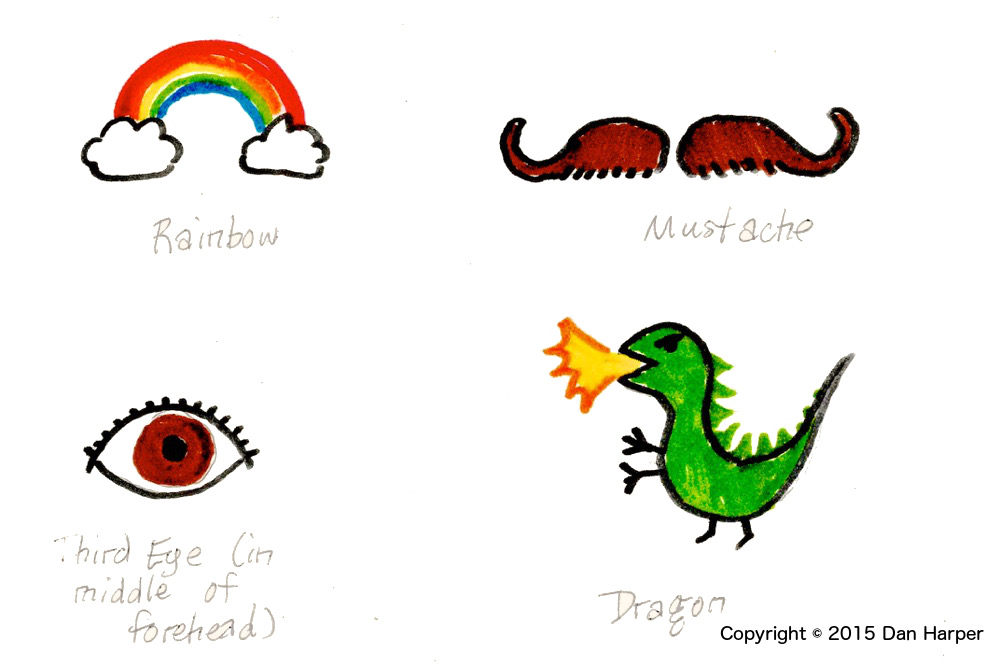
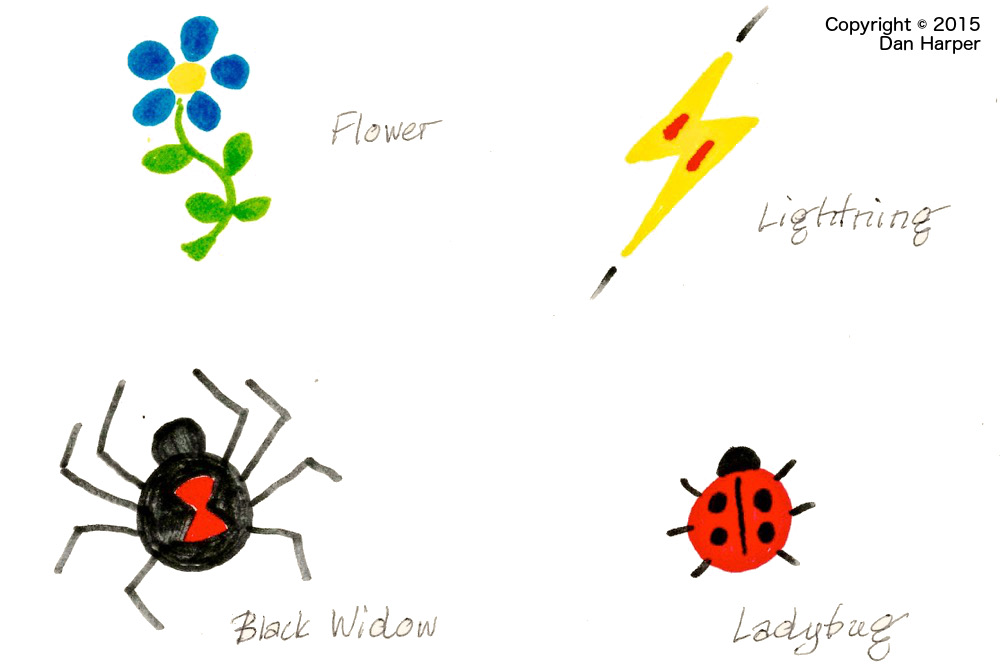
Some of our high school youth youth advisors went to Kids Carnival today, the fun event organized by the University AME Zion Church as a way for people of different races and ethnicities to get to know each other a little better while having a good time. Our youth group offered to do a face painting booth. We lucked out in that Elaine, a high school senior from the Palo Alto Vineyard Church, joined us — she is a fine artist who has her own business doing face painting for kids’ birthday parties. We let her do all the hard designs (Ice Bear, a Death Eaters logo, etc.), and we used our own easy designs.

Our designs turned out to be easy enough that children can do them (we let some of the children who came to our booth use our paints to paint designs on each other) — yet they’re satisfying and look pretty good when you’re done. I’m posting them here in case you want to use them next time you do face painting in your congregation. Except where noted, our designs are meant to go on cheeks or backs of hands. We had copies of the designs where children could look at them and choose the one they wanted. One last suggestion: it is worth spending extra money for good face paints; we bought the cheap ones, but when Elaine let us try hers, we saw that they were far better.

Face Painting 1

Face Painting 2

Face Painting 3

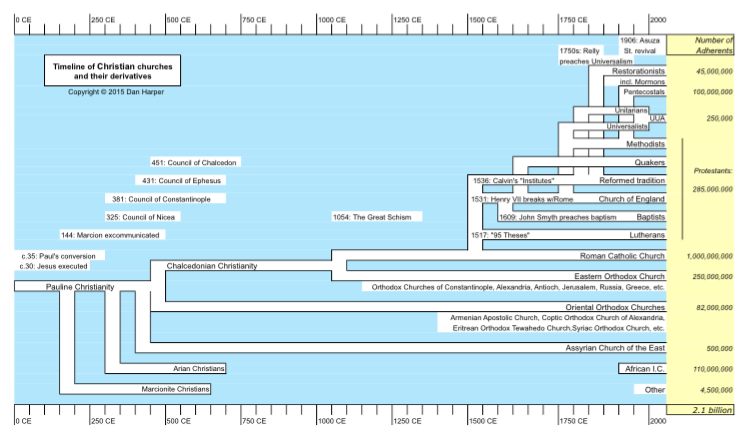
Chart of Christian churches

Another handout I developed for our “Neighboring Faith Communities” course for middle schoolers, a timeline of Christian churches and their derivatives:

Christian Church timeline thumbnail

Christian church timeline (PDF)

This is a revision of an earlier version of this timeline, which I originally posted here.

One purpose of this chart is to introduce middle schoolers to the incredible diversity of Christian churches, especially churches that are not well know in the West (i.e., Oriental Orthodox Churches, African Independent Churches), and groups that are often passed over or ignored by religious liberals (i.e., Restorationist groups including Mormons, Pentecostals).

Another purpose of the chart is to show how Unitarian Universalists do in fact derive from Christian churches — and further to show how very few in number we Unitarian Universalists are compared to the various Christian churches.

Chart edited. See comments.