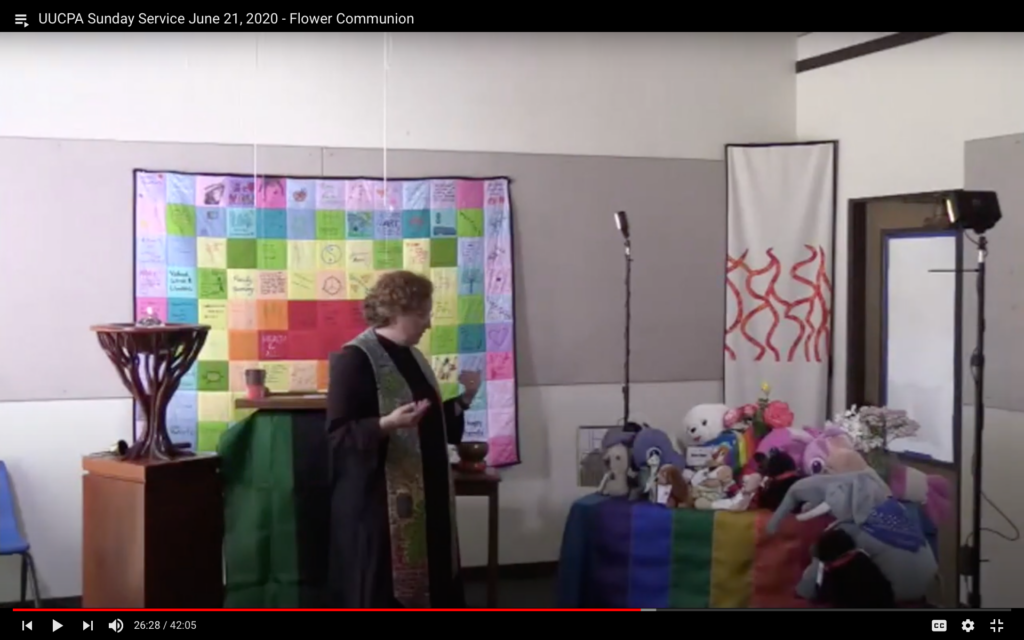
The stuffies who were staying on the Stuffed Animal Sleepover appeared in the worship service today, and participated in the Flower Communion. Here’s a photo of the senior minister, Amy Morgenstern, welcoming the stuffies to the service:
Yet Another Unitarian Universalist
A postmodern heretic's spiritual journey.

The stuffies who were staying on the Stuffed Animal Sleepover appeared in the worship service today, and participated in the Flower Communion. Here’s a photo of the senior minister, Amy Morgenstern, welcoming the stuffies to the service:
A group of Christian evangelicals have published a book titled “The Spiritual Danger of Donald Trump.” In an interview with Religion News Service, the editor, Ronald J. Sider, founder of Evangelicals for Social Action, answers the question, “So what is the spiritual danger of Donald Trump?”
“I would summarize it this way [Sider says]: Trump lies constantly. He has repeatedly demonstrated adulterous sexual behavior. He fails to make justice for the poor a concern in his policies. He constantly stokes white racism. His response to COVID-19 was dreadfully weak in the first couple of months. His position on climate change is simply disastrous. And his constant attacks on the fake media undermine democracy.”
Most Unitarian Universalists don’t like Donald Trump, but rarely do we speak about why he is a spiritual danger; mostly we focus on why he’s a political danger. I’m obviously not an evangelical Christian, and therefore not the target audience for Sider’s book or his remarks, but I think this summary of Trump as a spiritual danger is spot-on.
Another interesting point Sider makes in this interview is in response to the question of why white evangelicals supported Trump so strongly in 2016. A part of Sider’s response is particularly relevant to Unitarian Universalism:
“It’s partly because, let’s be honest, there’s a left wing fundamentalism as well as the right wing fundamentalism. And there’s a part of the liberal wing of the Democratic Party, which is really, I think, hostile to Christianity and certainly to evangelicalism. White evangelicals feel that, and don’t like it.”
This describes too many Unitarian Universalists: we can indeed come across as left wing fundamentalists who refuse to acknowledge that intelligent people can disagree with us on religious issues. For example, there are Unitarian Universalists who are convinced that global climate change is one of the top two or three most pressing issues facing humanity, who claim they’ll do everything they can to arrest global climate change, yet who are condescending and dismissive when they hear the term “creation care.”
There is no doubt that Donald Trump represents a pressing spiritual danger: he’s a liar, a racist, a misogynist, and he’s going to let the world go up in flames. It would be wise for us Unitarian Universalists to figure out how we can work effectively with all those who want to stop this clear and present spiritual danger.
A video to introduce the stuffed animal sleepover:
The fourth and final installment in the Ecojustice Avenger series:

The BBC reports that scientists are expecting more pandemics like COVID-19. Why?
“Many scientists agree that our behaviour — particularly deforestation and our encroachment on diverse wildlife habitats — is helping diseases to spread from animals into humans more frequently. According to Prof Kate Jones from University College London, evidence ‘broadly suggests that human-transformed ecosystems with lower biodiversity, such as agricultural or plantation landscapes, are often associated with increased human risk of many infections’.”
In other words, COVID-19 is a result of environmental destruction and mismanagement. And those of us in the wealthier countries are especially culpable:
“The current crisis, Prof Eric Fevre [from the University of Liverpool and the International Livestock Research Institute in Nairobi, Kenya] said, provides a lesson for many of us about the consequence of our own impact on the natural world. ‘All of the things we use and take for granted — the food we eat, the materials in our smart phones; the more we consume, the more someone will make money by extracting them and moving them around the world. So it’s incumbent on all of us to think about the resources we consume and the impact it has’.”
The third installment of the Ecojustice Avenger video series:
I’ve been re-reading one of the great American autobiographies, James Weldon Johnson’s “Along This Way.” Johnson was a renaissance man: poet, novelist, school teacher, writer of hit songs with his brother Rosamond, diplomat who served as American consul in Nicaragua during a revolution, and executive secretary of the NAACP.
In this last capacity, Johnson investigated a number of lynchings, and in his autobiography he describes an investigation into a lynching in 1917:
“I rushed to Memphis to to make an investigation of the burning alive of Ell Persons, a Negro [sic], charged with being an ‘axe murder.’ I was in Memphis ten days; I talked with the sheriff, with newspaper men, with a few white citizens, and many colored [sic] ones; I read through the Memphis papers covering the period; and nowhere could I find any evidence that Ell Persons was guilty of the crimes that had been committed. And, yet, without a trial, he was burned alive on the charge. I wrote out my findings, and they were published in a pamphlet that was widely circulated….”
More than a hundred years later, we’ve been hearing about the murders of George Floyd and Ahmaud Aubrey. Reading Johnson’s autobigraphy has prompted me to ask myself: What, if anything, has changed? The biggest change might well be the wide availability of videography, and the ability to disseminate videos almost immediately: instead of just reading a pamphlet some weeks after a lynching, we sometimes see a video of a lynching almost in real time. Another change: according to Johnson, some 5,000 people turned out to watch Ell Persons being burned alive; today, while the people doing the lynching still aren’t trying to hide their actions, at least some bystanders might call them out on it.
But in many ways it feels as though not much has changed. A hundred years later, black men are still being murdered without cause. Too many murderers of black men still get away with it. And, as my cousin Saba has pointed out, we still mostly don’t hear about the violence perpetrated on black women.
I suppose now I should offer some of the usual platitudes that white people offer, using key words like “justice” and “white supremacy” and “reconciliation” and so forth. But I think instead I’ll quote James Weldon Johnson’s key insight as he researched the Ell Persons case, as he discovered both the physical sufferings of the black victim, and the “moral degradation” of the white community:
“The truth flashed over me that in large measure the race question involves the saving of black America’s body and white America’s soul.”
It’s been interesting watching to see what online religious education resources people actually use. How-to craft videos? Single digits for number of views. Read-aloud programs? Low double digits, if I’m lucky. It’s not a great return for my invested time.
But what about “Story for All Ages” videos that are included in the Sunday service? We typically get over a hundred log-ins to our Zoom worship services, probably representing 1.5 humans on average, and posting on other social media (Facebook Live, Youtube) might add 10-30 views to the total. Plus a lot of informal positive feedback. These videos are definitely a better return for the time I invest, and as a result that’s what I’ve been concentrating on recently.
Since the “Story for All Ages” gets the largest audience, I thought maybe I’d try a tie-in video. The current “Story for All Ages” video series is about the conflict between Ecojustice Avenger and a dastardly villain named Trashman. The Ecojustice Avenger videos have a 12 second jingle, and after two episodes some kids had memorized all the lyrics to the jingle. That inspired me to expand that 12 second jingle to a full 1:41 music video, with videography inspired by Nam June Paik:
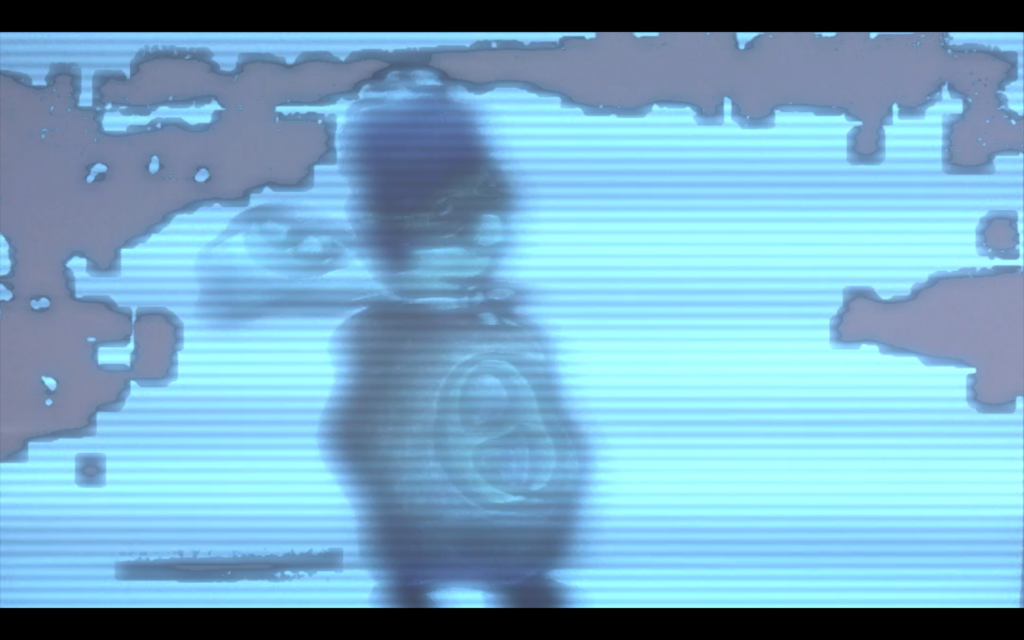
Will this reach kids? Maybe…probably not. But doing religious education in the age of COVID-19 requires constant experimentation until we discover what we can do that will reach kids.
Harvard Business Review (HBR) has a couple of articles on virtual meetings. Back on March 5, they published an article by Bob Frisch and Cary Greene titled “What It Takes To Run a Great Virtual Meeting.” If you’re experienced at running online meetings, most of this will seem like good common sense, but you should read it anyway. Some of HBR’s suggestions should be obvious, like “test the technology ahead of time.” Others may be less obvious, but are still critically important, like “make sure faces are visible.” HBR suggests having a facilitator for meetings, someone who can take the pulse of the group; and one of their more innovative ideas is that the facilitator can use a parallel phone-based survey tool like “Phone Everywhere” to get that feedback.
An earlier article, published in 2015, by Keith Ferrazi was titled “How To Run a Great Virtual Meeting.” This covers much of the same ground, though with different emphases. Ferrazi spent a couple of years researching virtual meetings, and his article summarizes his research findings. One of my favorite points from this article: ban multitasking, because it doesn’t work and it slows down the team. I’ve been guilty of multitasking at virtual meetings, and it’s true: when I start checking email, I lose track of what’s going on in the meeting. That’s one reasons why Ferrazi says to leave video on: so you can see when someone is trying to multitask. (This, by the way, is a big drawback of Google Meet: depending on how you set up the meeting, you can only see 4 people at a time.)
An article by John Wimberly of Congregational Consulting Group got me started reading up on the topic. Wimberley titles his article “Will There Ever Be A Non-Virtual Meeting Again?” Wimberley says that once the COVID crisis ends, many urban congregations will keep doing virtual meetings because of the time it saves commuting to and from meetings. Actually, it’s not just urban congregations: congregations in suburban areas also have traffic problems; plus virtual meeting can include those who can’t travel at night (elders and people with young children); and for those of us in regional congregations, drawing from a big geographical area, virtual meetings allow our more far-flung members to participate. Before COVID-19 hit, our Palo Alto congregation was already doing hybrid meetings — some people in person, some people online — and I expect after COVID-19, there will be more committee and Board members who opt for the virtual option.
The bottom line: since virtual meetings are here to stay, we should learn how to run great virtual meetings.
The second installment in the Ecojustice Avenger series: