Venison

Yes, yes, I know, once you saw a Disney movie in which a deer was killed and now you can’t eat venison. However, from an ecological standpoint, deer are a native species that fill an existing ecological niche, unlike the soybeans in your tofu which are invasive exotic species raised in monoculture fields that wipe out countless acres of habitat. And if you’re a small farmer, like Carol’s friend Eva, deer are an herbivore pest in a landscape that now lacks large carnivores to keep their population in check. So eating low-fat, free-range, non-GMO, antibiotic-free, organic venison that is untouched by American Agribusiness is actually an environmentally sound act that lets us humans fill the ecological niche of the large carnivores we have mostly extirpated from North America. It’s nice when we humans can play a positive role in the ecosystem, instead of just replacing the existing ecosystem with our own suburban and urban ecosystems.

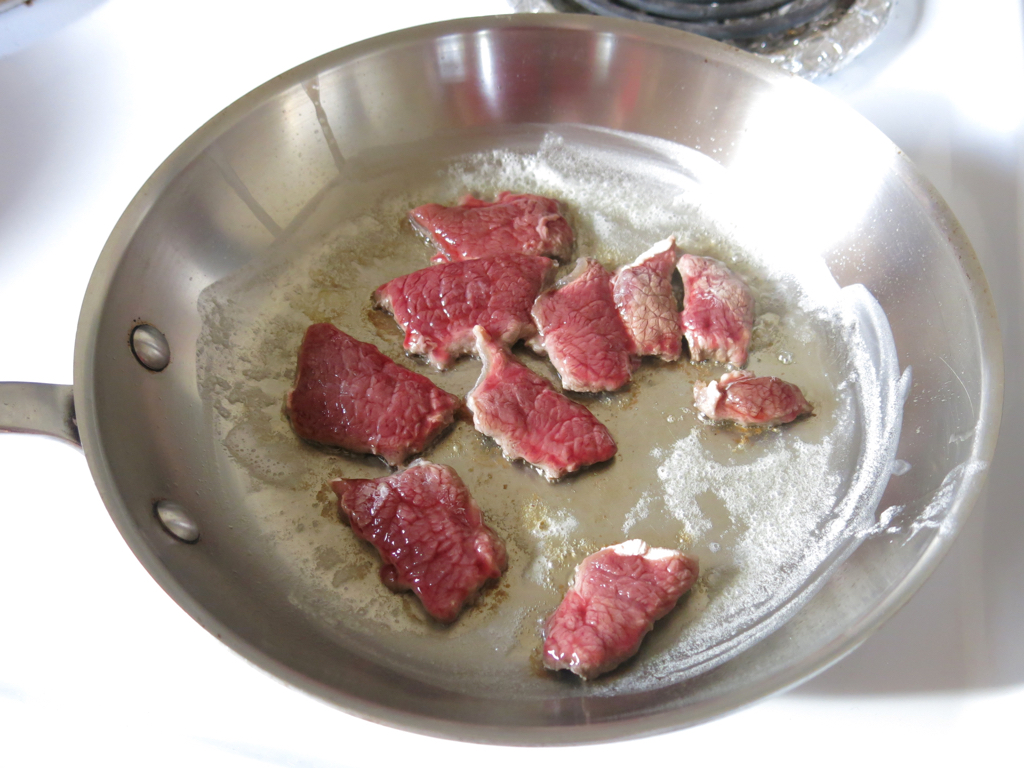
When she stayed with us earlier this week, Eva gave use part of a haunch of venison. Carol stir-fried some chunks of venison with onions and greens; it looked really good, but I decided I wanted plain venison. I sliced it thin, and gently fried it in a little butter for a late brunch.

Venison cooking

After gently frying both sides, I covered the pan and let it steam for a minute until the meat was just well-done, with no red in the center. It was fabulous: lean, tender, and very tasty. I re-heated some of the “Warthog” wheat berries in the pan drippings, and the combination of the nutty wheat, the butter, and the meat drippings was the perfect addition to a satisfying brunch.

Wheat

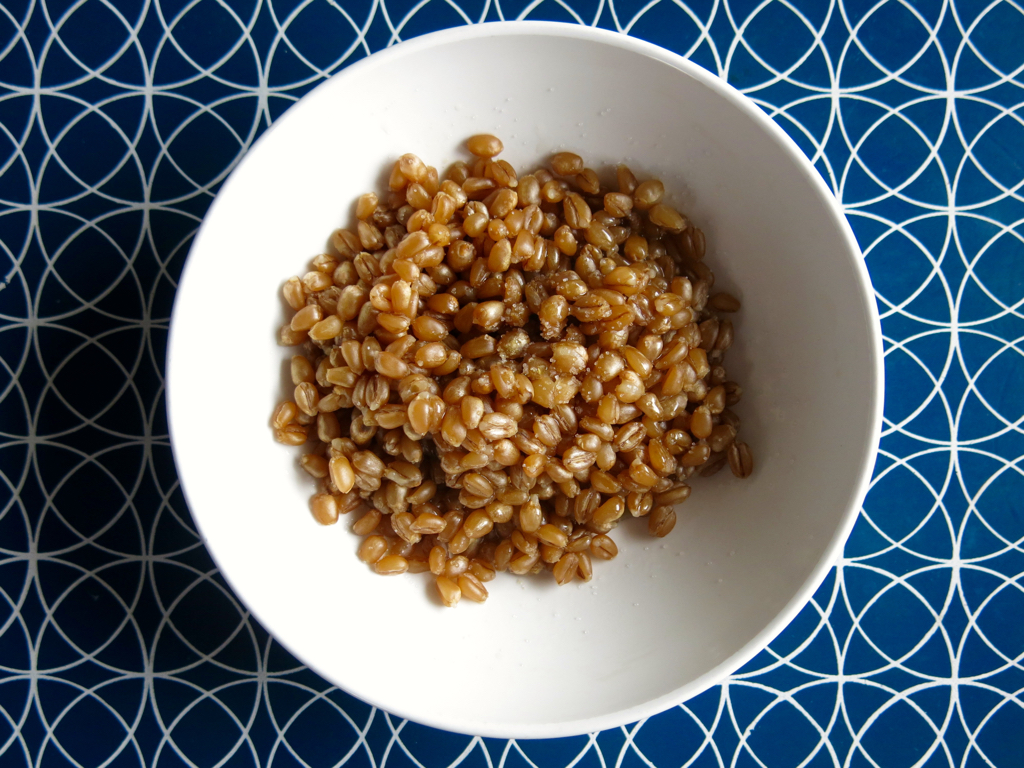
Carol’s friend Eva, who is a farmer, stayed with us last night. When farmers check luggage on the plane, what do they bring in that luggage? Turnips, onions, garlic, frozen venison — and wheat berries. The wheat berries are a hard winter variety called “Warthog,” from friends of Eva’s who farm in Essex, Massachusetts. Eva soaked the berries in water overnight, and we cooked them in the rice cooker this morning. We added a bit of olive oil and a sprinkling of salt: the perfect breakfast.

Hard winter wheat, var. Warthog

Supercharging Altoids (R)

Back in 2006, when Wrigley bought out Altoids (R) brand mints, they replaced the peppermint oil with artificial flavor. Although they soon resumed using real peppermint oil, the mints have never been as strongly flavored as they once were. So here’s how to supercharge Altoids (R) so they taste as peppermint-y as they did prior to 2006:

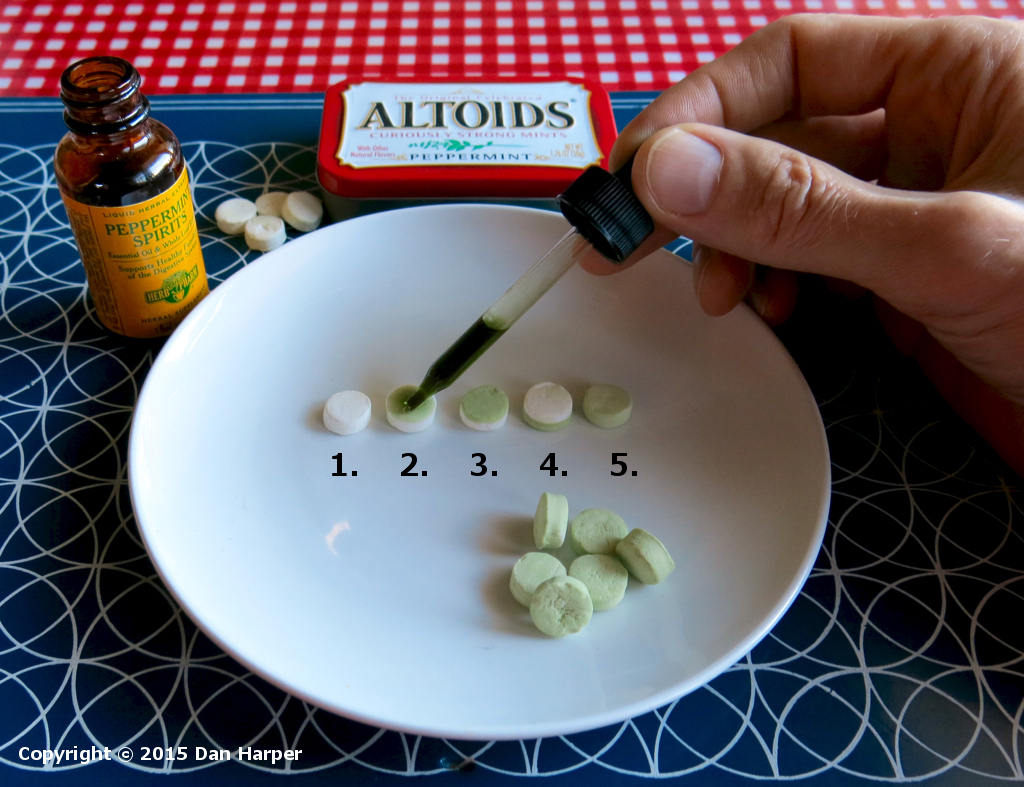
Go to your local health food store, and get the peppermint spirits which are sold as a dietary supplement. I got “Herb Pharm” brand “Peppermint Spirits Essential Oil and Whole Leaf Extract”. Note that they have changed the label since I bought mine (a one ounce bottle lasts a long time), and the new label is different than the one you see in the photograph below. Now get a small dinner plate, and spread out the mints on it.

Supercharging Altoids (R)

1. A mint ready for supercharging.
2. Adding peppermint spirits; the typical mint will absorb about three drops.
3. After adding peppermint spirits to one side, let the mint dry out (this could take 15 minutes).
4. A mint flipped over waiting for peppermint spirits to be added to the other side.
5. A supercharged mint drying out and waiting to be eaten.

Once you add peppermint spirits to both sides, the mints are somewhat damp and fragile, and it’s best to let them dry overnight before putting them back in the tin.

(If you want to know more about artificial flavor in Altoids, I wrote about it back in 2006 here, here, and here.)

Easy face painting

Some of our high school youth youth advisors went to Kids Carnival today, the fun event organized by the University AME Zion Church as a way for people of different races and ethnicities to get to know each other a little better while having a good time. Our youth group offered to do a face painting booth. We lucked out in that Elaine, a high school senior from the Palo Alto Vineyard Church, joined us — she is a fine artist who has her own business doing face painting for kids’ birthday parties. We let her do all the hard designs (Ice Bear, a Death Eaters logo, etc.), and we used our own easy designs.

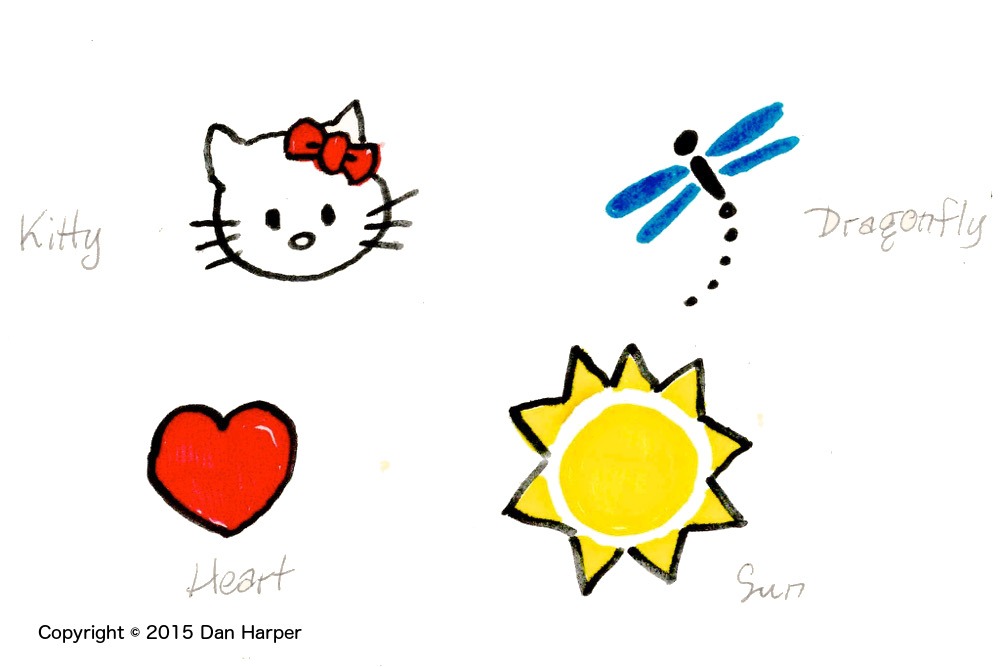
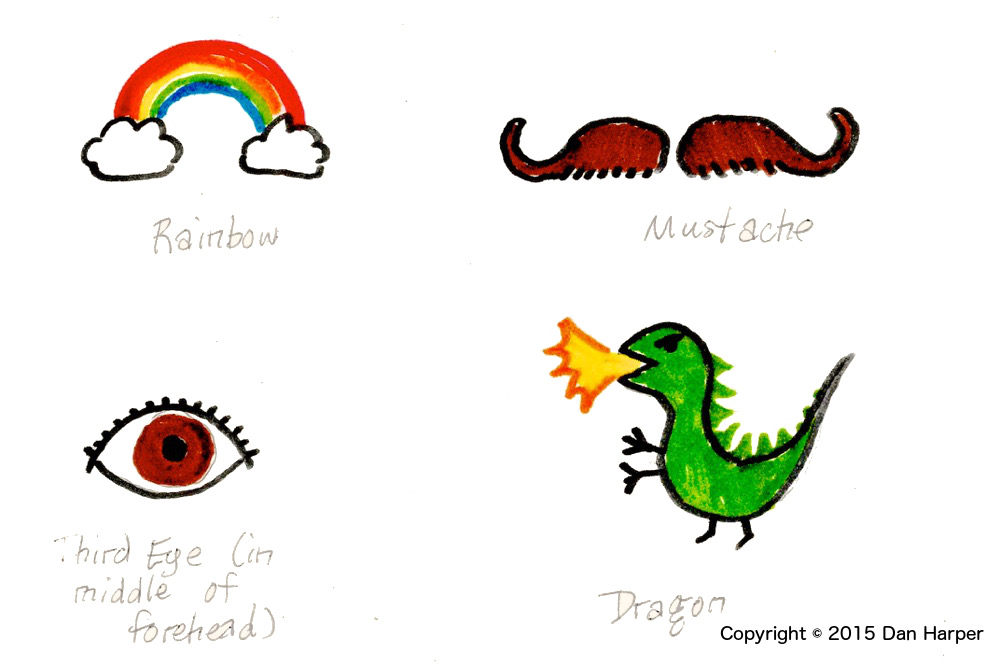
Our designs turned out to be easy enough that children can do them (we let some of the children who came to our booth use our paints to paint designs on each other) — yet they’re satisfying and look pretty good when you’re done. I’m posting them here in case you want to use them next time you do face painting in your congregation. Except where noted, our designs are meant to go on cheeks or backs of hands. We had copies of the designs where children could look at them and choose the one they wanted. One last suggestion: it is worth spending extra money for good face paints; we bought the cheap ones, but when Elaine let us try hers, we saw that they were far better.

Face Painting 1

Face Painting 2

Face Painting 3

Shoulder pole carrier for water

Every other year in our Sunday school, we do a recreation of a Judean Village in the year 29 C.E. Children become “apprentices” to artisans, and do activities that evoke village life in 29 C.E.

Carrying water by hand from the village well to wherever it was needed was an integral part of village life. This year, Edie Keating came up with an activity in which children learn how to use a traditional shoulder pole carrier to bring water to irrigate plants. Given the extreme drought that is blanketing most of California, this is also a very relevant activity. Ancient Judea had a very similar climate to ours — what if we had to carry all our water from a well by hand? — how would that change our water consumption habits?

I got to design a shoulder pole carrier using readily available materials. It was fun to design and build, and once it was built it was surprisingly comfortable and easy to use. This is a cool piece of ancient technology that really works well!

———
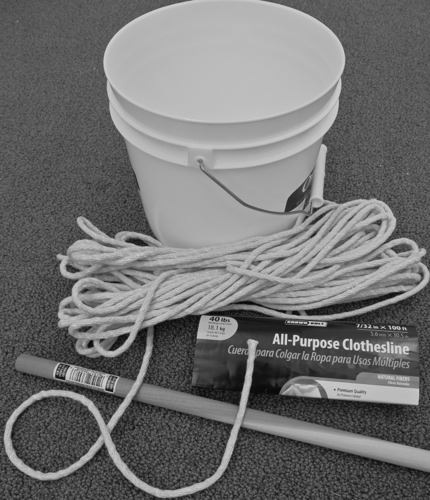
Assembled materials

Materials for 6 pole carriers:
— 100′ of 7/32″ cotton “sash cord” or “all purpose clothesline” (easy to tie, and soft on kids’ hands if they grab it)
— 12 ea. 1-gallon plastic buckets, often sold as painter’s buckets; the ones we like best look like miniature 5-gallon buckets with sturdy reinforcement at the top (see photo above)
— 6 pcs. 5/8″ dia. 4-foot long hardwood dowels
— 9/16″ drill bit and drill (hand drills work well for this project)

———
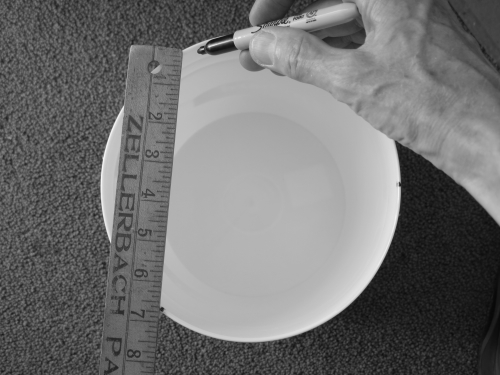
Measuring for the holes in the buckets

Step one:
Mark out locations for three holes spaced equally around the bucket. Our buckets were 7-3/4″ in diameter, and spacing the holes 6-3/4″ apart (as measured on a straight line, as in the photo above) provided fairly equal spacing.

———
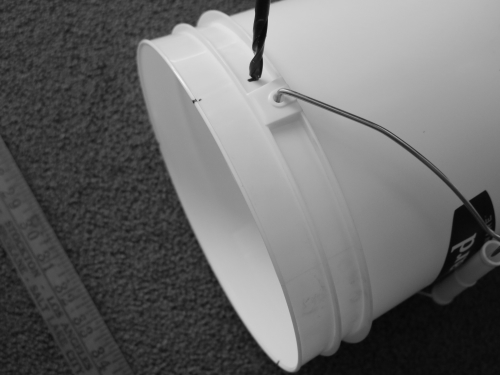
Drilling the holes in the buckets

Step two:
Drill three holes as shown in the photo above.

———
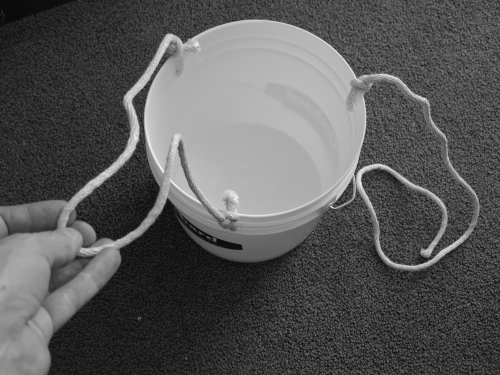
How the cords are tied to the buckets

Step three:
Cut two lengths of sash cord, one 6′ long, and one 4’6″ long. Thread cord through holes and tie with two half hitches as shown — the longer piece of cord is tied at its two ends through two holes, and the shorter piece of cord is tied at one end through one hole. Note that two half hitches function as a slip knot, so snug the knot down to the bucket. (If you don’t know how to tie two half hitches, look at a Scout handbook, or search the Web for instructions.)

Make two of these assemblies, one for each end of the dowel.

———
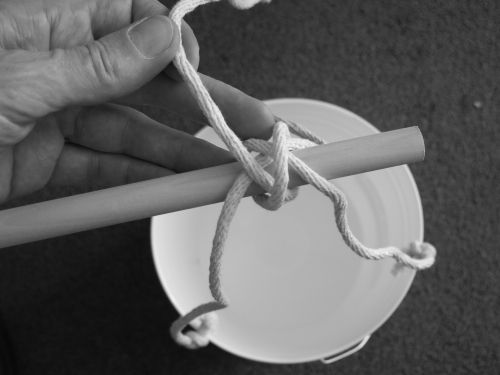
Tying the cords to the pole

Step four:
Loop the longer rope (tied off at both ends) over the dowel. Then tie a clove hitch, using the free end of the shorter cord, so that the clove hitch goes over the longer cord, and secures it to the dowel (see photo above).

Once you get the clove hitch tied, lift up the assembly, and see how the bucket is hanging. It will probably hang unevenly, so adjust all the cords until it hangs more or less evenly — this is much easier if you get someone to hold the dowel for you. When everything looks even, snug up the clove hitch so it’s tight. (You can also tie off the free end of the rope onto one of the other ropes, using two half hitches — this makes for a slightly more secure assembly, although it isn’t really necessary.)

———
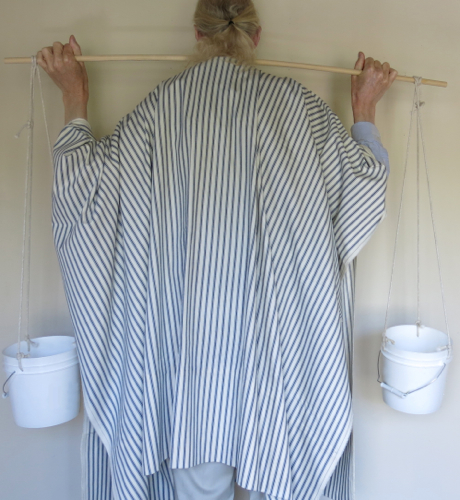
Person in ancient Judean costume with loaded shoulder pole carrier

Above is what the whole thing looks like when it’s completed, with each bucket filled about 1/3 full. Don’t fill the buckets more than half full — if you do, the water will slop all over your feet when you carry it, and there’s a good chance you’ll snap the dowel from the weight.

In fact, for most school-aged children, filling the buckets about a third full will provide the most pleasant experience. With that much water in the buckets, it’s heavy enough so that the water carrier stays in place on the child’s shoulders, but it’s not so heavy that it hurts. Notice that the dowel in this design is relatively thin so that it acts as a spring, providing some cushioning to the shoulders — carrying water with this water carrier is relatively comfortable.

Of course, you can also use this type of carrier with a heavier load in the middle, and with two people carrying, one on each end of the pole. Obviously, a longer, stronger pole would be needed.

If you want to carry bigger loads with a shoulder pole carrier, use a heavier pole. Asian cultures often use bamboo for the pole — it’s a material that’s light, flexible, and strong. Traditional European shoulder pole carriers were typically less flexible, and carved (like ox yokes) to fit around the neck and put more of the load on the shoulders.
Invertebrate pitfall trap

When we humans think about the interdependent web of life, we tend to think about the relationships between ourselves and familiar organisms like mammals and trees. These are organisms that are either larger than us or relatively close to us in size, or they are taxonomically close to us. But if you conduct a survey of biodiversity in a given tract of land, the majority of non-microscopic species you find will be invertebrates, e.g., insects, spiders, crustaceans, etc. For a more realistic theological understanding of the web of life, I think it’s necessary to develop a more realistic understanding of biodiversity. It is easy and fun to feel a connection through the web of life to relatively cute organisms like rabbits, and to relatively majestic organisms like redwoods. Understanding our connections with organisms that are not particularly cute or majestic expands our idea of the interdependent web of life.

A few years ago, I participated in a blogger’s bioblitz; a bioblitz is a study that provides a “snapshot of biodiversity.” One of the tools used in a bioblitz is an insect pitfall trap; this kind of trap provides a sampling of insects and other invertebrates. I decided to place an insect pitfall trap in our front yard, so I could see some of the invertebrates that live in our urban setting.

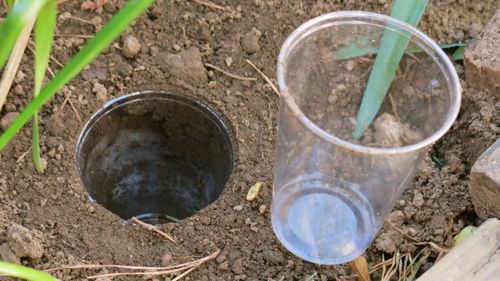
Some online research revealed that pitfall traps made of glass are most effective (Oecologia 9. VI. 1975, Volume 19, Issue 4, pp 345-357), but the easiest way to make a pitfall trap is with nested plastic drinking cups. You dig a hole deep enough to bury the two nested cups, and pack dirt around them so that the rim of the upper cup is exactly at ground level. Then you can remove the upper cup, dump out all the dirt that fell into it when you were burying it, and then replace it. I used two nested 10-ounce clear plastic drink cups:

BlogFeb1615a

To use pitfall traps ethically, you should check them at least once a day, and either release the captured organisms or collect them responsibly. If you’re expecting rain or hot sun, you should place some sort of cover over the trap, raised up an inch or two. The cover will keep rain and sun out, but still allow invertebrates to crawl into the trap. If you’re no longer going to use the trap, pull it out of the ground.

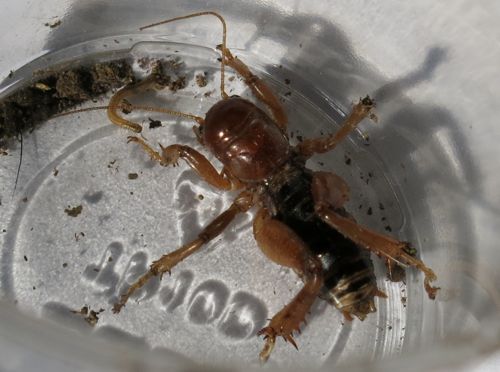
Here’s what I found in my pitfall trap this afternoon:

BlogFeb1615b

The large organism appears to be in the genus Stenopelmatus; from looking at online identification guides, I’d guess this organism is probably a Dark Jerusalem Cricket (Stenopelmatus fuscus [Haldeman, 1852]). Where does it fit into the web of life? According to the Nevada at Reno Department of Extension: “Because it is nocturnal and comes out of the ground at night to roam around, owls, including the endangered spotted owl, feed on it. Probably other nighttime predators such as coyotes, foxes, and badgers eat it as well.” As for their food sources, the Orange County (Calif.) Vector Control District (OCVCD) says the primary food sources of Jerusalem Crickets are “plant roots and tubers; however, “they also feed on other insects, even their own kind.” The OCVCD also states that Jerusalem Crickets do not pose a health threat to humans.

The other organisms in the trap — you can see something like a centipede under the Jerusalem Cricket’s left antenna — were too small for me to have any hope of identifying. Besides, if I’m going to accurately identify insects and similar invertebrates, I’d need to ask an entomologist equipped with powerful binocular microscope.

More about insect pitfall traps.

Concrete block rocket stove

This past Sunday, the middle school ecojustice Sunday school class cooked on rocket stoves. We based our stoves on design principles developed by Dr. Larry Winiarski, who is affiliated with the Aprovecho Research Center. A rocket stove makes more efficient use of biomass fuels (wood, twigs) through more complete combustion; this also results in fewer harmful emissions. According to the Aprovecho Research Center:

“Improved cooking stoves address at least 5 of the 8 United Nations’ Millennium Development Goals: [1] ending poverty and hunger; [2] gender equity; [3] child health; [4] maternal health; and [5] environmental sustainability.”

So while we don’t really need rocket stoves here in the Bay area (except perhaps in disaster situations), learning about and building them is a great introduction to using appropriate technology to meet ecojustice goals of human well being and environmental sustainability.

If you’re not familiar with rocket stove design principles,Aprovecho Research Center has an excellent introduction on this Web page. Scroll down and click on document no. 8, “Design Principles for Wood Burning Cook Stoves,” June, 2005.

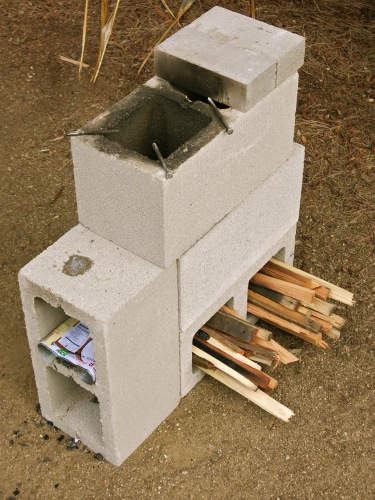
Enough background. Here are instructions for building a concrete block rocket stove, followed by photos of our rocket stove in action:

BlogJan2715a

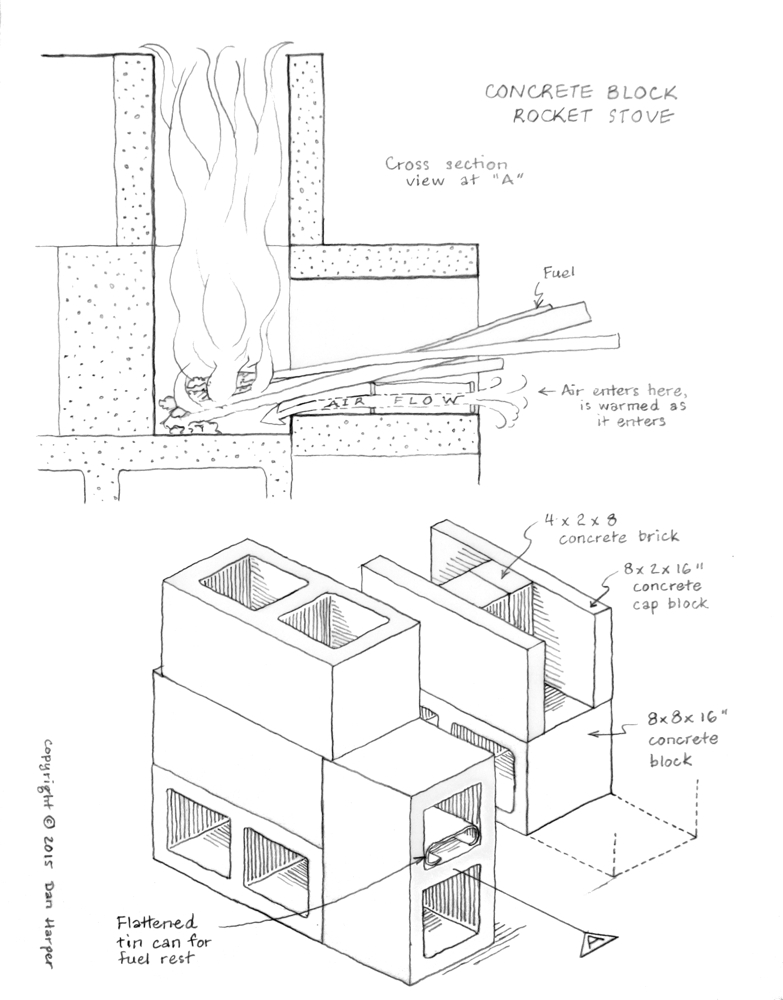
Click the image above for a drawing of how to build our concrete block rocket stove. You will find other plans for a concrete block rocket stove on the Web, but those plans typically require a concrete h-block, an oddball type of block that we were unable to find. However, most bit home improvement stores carry 8 x 2 x 16 inch concrete cap blocks, and 4 x 2 x 8 inch concrete brick — two cap blocks and two concrete brick can be arranged in an “H” shape to make a stove. In fact, this is a better solution than a concrete H-block, because you can adjust the concrete brick such that you have a constant cross-sectional area throughout the L-shaped combustion chamber (see “Design Principles for Wood Burning Cook Stoves,” principle 7).

BlogJan2715c

Above: The concrete block rocket stove after use. We placed two concrete bricks on the top on which to place cooking implements, etc. The bottom concrete block serves as a convenient place to store fire wood. Notice that our firewood is all salvaged building materials and wood pallets, split to appropriate size for burning.

BlogJan2715b

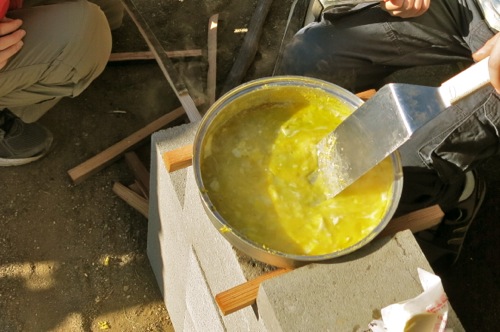
Above: Cooking on the stove. “Design Principles for Wood Burning Cook Stoves” states that a combustion chamber with a 12 x 12 cm cross sectional area is “usually sufficient for a family sized cooking stove.” Our concrete block rocket stove has a cross sectional area of 12.5 x 15 cm. It put out a good amount of heat for cooking scrambled eggs for half a dozen people. Note that one person is feeding the fuel into the stove, while the other cooks — we found it was challenging to cook and tend the fire at the same time.

We did not try to boil water on our concrete block rocket stove, to see how long that would take. Maybe that’s a task for a future class.

Update, one year on: This has proved to be a good, but not excellent, rocket stove design. The chief problem with this design is that the concrete block acts as a fairly large thermal mass, and it takes a while to heat the block. Once the block is warm, the stove functions pretty efficiently; while the block is still cook, it’s not as good. Another problem is that the stove is finicky, and requires constant attention to feeding fuel in order to maintain a fairly constant temperature. Nevertheless, given the low cost of materials, and the ease of construction, this remains a practical design.

16 brick rocket stove

In our middle school ecojustice class, one of the things we’re doing is experimenting with alternative low-cost, low-impact cooking methods, such as a solar oven made out of cardboard. Now we’re experimenting with rocket stoves, designed originally by Dr. Larry Winiarski and colleagues at the Aprovecho Research Center. Rocket stoves use biomass to cook, but are much more efficient than traditional cooking fires, and because they’re more efficient produce fewer pollutants such as smoke and harmful gasses. Not really something we need in the first world, except in disaster situations, but a huge advance for the developing world.

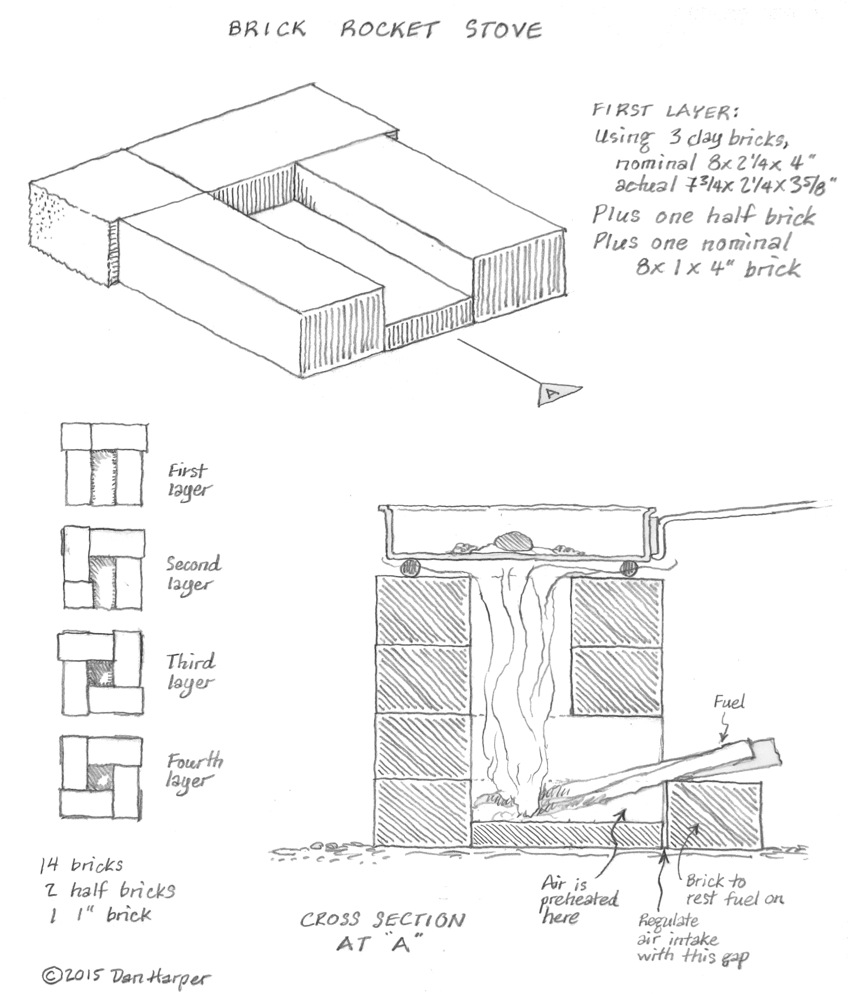
Last week in class, we put together a simple brick rocket stove but couldn’t get it to light. So I spent some time this week building and using a simple rocket stove made of 16 bricks. This stove is based on Larry Winiarski’s 16 brick stove, but instead of using adobe bricks I used clay bricks commonly available at masonry supply houses and building supply centers. Specifically, I used nominal fifteen 8 x 2-1/4 x 4 inch clay bricks, and one 8 x 1 x 4 inch clay brick, as shown in the sketch below:

RocketStoveSketch1a

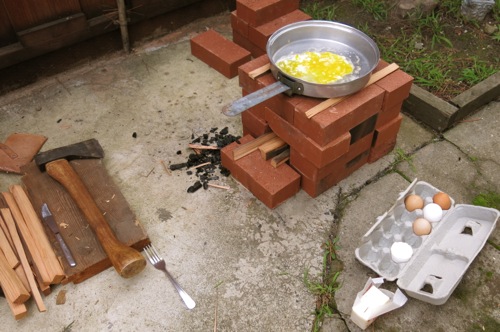
For fuel, I split an 18 inch long 2 x 10 into finger-sized pieces. To light the stove, I balled up a piece of paper and dropped it down the center hole, dropped some shavings, small scraps of wood, and slightly larger scraps of wood on top, then dropped a lighted match in. When the fire was burning well, I began feeding 3 to 4 pieces of fuel in from the bottom, adjusting the air intake gap as needed to get a hot flame.

The rocket stove needs you to pay attention to it. The fuel burns pretty quickly, and you have to keep pushing it into the combustion chamber, adding new fuel as needed. Once the fire was going strong — which took seven or eight minutes — I got ready to cook.

BlogJan1515

Continue reading “16 brick rocket stove”

Winter melon

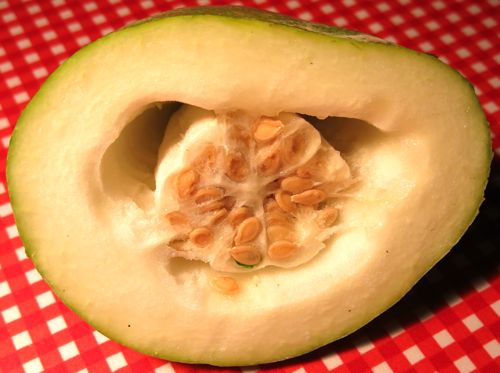
What would you do with a half a winter melon? I’ve gotten friendly with a farmstand that specializes in Asian vegetables at the San Mateo Farmer’s Market. The woman who runs the farmstand knows I love bitter melon, and has told me about its health benefits. She probably figured this white guy needed to expand his Asian melon repertoire, so today she gave me half a winter melon, and said, “Try it in soup.”

There are lots of winter melon soup recipes online, and I’m leaning towards a simple one with dried black mushrooms, chicken broth, a little bit of chopped meat, and some slices of ginger.* But — what would you do if someone gave you half a winter melon?

BlogOct1114b

*Two weeks later: And here’s the recipe I have been using for winter melon soup:

Half of a five pound winter melon, cut into 2 inch pieces (about 2 pounds of melon)
1 quart of chicken broth
1 knockwurst, cut into 1/2 inch circles
8-10 dried black Chinese mushrooms, soaked in hot water for 20 minutes
half a dozen slices of ginger root, peeled, and slivered
salt to taste

Bring the winter melon to a boil in water to cover, then simmer covered for 20 minutes.
Drain the water off.
Add chicken broth, mushrooms, ginger, and knockwurst to the cooked winter melon. Simmer for 20 minutes.

Adventures in solar cooking

Yesterday in Sunday school, two groups of kids started making solar ovens. While they were working, we had solar s’mores cooking in the solar oven I made on Saturday. However, it took a long time for the solar s’mores to cook. First problem: the morning clouds didn’t begin to clear until halfway through Sunday school. Second problem: thin clouds persisted most of the morning, and even the thinnest of clouds caused the temperature to drop at least ten degrees inside the oven. We started cooking the s’mores at about 10:00, and they weren’t really done until just before noon — after most of the kids had already gone home.

The clouds finally cleared away completely, and I left the solar oven outside my office for several hours in the early afternoon. The inside temperature rose to over 200 degrees Fahrenheit (200 degrees is as high as the meat thermometer goes), with outside air temperature in the high 70s. I heated up a mug of water, to over 170 degrees, and made a nice cup of tea. While I was making tea, Fred Z., from the Green Sanctuary Committee, stopped by and suggested trying cast iron cookware in the oven — it’s dark and absorbs heat well, plus it provides a good thermal mass to even out cooking temperature.

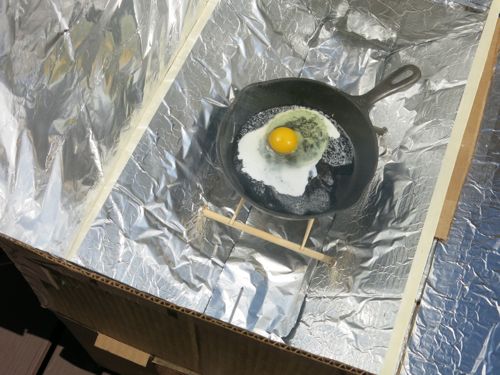
So this morning I dug out a small cast iron frying pan, and decided to try cooking a fried egg in the solar oven. The air temperature was about 65 degrees, but in spite of clear skies I couldn’t get the inside temperature over 190 degrees — which suggests I need better insulation in the oven. I cooked a fried egg, over easy:

BlogSep0814

It took about twenty minutes, and was really more of an egg baked in butter than it was a fried egg (it tasted good, though); obviously there is a lot more to be done to improve the efficiency of the oven.