
Critical Approaches to Faith and Environment

The 9 a.m. session on Tuesday, May 24, of the Sacred Texts Human Contexts conference, titled “Critical Approaches to Faith and Environment I,” included presentations by John Fadden, adjunct professor at St. John Fisher College, and Shalahudin Kafrawi, professor at Hobart and William Smith College.

In “The Apocalypse of John: Friend and/or Foe of the Environment?” Fadden gave an analysis of the book of Revelation. As a Biblical scholar, he said that we have to be careful about using a two thousand year old text to discuss contemporary issues. John of Patmos, the author of Revelation, was writing for a first century C.E. audience in the Roman Empire; he was not writing for a twenty-first century audience, and did not specifically address global climate change or other ecological concerns.

“He’s also not really concerned with the end of the world in the way we have perhaps come to associate with the apocalypse,” said Fadden, “especially what we have come to call dispensationalism,” a contemporary interpretive framework that inspired the Left Behind series of books. “That’s not really his interest,” said Fadden, and “as Biblical scholars, we have to be sympathetic to the first century audience.”

However, the intended audience of the Bible is often forgotten. For example, in 2005, during George W. Bush’s presidency, some observers believed that Bush was influenced by an apocalyptic attitude, and those observers believed this attitude had an impact on Bush’s environmental policies. Some of these observers went to far as to wish that Revelation had not been included in the Bible. But Fadden says you can’t really blame a first century text for George W. Bush’s environmental policies. “The problem is not the text so much as how you might interpret it,” he said.

Thus Fadden is interested in seeing if there is an alternative, “eco-friendly way of reading the text.”

Continue reading “Critical Approaches to Faith and Environment”
Panel on Environmental Relationships, Environmental Readings

The second Wednesday morning session of the Sacred Texts Human Contexts conference, titled “Environmental Relationships, Environmental Readings” at 11 a.m. on Wednesday, May 25 included presentations by Brianne Donaldson, professor at Monmouth College; Jamison Stallman, M.A. candidate at Union Theological Seminary; and Cecille M. Medina-Moldonado, M.A. candidate at Loyola University. I was most interested in hearing Donaldson’s presentation on Jainism, but ultimately found Medina-Moldonado’s presentation equally interesting.

Donaldson’s presentation, titled “I Ask Pardon of All Creatures: The Centrality More Than Human Life Jain Text and Rituals of Repentance,” began with some basic information about Jainsim, including an introduction to the principle of ahimsa, not causing harm. Pointing out that Mahavira, the key figure in early Jainism, was a contemporary of Gautama Buddha, she said, “Both buddha and Mahavira prioritize ethical action over Vedic ritual practice.” [Note that I am not able to include diacritical marks for Sanskrit transliteration on this Web site.]

“Jainism posits a universe of which our universe is just one part,” said Donaldson, adding, “There is no deity.” instead, according to the Tattvartha Sutra, there are six substances, including jiva which may be interpreted as soul, or as sentient substance. All organisms house a jiva, she said, including microorganisms.

Jains believe in reincarnation after death. They also believe in karma, said Donaldson, which she described as a kind of “causal entanglement. “Just to live in the world has a cost.”

“One’s own jiva might yet be reborn in a the body of a plant or animal,” said Donaldson, so care for other organisms is important, as one might sometime be reborn in one of those bodies. This leads to ethical concern for other beings.

Continue reading “Panel on Environmental Relationships, Environmental Readings”

Environmental ethics panel

Presenters at the Environmental Ethics session of the Sacred Texts Human Contexts conference at 9 a.m. on Wednesday, May 25, were Lyndsey Graves, recent graduate of Boston University School of Theology; Michael Malley, student at Methodist Theological School in Ohio; and Etin Anwar, professor at Hobart and William Smith College.

I was particularly interested to hear Graves’s presentation, “Liberal vs. Literal?: Opportunities for Environmentally Ethical Pentecostal Interpretations of Genesis 1:26-28.” Pentecostalism is arguably the fastest growing religious group in the world, and as such could be a valuable interfaith ally in addressing the current global environmental crises.

Graves chose to address Gen. 1:26-28 because it has been such an influential text, with its injunction to “subdue” and have “dominion” over the earth. While this text has often been interpreted as giving humankind license to exploit other organisms and non-living things, eco-theologians have re-interpreted the text as calling on humans to be responsible stewards of the earth. Graves said that today, some Pentecostals are now “creatively coming up with ways to reinterpret Genesis 1:26-28.”

“I am focusing on the words ‘dominion’ and ‘subdue’,” Graves said. She pointed out that liberal Christians can say that this passage is not particularly important to them, or they can re-interpret the text to call for stewardship, “which I do not think is really justified in the Hebrew.”

But Pentecostals do not really have these options. Pentecostals assert the “inerrancy of the word of God, and because of this they do not aim to evaluate the Bible, but “to understand it and submit” to the will of God.

Graves reviewed the work of several relevant theologians who have provided readings of the text that might prove useful to Pentecostals.

Continue reading “Environmental ethics panel”

Catherine Keller on “Ecologies of Diversity”

Catherine Keller, author of From a Broken Web, was the keynote speaker at the opening session of the 2016 Sacred Texts and Human Contexts conference at Nazareth College, Rochester, New York. This year’s conference theme is “Nature and Environment in World Religions.”

Keller’s address was titled “Ecologies of Diversity: Beyond Religious and Human Exceptionalism.”

To help address the global environmental crisis, Keller believes religions must move beyond human exceptionalism — that is, religions have to get over the notion that humans are somehow more privileged than other organisms. Furthermore, she believes that we must also move beyond religious exceptionalism.

She said she assumed that those of us attending the conference are participants in a faith that is “planetary.” “By talking together, we hope to get and give some hope,” she said, “Hope for the planetary future.” She added: “Those hopes come encoded in our sacred texts.”

Keller went on to make three main points:

First, the unprecedented planetary emergency should not be treated as exceptional, she said. The current ecological crisis is driven both by politics that use emergency powers to prolong the crisis, and by various types of exceptionalism. Instead, she said the planetary emergency can be understood as “an emergence.”

Second, Keller believes “an alternative politics” is needed. “The key to this alternative is, I believe, what might be called ‘entangled difference’.” Her 2015 book Cloud of the Impossible: Negative Theology and Planetary Entanglement goes into more detail on “entanglement,” which she relates to the concept of quantum entanglement.

“Difference is not a separation, but a relation,” she pointed out. Thus, difference and entanglement can go hand in hand. “And so while difference may exclude or ignore” that from which it is different, there is still a relationship between the things that are different.

Third, Keller said, “If we can turn catastrophe into catalyst, the answer is hope.” In fact, she said that “catastrophe must become a catalyst” in order for positive action to happen.

Continue reading “Catherine Keller on “Ecologies of Diversity””

William R. Jones writing retreat

Hassahan Batts writes: “Practitioners Research and Scholarship Institute (www.prasi.org) is having another writing retreat where we are bringing together students of Dr. Jones in Allentown, Pennsylvania. If interested please email justequality@yahoo.com .”

No date given, so if you’re interested I’d suggest writing to the above email address right away.

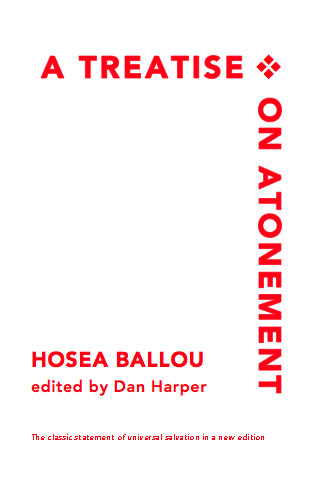
New edition of “A Treatise on Atonement”

Now in print: a new reader’s edition of Hosea Ballou’s classic statement of universal salvation, A Treatise on Atonement.

This new edition has been edited for clarity and ease of reading. I broke up long paragraphs, modernized punctuation, and added section breaks where there was a logical break in the text. I also added an extensive general index that references names, topics, etc., and also references Ballou’s entertaining illustrations and parables. Scriptural references have been added in the text where missing, and there is a full scriptural index. An appendix has a brief biography of Ballou, written by Thomas Whittemore a year before Ballou’s death.

This project started almost a decade ago, when I couldn’t find an adequate online edition of Ballou’s Treatise. Scott Wells, Russell Allen, and Steve Rowe all helped produce the Web edition, which went online in 2011. This new print version represents a complete revision of the online edition, with added indices and appendix.

Why bother with a new print edition when the classic Ernest Cassara edition, published by the Unitarian Universalist Association, is still in print? Most importantly, the text of the Cassara edition retains the crazy-long paragraphs of the early nineteenth century editions; adding new paragraph breaks makes the book much easier to read. Then too, I’ve long felt that the index to the Cassara edition was inadequate. Finally, after Cassara’s death earlier this year, there was no longer any hope that he might revise his edition.

The new 2015 edition of A Treatise on Atonement is available now through Lulu.com for $12.99 plus about $3.99 for shipping. In approximately 8 weeks, it will also be available direct through major online booksellers, as well as through bookstores via Ingram distributors, at a retail price of about $12.99 (the minimum price I can set that allows such wide distribution).

Treatise on Atonement, thumbnail of cover

What’s a deity?

This week I’ve been posting images of deities. But what is a deity, anyway?

Here in the United States, popular culture has been heavily influenced by Protestant Christian culture, and so when we are asked to define a deity, we default to the concept of a monotheistic transcendent deity. If we have to draw a picture of this deity, we might either draw a picture of a man with a white beard sitting on a cloud, or say that this deity is transcendent and can’t be pictured.

However, most of the human race, for most of human history, has had a far more complex and nuanced understanding of deities. In our own Western cultural tradition, which extends back to the civilizations of Rome, Greece, and the ancient Near East more generally, we can find a great diversity of deities. Here’s a list of some of the categories of deity we can identify in the Western religious traditions:

• a single transcendent deity, e.g., the transcendent god of Xenophanes and other early Greek philosophers; God for some Jews; God the Father for some Christian sects
• a most powerful deity among other deities, e.g., Zeus in ancient Greece
• greater deities, e.g., the more powerful ancient Egyptian deities such as Horus, Osiris, and Ra
• lesser deities, e.g., the Titans in ancient Greece
• local deities, e.g., river gods, deities of a grove or forest, etc.
• household deities, e.g., the household gods of ancient Rome, etc.
• deified humans, e.g., the ancient Egyptian Pharaoh, Roman emperors deified after death, etc. (some might argue that the Virgin Mary of some Christian sects fits into this category)
• humans that are more than mortal but slightly less than gods, e.g., Herakles for the ancient Greeks, Jesus for the Christian followers of Arius, etc.
• humans with special powers who are worthy of veneration, e.g., canonized saints, sports figures and celebrities, etc.
• abstract concepts as deities, e.g., god as the unmoved mover in Aristotle, scientific method, financial success, etc.

These are just the first examples from the Western religious traditions that come to my mind. Then we can add in all the deities which are current in our increasingly multicultural world, such as the vast hierarchy of Hindu deities, the several Buddhas (who may appear as humans with special powers, but who may also appear as transcendent deities), ancestors who are venerated (as in some African traditions), deities as part of nature or tied to natural places (as with some Navajo deities), etc., etc.

I don’t believe we should accept without question the U.S. Protestant Christian definition of deity as a single transcendent god in whom one either believes or doesn’t believe. Humans in the U.S. today venerate a variety of deities, many of which look nothing like the U.S. Protestant transcendent God. And that veneration can take a variety of forms, from overt public worship to more covert forms of veneration. Given that, don’t you think that there is a lot more religion in the U.S. today than is captured by polls which ask whether people believe in “God” and attend “church”?

Ancient Greek marriage laws and same-sex marriage

During the Supreme Court argument session on Obergefell v. Hodges, according to the transcription, Justice Alito had the following exchange with Mary Bonauto, Esq., representing the petitioners:

JUSTICE ALITO: But there have been cultures that did not frown on homosexuality. That is not a universal opinion throughout history and across all cultures. Ancient Greece is an example. It was ­­– it was well accepted within certain bounds. But did they have same-­sex marriage in ancient Greece?
MS. BONAUTO: Yeah. They don’t ­­– I don’t believe they had anything comparable to what we have, Your Honor. You know, and we’re talking about —
JUSTICE ALITO: Well, they had marriage, didn’t they?
MS. BONAUTO: Yeah, they had ­­– yes. They had some sort of marriage.

[p. 14 of the official transcript]

I have some interest in ancient Greek thought, and so I’d like to stop right there for a moment. What sort of concept of marriage did the ancient Greeks have, and is it something we would look to as analogous to our present-day concept of marriage? Continue reading “Ancient Greek marriage laws and same-sex marriage”

Retelling our story

The following is excerpted from “Symbolic Storytelling, Freedom Movements, and Church Education: Cesar Chavez as a Virtuoso of Identity,” Ted Newell, Religious Education, vol. 109, no. 5, p. 550:

“Worldviews draw on assumptions, on storied answers to the most basic questions of humankind. Their presuppositions are not irrational but pre-rational. A worldview framework is required for thought itself. Worldviews are the lenses through which humans see the cosmos and themselves within it. Accordingly, an attempt to adjudicate between worldviews by means of reason is likely to be a disguised attempt of one worldview to subdue another. Reason is not neutral but is particular, drawn from its own presuppositions — scientific reason included (Kuhn 1996; Harding 1986; Milbank 2006). There is no neutral ground on which to stand.”

There’s nothing here that is new or surprising, given the ongoing conversations about multiculturalism and postmodernism. But what does interest me is where Newell takes this argument: he calls for us to re-tell old stories for new times: “The older meaning-making matrices have broken down. New expressions of old stories or perhaps new stories are needed.” Newell is speaking from within a Christian worldview, and so he calls for new “holistic story-weavers” to re-tell the story of Christianity in order to bring renewal.

It would be interesting to try to re-tell the story of Unitarian Universalism in order to bring renewal. But what is our story? Is ours a story of a new reformation of Christianity that has called us into a post-Christian worldview? (This is a story Dana Greeley hints at in his 1971 memoir Twenty Five Beacon Street.) Is ours a story of human beings struggling to manifest in our religious communities a worldview of justice for all persons? (This is a story that Mark Morrison-Reed sometimes tells in his books.) Or maybe this — we don’t have one central compelling story that we can all unite around, in the way Ted Newell says that “Christianity must always be called back to [the story of] the Cross” — is ours a story of not having one story? (And this may be the story we most often tell about ourselves — “You can believe anything you want” — but I don’t think it is a very interesting or compelling story.)

Actually, instead of asking about our stories, it might be more interesting to ask about who are storytellers are: Which Unitarian Universalists are currently telling compelling new stories, stories which may bring renewal? The best example of a Unitarian Universalist “holistic story-weaver” that I can think of is Mark Morison-Reed. Aside from Mark’s stories, the Unitarian Universalist stories I’ve been hearing are either too particular to be holistic, or they rely on reason to subdue and subjugate competing worldviews.

The story that I’m waiting to hear will begin with the story of the relationships between humans, and how humans can manifest justice in their relationships with one another. But it will also tell about the relationship of humans to transcendence. It will also tell about the relationship of humans to non-human beings.

And it will be a really good story, one that won’t put me to sleep — which means it will be a story that’s good enough, and deep enough, so it can be told to children without having them slump down in their seats from boredom.

Medusa

I’m writing lesson plans and teacher resources for a curriculum for upper elementary grades on Greek myths. The core material in the curriculum was developed with Tessa Swartz, a middle school student who had taken classes with me where I piloted some of the preliminary material. Tessa proved to be a valuable collaborator, especially given her sensitivity to the essentially alien nature of Greek myths, and her willingness to go beyond the common trite interpretations of many of these myths. As we developed the core material of the curriculum, both of us got interested in the figure of Medusa. Here’s an excerpt from this new curriculum, a teacher resource on Medusa:

Medusa as imagined by the artist CarvaggioWhen we chose stories for this course, both of us placed the Medusa story at the top of our lists. What makes Medusa such a fascinating figure? The face of Medusa contains great power: the power to freeze others into stone. On the other hand, we considered Medusa’s killer, Perseus, to be little better than a bully, a strong-arm man who coerces others into doing what he wants through violence or the threat of violence. So the story of Medusa can lead to interesting explorations of power, and the use of power.

Let’s look at Medusa first: Continue reading “Medusa”