
The UU year in review: 2021

Wow. It’s been a year of change. As 2021 winds down, I’ll briefly summarize the changes I’ve seen in Unitarian Universalist congregations — some positive, some not so positive, some neutral.

Not-so-positive

(A) Enrollments of children and teens appear to be falling precipitously. We don’t yet have official numbers from the year-end certification count, but I’m estimating declines of 33% to 100% across the board.

(B) Adult membership also appears to be falling in most congregations, though the declines are not as steep.

(C) There appear to be many fewer newcomers in most congregations. The lack of newcomers probably accounts for about half of the decline in adult membership. Most Unitarian Universalist congregations have an annual turnover rate of 10-25% (due to moving away, death, lack of interest, etc.), and depend on a steady stream of newcomers to maintain stable membership.

(D) From what I can tell, most congregations saw a decline in revenues this year. The decline can be attributed to the general decline in membership, loss of other revenue streams such as rentals, and the end of the federal Payroll Protection Plan.

(E) I’d say that more peripheral people have gotten out of the habit of occasional participation in the life of the congregation. It’s still too soon to know if they’ll ever come back, but I’m not hopeful.

(F) This past year saw an epidemic of clergy resignations. In the spring, the Unitarian Universalist Association was begging ministers to come out of retirement to fill all the interim ministry positions. By all accounts, this past year saw a shortage of ministers.

Neutral

(G) I expected more resignations by other (non-clergy) paid staffers in UU congregations this past year. But so far I’m not seeing evidence that that happened. This may be because so many other paid staffers are part timers, meaning they weren’t exposed to as much stress as full-time ministers. Or it could be that the resignations happened, but they’ve been less visible than minister resignations.

Positive

(H) Online adult religious education classes have proved to be more popular than in-person classes in some congregations. The convenience of attending a class while sitting comfortably at home turns out to be quite attractive to many.

(I) Moving online apparently has worked for many (not all) support groups, again due to the convenience.

(J) Congregations have adopted digital giving tools, to the pleasure of most people under the age of 50.

(K) Most Unitarian Universalist congregations have developed good to excellent online services. Online services have proved so successful that most of the congregations I know of plan to continue multi-platform services (i.e., combined online and in-person services) after the pandemic is over.

(L) Online does not work for everything. And most Unitarian Universalist congregations have developed safe ways of having at least some in-person programs.

Summary

In a time of great change, it’s easy to get despondent, just because change can be so disorienting. But I have to say I’m feeling mostly optimistic. In a follow-up post, I’ll have more to say about how I believe we can address the not-so-positive changes productively.

But the positive aspects of this year of change are very positive. Even though our primary “product” continues to be in-person connections, it’s also good to be able to expand the ways we can connect with our congregations, by adding multi-platform services, online classes, and digital giving.
Scrooge would have loved omicron

Scrooge famously said: “If I could work my will, every idiot who goes about with ‘Merry Christmas’ on his lips, should be boiled with his own pudding, and buried with a stake of holly through his heart!”

The omicron strain of COVID-19 is acting like Scrooge. If you go wish your family ‘Merry Christmas’ in person, you could wind up with omicron in your lungs. Bah humbug.

A month ago, we started planning in-person services for Christmas Eve. But as of today, it looks like we’re going to be moving to online-only for Christmas Eve. Omicron is present here in Santa Clara County. Omicron doubles every 2-4 days (depending on who you listen to). Vaccinated and boostered people are getting omicron. Everyone is expecting a major surge by mid-January. So in-person indoors meetings are most definitely Not A Good Idea. Bah humbug indeed.

I had been looking forward to seeing people in person on Christmas Eve — especially college students, many of whom come home for winter breaks. But honestly I’m relieved that we’re not going to have in-person services. I admit it — I don’t like the looks of omicron.

So — see you online….

Unitarians in Palo Alto, 1921-1925

Part Five of a history I’m writing, telling the story of Unitarians in Palo Alto from the founding of the town in 1891 up to the dissolution of the old Unitarian Church of Palo Alto in 1934. If you want the footnotes, you’ll have to wait until the print version of this history comes out in the spring of 2022.

Part OnePart TwoPart ThreePart Four

A Fresh Start, 1921-1925

In November, 1921, Elmo Arnold Robinson, known as “Robbie,” arrived at the Unitarian Church of Palo Alto with his wife Olga and sons Kelsey, who was 9 months old, and Arnold, almost 5 years old. Robbie, ordained as a Universalist minister, had lots of experience in small congregations, plus he had just finished a two-year stint as the Director of Religious Education at a church in southern California. Olga was also licensed as a Universalist minister, although her time was taken up with her small children. It’s hard to imagine that the Unitarian Church of Palo Alto could have found a better match for their needs.

Not much happened in Robinson’s first year, except that Sunday school enrollment dropped still further. Emma Rendtorff had been the superintendent of the Sunday school in the 1920-1921 school year, and Sunday school enrollment crept back up to 31 children, but that was Emma’s last year as superintendent; her daughter Gertrude entered Stanford University in the fall of 1921, so Emma was no longer quite so invested in the Sunday school. In 1921-1922, Elmo Robinson’s first year, the church went through three Sunday school superintendents: Jessie Morton, who was William H. Carruth’s mother-in-law; William Ewert, a student at Stanford University; and Frank Gonzales, another Stanford student who served the longest of the three. With all that turnover, it’s not surprising that enrollment in the Sunday school dropped to 20, probably the lowest enrollment since 1908.

But Elmo Robinson had already turned his thoughts to religious education. In the summer of 1922, his essay “The Place of the Child in the Religious Education Community” was published in the Pacific Unitarian. This essay outlined a progressive philosophy of religious education that was tied to social reform:

“Every religious community believes that the future can be made better than the present. Every church, while cherishing certain ideals and methods of the past, must fire its young people with a vision of the future which will encourage them to devise new ways and means to realize it. Do you want world peace? World justice? The cooperative commonwealth?… All these things can be accomplished only by admitting children and young people to the full fellowship of the religious community as friends….”

Presumably, this essay repeated what had already been going on in the Palo Alto church. Bertha Chapman Cady was one of the teachers in the Sunday school in 1921-1922, and she involved the children in helping to run the class; one of her daughters, for example, became the class secretary. Children were becoming fully involved into the religious community of the church. The lay leaders seem to have found his vision a compelling one. The next school year, 1922-1923, the charismatic William Carruth agreed to be the superintendent of the Sunday school, and enrollment immediately shot up to 33 children.

Continue reading “Unitarians in Palo Alto, 1921-1925”

“Rigid methodologically”

In a 2004 interview with Christian Century magazine, progressive evangelical Brian McLaren compared conservative evangelical Christians with more progressive Christians:

“[Religious] conservatives tend to be rigid theologically and promiscuous pragmatically and [religious] liberals tend to be rigid methodologically and a lot more free theologically ….”

Although McLaren wasn’t talking about Unitarian Universalists (he probably doesn’t know we exist), what he says applies to us: we are indeed free theologically, but rigid methodologically. Wouldn’t it be nice if we could be a little more “pragmatically promiscuous”….

Institutionalism

I sometimes like to say that I’m religious but not spiritual, because I associate “religion” with institutions, and “spirituality” with individualism. I’ve come to really dislike the hyper-individualism of the U.S. today, and for me institutionalism lies at the very heart of my religion. So to better express my religious values, I just added an article on institutionalism to my static website.

Your comments are welcome, but you’ll have to comment here or send me emial.

Thanksgiving with family, pt. 3

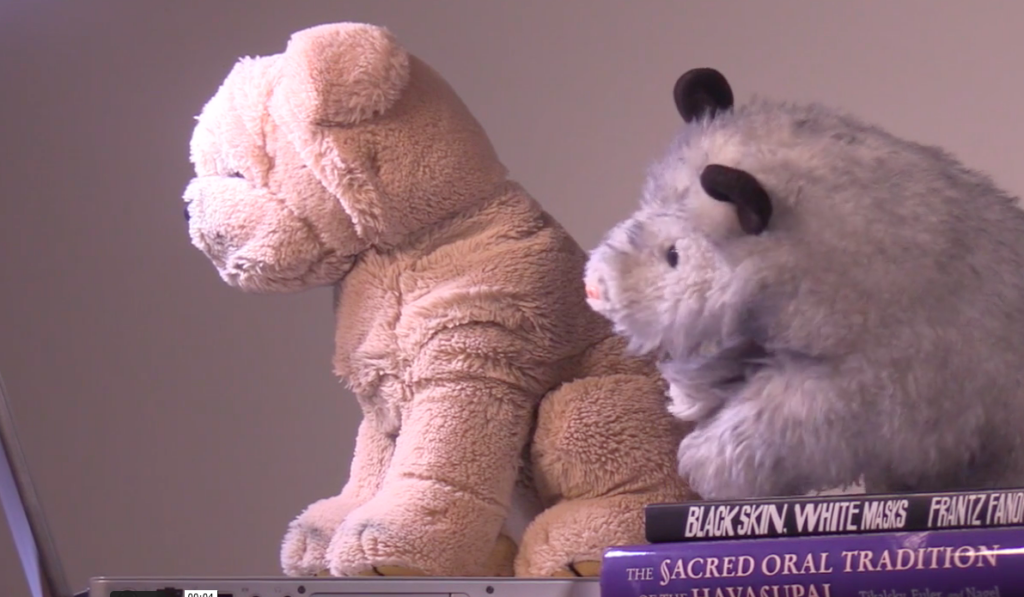
In the conclusion to the “Thanksgiving with Family” series, Muds and Possum talk over the Thanksgiving dinners they had with their relatives. For both of them, it didn’t go as badly as they had feared!

As usual, full text is below the fold.

Continue reading “Thanksgiving with family, pt. 3”

Thanksgiving with family, pt. 2

Dr. Sharpie, Rolf, Ms. and Mr. Bear, and Elephant share Thanksgiving dinner together. They wonder how Thanksgiving dinner went for Muds and Possum. Just then, Muds and Possum come home….

As usual, full text is below the fold. Part 3 coming soon.

Continue reading “Thanksgiving with family, pt. 2”

Thanksgiving with family, pt. 1

Muds and Possum are worried about going to visit relatives at Thanksgiving, because of uncomfortable conversations with relatives who have differing opinions about climate change, gender, and religion….

As usual, full text is below the fold. Go to Part 2.

Continue reading “Thanksgiving with family, pt. 1”

Gender-balanced kids’ book of Bible stories

An interesting new children’s book of Bible stories is being funded on Kickstarter. The goal: a kid’s book that’s gender-balanced. Why? Because for the majority of children’s Bible story books, “female characters are vastly underrepresented in both the stories and the illustrations.” The illustrations are also going to show racially diverse characters. Admirable, and I look forward to seeing the book — which sadly won’t be published till 2023.

The old Unitarian Universalist “Timeless Themes” stories, while not completely gender-balanced, had pretty good representation of women. It would be fun to update that with some multi-racial illustrations. And wouldn’t it be nice if we had a UU children’s book of Bible stories that recognizes that God is non-binary gender? Uh huh, that’s what it says in Genesis 1:27: “So God created humankind in his image, in the image of God he created them; male and female he created them.” Ignore the pronouns (nobody remembers ask ask God what their pronouns are), and it’s pretty clear that all genders are created in God’s image.