A video of memories of the stuffed animal sleepover:

A postmodern heretic's spiritual journey.

A video of memories of the stuffed animal sleepover:
Shaun Bythell, a used bookseller in Scotland, has made a video showing how to repair a Kindle:
[SPOILER ALERT]
Here’s my favorite still from the video:

We already know that friends don’t let friends buy books from Amazon — Amazon’ s business practices have reduced author income while reducing the profitability of bookstores to a razor-thin margin. Friends certainly don’t let friends buy Kindles, because they don’t want their friends being tracked by Amazon — no one needs a faceless multinational corporation learning exactly how much of every book you read, and what you underline in your book, and what color your underwear is.
A good friend will tell their friends to buy their new books from a place like the Seminary Coop Bookstore, or used books from a place like Powell’s (but not from ABE, it’s owned by Amazon), or if you’re in the U.K. from Shaun Bythell’s The Bookshop — or better yet, buy your books from your local bookseller, so they don’t go out of business.
When the County Commissioners of Palm Beach County, Florida, held a vote in a public meeting to mandate wearing face masks in the county, at least two of the public comments dove into bad theology (as captured on video, as shown on the BBC News Web site). One commenter forlornly said:
“They want to throw God’s wonderful breathing system out the door. You’re all turning your backs on it.”
By this theological argument, anything that is done that augments or alters God’s wonderful breathing system is forbidden. Thus, we should not allow surgeons to wear face masks while performing surgery; we should not supply supplementary air pressure or oxygen to help people breathe while flying on a jet at high altitudes; and so on. Clearly this argument is absurd on its face.
“You literally cannot mandate somebody to wear a [face] mask knowing that that mask is killing people…. And my — the people, we the people, are waking up, and we know what citizen’s arrest is. Because citizen’s arrests are already happening…. And every single one of you [the commissioners] that are obeying the Devil’s laws are going to be arrested.”
The bad theology here lies in the ill-defined phrase, “the Devil’s laws.” If the speaker defined what “the Devil’s laws” actually are (in her view), then there’s the possibility of a conversation with her about how she has misinterpreted the Devil’s laws. Instead, the speaker uses the phrase to block off any two-way conversation: she knows what she wants, and she’s not going to listen to anyone else.
I would also term this bad theology in part because by most definitions of the Devil, the Devil is a supernatural being who sows discord: this woman’s divisive speech, her threats against the commissioners, are sowing discord, and therefore by most definitions of the Devil she is, in fact, doing the Devil’s work for him. It’s also bad theology because she’s using religious terms as a bludgeon instead of using reason to come to understanding; but theology is actually firmly rooted in the assumption that God gave humans the capacity for reason, which leads to the conclusion that God wants humans to use their reason instead of jumping to unreasoned conclusions; by going against God’s purpose for human beings, the speaker is (once again) doing the Devil’s work. Finally, it’s bad theology because the speaker is using her irrational arguments to justify vigilanteism; again, by most definitions of the Devil, the Devil is a being who loves vigilanteism because it breaks down the social order; once again the speaker is doing the Devil’s work for him.
Oh dear. Such bad theology!
There were, of course, people who spoke rationally about the necessity of wearing masks. One commenter said:
“I’m going to speak on behalf of a friend who’s home sick with COVID. She says she did not wear her mask for one day at the beach, and a friend who was asymptomatic infected her and fifteen other people. And she said [to me], ‘Please go there and tell them [the commissioners] I didn’t wear a mask because I so many other people without a mask on, [and] I forgot I was in the middle of a pandemic.”
Forget the bad theology. Wear your mask.
Below is the text of an online talk I gave on feminist theology this evening. The best part of the talk was the discussion afterwards; unfortunately I can’t reproduce that here.
I’d like to begin with the predictive power of feminist theory. Back in the year 2000, feminist theorist and public intellectual bell hooks wrote a slim volume titled Feminism Is for Everybody. In one of the essays in that book, hooks describes what men can become in the absence of feminism:
“Patriarchal masculinity encourages encourages men to be pathologically narcissistic, infantile, and psychologically dependent on the privileges (however relative) that they receive simply for having been born male. Many men feel that their lives are being threatened if these privileges are taken away, as they have structured no meaningful core identity.”
These two sentences, written twenty years ago, accurately describe several contemporary politicians, including Donald Trump, our current president of the United States. Trump is an extreme example of what happens to a man who is firmly rooted in patriarchal masculinity. Unfortunately, he’s not the only American male this description fits. I’ll go further and say that, due to a decades-long decline in feminism, most white American men — including myself — fit this description to a greater or lesser degree. We white men in America all tend to think we are the most important people in the room, even when we claim to to be enlightened feminists; this means we are all narcissistic to some degree, and infantile insofar as we are psychologically dependent on our male privilege. (Parenthetical note about the reality of male privilege: one of the most interesting things that I have learned from the greater willingness of transgendered persons to be open about their gender identity is hearing what it’s like for people who transition from female to male in their college years: they report that suddenly they have male privilege; suddenly women and other men defer to them; suddenly their opinion becomes more important just be virtue of being male.)
Seeing all these narcissistic, infantile, dependent men should be a wake-up call to all of us, and especially to us as Unitarian Universalists. We already knew that patriarchal masculinity damages girls and women girls through sexual violence and sexual harassment, through repressing their natural abilities. But patriarchal masculinity is also warping boys and men, and it’s creating increasing numbers of toxic monsters like Donald Trump.
We need feminism more than ever before. In particular, we Unitarian Universalists need to develop a feminist theology that offers a positive vision of hope for our future. For this is one of the things that Unitarian Universalism can do best in our society: offer a positive vision.
At the Unitarian Universalist Church of Palo Alto (UUCPA), we say that our mission is to transform ourselves, each other, and the world. A positive feminist vision can help all genders, including men, transform themselves into whole and psychologically healthy human beings. A positive feminist vision can help us keep men and boys from being warped by patriarchal masculinity, and help all other genders from suffering damage at the hands of patriarchal masculinity. A positive feminist vision can help us envision a world where humans do not try to dominate other humans, and where humanity does not try to dominate the non-human world.
With this in mind, this adult religious education class is going to be a whirl-wind tour of feminist theology. I’m going to touch on four feminist theorists that have influenced the way Unitarian Universalists have thought about women and about feminism. And in the end, I hope I will have outlined something of a feminist vision of hope.
I’ll start with Mary Daly, because her 1973 book Beyond God the Father had a huge impact on U.S. feminists, including Unitarian Universalists. Beyond God the Father pointed out how religion did not need to be founded on a vision of a male god; we did not need to reinforce patriarchal masculinity through the belief structures and institutions of organized religion. In this book Daly wrote: “Exclusively masculine symbolism for God, for the notion of divine ‘incarnation’ in human nature, and for the human relationship to God reinforce sexual hierarchy. Tremendous damage is done….” [p. 4] Unitarian Universalist paid attention, and within ten years we, like many of the more liberal religious groups in the U.S., began including women’s voices and images in religion by, for example, issuing collections of hymns that replaced the old masculine religious imagery with gender-neutral imagery. By 1985, the Unitarian Universalist Association had revised its statement of principles and purposes with the express intent of removing sexist references.
However, Unitarian Unviersalists did not, for the most part, follow Daly as she became increasingly radical in her feminism. Unitarian Universalists aimed for equality between men and women. But in 1978, in her book Gyn/Ecology, Daly criticized equality under what she calls “tokenism.” According to Daly, tokenism “is commonly guised as Equal Rights, and [it] yields token victories….” Daly went on to assert that tokenism, or equal rights, whatever you want to call it, serves to deflect what she calls “gynergy,” which might be loosely defined as female power unbounded by patriarchy.
The effect of tokenism and equal rights, said Daly, is that:
“…female power, galvanized under deceptive slogans of sisterhood, is swallowed by The Fraternity. This method of vampirizing the Female Self saps women by giving illusions of partial success while at the same time making Success appear to be a far-distant, extremely difficult to obtain ‘elusive objective.’ When the oppressed are worn out in the game of chasing the elusive shadow of Success, some ‘successes’ are permitted to occur — ‘victories’ which can easily be withdrawn when the victim’s energies have been restored. Subsequently, women are lured into repeating efforts to regain the hard-won apparent gains.”
While this statement still may appear radical to us Unitarian Universalists today, I believe Daly gave an accurate prophesy of what actually happened in Unitarian Universalism. We Unitarian Universalists went down the path of equal rights: we worked hard to make sure of women’s equality in ministry; we worked hard to provide non-gendered references in our hymnal and other worship resources, in the name of equality; we worked hard to provide equality in lay leaders, both at the level of local congregations, and at the denominational level. And what was the result?
Today, a bit more than half our Unitarian Universalist ministers are women; yet male ministers are still more likely to have the high-paying positions at high-profile congregations. Furthermore, religious educators — who do what is traditionally considered “women’s work” and nine-tenths of whom are women — are mostly part-time and poorly paid employees whose jobs are the first to be cut in economic hard times. (Parenthetical note: two northern California congregations have cut their religious educator position entirely in the past twelve months rather than reduce the hours or salary of the minister position, thus revealing that “men’s work” is more valuable to us than “women’s work.”) So even though women serve equally as unitarian Universalist ministers, “women’s work,” taking care of children, is still devalued. Overall, success for women as religious professionals remains exactly what Daly said it would be: a “far-distant, extremely difficult to obtain ‘elusive objective’,” in spite of some hard-fought successes.
It is depressing to see this play out in Unitarian Universalism. In 1985, Daly wrote: “Despite the many and solid gains of recent years, the battering of women’s psyches in this period of backlash has dis-couraged many from the process of understanding phallocracy and imagining ways of breaking out. Indeed women are terrorized into amnesia and made afraid to know the full implications of patriarchal power.” Too bad Unitarian Universalism didn’t follow Mary Daly’s lead; as it is, we still don’t have an adequate feminist vision of hope for the future.
Unfortunately, I even see this dynamic at play in our own congregation. While girls at UUCPA have a great role model in Amy Morgenstern as the religious head of the congregation; while they can see me, a man, getting great satisfaction from doing women’s work; — nevertheless the congregation is still run on the “Great Man” model of leadership, with a powerful Board president (who happens to be a woman), and a powerful senior minister (who does however make every effort to distribute power widely). This is to say: we still rely on a patriarchal model of leadership and management at UUCPA; perhaps it could not be otherwise, for here we are in Silicon Valley, surrounded by the virulent sexism of the tech industry; and like it or not, we are affected by our surrounding culture. At UUCPA, we are perhaps less patriarchal than the surrounding culture, but we are very far from the positive vision outlined by Daly, of women freed to be themselves, freed of male domination.
Domination becomes an important concept in feminist, and to explore it a little further I’ll turn now to Rosemary Radford Reuther. Reuther is a feminist theologian who is connected to eco-feminism, which I addressed in the last class. So I won’t spend as much time on her as I did on Daly. But I would like to read you this passage from Reuther’s book “Sexism and God-talk,” where she talks about the roots of domination:
“In her well-known article ‘Is Female to Male as Nature Is to Culture?’ Sherry Ortner postulates a universal devaluation of the hierarchy of culture (the sphere of human control) over nature (spontaneous processes that humans don’t originate or control but are dependent on). Women are symbolized as ‘closer to nature’ than men and thus fall in an intermediate position between culture as the male sphere and uncontrolled nature. This is due both to woman’s physiological role in the biological processes that reproduce the species rather than in processes that enhance her as an individual and to the ability of male collective power to extend women’s physiological role into social roles confined to child nurture and domestic labor. Female physiological processes are viewed as dangerous and polluting to higher (male) culture. Her social roles are regarded as inferior to those of males, falling lower on the nature-culture hierarchy.” [p. 62]
Reuther wrote this in 1983, and we might argue with her based on today’s more careful distinction between gender identity, biological sex, and gender roles. Nevertheless, it’s clear that patriarchy exists; and Reuther is making a larger point here:
“Ultimately we have to ask why nature itself comes to be seen as devalued and inferior to the human. We cannot criticize the hierarchy of male over female without ultimately criticizing and overcoming the hierarchy of humans over nature.” [p. 62]
In this passage, Reuther is leading us to the conclusion that environmental destruction is caused by patriarchy. It’s a hierarchy, where humans are more highly valued than the non-human realm, and then in the human realm men are more highly valued than women. We can, by the way, extend this argument further: non-white humans have been symbolized as somehow closer to nature than white humans — black people are supposed to be better dancers and athletes, indigenous peoples of the Americas are seen to be more attuned to nature, and so on — and thus non-white people are seen as falling lower on the culture hierarchy than white men.
Since we explored ecofeminism in the last class, I’m not going to go any further into this topic, except to say that I continue to believe that ecofeminism, with its critique of domination, offers a powerful vision of hope for the future.
Domination is related to another topic in feminist thinking, understanding violence against women. And this brings us to Rebecca Parker, a liberal Christian who was for many years the president of Starr King School for the Ministry, a Unitarian Universalist theological school. In a book she wrote with Rita Nakashima Brock titled “Proverbs of Ashes,” Rebecca Parker wrote:
“A woman’s religious home can be a place where she is endangered rather than nurtured, put at risk rather than initiated into freedom and life…. women need to construct alternative religious ideas that allow for women’s lives to be resurrected from the scourges of violence and abuse.” [p. 19]
Parker writes from a liberal Christian perspective, and she specifically targets Christian ideals of sacrifice. Many Christian women find justification for tolerating abuse in the Christian story: that Jesus died for our sins, that the Christian God was sacrificed on the cross to redeem all humanity. If Jesus could make the ultimate sacrifice, then surely a human woman could follow Jesus’s example, and put her life at risk by enduring abuse from her husband, a clergyman, a man in her church.
Now then, non-Christian Unitarian Universalists, you shouldn’t feel smug when you hear this. True, Unitarian Universalists — both those of us who are Christian and those of us who are not — have for the most part rejected the idea that Jesus gave his life to redeem all humanity. However, all too often I have seen Unitarian Universalism women abused by men, and not finding the resources to resist such abuse in Unitarian Universalism.
I am particularly bothered by the male Unitarian Universalist ministers who prey on women. In my home church, the man who was minister when I was a child had sexual intercourse with quite a few women in the congregation. I don’t want to demonize him, for he did many things right: he spoke out against the Vietnam War when it wasn’t popular to do so; he advocated tirelessly for better programs and ministries for children. But at the same time he was a sexual predator, and the congregation tolerated his behavior for too many years before finally ousting him.
And UUCPA is a congregation where many women were not able to feel safe from the mid-1970s through 1999. Bill Jacobson was the minister of UUCPA during this time, and it’s pretty clear that he was a sexual predator who had sexual intercourse with women in the congregation, possibly including teenagers. Now some might want to excuse Jacobson, arguing that in those years we didn’t know as much as we do now about the negative effects that happen when a minister, someone with institutional power, has sex with someone in the congregation. I’m willing to excuse single male ministers who married a woman in their congregation — behavior we now know to be unacceptable, but which was considered acceptable for many years — but I am not willing to excuse a male minister who had sexual contact with multiple women in his congregation; there never was any acceptable justification for such behavior; those male ministers were sexual predators because they could get away with it, not because it was considered right or proper behavior.
Indeed, it was only a few years ago that the Unitarian Universalist Ministers Association changed its code of ethics to specifically prohibit having sex with congregants. And the code of ethics went further than that: if one minister believed another minister was engaging in behavior against the code of ethics, the first minister was supposed to confront the misbehaving minister before doing anything else. I was a member of the Unitarian Universalist Ministers Association in those days, and I ignored that last requirement. There were male ministers who were known to us to prey on female religious educators, and I was one of several ministers who told women who were new religious educators to stay away from those male ministers; confronting those men would have been an exercise in futility, since they were part of the Old Boys Network, and we religious educators were relatively powerless; confronting them might cost us our jobs; yet we wanted to be sure vulnerable women were warned.
(As an aside, one of those sexual predators is still an active Unitarian Universalist minister and is revered in the denomination; everyone once in a while, someone will tell me how wonderful he is, and I still stay silent. He has more power and money than I do, and I don’t want to be sued by him for slander nor bad-mouthed by him to important denominational officials. I tell you this as an example of the extent to which patriarchy still rules in Unitarian Universalism.)
I will say that UUCPA is doing better than the denomination as a whole in protecting women in our congregation from sexual harassment, including sexual predation, unwanted touch, unwanted contact, and so on. At UUCPA, we have a pretty good behavioral covenant. Men at UUCPA mostly behave pretty well — or at least, we behave better than the wider culture — and for the most part, when UUCPA men are told to back off, we back off. For the most part.
But let’s face it, in a society governed by patriarchal masculinity, I may well be unaware of instances of misbehavior by men in the congregation (and if you’re a woman who has experienced sexual harassment at UUCPA, I hope you will feel able to tell Amy, me, or a member of the Committee on Ministry about it). And I readily admit we UUCPA men are still pretty bad about dominating conversations, talking over women, not hearing women’s concerns or women’s voices. We still have work to do.
Nevertheless, Rebecca Parker offers us a vision of hope for the future, and I recommend the book Proverbs of Ashes to you. Rebecca Parker and Rita Nakashima Brock offer powerful stories of how women have faced up to sexual violence. They also offer an important message for those of us who haven’t experienced sexual violence, but who are trying to help and understand those who have. Brock and Parker say: Be quiet and listen. I think this is especially powerful, because under patriarchy we’re either supposed to fix problems, or defend ourselves and pretend the problem doesn’t exist. Of course, if a woman tells me that she is currently experiencing sexual harassment or sexual violence or domestic violence, I’m going to ask her if I can help extricate her from that situation. But more important is to listen without turning away; to listen in order to try to understand.
This is an important part of a feminist vision for the future: listen to those who have experienced violence. And in this moment when the wider culture is suddenly aware of the daily violence experienced by people of color, this is an important thing to remember. Yes, we all need to work together to change policing policies so we prevent further violence. But those of us who have not experienced this kind of violence also have to listen to people of color who have experienced; to listen without turning away from the anger and rage. I would go further and say this is ultimately a religious task: to still our own needs, and listen to those who have been harmed by violence. And this is an essential step towards ending, or at least greatly reducing violence.
I have time for a brief look at one more feminist theologian, the neo-Pagan writer Starhawk. Here is Starhawk’s vision for her feminist neo-Pagan theology, taken from her 1987 book Truth or Dare: Encounters with Power, Authority, and Mystery:
“We are never apart from the power of the mysteries. Every breath we take encompasses the circle of birth, death, and rebirth. The forces that push the blood cells through our veins are the same forces that spun the universe out of the primal ball of fire. We do not know what those forces are. We can invoke them, but we cannot control them…. Yet somehow we human beings … have managed to create a culture in which the power of the mysteries has been denied and power itself has been redefined as power-over, as domination and control… We are not particularly happy in this condition. We do not enjoy being the targets of nuclear warheads or developing cancer from our polluted environment. We do not enjoy starving, or wasting our lives in meaningless work, nor are we eager to be raped, abused, tortured, or bossed around. Whether the bosses enjoy their role is not the issue. The question is, how are the rest of us controlled? Or, even more to the point, How do we break control and set ourselves free?” [p. 6]
Starhawk has been a big influence within Unitarian Universalism partly because she offers a powerful vision of a feminine divinity, but perhaps more importantly because of her insistence that religious ritual is essential for social justice work, and also because she offers practices and exercises to reveal the working of power and authority in groups. Indeed, her book Truth or Dare is almost a recipe book for how to do groups based on feminist power analysis. I use her tools and exercises all the time in small groups that I’m a part of.
In particular, she takes the distinction between power-over and power-with — a distinction that, to the best of my knowledge, was first articulated by theologina Bernard Loomer, who was affiliated with both the Presbyterians and the Unitarian Universalists — Starhawk takes the somewhat lofty concepts of power-over and power-with and translates them into practical things you can implement in your small group. Here’s how she defines these two types of power in Truth or Dare:
“Power-over is decision-making power, control. In a hierarchy, it flows from the top down. In an egalitarian group, it remains broadly based. Decisions are made by the people most affected by them, and/or those who will carry them out. Power-with is influence. Whose voice is listened to? Whose ideas are most likely to be adopted?” [p. 268]
Starhawk also considers a third type of power, power-from-within, and explores how that type of power can be used to resist domination and control. And although Truth or Dare is a little dated now, it’s still an excellent resource for building non-patriarchal leadership in small religious groups.
So I’ve almost concluded my whirlwind tour of feminist theology. I’ve left a lot out of this whirlwind tour. I wish I had had time to talk about Sharon Welch, a theologian and ethicist who is both a humanist and a feminist. I wish I had had more time to talk about the feminist thinking of black women theologians, and Latina women theologians, and so on. I wish I had had time to dive into Queer theology, and talk about non-binary gender definitions in theological thinking. I wish I knew enough myself to talk about some of these things!
But I don’t have time. So I’ll end with a final vision of hope from the feminist bell hooks, again from her book “Feminism Is for Everybody,” published back in 2000:
“We are told again and again by patriarchal mass media, by sexist leaders, that feminism is dead, that it no longer has meaning. In actuality, females and males [editorial addition: and all other genders] of all ages, everywhere, continue to grapple with the issue of gender equality, continue to seek roles for themselves that will liberate rather than restrict and confine; and they continue to turn to feminism for answers. Visionary feminism offers us hope for the future….” [p. 117]
All praise to the protesters. I didn’t go to any anti-racism protests myself, because I’m in a higher risk group for COVID-19, but the world-wide protests have brought anti-black racism and unjust policing practices to world consciousness.
But now comes the hard part: working at the local level to end unjust policing practices. This is going to be hard because we’re all going to have to dig into the messy details of local politics.
For example:
Last night, I received an emergency email from the San Mateo branch of the NAACP. Someone discocvered an unpleasant surprise in the agenda of today’s meeting of the San Mateo County Board of Supervisors. Rev. Lorrie Owens, president of the San Mateo branch, writes:
“The Board will be voting on a resolution to approve the Fiscal Year 2020-2021 budget, which includes an item we are vehemently against. Last month, at the 05/05/2020 Board of Supervisors Meeting, the supervisors vote to waive the Request for Proposal process to allow for an expenditure of not to exceed $922,110.83 to purchase 310 new Tasers for Axon Enterprise, Inc.”
In other words, the Board of Supervisors is going to budget nearly a million dollars to buy a weapon that has been used disproportionately on people of color, and is linked to unjust policing practices. And the Board is doing this in the face of an impending budget crisis brought on by the massive economic crisis we’re facing.
Well, I submitted a comment to the Board, although I read the NAACP email too late and missed the deadline for public comments. Yet I’m sure there will be plenty of NAACP members who submitted timely comments, and whowill be able to attend the online meeting, and speak against this unjust and fiscally irresponsible budget item.
But my real point is this: the policies that result in unjust policing are rooted in this kind of obscure local politics. The decisions to militarize the police, to authorize the police to use disproportionate force, don’t get made by police chiefs or police officers. These decisions get made by local officials, often in the form of budget priorities. Most of these local officials mean well, but their actions receive little scrutiny by us voters.
In other words, the responsibility of us voters goes beyond voting once a year in general elections. We also have to watch over local officials throughout the year. And if you don’t have the time or expertise to dig into county budget details (I know I don’t), then you join an organization that you trust to do that digging for you.
If you’re healthy enough to go to protests, by all means go. But anyone who cares about anti-racism and unjust policing also has to commit to being involved in local politics. And, based on my experience, joining your local branch of the NAACP is a good place to start influencing local politics.
I heard about stuffed animal sleepovers from my sister Abby, the children’s librarian. Children’s librarians have been hosting stuffed animal sleepovers at their libraries for some years now. I thought it would be fun to do one for my congregation, but the time never seemed quite right. But now, when children aren’t allowed to go into the congregation’s buildings due to the pandemic, is the perfect time for a stuffed animal sleepover.
So here’s how you can host a stuffed animal sleepover at your congregation.
The end result of a stuffed animal sleepover is a photo album that you post on Facebook or other social media platform. I started out by looking at a couple of Abby’s photo albums from her stuffed animal sleepovers at the Harvard, Mass., public library: the 2019 Stuffed Animal Sleepover and the 2018 Stuffed Animal Sleepover. And for your reference, here’s our 2020 Stuffed Animal Sleepover.
Abby pointed out some of the educational content in what seems like light-hearted fun. In the course of the sleepover, the stuffed animals see some of the library’s resources that might be of interest to children; they look at some books that Abby wanted to make more widely known; and they became familiar with the library building as a place that was both fun and welcoming to children.

That helped me establish my own educational content. In my congregation, our primary educational goal is to have fun and build community. This is both a practical goal — organized religion is very much an optional activity in our culture, and if it isn’t fun then families are less likely to remain involved — and an idealistic goal — religious education is not mere preparation for life, it is learning by doing, learning how to build the beloved community by creating community in religious education settings. So in my congregation, a Stuffed Animal Sleepover is going to be light-hearted fun for kids, it’s going to promote a feeling of identity with the congregation, and it’s going to show stuffed animals living in beloved community.
With that idea in mind, I began to write out a script for the photos I wanted to take. Because children have now been away from our building for three months, I wanted to show remind them what their classrooms and other places on campus look like. I wanted to incorporate some of the basic rituals of congregational life, including lighting a flaming chalice, drinking hot chocolate (in surveys with children, over 90% of kids report hot chocolate as a favorite part of our congregation), and being in a worship service in our Main Hall.
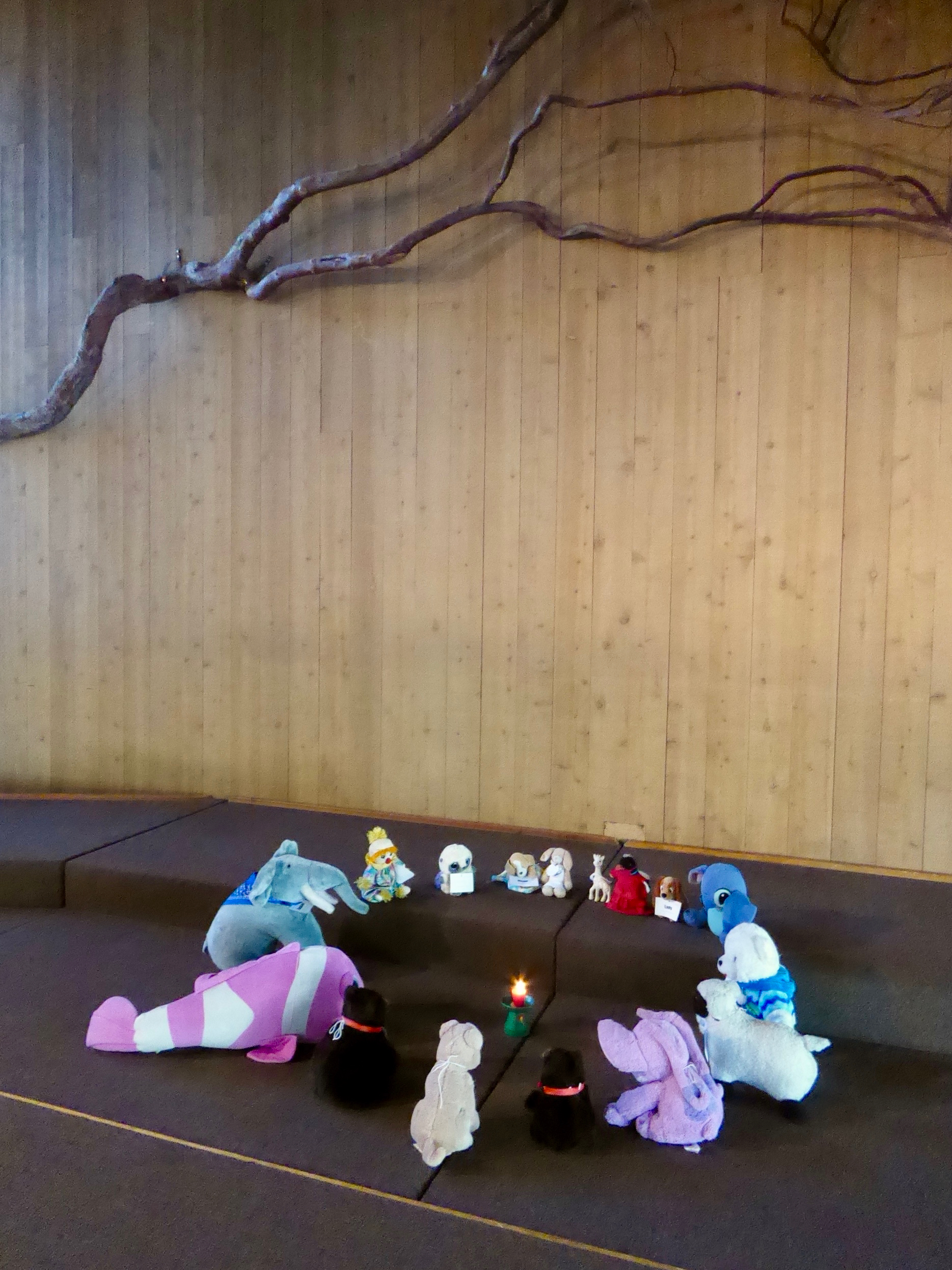
The actual written script didn’t go into all this high-level stuff, though. My script was terse and practical. Here’s an excerpt:
Saturday morning:
Room 10:
Brunch
[Props: Granola, hot chocolate]
Lighting chalice, check-in
[Props: chalice, candle, matches]
Room 7:
Play time
[Props: play equipment already in the room]
Room 6:
Playing games
[Props: board games]
Coloring
[Props: crayons, coloring pages]
POST PHOTOS TAKEN THUS FAR

Our campus is spread out, so I used a wagon to carry the stuffed animals from one location to the next. The wagon also allowed me to show more of the campus: I could leave the stuffies in the wagon, as if they’re going on a tour, and take photos of them admiring parts of the campus.

The captions you write are just as important as the photos themselves. In the captions, you find out that the stuffed animals vote when they’re making important decisions; you learn that some of the stuffies identify as LGBTQ+; you discover that the stuffies have conversations about race and racism; etc.
I was also able to showcase some of my favorite cooperative board games, and I could highlight some books to which I wanted to draw attention.

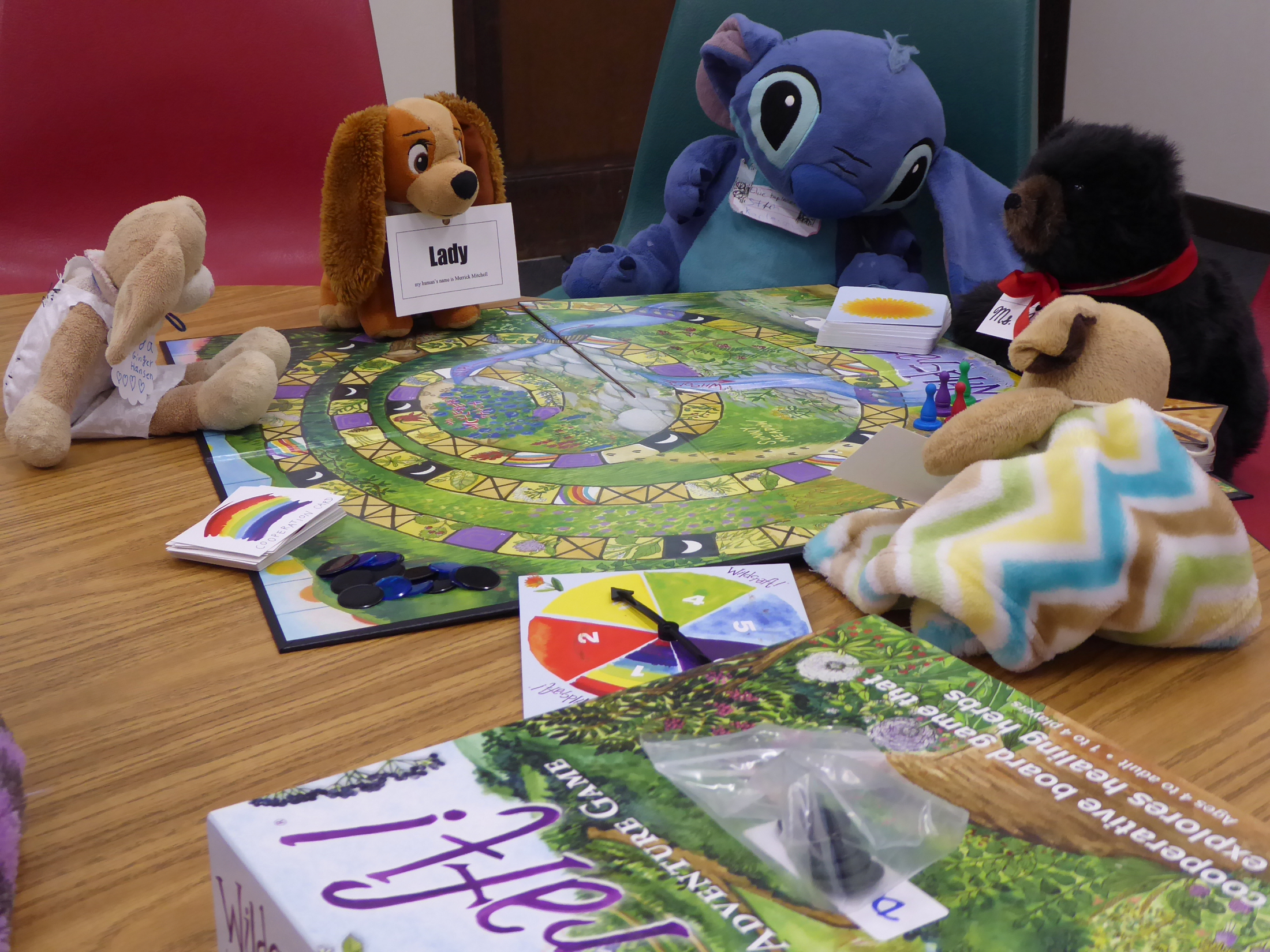
I created an online registration form for the stuffed animals. Mostly, I wanted to have the cell phone and name of the adult who was going to be dropping off the stuffed animal. But, at the instigation of my sister, I added questions like: What time does your stuffie have to go to bed? and What kind of snakc is your stuffed animal allowed to have?
Publicity started going out 3 weeks before the event, with an announcement in the monthly religious education newsletter. I made a two and a half minute video with the two chaperones, two plush puppets named Mr. and Ms. Bear who were going to be the chaperones of the event, and this video was aired during the congregation’s online worship service the week before the event. Then I sent out email announcements 3 days before, and the day before. Out of a total enrollment of 112 children and teens, 10 children brought stuffies to participate. (Several other parents told me that their child couldn’t bear to part with a stuffie; some families just plain forgot; and some more families reported that their family didn’t understand what it was all about, but now that they knew they would participate the next time.)
I spent most of Wednesday prepping rooms for photos. A homeless shelter had just vacated our rooms a few days before, so I did some touch-up cleaning, arranged furniture the way kids would remember it, etc. More importantly, I got props ready — story books, games, snacks, etc., were either placed in the room where they’d be used, or were placed in paper bags ready to carry to the appropriate room.
Drop-off for stuffies was Friday evening. I asked that stuffies be brought in a paper bag, and told everyone that they were going to be left overnight in quarantine (actually to minimize my own risk of getting COVID-19 from a stuffie). I posted a few photos of the check-in process on Facebook, to build some initial interest.
Saturday was a 12 hour day. I planned to take between 80 and 90 photos (I actually wound up taking 83 on Saturday). Moving stuffies from room to room, arranging the stuffies and props, taking extra photos just in case, uploading photos to Facebook and writing cpations — it all takes time. I managed an hour for lunch, and half an hour for dinner. Bed time for the stuffies was 8 p.m., but then I spent another hour or so cleaning up.
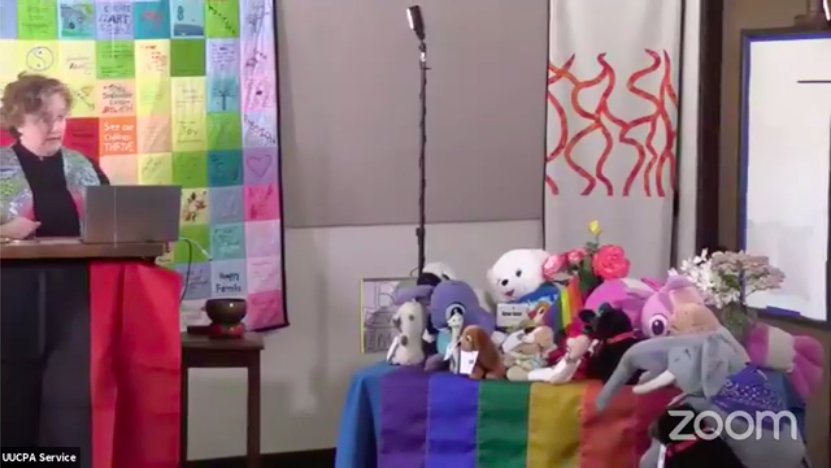
Then on Sunday morning, the stuffies appeared in the livestreamed service. Arranging them, and lighting them, took more time of course. Then once the service was over, I returned them to their paper bags, and spent the afternoon waiting for families to come pick them up again.
As my sister Abby warned me, doing a Stuffed Animal Sleepover takes hours and hours of time; I spent most of my forty hours this past week on the sleepover. The response — both from the children, and from adults with no children — has been overwhelmingly positive. Plus this is the perfect activity for this pandemic– yes the stuffies are cute, yes there’s some obvious educational content — but right now people of all ages just want to see the campus that they spent so many happy hours in before shelter-in-place.
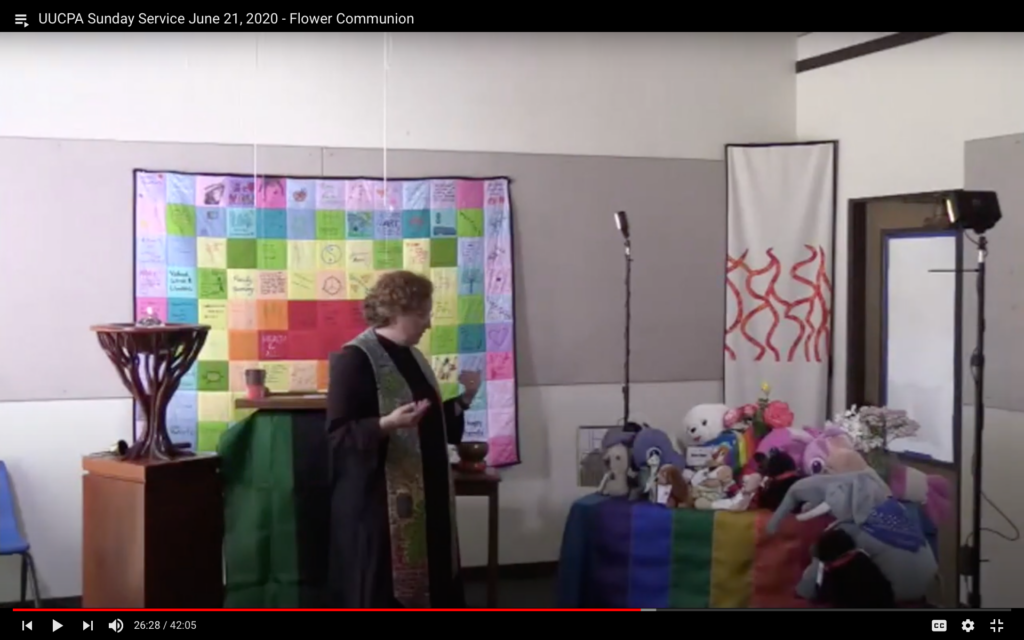
The stuffies who were staying on the Stuffed Animal Sleepover appeared in the worship service today, and participated in the Flower Communion. Here’s a photo of the senior minister, Amy Morgenstern, welcoming the stuffies to the service:
A recent post on the Black Issues in Philosophy blog explores the dangers inherent in forgetting this history of violence perpetrated on black people. The authors, Desireé Melonas, professor at Birmingham-Southern College, and Alex Melonas, and independent scholar, note that society’s forgetfulness in this area can cause “black people [to become] subjects thought existentially to inhabit the realm of the ‘unreal,’ having therefore no legitimate claim on reality….” Needless to say, this has negative consequences for black people:
“We know that keeping intact historical accounts that blot out or minimize the severity of black terror violence perpetuates the idea that black people aren’t human beings whose lives are worth preserving, that they aren’t human beings at all. Reality, then, continues to conform itself around this idea.”
Melonas and Melonas have been addressing this existential threat on a local level by “confronting historical erasure.” They do this through a community remembrance coalition, one of many such coalitions across the U.S., to memorialize the victims of racial terror, educate local communities about instances of racial terror that have been effectively erased from community memory, and then advocating for racial justice in the present day. They say: “By renegotiating the boundaries of our collective memory, we invite into our consciousnesses an alternative view of those whom we ought to consider valuable.”
Their blog post, titled “Why We Forget,” is thoughtful and readable, both in exploring some of the philosophical problems that arise from communal forgetfulness, and in suggesting concrete and practical ways to address those problems.
A group of Christian evangelicals have published a book titled “The Spiritual Danger of Donald Trump.” In an interview with Religion News Service, the editor, Ronald J. Sider, founder of Evangelicals for Social Action, answers the question, “So what is the spiritual danger of Donald Trump?”
“I would summarize it this way [Sider says]: Trump lies constantly. He has repeatedly demonstrated adulterous sexual behavior. He fails to make justice for the poor a concern in his policies. He constantly stokes white racism. His response to COVID-19 was dreadfully weak in the first couple of months. His position on climate change is simply disastrous. And his constant attacks on the fake media undermine democracy.”
Most Unitarian Universalists don’t like Donald Trump, but rarely do we speak about why he is a spiritual danger; mostly we focus on why he’s a political danger. I’m obviously not an evangelical Christian, and therefore not the target audience for Sider’s book or his remarks, but I think this summary of Trump as a spiritual danger is spot-on.
Another interesting point Sider makes in this interview is in response to the question of why white evangelicals supported Trump so strongly in 2016. A part of Sider’s response is particularly relevant to Unitarian Universalism:
“It’s partly because, let’s be honest, there’s a left wing fundamentalism as well as the right wing fundamentalism. And there’s a part of the liberal wing of the Democratic Party, which is really, I think, hostile to Christianity and certainly to evangelicalism. White evangelicals feel that, and don’t like it.”
This describes too many Unitarian Universalists: we can indeed come across as left wing fundamentalists who refuse to acknowledge that intelligent people can disagree with us on religious issues. For example, there are Unitarian Universalists who are convinced that global climate change is one of the top two or three most pressing issues facing humanity, who claim they’ll do everything they can to arrest global climate change, yet who are condescending and dismissive when they hear the term “creation care.”
There is no doubt that Donald Trump represents a pressing spiritual danger: he’s a liar, a racist, a misogynist, and he’s going to let the world go up in flames. It would be wise for us Unitarian Universalists to figure out how we can work effectively with all those who want to stop this clear and present spiritual danger.
A video to introduce the stuffed animal sleepover: