I’m watching the case rates in Santa Clara County, where the Palo Alto congregation is located. The 7-day rolling average is over 4,000 — yikes, that’s high. On the other hand, preliminary figures for mortality seem to show a low death rate — probably due in part to the fact that 82.8% of county residents have been fully vaccinated (thought only 58.2% of eligible residents have received boosters). But on the other other hand (that’s three hands, if you’re keeping track), anecdotal evidence from health care professionals says that ICU beds are getting full again, and elective surgeries and procedures that require an overnight stay in the hospital are being postponed.
Obviously, this is not where we hoped to be. But rather than feeling discouraged, I suggest we consider this as another problem in planning. So, how do we plan for next steps in our congregations?
First, just to say the obvious — any plan we make has to be flexible, to account for changing circumstances.
Second, to say something else that’s obvious — we’ve discovered that the big thing that draws many people to UU congregations is the community. Sure, we like the theology, but the big draw is a chance to be a part of a community with shared values. And many people want to get a regular dose of UU community in person.
Third, something else that’s obvious — we’re gaining a pretty good sense of what’s safest, and less safe. It’s safest to do in-person gatherings that are outdoors, distanced (or small groups), and masked. It’s less safe to do indoors events, but some indoors events are still possible in some circumstances. Instead of saying, “Oh we can’t do what we used to do, waaah!” we probably need to start saying, “Gee, what are our present options for fun and engaging communal events?”
So here’s one obvious thing I believe we should be doing: we should be planning outdoors events. Whatever that might be: outdoors worship services, outdoors small group meetings, outdoors classes. (And I know what those of you are going to say who live where winters are really cold — you’re going to say this doesn’t apply to you. Well, my-sister-the-children’s-librarian, who lives and works in Massachusetts, is doing outdoors story time for kids in the winter; sure, her attendance is lower, but people still show up.) It’s true that not everyone in your congregation is going to come to outdoors events, but I suspect enough people are hungry for in-person interaction that it’s worth doing.
Another thing I believe we have to do: start planning like COVID is not going away. I would love it if COVID suddenly decided to go away next month. But it now looks like there’s a good chance that COVID is going to become endemic. If it has become endemic, then we’re going to have to learn to live with it. So maybe we should start thinking about one or more of the following: requiring proof of vaccination; think about shorter indoor worship services (e.g., 45 min., to limit time spent indoors); adding more worship services (so you can have more smaller indoors services); creating permanent spaces for outdoor programs where possible; improving ventilation in indoor spaces; and/or many other things.
Another obvious thing we should do: for our online offerings, keep improving community interaction. I’ve been noticing that many people are getting better at participating in online events — video conferencing is a learned skill. Similarly, I believe many of us are getting better at facilitating online communal interactions. In my own case, I’ve become much better at teaching online, and at facilitating online meetings — again, these are learned skills. As we continue to get better at participating in and leading online events, one of our goals should be improving community interaction.
One final thing I believe we should be doing: we should go easy on ourselves. Yes, the pandemic is probably going to kill off some UU congregations; but if you start thinking that way, you’re liable to either get tense and stressed out, or sad and filled with grief, neither of which is going to help keep your congregation going. Of course, getting overwhelmed and doing nothing is also not helpful; my point here is that we do need to do something, we just don’t need to be overachievers. My primary rule for congregational life has always been: if it’s not fun, let’s not do it. This still holds true during the pandemic!
I’m actually feeling pretty positive about congregational life in the immediate future. Yes it’s different from what I’m used to, and yes it’s hard to let go of a lifetime of past expectations, and yes change is annoying and difficult. But new possibilities are opening up, and I’m actually feeling quite positive about the future of our congregations.
I recently learned that the song “We Shall Overcome” is now in the public domain, due to a 2017 court ruling and a 2018 settlement. A lawyer tells the whole story in some detail here.
The short version: In 2017, a federal court ruled that the tune, arrangement, and first verse of “We Shall Overcome” are in the public domain (We Shall Overcome Foundation v. The Richmond Organization, Inc., 2017 WL 3981311 [S.D.N.Y. Sept. 8, 2017]). In addition to the court ruling, the defendant and plaintiff subsequently entered into a settlement agreement which said, in part, that TRO would not “claim copyright in the melody or lyrics of any verse of the song ‘We Shall Overcome’”; furthermore, TRO agreed that all verses of the song were “hereafter dedicated to the public domain” (We Shall Overcome Foundation v. The Richmond Org., 330 F. Supp. 3d 960 [S.D.N.Y. 2018]).
This is very good news indeed. Sure, now the song can be used in all sorts of horrible advertising. At the same time, now you cannot be slapped with a royalty fee for using “We Shall Overcome” in your worship service, in the video that you made of some rally or demonstration, or in the audio recording of you singing at a coffeehouse.
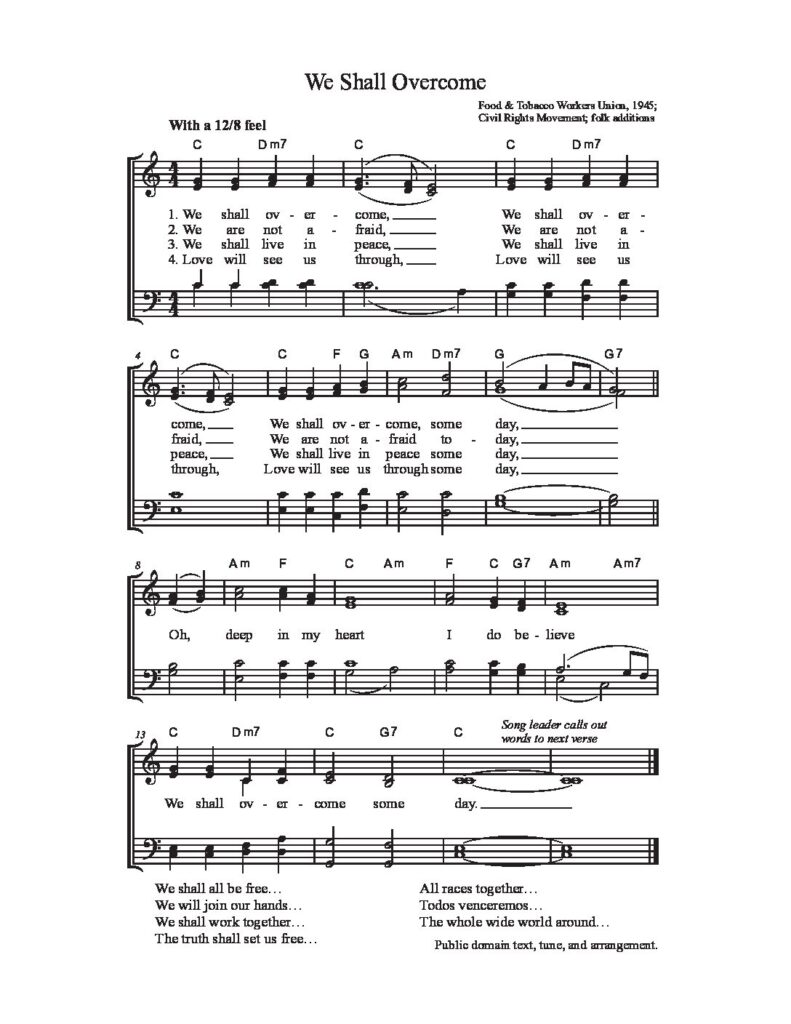
Of course, just about all the piano or choral arrangements out there are copyright protected, including the one in the current UU hymnal. So here’s a very basic arrangement of “We Shall Overcome” which I’m releasing into the public domain; and hey, if you don’t like my version, it’s a public domain song so you can write your own! (I’ve changed a couple of the usual verses so they’re less ableist.)
Click the image above for sheet music.
By the way, I’m finding that it’s a good song to sing around the house now that we’re hunkered down because of the Omicron surge.
I just uploaded another batch of 26 copyright-free hymns onto Google Drive.
This collection of copyright-free hymns now includes a total of 63 hymns, with 38 copyright-free versions of hymns in the two current Unitarian Universalist hymnals, along with 24 other hymns and songs (including classics like “Swing Low Sweet Chariot” and “Michael Row Your Boat Ashore,” which really should be in our hymnals anyway). Not only are tune, text, and arrangement copyright-free, but the typesetting is as well, so you can project these or place them in online orders of service without a problem.
The “ReadMe” file in the Google Drive folder gives some information about each hymn, and also gives the corresponding number if there’s a version of the hymn in one of the UU hymnals.
In several cases, hymn texts now offer degenderized lyrics, for those who prefer to move away from binary gender options (e.g, for “The Earth is our mother,” the alternative “The Earth is our parent” is suggested). Eventually, I’ll offer degenderized options for all lyrics, but it takes — so — much — time to produce quality music typesetting that I can’t promise when I’ll get to it.
Whether you use these in your congregation’s online worship services, or at home, or around a campfire, I think you’ll find lots of fun and uplifting music here. I’d love it if you’d let me know where and how and if you use this music!
Update, 1/18/2022: Now up to 71 total hymns and spiritual songs, with 44 of them being copyright-free versions of hymns from the two current UU hymnals. List of hymns (with references to hymnal numbers, and notes on copyright status) below the fold.
Where do the words for the hymn “We Sing of Golden Mornings” come from? This hymn appears in the 1955 American Ethical Union hymnal We Sing of Life, and in the 1993 Unitarian Universalist hymnal Singing the Living Tradition. In the latter hymanl, the words are attributed to Ralph Waldo Emerson, “recast 1925, 1950, 1990.”
But a quick web search shows that the phrase “golden mornings” does not appear anywhere in Emerson’s poetry. The same is true of several other distinctive phrases in the hymn: “flashing sunshine,” “heart courageous,” “earth’s great splendor,” etc. I can’t even figure out from which of Emerson’s poems this hymn might have been derived.
Eunice Boardman (Exploring Music, vol. 4, Holt, Rhinehart, and Winston, 1971, p. 26) attributes this as “words by Vincent Silliman from a poem by Ralph Waldo Emerson.” Well, maybe. But I can’t find any Emerson poem that even vaguely resembles this. Clarence Burley, in an essay “Emerson the Lyricist” (Emerson Society Papers, vol. 8, no. 1, spring, 1997, p. 5), says that as this poem “does not appear in the Library of America edition [of Emerson’s complete poems], I don’t know the extent of recasting and revising.” That’s a nice, polite way of stating my conclusion — that this hymn is Not Emerson.
(Oh, and to complicate matters more, the music attribution is also wrong. The tune is in fact from William Walker’s Southern Harmony, only slightly modified. But the harmonization in Singing the Living Tradition is most definitely not by William Walker, which raises the question: Who wrote the harmonization?)
Part Six of a history I’m writing, telling the story of Unitarians in Palo Alto from the founding of the town in 1891 up to the dissolution of the old Unitarian Church of Palo Alto in 1934. If you want the footnotes, you’ll have to wait until the print version of this history comes out in the spring of 2022.
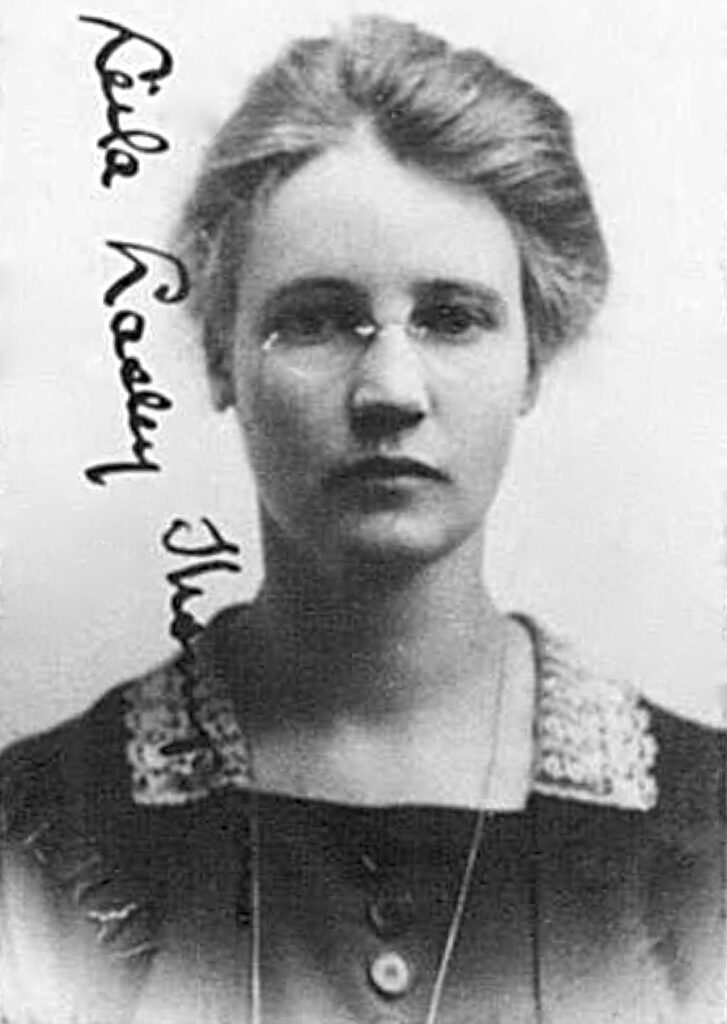
In late 1925, Elmo Robinson could look back on “four happy years, profitable to me, and I hope to the church.” But he had grown restive. He received a grant so that he could study for a semester at Harvard University in the first half of 1926. He found, or the church found, Leila Lasley Thompson to fill in for him while he was away. Thompson had married a soldier in 1918 who then was killed in action a few months later, leaving her a war widow. She then studied for the ministry at Manchester College, Oxford, England, a Unitarian theological school; was fellowshipped as a Unitarian minister by the American Unitarian Association; and pursued post-graduate study in 1925 at the Pacific Unitarian School for the Ministry.
Robinson departed at the end of 1925, leaving Leila Thompson in charge of the congregation. The congregation ordained her on Sunday, February 7, 1926. A month or so later, Robinson decided that he wasn’t going to return to the church. He apparently decided to pursue an academic career, although a note from him dated April 5, 1926, has a cryptic reference about protecting himself from “the charge of using this leave of absence as an opportunity of running away from an unpleasant situation without giving everyone a chance to be heard.” The “unpleasant situation” may well have been the long-standing conflict between the pacifist faction and the pro-war faction. Not even Robinson, with his skill and experience, had been able to heal that conflict.
After going east, Robinson never returned to Palo Alto — which sounds a little too much like Bradley Gilman’s departure from the church. In September, 1926, the church called Leila Thompson as the sole minister of the church. She was reportedly the first regularly ordained woman to serve a minister of a Palo Alto church.
Sadly, Leila Thompson received little support from the lay leaders. Sunday morning attendance dropped even more, from 34 in 1925, down to 27 in 1926, and then to 22 in 1927. Sunday school plummeted from 62 in 1925 down to 25 by 1927. The Young People’s Group continued to be active; Gertrude Rendtorff was still a Stanford student, and perhaps her continued participation kept that group going.
Alfred S. Niles, a lifelong Unitarian, moved to Palo Alto with his wife Florence, also a Unitarian, in the fall of 1927. When they arrived in town, Alfred and Florence sought out the Unitarian church. He found a church that was “still functioning, but rather feebly.” He was told that the church had once been active, “but the minister at the time of World War I had been a pacifist and conscientious objector [i.e., William Short, Jr.], and this had caused a split in the church from which it never recovered.”
Attendance got so low that the congregation tried moving the services to the evening, but that didn’t help matters. At the end of December, 1927, Leila Thompson resigned. It appears from the extant records that everyone became aware that there really wasn’t enough money to pay her salary any more, not even with the assistance the church still received from the American Unitarian Association. The church got Clarence Vickland, a student at the Pacific Unitarian School for the Ministry, to come preach to them in 1927-1928. Sunday morning attendance continued to drop, down to an average of 21, and by December, 1928, the Sunday school had closed “as there was not sufficient interest manifested to justify continuing the work.”
Finally, in 1929, the church stopped holding services altogether. Clarence Vickland wrote to the Women’s Alliance asking if they would like to host a visiting Unitarian minister on March 3, but they replied that “it would be impossible to get the congregation together.” 1929 was also the year that Karl and Emma Rendtorff retired to Carmel. With the Rendtorffs about to leave town, there was no real hope for the church. In May, 1930, Rufus Hatch Kimball reported to the Women’s Alliance that the Board of Trustees had turned the church building over to the American Unitarian Association. The church had finally dissolved.
The Women’s Alliance was declining, too. They continued to work on charitable projects — at their June, 1932, meeting, they worked on sewing for the Needlework Guild — but their numbers were shrinking. By May, 1930, the membership list had only nineteen names, and after Anna Probst Zschokke’s name appeared the notation, “Died May 30, 1929.” Like the church, the Alliance was slowly winding down and dying away.
The building sat vacant until early 1931. Then in February, 1931, Mary Engle reported to the Alliance that the American Unitarian Association had begun fixing up the building, and it was “now all in good repair and new locks have been put on the doors so that no invading hands could open them and…have access to Church of Alliance property.” By Easter Sunday, services were once again being held in the church, and Merrill Bates, the theological student who had been given charge of the church, had started up the church school once again.
The Alliance tried to help with the revived Sunday school, but grew discouraged with the tiny attendance, leaving Merrill Bates to manage on his own. Merrill Bates, Berkeley Blake, regional field secretary for the American Unitarian Association, and William S. Morgan, president of the Pacific Unitarian School for the Ministry, each preached to the church once a month, with Bates arranging supply preachers for the other Sundays.
Bates continued in the Palo Alto church until he graduated in spring of 1934. It’s hard to know how many of the old-time members still participated in the church. On March 27, 1932, Henry David Gray, who had become a member of the church in 1905, preached the Easter sermon. But most of the old members had either died, or moved away, or given up on the church. The Alliance held its last meeting on October 11, 1932, without even coming to a conclusion as to whether they should formally dissolve or not.
In April, 1934 — a month or so before Merrill Bates graduated from the Pacific Unitarian School for the Ministry — the American Unitarian Association put a “For Sale” sign up in front of the building. The building soon sold, for less than its mortgaged value. The American Unitarian Association retained possession of the organ, however, and gave it to the Unitarian church in Stockton, Calif. on permanent loan (Clarence Vickland was then the minister in Stockton). As Alfred Niles put it, there would be “no more organized Unitarianism in Palo Alto for several years.”
Interregnum, 1934-1947
Indeed, there was no organized Unitarianism in Palo Alto for almost exactly thirteen years. In 1936, the liberal Quaker Elton Trueblood became the chaplain at Stanford University, and some Unitarians — like Alfred and Frances Niles — found Stanford’s Memorial Church a congenial place to go on Sunday mornings. Other Unitarians found other religious homes. Josephine Duveneck became active with the American Friends (Quaker) Service Committee, and eventually became a Quaker herself. Alice Locke Park also became a Quaker. Several Palo Alto Unitarians gave up on organized religion altogether.
Even for the Unitarians who went to hear Elton Trueblood preach each week at Stanford, there was no Unitarian Sunday school for those with children, and there was no Unitarian minister to officiate at rites of passage such as weddings and funerals. Perhaps more importantly for many, there was no Unitarian community of which to be a part. Then when Elton Trueblood left Stanford in 1945, there wasn’t even any liberal preaching in town.
In May, 1944, the American Unitarian Association organized the Church of the Larger Fellowship to serve Unitarians who didn’t have a nearby Unitarian church that they could belong to. This was a sort of mailorder church which sent monthly newsletters with sermons and other material of interest to Unitarians; it was, in a sense, an expansion of the old Post Office Mission. The Church of the Larger Fellowship grew quickly, and within three years, a dozen or so Palo Alto Unitarians had already joined.
A New Congregation, 1947
In November, 1946, Alfred Niles saw a notice in the Christian Register, then the name of the denominational periodical, that the American Unitarian Association had appointed Rev. Delos O’Brian to be the the Regional Director for the West Coast, with an office in San Francisco. In February, 1947, Alfred Niles made an appointment to visit Delos O’Brian, who showed him two lists of names from the Church of the Larger Fellowship, one with a dozen names from the Palo Alto area, and another with a dozen names from San Mateo. Delos O’Brian was still undecided whether to organize a new Unitarian church in Palo Alto or San Mateo, and Alfred Niles later claimed that it was his visit that helped tilt the balance to Palo Alto. And on April 6, 1947, Delos O’Brian held an initial meeting to organize a new Unitarian group in Palo Alto. The Palo Alto Unitarian Society, as it was first known, grew quickly. Organized Unitarianism had finally returned to Palo Alto.
But even though many of the members of the old Unitarian Church of Palo Alto still lived in the area, most of them did not join the new congregation. Ruth and Everett Calderwood, who were only in their fifties, first claimed they were too elderly to take part, though later they did make financial contributions to the church. Katherine Carruth, who was then seventy-one, said she was sorry but she was too old to participate.
Edna True, on the other hand, who at seventy-two was older than the Calderwoods or Katherine Carruth, attended the very first meeting of the society, and became a member of the congregation. Clearly, while some Palo Alto Unitarians retained their enthusiasm for being part of a Unitarian church, others had lost all such enthusiasm. When Dan Lion arrived in Palo Alto as the first full-time minister of the new church, he made contact with some of the former Palo Alto Unitarians. He made an audio recording of his memories of calling on some of those former Palo Alto Unitarians, and while that recording has been lost, nevertheless, we can make a pretty good guess why those former Palo Alto Unitarians stayed away — the bitter conflicts that split the church, the incessant lack of money, the sense that they had been betrayed by some of their ministers and by the denomination, all contributed to drive these people away from any Unitarian congregation.
Other former Palo Alto Unitarians were happy to join the new congregation. Alfred and Frances Niles were central figures in the new congregation. Edna True was a member of the congregation up until she died, when she left a large bequest to the church. Rufus Kimball was integral in helping the new congregation claim its tax-exempt status. Ruth Steinmetz, a graduate of the old church’s Sunday school, joined the new church and remained active in it the rest of her life. Cornelis Bol, who had moved to Holland before the First World WAr, returned to Palo Alto in time to join the new congregation. Walter Palmer, who lived in Oakland by then, heard about the new church, and contacted them saying that he had been one of the charter members of the old church, and would like to be on the mailing list, though he wouldn’t be able to participate. Gertrude Rendtorff, living in Monterey, also heard about the new church in Palo Alto and asked to be on the mailing list.
Then too, as time went on, descendants of some of those former Palo Alto Unitarian families resumed a connection to the church. Guido Townley Marx, grandson of Palo Alto Unitarians Guido H. and Gertrude Marx, was married in the new church. Candace Longanecker, granddaughter of Errol and Laura Longanecker, was another grandchild who was married in the new church. And over the years, Dan Lion officiated at the memorial services of a handful of those former Palo Alto Unitarians.
The new congregation, renamed the Palo Alto Unitarian Church in 1951, was wildly successful. By 1965, they had three worship services each Sunday, and the Sunday school had some six hundred children enrolled. In less than twenty years, the Palo Alto Unitarian Church became one of the largest Unitarian congregations on the West Coast. So why did the old Unitarian Church of Palo Alto die, and the new Palo Alto Unitarian Church succeed?
Partly, it was a matter of demographics and the economy. Before the Second World War, Palo Alto was a small town, probably too small to support a viable Unitarian church. After the war, both Palo Alto and the surrounding area gained population rapidly while at the same time the economy was booming. This meant the new congregation could grow quickly so it didn’t need to be subsidized by the denomination, and furthermore the new congregation could attract, and pay for, excellent professional leadership. But then when the new congregation faced financial stress in the late 1960s and early 1970s, due both to demographic decline and a declining economy, conflict erupted and membership and participation plummeted. Demographics and the economy are major influences on congregational growth and decline.
It was also partly because the old Unitarian Church of Palo Alto was unable to integrate new leadership. It’s no coincidence that the congregation died within a year after Karl and Emma Rendtorff retired to Carmel. By the 1920s, the Women’s Alliance consisted solely of elderly and middle-aged women; the older women had not made room for young women to be part of the Alliance. As they aged, the small core of leaders that ran the old church was reluctant to share power with younger people.
Then too, the conflicts that engulfed the old church never healed. Marion Alderton, Alice Park, Josephine Duveneck and others never really forgave their fellow Unitarians. And there were others who didn’t formally resign from the church, but nor could they ever quite forgive. The old Unitarian Church of Palo Alto proved unable to deal effectively with the conflict between the pro-war faction and the pacifists.
Perhaps most importantly, though, the old Unitarian Church of Palo Alto didn’t have a compelling vision for itself. For much of its history, it was little more than a social club that happened to own a beautiful little building. This was part of the reason they couldn’t overcome their conflicts — when a congregation is little more than a social group, with no big purpose, there is nothing larger to inspire people to move past the conflict. Because the congregation was little more than a social group, when Elmo Arnold Robinson came along and welcomed people of different classes and ethnic groups into the church, the long-time members didn’t even bother to engage with the newcomers. As a result, they were unable to retain the newcomers who could provide new leadership, and help pay the bills. Indeed, by the late 1920s the long-time members seemed to have lost interest in Unitarianism, and to have lost interest in figuring out how their Unitarian church could affect the wider community.
In late 1947, Rev. Nat Lauriat ran into a similar problem, with a new generation of Palo Alto Unitarians. Lauriat was the dynamic minister of the San Jose Unitarian church who drove up to Palo Alto each week to preach to the new Palo Alto Unitarian Society, and to help them get organized. He wrote to denominational officials that “the general feeling was to proceed with great caution, and just have a pleasant little group.” However, Nat Lauriat found younger Unitarians who “wanted more action and growth,” and with his encouragement, these younger Unitarians were the ones who took over leadership, and built a thriving new congregation on their vision of Unitarianism as a force for good in the world. Nat Lauriat challenged the Palo Alto Unitarians to think of liberal religion as more than just a social club.
This is a perennial challenge for any Unitarian Universalist congregation. It is a challenge that Palo Alto Unitarian Universalists face today. There is still a feeling among some of today’s Palo Alto Unitarian Universalists “to proceed with great caution, and just have a pleasant little group.” But when we hear the story of the old Unitarian Church of Palo Alto, we find that proceeding “with great caution” and having “a pleasant little group” ultimately leads to decay and dissolution. It’s the congregations with a larger vision — the congregations that hunger for “more action and growth” — that grow and thrive, that nurture the growth of their members, and that ultimately change the world around them for the better.
Wow. It’s been a year of change. As 2021 winds down, I’ll briefly summarize the changes I’ve seen in Unitarian Universalist congregations — some positive, some not so positive, some neutral.
Not-so-positive
(A) Enrollments of children and teens appear to be falling precipitously. We don’t yet have official numbers from the year-end certification count, but I’m estimating declines of 33% to 100% across the board.
(B) Adult membership also appears to be falling in most congregations, though the declines are not as steep.
(C) There appear to be many fewer newcomers in most congregations. The lack of newcomers probably accounts for about half of the decline in adult membership. Most Unitarian Universalist congregations have an annual turnover rate of 10-25% (due to moving away, death, lack of interest, etc.), and depend on a steady stream of newcomers to maintain stable membership.
(D) From what I can tell, most congregations saw a decline in revenues this year. The decline can be attributed to the general decline in membership, loss of other revenue streams such as rentals, and the end of the federal Payroll Protection Plan.
(E) I’d say that more peripheral people have gotten out of the habit of occasional participation in the life of the congregation. It’s still too soon to know if they’ll ever come back, but I’m not hopeful.
(F) This past year saw an epidemic of clergy resignations. In the spring, the Unitarian Universalist Association was begging ministers to come out of retirement to fill all the interim ministry positions. By all accounts, this past year saw a shortage of ministers.
Neutral
(G) I expected more resignations by other (non-clergy) paid staffers in UU congregations this past year. But so far I’m not seeing evidence that that happened. This may be because so many other paid staffers are part timers, meaning they weren’t exposed to as much stress as full-time ministers. Or it could be that the resignations happened, but they’ve been less visible than minister resignations.
Positive
(H) Online adult religious education classes have proved to be more popular than in-person classes in some congregations. The convenience of attending a class while sitting comfortably at home turns out to be quite attractive to many.
(I) Moving online apparently has worked for many (not all) support groups, again due to the convenience.
(J) Congregations have adopted digital giving tools, to the pleasure of most people under the age of 50.
(K) Most Unitarian Universalist congregations have developed good to excellent online services. Online services have proved so successful that most of the congregations I know of plan to continue multi-platform services (i.e., combined online and in-person services) after the pandemic is over.
(L) Online does not work for everything. And most Unitarian Universalist congregations have developed safe ways of having at least some in-person programs.
Summary
In a time of great change, it’s easy to get despondent, just because change can be so disorienting. But I have to say I’m feeling mostly optimistic. In a follow-up post, I’ll have more to say about how I believe we can address the not-so-positive changes productively.
But the positive aspects of this year of change are very positive. Even though our primary “product” continues to be in-person connections, it’s also good to be able to expand the ways we can connect with our congregations, by adding multi-platform services, online classes, and digital giving.
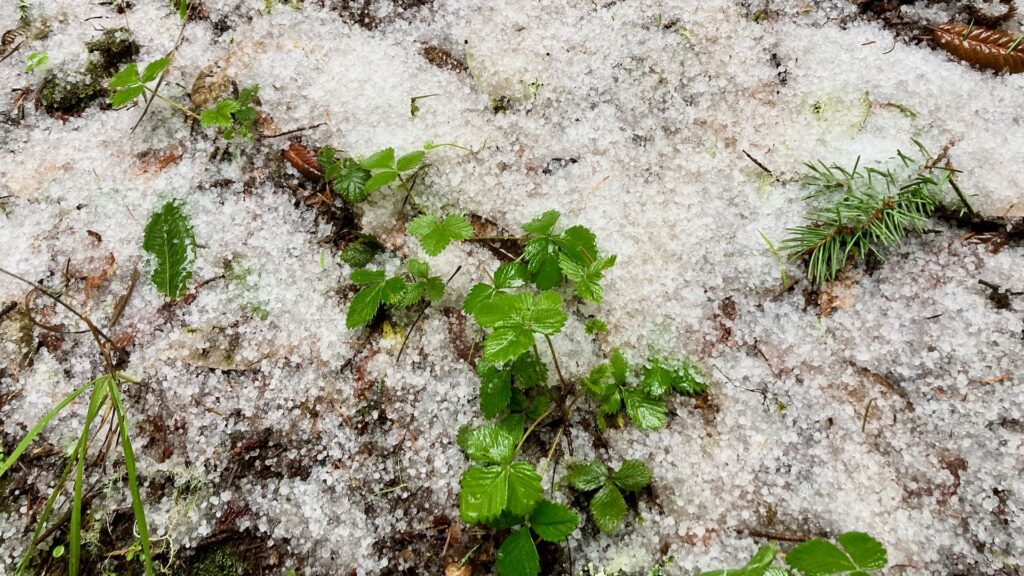
This morning, I went for a walk up in the Santa Cruz Mountains. I was expecting showers, and forecast warned me there might even be thunderstorms. But I was not expecting hail.
In places, the tiny hailstones covered the ground, looking so much like snow that I decided it was a white Christmas — just like the ones we used to have at home.
I was wary of driving down winding, twisty mountain roads covered with a quarter of an inch of hail stones. But I watched other cars drive by without any trouble, and decided to try. The driving wasn’t that bad — after about five minutes I got below 1500 feet elevation, and the roads were clear of hail.
Possum asks Dr. Sharpie about the meaning of Christmas. Then Possum asks some of his other housemates, and Muds finally helps him find the meaning of Christmas.
Peter Kasin, the coordinator of the monthly sea chantey singing from San Francisco Maritime Historical Park, sent out a holiday greeting filled with fish puns.
I love fish puns. Even though they give some people a haddock, and other people carp about them, and still others say that puns are crappie — I love fish puns.
What I liked best about Peter Kasin’s fish-pun-laden holiday greeting were the fishy Christmas carols: “Cod Rest Ye Moray, Gentlemenhaden,” “Shark, the Herring Angelfish Sing,” and “Koi to the World.”
I trout you can come up with any more fishy carols….
Scrooge famously said: “If I could work my will, every idiot who goes about with ‘Merry Christmas’ on his lips, should be boiled with his own pudding, and buried with a stake of holly through his heart!”
The omicron strain of COVID-19 is acting like Scrooge. If you go wish your family ‘Merry Christmas’ in person, you could wind up with omicron in your lungs. Bah humbug.
A month ago, we started planning in-person services for Christmas Eve. But as of today, it looks like we’re going to be moving to online-only for Christmas Eve. Omicron is present here in Santa Clara County. Omicron doubles every 2-4 days (depending on who you listen to). Vaccinated and boostered people are getting omicron. Everyone is expecting a major surge by mid-January. So in-person indoors meetings are most definitely Not A Good Idea. Bah humbug indeed.
I had been looking forward to seeing people in person on Christmas Eve — especially college students, many of whom come home for winter breaks. But honestly I’m relieved that we’re not going to have in-person services. I admit it — I don’t like the looks of omicron.