
How to make congee in a rice cooker

Congee (rice porridge) is my go-to food when I’m ill. But because I’m feeling ill, I didn’t want to make congee the traditional way, cooking it on the stove and stirring it by hand for hours. I wanted to make congee in a rice cooker.

All the recipes I found online used the wrong proportion of rice to water. Typically, congee is made with 1 part rice to ten parts water. But the rice-cooker congee recipes I saw gave proportions more like 1 to 4 or 1 to 5. That doesn’t really make congee, it just makes sloppy rice.

So here’s what I did:

For a one-quart rice cooker, start with half a cup of rice.

Wash the rice to remove as much rice starch as possible. Pour some water in, and use your fingers to massage the rice until the water turns cloudy. Dump out the cloudy water. Repeat until the water runs clear, about 6-9 changes of water. (If you don’t wash the rice, you’ll wind up with a glutinous mass, which is not congee.)

After the rice is washed, add a cup and a half of water. (I know this is only a 1 to 3 proportion, but wait!) Turn the rice cooker on.

When the rice cooker shuts off, leave it on the “warming” setting. Boil a cup and a half of water, and add it to the rice cooker. Stir well. You’re now at a 1 to 6 proportion.

After an hour on the “warming” setting, the rice should absorb a lot more water, and the mix will now be fairly stiff. Boil another cup of water, and add it to the rice cooker. Stir well. That’s a 1 to 8 ratio, which seems to be about right for my rice cooker. Yours may vary, and you can add a little more water if you prefer a thinner consistency. Be careful, though. When I make congee in a rice cooker, it seems to require less water.

A rice cooker with congee in it.
Here’s my rice cooker, showing the consistency of my congee.

Songs and signs — Isaiah 13:15-16 and Genesis 19:6-8

Religion News Service reports:

“If you’re an exvangelical who has been scrolling through TikTok lately, you may have stumbled across a duo singing what sounds suspiciously like evangelical worship music. Until you hear the lyrics. ‘Anyone who is captured will be cut down and run through with a sword,’ they sing in harmony, guitar strums in sync. ‘Their little children will be dashed to death before their eyes.'” [They’re quoting Isaiah 13:15-16 from the Bible.]

I recommend watching the TikTok video. It’s quite well done. And it makes you think.

It reminds me of some Unitarian Universalist teens I knew twenty years ago, long before the days of TikTok. Their eyes had been caught by the fans at sports events who held up signs reading “John 3:16.” This Bible verse is the favorite of traditional Christians: “For God so loved the world, that he gave his only begotten Son, that whosoever believeth in him should not perish, but have everlasting life.” It is supposed to entice nonbelievers into becoming Christians.

In response, these Unitarian Universalist teens decided that they were going to make a sign that read “Genesis 19:6-8” and hold it up during a Red Sox game. That’s the Bible passage where a mob besieges Lot’s house, because he’s hiding some angels from God. The mob demands that Lot throw the angels out to them, so they can lynch them. But instead Lots offers to throw his virgin daughters out to the mob to be raped by them. He’d rather sacrifice his daughters than betray the angels.

The Bible is a complex book. It contains some good ethical writing, it has some profound mystical moments, but it also contains passages that are difficult to interpret, and it has icky bits as well. You can’t just pick out the dozen verses you especially enjoy, and ignore the difficult parts and the icky bits.

“Somebody who’s asleep will not say no”

ANDRE: “OK. Yes. We’re bored now. We’re all bored. But has it ever occurred to you, Wally, that the process which creates this boredom that we see in the world now may very well be a self-perpetuating unconscious form of brain-washing created by a world totalitarian government based on money? And that all of this is much more dangerous, really, than one thinks? And that it’s not just q question of individual survival, Wally, but that somebody who’d bored is asleep? And somebody who’s asleep will not say no?” — My Dinner with Andre: A screenplay for the film by Louis Malle, by Wallace Shawn and Andre Gregory (New York: Grove Press, 1981), pp. 91-92

If we were bored back in 1981 when this screenplay was written, we are even more bored now. We try to keep our boredom at bay with social media — reading Facebook posts from people we don’t really care about instead of talking to neighbors, looking at Instagram photos instead of at our children — and as a result, we’re not just bored, we’re lonely.

And too many of us are not saying no. We’re not saying no to demagogues and Christian nationalists and sadistic employers.

Maybe we need to wake up.

Conservatism

“All academic thinking, whether right, left, or middle, is conservative in the extreme…. Nobody wants to hear what he [sic] hasn’t heard before.” — Hannah Arendt, in a letter to the philosopher Richard J. Bernstein, quoted in Jordi Graupera, “A Philosophy Professor’s Final Class,” New Yorker magazine, January 3, 2023.

What Hannah Arendt says applies in large part to religion as well. Religion tends to conservatism for the same reason academia tends to conservatism: people would prefer not to hear something they haven’t heard before.

However, organized religion is somewhat less conservative than individualized religion. In other words, someone who is “spiritual but not religious” (SBNR) is likely to be more conservative than someone who is part of a religious community.

This is analogous to the tendency of an autodidact to be more conservative than an academic working in academia. When an autodidact has to listen to a challenge to their hard-won, often tenuous knowledge, it can feel like an assault on their very self-hood. When a tenured faculty member has to listen to a challenge to their hard-won knowledge, at least they’re getting paid for it.

So here’s the question. In a time when organized religion is in decline here in the US, should those of us in organized religion give in to the tendency to extreme conservatism? Or should we try to be a little more open?

Richard J. Bernstein had a strong opinion about this question. Jordi Graupera paraphrases Bernstein’s response: “We must all fight off this tendency to conformity, [Bernstein] said. Even intelligent people learn to go along with what is conventional, he explained, and they reject good philosophy.”

Elon’s jet

You’ve probably heard about the website Elon’s Jet, which tracks one of Elon Musk’s private jets (he apparently has several; this just happens to be the one he uses most often).

Well, the person running that website just calculated the total carbon emissions of Elon’s jet in the year 2022 — 1,895 tons of CO² emissions. This has been posted on Mastodon, and as you’d expect people are having fun doing some additional math.

One Mastodonian pointed out that Musk’s CO² emissions from jet flight alone in 2022 are about 122 times the total carbon footprint of the average US resident; or about 370 times the total carbon footprint of the average person in the world. Yet another Mastodonian calculated that Musk’s jet produces more carbon emissions in a single day than the average US car produces in a year. And a particularly cynical Mastodonian noted: “I’m sure we can offset most of that CO² if we all collectively drink with cardboard straws.”

I will note in conclusion that Musk banned Elon’s Jet from Twitter, claiming that releasing this information could endanger his children, who sometimes fly on the jet. I would suggest that Musk is doing far more to endanger his children by flying his damn jet, and accelerating climate change.

“Healthy Congregations”

Pam, the minister at the Unitarian Universalist congregation just down the street in Scituate, told me about “Healthy Congregations,” a nonprofit that carries on the work of Rabbi Edwin Friedman and Peter Steinke. Friedman applied Murray Bowen’s family systems theory to congregational life, which is outlined in his book Generation to Generation. Beginning in the 1990s, Steinke developed workshops to train workshop facilitators in systems theory.

I read Friedman’s book years ago. Family systems theory really does provide good insight into how congregations work. (I feel it also provides insight into how any face-to-face membership organization works.) Somehow I’m going to have to figure out how to fit one of their online workshops into my schedule….

“Water is sacred”

In an essay titled “Jain Ecology,” Satish Kumar records a “water sutra” taught to him by his mother:

Waste no water
Don’t ever spill it
Water is precious
Water is sacred
The way you use water is the measure of you
Water is witness
Water is the judge
Your wisdom rests on your careful use of water.
(Satish Kumar, “Jain Ecology,” Jainism and Ecology, ed. Christopher Key Chapple [Harvard Univ., 2002], p. 187)

This sutra expresses an ethic that is removed from Western thinking. Most Westerners would agree that humans are sacred, in some sense of the word”sacred.” Some Westerners would argue that animals are sacred. Maybe a few Westerners would contend that plants and fungi are sacred. But as for inanimate objects — or bacteria, archaea, and eukaryota aside from plants, animals, and fungi — I think only a very tiny minority of Westerners would consider these to be sacred.

If water, earth, and air are sacred, it would much easier to advocate for treating them with respect. But since they are not sacred in the West, then if you want to protect them from pollution or wastefulness, you wind up arguing from a selfish point of view — we should protect water, earth, and air because to do so is to protect our own health.

This represents a big difference in the ethics of ecology.

Grumpiness and ukuleles

Three of us were in the office in the early afternoon. Each of us was feeling a little bit grumpy. Each of us was glad to be done with 2022, and hoping that 2023 will be a little bit better.

I told them my theory. Here we are, three years into a pandemic. Historically, pandemics have ended after a year and a half. But this pandemic is still going strong. I told them about this article I read that blamed the Ukraine war on the pandemic — Putin took advantage of societal chaos to launch his war.

I think I might even blame the pandemic for what happened in the U.S. House of Representatives today. The Republicans could not elect a Speaker of the House. Sure, we can blame it on right-wing extremists and ideologues. But I suspect part of the reason that people are voting right wing extremists and ideologues into office is that people are afraid and angry and doing stupid things like voting for people who can’t and won’t govern effectively.

It’s time to start playing ukulele again. I’ll never be a good ukulele player, but who cares. Pick up a ukulele, and you can’t help smiling. To quote George Harrison: “[The uke] is one instrument you can’t play and not laugh.”

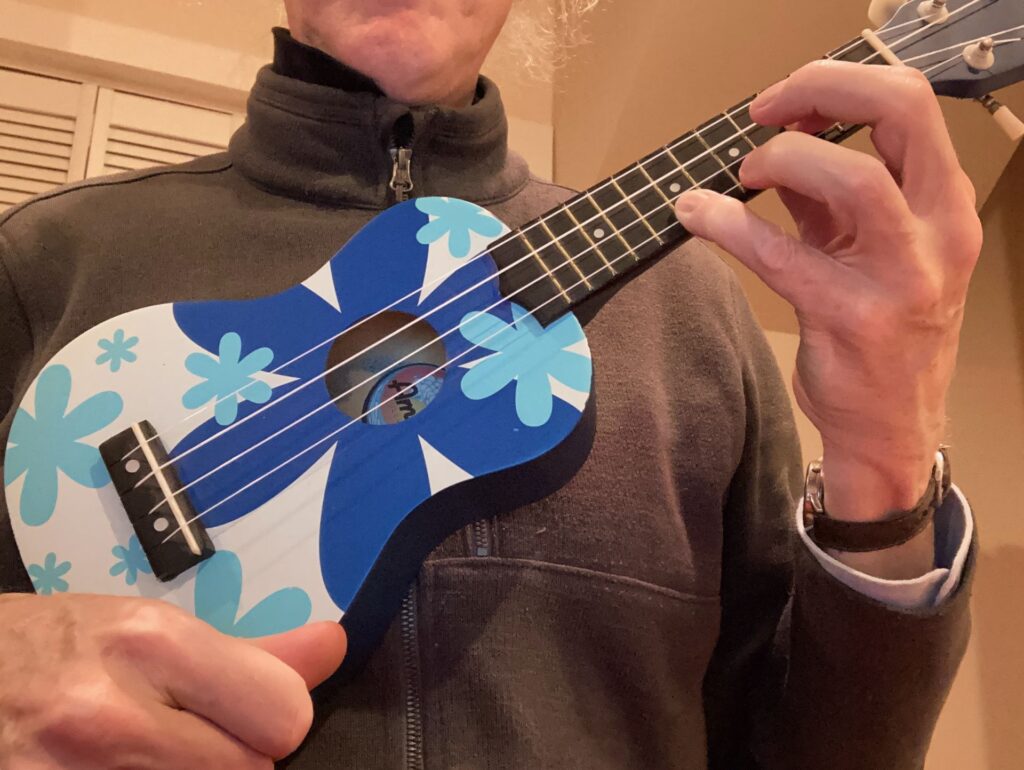
Even if I can’t play it very well, a uke makes me feel better. Especially if it’s Carol’s uke, the one with blue flowers painted on it.

Me holding a ukulele with blue flowers painted on it.
Carol’s uke

In person or online….

Three years ago at this time, I was planning to attend General Assembly, the annual gathering of Unitarian Universalists. I was finally getting recovering from a major health issue, and ready to travel again. Then, of course, the pandemic hit.

Well, we’re slowly learning to live with the ongoing pandemic. I live close enough to Pittsburgh, the location for this year’s General Assembly, that I could drive there. The question is — by the time General Assembly rolls around, am I going to be psychologically ready to attend a gathering with more than a thousand people?

I’m not ready to make a decision. Maybe I’ll watch online (I’ve come to quite like online attendance at conferences). Maybe I’ll attend in person (if I drove to Pittsburgh I could stop and see cousins Steve and Cheryl, and friends Paul and Gina on the way). Maybe I’ll set up a local conference-watch party, to combine a smaller in-person gathering with General Assembly programming. I hate to admit this, but I’ve been feeling fairly disconnected from denominational politics so I might just ignore General Assembly.

I wonder what other people are thinking about this year’s General Assembly….

An expert look back at the pandemic

STAT News takes a look at what most surprised experts about the COVID pandemic. STAT senior writer Helen Branswell’s article is well worth reading.

The point that I found most interesting: “How long the damn thing has lasted.” Branswell reports:

“[In the past,] the pandemics that have been recorded have mainly been caused by flu. And in the recorded flu pandemics, there was generally a wave or two — sometimes, in some places three — and then humans and the new virus reached a detente. The new flu virus settled into causing seasonal flu activity, not pandemic flu.

“A lot of people STAT spoke to thought that was the way this pandemic would play out. They didn’t anticipate that we’d be where we are now, with waves of transmission still occurring at various points in the year, rather than during the winter, as is the way of most respiratory pathogens.

“‘I never would have imagined that three years later we would still be dealing with this in the way that it’s ever-present in our conversations and in our society,’ said Messonnier, the former CDC official….”

As a layperson, I never dreamed that after three years, we’d still be dealing with high levels of virus transmission, and serious health consequences. I’m glad to know that the experts are equally flummoxed.

And the second most interesting point, from my point of view: “The ripple effect.” Branswell summarizes what one expert said:

“…Hatchett, for all his studying of previous pandemics, wasn’t anticipating the geopolitical impacts of this one. He likens it to a meteor strike. [emphasis added]

“In addition to the crushing waves of illness, the lives lost, the swamping of hospitals, and the disruption to routine health care, he points to the economic disruption of the past couple of years, the onset of inflation, the spike in energy prices, and the upheaval in supply chains as all being of a piece….”

Another ripple effect not mentioned in the article, but which I see every day: the COVID pandemic has changed the shape of religion in the U.S. permanently. The pandemic accelerated the ongoing trend of disaffiliation from religious organizations. The pandemic is finishing off a fair number of congregations already weakened by the Great Recession in 2008. The pandemic deepened the divide between the conservative Christians who were vaccine deniers, and everyone else who was religious (and who had to explain that yes they were religious, but they were vaccinated). The pandemic advanced livestreaming acceptance incredibly rapidly. The pandemic is causing quite a few religious professionals to seek other lines of work….

The list goes on. Yes, it was like a meteor strike. Organized religion in the U.S. will never be the same.