Ferguson, six months on

Six months ago today, Michael Brown was shot and killed by a police officer in Ferguson, Missouri. I did not then, and do not now, find this shooting to be astonishing. Brown’s killing was preceded by other, similar, well-publicized events. Most notably, in 2009, Oscar Grant, another young black man, was shot and killed by a police officer. And in 2012, Trayvon Martin was shot and killed by by a neighborhood watch coordinator. And on August 5, 2014, John Crawford III was shot and killed by police officers in a Walmart store. In the bare fact of Brown’s killing, there wasn’t much to astonish.

This kind of violence has been going on for a long time. W.E.B. DuBois, in his book Black Reconstruction in America, 1860-1880, wrote about the “widespread violence in the South, the murder and mobs,” that occurred during Reconstruction:

“Probably in no country in the civilized world did human life become so cheap. This condition prevails among both white and black and characterizes the South even to our day. A spirit of lawlessness became widespread. White people became a law unto themselves, and black men, so far as their aggressions were confined to their own people, need not fear the intervention of white police. Practically all men went armed and the South reached the extraordinary distinction of being the only modern civilized country where human beings were publicly burned alive.” [p. 700]

The violence described by W.E.B. DuBois no longer exists in quite that form, but it counts as its direct lineal descendant the violence that killed Oscar Grant, Michael Brown, and many others. While such violence might surprise us, it has lost its power to astonish.

But there were things about Brown’s killing that did astonish me. The initial response of police and elected officials to the protests which followed Browns’ killing was astonishingly tone-deaf — it was almost as if police and elected officials were trying to say things that would inflame tensions. The grand jury investigation was similarly tone-deaf — I sometimes felt was as if the district attorney’s office did everything they could to erode my trust.

Further, I was astonished how many non-black people actually paid attention to Michael Brown’s killing. Whether they reviled him for stealing cigarillos, or lauded him for being a hero, it seemed to me that more non-black people noticed Brown’s death than noticed the death of, say, Oscar Grant or John Crawford. White people in particular seemed to pay close attention. What drew the attention of so many of us white people? Was it the militarized police response to the protests in Ferguson that drew white people’s attention? — with some whites fearing that such militarized tactics could well be used on them, and other whites feeling safer because the police had so much military gear with which to quash protests? I don’t know. I only wish more white people could express a more nuanced view of Michael Brown, making him out to be neither a one-dimensional saint, nor a one-dimensional sinner, but rather a complex human being living in a difficult and complex world.

And I admit I was sometimes astonished by the way some whites responded to Brown’s killing. I remember seeing a video of one of the Ferguson protests where someone who appeared to be white harangued a black police officer, telling the officer that he should get rid of his uniform and join the protesters. This seemed to be another response lacking awareness of the nuances and complexity of the issue at hand.

But it is not easy for us white people to talk about race so openly. White people rarely talk about race with other white people. I can tell you this from experience:— if you’re a white person and you want to end a conversation with another white person, bring up the topic of race: as often as not, the other white person will find an excuse to end the conversation; sometimes they just walk away from you, which can feel a little strange.

If the Ferguson protests do prompt conversations about race among us white people, I will consider that a positive result. Here is W.E.B. DuBois again, from the same book, a few pragraphs after the quotation given above: “The theory of race was supplemented by a carefully planned and slowly evolved method, which drove such a wedge between the white and black workers that there probably are not today in the world two groups of workers with practically identical interests who hate and fear each other so deeply and persistently and who are kept so far apart that neither sees anything of common interest.” If the Ferguson protests provoke a wide conversation about the importance of black lives, that would be an even better result.

Those wedges DuBois talks about are driven between other racial groups in the United States as well. Somehow we have to extract those wedges that have been driven between all the races in the United States.
Snowstorm

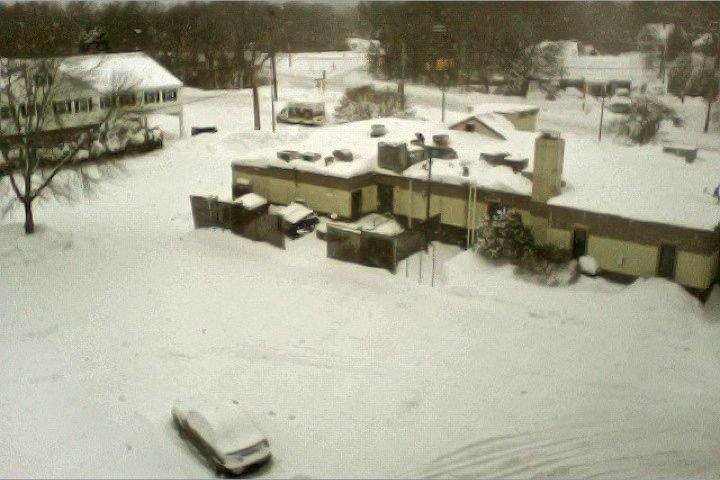
I’m in Massachusetts visiting my dad. It’s snowing. And snowing. And snowing. It’s been snowing for two days now. They had something like three feet of snow when I got here, and it looks like this storm is going to dump another foot or foot and a half of snow. Here’s the view from my motel window:

BlogFeb0915

That road behind the buildings? That’s the interchange of Route 110 and Interstate 495. At this time of day, you’d expect lots of cars. But everything is closed due to snow, so as you can see there is hardly any traffic out there. And the parking lot for the restaurant next door is basically empty.

I just wish they could send some of this snow to the Sierra Nevada mountains in California, where it is desperately needed.

No one sings in church any more

On the Sacred Harp Friends page on Facebook, Katie posted a link to a blog post by Thom Schulz, titled “Why They Don’t Sing on Sunday Anymore.” Schulz’s reasons why people don’t sing in church: too often services are spectator events; church music is dominated by professionals, to the point of squeezing us amateurs out; sometimes the volume gets cranked up so high people just stop singing; the hymns are unfamiliar or hard to sing.

Katie then noted that Sacred Harp singers do sing, and we sing fervently — because there are no spectators, there are no professionals, it’s loud but not deafening, and Sacred harp singers have been singing pretty much the same tunes for a century and a half.

Actually, in my church people do sing. Amy, the senior minister, and I made a pact some years ago that the first hymn would mostly get chosen from a pool of ten or so hymns; that way, the kids can memorize ten or so hymns and know them by heart. And indeed the kids (and the adults) do memorize those hymns, and they do sing with fervor and gusto. In one recent service, I watched as one of our more cynical upper elementary kids stood on a chair, hung on to dad, and sang with utter abandon; cynicism gone, this child was completely lost in the hymn.

Given my experience, I’m with Thom Schulz: congregational singing does not need spectators, over-professionalism, blare, or crappy songs. Congregational singing can aim towards joy, towards ecstatic union with the universe through song. Congregational singing can be — should be — cynical kids belting out a favorite hymn at the tops of their voices, completely lost in the moment.

BlogJan2815

Concrete block rocket stove

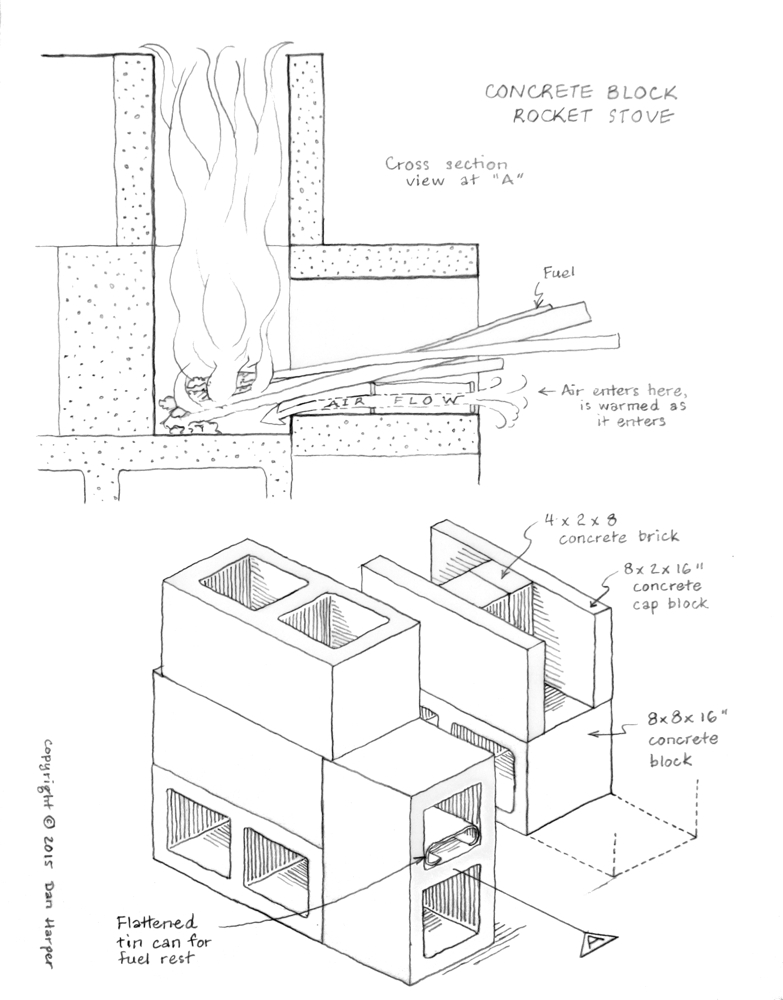
This past Sunday, the middle school ecojustice Sunday school class cooked on rocket stoves. We based our stoves on design principles developed by Dr. Larry Winiarski, who is affiliated with the Aprovecho Research Center. A rocket stove makes more efficient use of biomass fuels (wood, twigs) through more complete combustion; this also results in fewer harmful emissions. According to the Aprovecho Research Center:

“Improved cooking stoves address at least 5 of the 8 United Nations’ Millennium Development Goals: [1] ending poverty and hunger; [2] gender equity; [3] child health; [4] maternal health; and [5] environmental sustainability.”

So while we don’t really need rocket stoves here in the Bay area (except perhaps in disaster situations), learning about and building them is a great introduction to using appropriate technology to meet ecojustice goals of human well being and environmental sustainability.

If you’re not familiar with rocket stove design principles,Aprovecho Research Center has an excellent introduction on this Web page. Scroll down and click on document no. 8, “Design Principles for Wood Burning Cook Stoves,” June, 2005.

Enough background. Here are instructions for building a concrete block rocket stove, followed by photos of our rocket stove in action:

BlogJan2715a

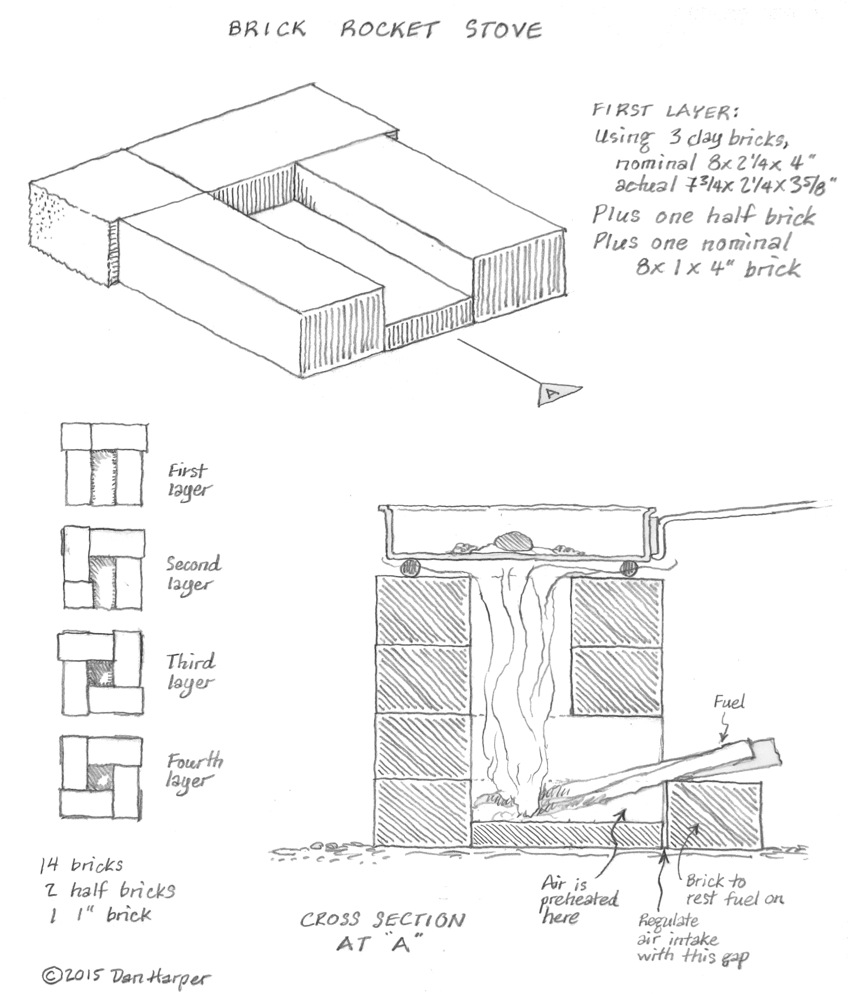
Click the image above for a drawing of how to build our concrete block rocket stove. You will find other plans for a concrete block rocket stove on the Web, but those plans typically require a concrete h-block, an oddball type of block that we were unable to find. However, most bit home improvement stores carry 8 x 2 x 16 inch concrete cap blocks, and 4 x 2 x 8 inch concrete brick — two cap blocks and two concrete brick can be arranged in an “H” shape to make a stove. In fact, this is a better solution than a concrete H-block, because you can adjust the concrete brick such that you have a constant cross-sectional area throughout the L-shaped combustion chamber (see “Design Principles for Wood Burning Cook Stoves,” principle 7).

BlogJan2715c

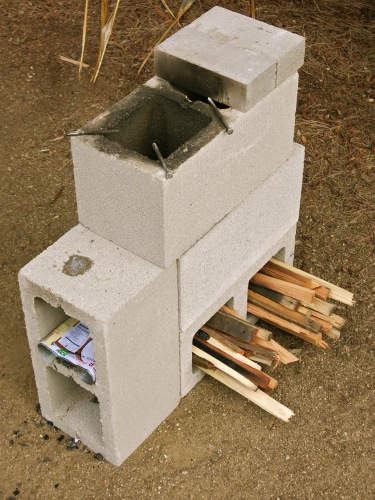
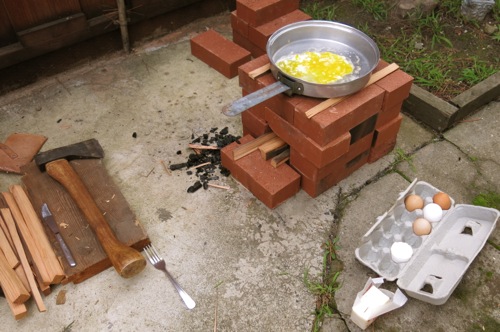
Above: The concrete block rocket stove after use. We placed two concrete bricks on the top on which to place cooking implements, etc. The bottom concrete block serves as a convenient place to store fire wood. Notice that our firewood is all salvaged building materials and wood pallets, split to appropriate size for burning.

BlogJan2715b

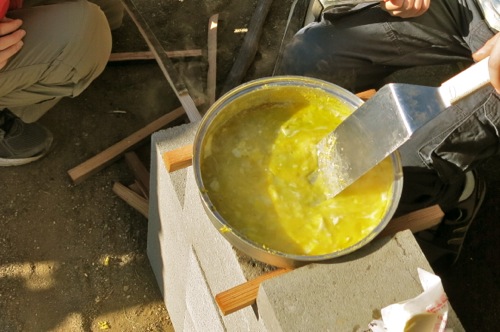
Above: Cooking on the stove. “Design Principles for Wood Burning Cook Stoves” states that a combustion chamber with a 12 x 12 cm cross sectional area is “usually sufficient for a family sized cooking stove.” Our concrete block rocket stove has a cross sectional area of 12.5 x 15 cm. It put out a good amount of heat for cooking scrambled eggs for half a dozen people. Note that one person is feeding the fuel into the stove, while the other cooks — we found it was challenging to cook and tend the fire at the same time.

We did not try to boil water on our concrete block rocket stove, to see how long that would take. Maybe that’s a task for a future class.

Update, one year on: This has proved to be a good, but not excellent, rocket stove design. The chief problem with this design is that the concrete block acts as a fairly large thermal mass, and it takes a while to heat the block. Once the block is warm, the stove functions pretty efficiently; while the block is still cook, it’s not as good. Another problem is that the stove is finicky, and requires constant attention to feeding fuel in order to maintain a fairly constant temperature. Nevertheless, given the low cost of materials, and the ease of construction, this remains a practical design.

Mammal signs

Yesterday, Carol noticed some scat and other mammal signs in our garden. First, something has been eating the tree kale Carol has been growing. The bitten-off leaves and stems are some 425 mm / 17 inches from the ground:

BlogJan2315b

This seems a little high off the ground for rabbits. According Jameson and Peeters Mammals of California, the rabbit most likely to be found in our area is Audubon’s Cottontail (Sylvilagus audubonii). The total length, from nose to tail, of Audubon’s Cottontail is 370-400 mm, or about 15 inches; it would be a stretch (but possible) for a rabbit that size to reach up 425 mm to nibble on stems and leaves.

Right next to the tree kale is a deposit of scat: many small pellets, all about 5-7 mm in diameter. This, according to Olas Murie in A Field Guide to Animal Tracks would be absolutely typical of cottontails. But it may be coincidence that there’s a deposit of cottontail scat right next to the bitten-off twigs, and it could be that a deer got into our yard; Carol has seen deer down the cul-de-sac on which we live, and we suspect that they move up and down San Mateo Creek, which is less than a block from our house.

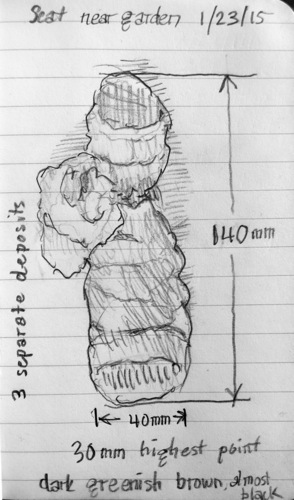
There’s another scat right next to another of our garden beds. Here’s my sketch of it:

BlogJan2315a

The lack of taper on the ends, and the relatively large size, leads me to believe that these are raccoon scat. Murie says that raccoon scat can be difficult to identify, and “may be confused with the larger skunks and opossum.” But given the size — on the large size for raccoons, probably too big for skunks or opossums — and the fact that we regularly see raccoons at night in our garden, I’m going to guess this is from a raccoon.

Sacred Harp Convention

Once every three years, the All-California Sacred Harp Convention comes to the Bay area. It’s going on this weekend.

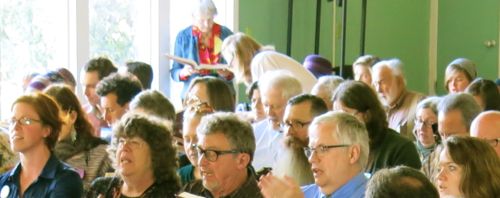
What is Sacred Harp, you ask? It has nothing to do with harps, but you sing from a book called The Sacred Harp. At a Sacred Harp convention, you sing for three hours in four-part harmony at the top of your lungs along with 150 other singers who range in age from 8 to 80-something. Then you break for this fabulous potluck lunch, where you eat more good food than you can believe. Then you go back sing again for another three hours in the afternoon. Then you go back the next day and do it all over again.

16 brick rocket stove

In our middle school ecojustice class, one of the things we’re doing is experimenting with alternative low-cost, low-impact cooking methods, such as a solar oven made out of cardboard. Now we’re experimenting with rocket stoves, designed originally by Dr. Larry Winiarski and colleagues at the Aprovecho Research Center. Rocket stoves use biomass to cook, but are much more efficient than traditional cooking fires, and because they’re more efficient produce fewer pollutants such as smoke and harmful gasses. Not really something we need in the first world, except in disaster situations, but a huge advance for the developing world.

Last week in class, we put together a simple brick rocket stove but couldn’t get it to light. So I spent some time this week building and using a simple rocket stove made of 16 bricks. This stove is based on Larry Winiarski’s 16 brick stove, but instead of using adobe bricks I used clay bricks commonly available at masonry supply houses and building supply centers. Specifically, I used nominal fifteen 8 x 2-1/4 x 4 inch clay bricks, and one 8 x 1 x 4 inch clay brick, as shown in the sketch below:

RocketStoveSketch1a

For fuel, I split an 18 inch long 2 x 10 into finger-sized pieces. To light the stove, I balled up a piece of paper and dropped it down the center hole, dropped some shavings, small scraps of wood, and slightly larger scraps of wood on top, then dropped a lighted match in. When the fire was burning well, I began feeding 3 to 4 pieces of fuel in from the bottom, adjusting the air intake gap as needed to get a hot flame.

The rocket stove needs you to pay attention to it. The fuel burns pretty quickly, and you have to keep pushing it into the combustion chamber, adding new fuel as needed. Once the fire was going strong — which took seven or eight minutes — I got ready to cook.

BlogJan1515

Continue reading “16 brick rocket stove”

Medusa

I’m writing lesson plans and teacher resources for a curriculum for upper elementary grades on Greek myths. The core material in the curriculum was developed with Tessa Swartz, a middle school student who had taken classes with me where I piloted some of the preliminary material. Tessa proved to be a valuable collaborator, especially given her sensitivity to the essentially alien nature of Greek myths, and her willingness to go beyond the common trite interpretations of many of these myths. As we developed the core material of the curriculum, both of us got interested in the figure of Medusa. Here’s an excerpt from this new curriculum, a teacher resource on Medusa:

Medusa as imagined by the artist CarvaggioWhen we chose stories for this course, both of us placed the Medusa story at the top of our lists. What makes Medusa such a fascinating figure? The face of Medusa contains great power: the power to freeze others into stone. On the other hand, we considered Medusa’s killer, Perseus, to be little better than a bully, a strong-arm man who coerces others into doing what he wants through violence or the threat of violence. So the story of Medusa can lead to interesting explorations of power, and the use of power.

Let’s look at Medusa first: Continue reading “Medusa”

Kurt Kuhwald’s thoughts on Starr King

Recently, I talked with Kurt Kuhwald, former professor at Starr King School for the Ministry, about the school’s search process for a new president. Kurt had some interesting things to say about the search, and the conflict that erupted during and after the search.

Before I get to Kurt’s thoughts, you may want to review what happened at Starr King. I have a short post about the situation here. Since I wrote that post, the New York Times covered the story in a balanced and well-written article here, and UU World did a carefully-written article in November which you can read here. Now back to Kurt.

Kurt is someone for whom I have great respect, particularly in his thoughtful and passionate approach to ethical issues, and to issues of prophetic importance. I was lucky enough to have lunch with Kurt a couple of weeks ago, and we talked about several prophetic issues: global climate change; the protests following Ferguson; and the mess at Starr King. We wound up spending most of our time talking about Starr King, not because it is of greater importance than Ferguson or global climate justice, but because it was so fresh in the minds of both of us. Actually, mostly I listened — Kurt has a unique and powerful interpretation of the Starr King situation, and I wanted to hear what he said.

Kurt has been kind enough to send me several documents that he is willing to make public, and with his permission, I am posting them here on my blog. You can click on one of the links below to go to a specific letter, or just scroll down to read these four documents in order:

Kurt’s letter of resignation from Starr King;
An addendum to that letter giving more detail on his reasons for resigning;
A letter to the Ad Hoc Committee set up by Starr King to investigate the situation;
A letter to the members of the UUA Board regarding Starr King.

As I talked with Kurt, it struck me that there was a deep current of theology running through everything Kurt said. He is talking about a theology of power; he is critiquing one way power is wielded in contemporary religious institutions. This is an incredibly important critque. I believe it would behoove anyone with an interest in the mess at Starr King to read or re-read Bernard Loomer’s important 1976 essay “Two Conceptions of Power.” Finally, out of respect for Kurt’s deep theological insights, I’m going to say that if you’d like to comment here you should exhibit some theological thinking. If you’re not sure how to think theologically about this issue, read Loomer’s essay.

As always, I reserve the right to delete or edit comments that I feel are discourteous, rude, or off-topic.

Scroll down to start reading Kurt’s letters….

Update, 14 January 2015: Kurt Kuhwald asked me if I’d be willing to post Dorsey Blake’s letter of resignation from Starr King; until January 9, he was Associate Professor of Spirituality and Prophetic Justice. Since Kurt Kuhwald and Dorsey Blake timed their resignations for the same day, and since they share a prophetic vision for liberal religion, I felt it was appropriate to add that letter to this blog post. Having received Dorsey Blake’s permission, I have added his letter below:
Dorsey Blake’s letter of resignation

Continue reading “Kurt Kuhwald’s thoughts on Starr King”

Ants

Recently, I stumbled across the AntWeb site, sponsored by the California Academy of Sciences. Once you create a login (and all you have to provide is a username and password, no other info), you have access to tons of photographs of ant specimens, taken through a powerful microscope. Of particular interest to me is the online field guide to California ants, with photos of nearly all of the 270 resident species. The curator of the California pages writes:

“Prominent California ants include seed-harvesting species in the genera Messor, Pheidole and Pogonomyrmex; honeypot ants in the genus Myrmecocystus; a diverse array of species in the genera Camponotus (“carpenter ants”) and Formica; native fire ants (Solenopsis spp.); velvety tree ants (Liometopum spp.); and the introduced Argentine ant (Linepithema humile). This last named species is particularly common in urban and suburban parts of California, where it establishes dense populations and eliminates most native species of ants.”

I’ve always thoughts ants were interesting creatures. Now having looked through dozens of photos of ants I will go further and say that they are beautiful creatures. Even the Argentine ant appears beautiful, in spite of the destruction it does to native arthropods.

I am also fascinated by the written descriptions; these descriptions have their own kind of beauty, which may be found in their economy and laconic precision. Here, for example, is how to identify the Argentine ant — remembering that you will need a powerful binocular microscope to see all these details:

Diagnosis among workers of introduced and commonly intercepted ants in the United States. Antenna 12-segmented. Antennal scape length less than 1.5x head length. Eyes medium to large (greater than 5 facets); do not break outline of head; placed distinctly below midline of face. Antennal sockets and posterior clypeal margin separated by a distance less than the minimum width of antennal scape. Anterior clypeal margin variously produced, but never with one median and two lateral rounded projections. Mandible lacking distinct basal angle. Profile of mesosomal dorsum with two distinct convexities. Dorsum of mesosoma lacking a deep and broad concavity; lacking erect hairs. Promesonotum separated from propodeum by metanotal groove. Propodeum with dorsal surface not distinctly shorter than posterior face; angular, with flat to weakly convex dorsal and posterior faces. Propodeum and petiolar node both lacking a pair of short teeth. Mesopleura and metapleural bulla covered with dense pubescence. Propodeal spiracle bordering posterior margin of propodeal profile. Waist 1-segmented. Petiole upright and not appearing flattened. Gaster armed with ventral slit. Erect hairs lacking from cephalic dorsum (above eye level), pronotum, and gastral tergites 1 and 2. Dull, not shining, and color uniformly light to dark brown. Measurements: head length (HL) 0.56–0.93 mm, head width (HW) 0.53–0.71 mm.”