Ants

Recently, I stumbled across the AntWeb site, sponsored by the California Academy of Sciences. Once you create a login (and all you have to provide is a username and password, no other info), you have access to tons of photographs of ant specimens, taken through a powerful microscope. Of particular interest to me is the online field guide to California ants, with photos of nearly all of the 270 resident species. The curator of the California pages writes:

“Prominent California ants include seed-harvesting species in the genera Messor, Pheidole and Pogonomyrmex; honeypot ants in the genus Myrmecocystus; a diverse array of species in the genera Camponotus (“carpenter ants”) and Formica; native fire ants (Solenopsis spp.); velvety tree ants (Liometopum spp.); and the introduced Argentine ant (Linepithema humile). This last named species is particularly common in urban and suburban parts of California, where it establishes dense populations and eliminates most native species of ants.”

I’ve always thoughts ants were interesting creatures. Now having looked through dozens of photos of ants I will go further and say that they are beautiful creatures. Even the Argentine ant appears beautiful, in spite of the destruction it does to native arthropods.

I am also fascinated by the written descriptions; these descriptions have their own kind of beauty, which may be found in their economy and laconic precision. Here, for example, is how to identify the Argentine ant — remembering that you will need a powerful binocular microscope to see all these details:

Diagnosis among workers of introduced and commonly intercepted ants in the United States. Antenna 12-segmented. Antennal scape length less than 1.5x head length. Eyes medium to large (greater than 5 facets); do not break outline of head; placed distinctly below midline of face. Antennal sockets and posterior clypeal margin separated by a distance less than the minimum width of antennal scape. Anterior clypeal margin variously produced, but never with one median and two lateral rounded projections. Mandible lacking distinct basal angle. Profile of mesosomal dorsum with two distinct convexities. Dorsum of mesosoma lacking a deep and broad concavity; lacking erect hairs. Promesonotum separated from propodeum by metanotal groove. Propodeum with dorsal surface not distinctly shorter than posterior face; angular, with flat to weakly convex dorsal and posterior faces. Propodeum and petiolar node both lacking a pair of short teeth. Mesopleura and metapleural bulla covered with dense pubescence. Propodeal spiracle bordering posterior margin of propodeal profile. Waist 1-segmented. Petiole upright and not appearing flattened. Gaster armed with ventral slit. Erect hairs lacking from cephalic dorsum (above eye level), pronotum, and gastral tergites 1 and 2. Dull, not shining, and color uniformly light to dark brown. Measurements: head length (HL) 0.56–0.93 mm, head width (HW) 0.53–0.71 mm.”
Time, like the tide, sweeps over the new year

The following poem appears in A Collection of Hymns on the Most Important Subjects of the Gospel, edited by Thomas Humphrys (Bristol, England: Biggs & Cottle, 1798), pp. 14-15, as a meditation on the new year:

My days, my weeks, my months, my years,
Fly rapid like the whirling spheres
Around the steady pole;
Time, like the tide, its motion keeps,
Till I shall launch those boundless deeps
Where endless ages roll.

The grave is near the cradle seen,
How swift the moments pass between
And whisper as they fly;
“Unthinking man remember this,
“Thou midst thy sublunary bliss
“Most groan, and gasp, and die.”

Eternal bliss, eternal woe,
Hangs on this inch of time below,
On this precarious breath:
The God of nature only knows,
Whether another year shall close,
Ere I expire in death.

Long ere the sun shall run its round,
I may be buried under ground,
And there in silence rot;
Alas! one hour may close the scene,
And ere twelve months shall roll between,
My name be quite forgot….

These late-eighteenth century sentiments probably soundm foreign to most early-twenty-first century American minds. Contemporary American culture insists we be optimistic about the future, so this poem may strike you as morbid. Certainly I do not agree with the theology of the poem, which the poet goes on to wonder whether he or she will go to heaven or hell after death, and in the concluding verse prays: “Help me to choose that better way” that will lead to heaven.

Yet though I do not agree with the theology, it’s not a bad idea to remember that death is just around the corner. We needn’t think obsessively about death and dying, but it can be freeing to realize that many small things that loom large in daily life are not that important. What is important is striving to be the best person possible, which in turn should help us realize that self-reflection and self-knowledge take priority over striving to buy consumer goods or striving to get a promotion at work or striving to get your children into Ivy League schools. In this realization lies freedom.

I don’t know who wrote the poem originally. Humphrys does not attribute this poem to a specific author. Another version of this poem was printed in The Poetical Monitor: consisting of pieces select and original for the improvement of the young in virtue and piety: intended to succeed Dr. Watts’ Divine and moral songs, etc., edited by Elizabeth Hill (London: Shakespear’s-Walk Female Charity School, 1796), pp. 64-65. The poem appears under the tile “On the Eve of the New Year,” and Hill lists the author as “Green.” Perhaps an astute reader can track down the author. Continue reading “Time, like the tide, sweeps over the new year”

Caroling

Jenni suggested the Ferry Building in San Francisco, so that’s where Ray, Tara, and I met her a little after three this afternoon. Both our tenors were ill, but we figured no one would notice that both Ray and I were singing bass. We started out just inside the main entrance, but between the traffic along Embarcadero and the crowds in the building, it was too noisy. So we went down to the south entrance, and set up there. “What should we start with?” “Deck the Hall, page 11.” Jenni counted us in, and we began to sing.

Once we got in the groove of singing, I could relax a little and look at the people who were listening to us. Everyone was smiling. Except two small children, who stood listenly raptly, their mouths slightly open. We decided to take a break, and the woman who was with the two children thanked us. “My kids are just enthralled,” she said. “Oh, then we’ll sing something else for you,” said Jenni. The kids wanted to hear “Frosty the Snowman,” but we didn’t have the music for it, so we settled on “Jingle Bells.”

Later we sang at the north end of the Ferry Building, and people had the same reactions: the adults all smiled, and the children just stood and listened. We all hear a lot of Christmas music in December — the endless Christmas carols played as background music in stores, the songs you hear on the radio — but it’s much better when you hear live music, even when it’s performed by people who are not professional musicians. Live music is not neatly packaged by corporate bean counters; it is not controlled by the touch of your finger on a touch screen; it is not performed in some acoustically perfect recording studio somewhere. Unlike recorded music, it is imperfect and alive and a little bit wild.

We sang until we got tired. We sang several of the carols several times over, but they never got boring, because people were smiling, and one little girl started dancing. Finally we had to stop singing. We were all smiling, too.

Storm

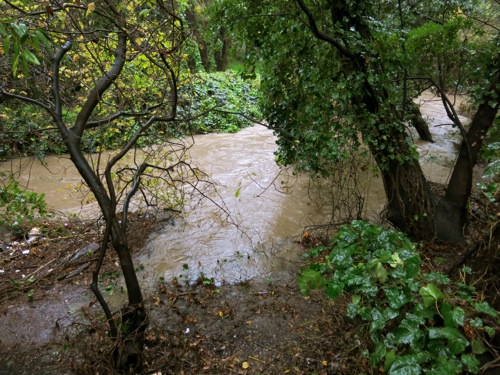
The middle school ecojustice Sunday school class got approval from the Board for installing a rain barrel at church. Last night, Buzz and I rushed to put a downspout from one of the roof drains into the rain barrel, in anticipation of today’s storm. It looks like our rushing was worth it: we’ve had over two and a half inches of rain since then.

I just took a little walk around our neighborhood. San Mateo Creek was filled with rushing brown water, but the water level is still ten to fifteen feet below the tops of the banks. The ground is pretty well saturated, and I could see puddles everywhere. But the storm drains are still working and the streets aren’t flooded around here. And I can see jetliners flying through the low clouds towards the airport, so it looks like SFO is open.

BlogDec1114

Above: San Mateo Creek at about 3:45 today, from the Delaware St. bridge. Those trees on the right are usually well out of the water.

But according the Twitter, other places around the Bay area are experiencing flooding. For example, Highway 101 south of San Francisco is flooded in places, and traffic is just a mess. I feel lucky that I was scheduled to work at home today.

How I read

Mr. Elphinston talked of a new book that was much admired, and asked Dr. Johnson if he had read it. JOHNSON. ‘I have looked into it.’ ‘What, (said Elphinston,) have you not read it through? Johnson, offended at being so pressed, and so obliged to own his cursory mode of reading, answered tartly, ‘No, Sir, do you read books through?’

James Boswell, Life of Johnson, April 19, 1773 (in my 1924 Oxford University Press edition, vol. 1, p. 493)

Outdoors

The errands and chores took up most of the day, and everything took more time than usual due to the traffic which got increasingly worse as the day went on, as the winter storm warnings for Wednesday grew more dire. Get your Thanksgiving shopping done today! shouted the news media. Begin your Thanksgiving travels now! But in spite of all the traffic, and in spite of the errands and chores I had to do, I did manage to get outdoors.

I got up early and drove to White Pond. I walked to the pond over the bluff on the southeastern shore, and as the pond came into view, the white sand banks stood out through the November gloom, and I was struck by how appropriate its name is. The rainbow trout were rising well within casting distance of the shore, little dimples of water appearing her and there as a fish sucked a fly underwater. But the trout didn’t like anything I cast; there was a hatch of flies going on, and I suspect they were completely absorbed by that; had I been fly fishing, perhaps I could have presented something they would have struck at.

A woman came walking down the shore, and we started chatting. “I haven’t fished here in a dozen years,” I said, “and the houses seem to keep getting bigger.” The houses on the pond started out as modest summer cottages, but now many have them have transmogrified into McMansions. “Oh, it’s terrible,” she said, “they keep expanding them. Some of them are huge now. Three, four floors.” I didn’t say it out loud, but I thought: this is what growing wealth inequality is doing to Concord, Massachusetts: changing it into an enclave of the elite. That thought dampened my mood, so I started fishing again.

After three quarters of an hour, the rainbows stopped rising, and I went off to start my errands. Sadly, I had to spend most of the rest of the day either in the car, or indoors.

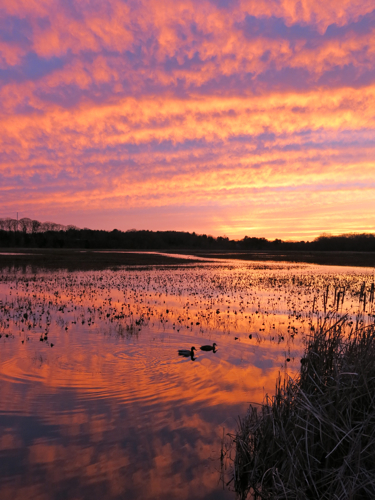
But as the day turned towards dusk, I found I had just enough time to go to Great Meadows National Wildlife Refuge and see what birds were there. I arrived too late to see the immature Bald Eagle that has been there for the last couple of days, but I arrived just in time for one of the most spectacular sunsets I have seen in months.

BlogNov2514

Above: Two Mallards swimming in the upper pool at Great Meadows, Concord, Mass.

The radiant life

Last week, Dad spent quite a bit of time talking with my sisters and me about World War II. I think it is very difficult for us now to understand how traumatic those war years were, and to understand how the war and trauma affected those who lived through it; they were dark years indeed.

When Dad was at college right after World War II, he took a philosophy course with Rufus Jones, the great Quaker philosopher and theologian. He still has several books by Jone on his bookshelf, and while I was looking for something to read this morning, I pulled out Jones’s The Radiant Life, published in 1944, in the middle of the war. The book represents Jones’s search for “gleams of radiance” which might be found “in spite of the darkness of the time.”

Like his contemporaries, the Unitarian theologian James Luther Adams and Reinhold Niebuhr, both of whom were also profoundly affected by the war and by the evils perpetrated by Nazi Germany, Jones felt he could no longer cling to the sunny optimism of the Progressives, nor to the even sunnier optimism of Emerson. Where, then, should we turn to find gleams of light? James Luther Adams turned towards the social structure of voluntary associations: finding light in building robust communities that could move us towards the good. Reinhold Niebuhr turned towards pragmatism and Christian realism: accepting that in a corrupt world we may not find all the light we need (this, I believe, is the origin of Neibuhr’s famous “Serenity Prayer).

Jones, Quaker that he was, found a different answer to the traumas of the mid-twentieth century Western world: he encouraged us to accept the reality around us but also to look for the light that was always there. He wrote:

“The Kennebago Mountains are visible in the far horizon of my home in Maine, but they come into sight only when the wind is north-west and has blown the sky clear of fog and mist and cloud. Then there they are, in all their distant purple glory. But we know that they are there all the time, when the wind is east or south, though we cannot see them, and we say to our visitors, wait until the wind comes round and blows from Saskatchewan, and then you will see our mountains which are over there in our far sky-line! Some persons’ lights up like that only when the wind is in the right quarter. I am pleading for a type of life that is sunlit and radiant, not only in fair weather and when the going is smooth, but from a deep inward principle and discovery which makes it lovely and beautiful in all weathers.”

I think I like Jones’s approach better than either Adams or Neibuhr — not that I think that any one of them has the final and complete truth of the matter, nor the final answer to the traumas of life; no single human being can ever know the complete truth of anything. But to know that the mountains are always there, even when you can’t see them because they are obscured — that is worth remembering. I can see why my father liked Jones so much, and continues to like him. Adams focuses on human relations, which I admire, but I sometimes wish Adams let in a little more of Emerson’s sunshine. However, Emerson is too sunny, except in his poetry, and sometimes I can’t quite believe him. Niebuhr is too dark, and I don’t want to believe him.

How do we get through the traumas of contemporary life? How do we get through the horrors of war and terror? How can we face the damage humans are doing to the rest of creation? How can we make it through the struggles of human life, of grief and death and all the rest? I like Rufus Jones’s answer: remember that the mountains are always there even when you can’t see them. Or, to put it another way, look for the gleams of light which always may be found even in the darkest of times.