In the final installment of this series, Possum feels better — as does Mr. Bear.

As usual, full script is below.
Continue reading “Possum still feels stressed, conclusion”Yet Another Unitarian Universalist
A postmodern heretic's spiritual journey.

In the final installment of this series, Possum feels better — as does Mr. Bear.
As usual, full script is below.
Continue reading “Possum still feels stressed, conclusion”Sharpie gives Possum some new ideas about a spiritual practice, so Possum won’t feel bored.

Full script below the fold….
Continue reading “Possum still feels stressed, part two”A few months ago, Dr. Sharpie showed Possum some spiritual practices that might make him feel less stressed. Possum says those spiritual practices don’t work any more for him, but Sharpie has an idea….

The full text of the video is below the fold.
Continue reading “Possum still feels stressed, part one”We find out what happened to Akhenaten….

As usual, full text is below the fold.
Continue reading “Akhenaten, part three”In one of the “lightning talks” in today’s session of the Religious Education Association annual meeting, Dr. Eileen Daily of Boston University’s School of Theology posed some questions about how the pandemic is going to change religious education. One of the questions she asked is whether this is an opportunity to reach out to the “nones,” those who are not affiliated with organized religion (remembering that many of the “nones” are “spiritual but not religious”).
A few hours later, I was in a small group conversation with some scholars and practitioners, and we wound up talking about online learning — not surprising given that the pandemic has driven both the academics and those of us working in congregations to doing all our teaching using distance education techniques. I posed the idea that a nonprofit structured like Khan Academy, but devoted to religious education, could be a worthwhile project. Then the conversation moved on….
But I’ve been thinking about that idea since then. What if there were a Khan Academy for online religious education? I could envision three main curricular areas such an entity could address: (1) religious literacy, including resources to introduce young people to the wide variety of religious expression in their community and in the wider world; (2) skills associated with the practice of organized religion including leadership in nonprofit membership organizations (voluntary associations), social justice organizing, group singing, etc.; and (3) building community including building both interpersonal skills (social skills) and intrapersonal skills (self awareness).
I’m leaving out a fourth major curricular area: the kind of “faith formation” that is instruction on how to participate within a specific religious or denominational tradition. Should a nonprofit producing interreligious learning material produce this kind of faith formation? Well, no — if we’re trying to serve the “nones” as well as though affiliated with organized religion, denominational faith formation will not be a central concern. But what if we think big? If this nonprofit is designed from the beginning to scale up (think: Khan Academy), and if this nonprofit builds expertise in delivering online religious education, then when it grows in size and expertise the nonprofit will eventually becomes able to enter into partnerships with various religious groups to produce this kind of faith formation material.
So what are the funding sources for this nonprofit going to be? I think at the beginning, this nonprofit is either going to be the brainchild of someone like Sal Khan, and inspired charismatic leader with the skills to create content and then bring other people into the project — in this first case, the project is self-funded until it gets big enough to scale up — either that, or it could be hosted by a university that has both experts in religious education and some level of IT support (but if such an organization starts in the academy, I would hope that the plan is to quickly spin it off as a separate nonprofit). Then as the nonprofit grows, because it’s not tied to a specific religious organization, I would expect that a substantial part of the funding would be grants from philanthropic organizations. And why not target Big Tech for grants? — using research that shows that religious literacy can reduce religious bullying and religious violence, you could make a pretty compelling case that this kind of education is important and worth funding.
I’m sure others have already come up with the same idea. And who knows, maybe there’s already such an organization out there….
Possum, Packrat, and Dr. Sharpie — er, Queen Sharpie — present photos from UUCPA kids showing their stuffies in Halloween costumes. Whose costume is best? Queen Sharpie has an answer…. (Updated version of the video, with three more stuffie costumes.)

Complete text of the video is below the fold….
Continue reading “Possum presents: Halloween costumes for stuffies”The Pharaoh Akhenaten decides to get rid of all the old gods. Queen Nefertiti doesn’t agree. The Chief Priest has an idea….
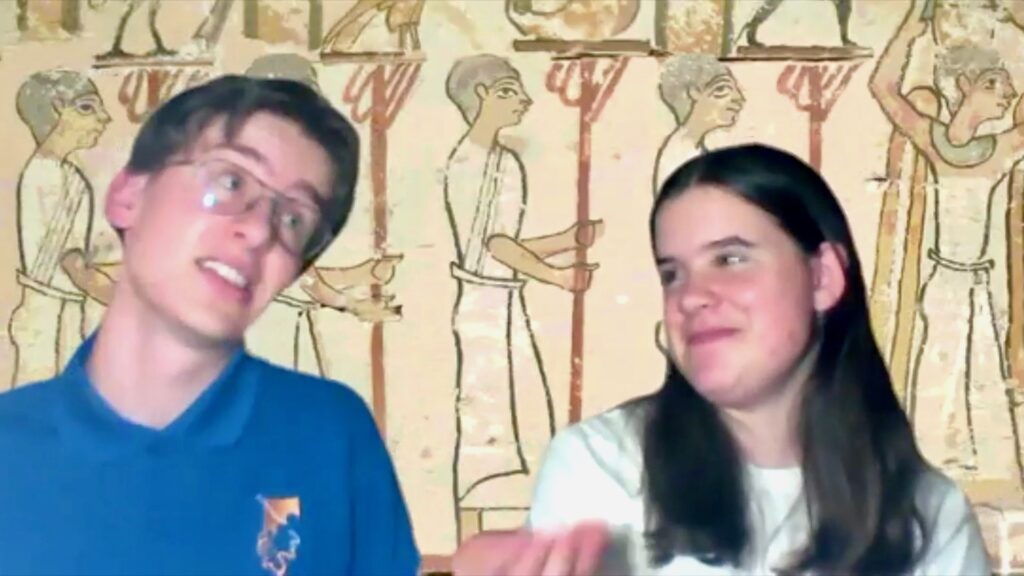
As usual, the full script is below the fold….
Continue reading “Akhenaten, part two”There used to be a Unitarian curriculum on the Pharaoh Akhenaten, purportedly the first monotheist, maybe the first unitarian. This is my take on the Akhenaten story….

As usual, the full text of the script is below.
Continue reading “Akhenaten, part one”Another in an occasional series of videos that retell Jataka tales:

As usual, full script is below….
Continue reading “The Elephant and the Dog”I am increasingly convinced that the pandemic is accelerating a number of trends that are going to change the way we do religious education in our local congregations fairly quickly. However, I don’t these trends should lead us to proclaim either the “post Sunday school era” or “the death os Sunday school.”
And before you get too excited (“Yay, the death of Sunday school!”) or too sad (“Nooo, I miss Sunday school!”), let’s look at a couple of the trends that affect religious education, trends that are being accelerated by the pandemic…..
1. Current trends affecting religious education
2. Where we came from, 1781 to the present
1965-2005
1900-1965
1781-1900
3. Why the “post Sunday school” advocates are right
4. Why the “post Sunday school” advocates are wrong
5. Expanding our religious education possibilities
6. The whole church as curriculum
7. New models for funding
8. Final thoughts
———
First and foremost among current trends, most American congregations face looming financial difficulties. Staff costs continue to outpace inflation, driven in part by health insurance costs. Staff costs in Unitarian Universalist congregations are also under pressure because we expect our professional staff — both ordained ministers and lay religious educators — to have at least a four year college degree, and often three or more years of graduate study; staffers have to pay off their college debts, and that means they need relatively high salaries. Finally, there’s always Baumol’s Cost Disease: American congregations represent an “technologically stagnant sector” which means congregations experience “above average cost and price increases.” The amount each person gives to a congregation has to increase faster than inflation, just so the congregation can provide the same amount of services.
Continue reading “The evolving state of religious education”