The Walters Museum in Baltimore has a small selection of South Arabian art. I’m completely unfamiliar with South Arabian art, and before I went to the Walters Museum yesterday I knew nothing about its long history. According to the Smithsonian National Museum of Asian Art:
“For over a thousand years, from around 800 B.C.E. to 600 C.E., the kingdoms of Qataban, Saba (biblical Sheba), and Himyar grew fabulously wealthy from their control over the caravan routes of the southern Arabian peninsula and, in particular, from the international trade in frankincense and myrrh. Excavations at the capitals of these ancient kingdoms have yielded spectacular examples of architecture, distinctive stone funerary sculpture, elaborate inscriptions on stone, bronze, and wood, and sophisticated metalwork.”
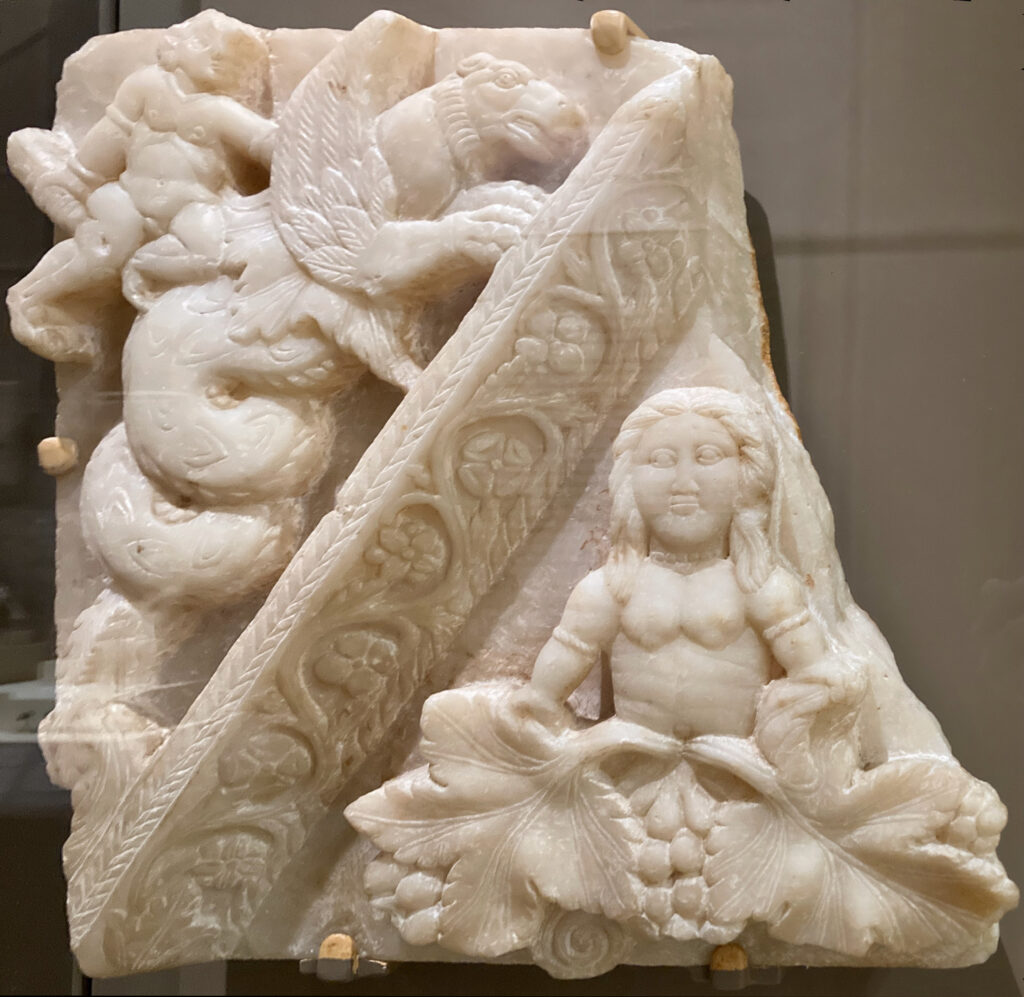
One of my favorite pieces of South Arabian art on the view at the Walters Museum is an unnamed goddess, who appears in a fragment of a pediment. She sits next to a child deity. Due to the lighting, I found it difficult to take a photograph due to the reflections on the glass case which houses this goddess; I had to do a fair amount of digital manipulation to make her look more or less the way she looks in the museum.
Here’s what the museum label says about this sculpture:
Fragment of a Pediment with a Goddess South Arabia (Marib), 2nd century A.D. The upper left side of this composition depicts an imaginary creature composed of an Asiatic lion’s head, a serpent-like body, a fishtail, and wings. A nude child deity grasps one of the creature’s wings with his left hand and holds a short sword in his right hand to control it. A smaller fragment containing the head of a similar composite beast in the British Museum might be the complement to this vignette. The lower right section depicts a nude fertility goddess emerging from vine leaves and grapes. With the increasing influence of Greco-Roman culture curing the 2nd and 3rd centuries A.D., new artistic styles and motifs, such as this female deity, became a part of South Arabian culture. Calcite-alabaster 21.74, gift of Girard and Carolyn Fester, 2014
I wonder if she was really a fertility goddess, or a goddess of wine. I don’t think we’ll ever know.
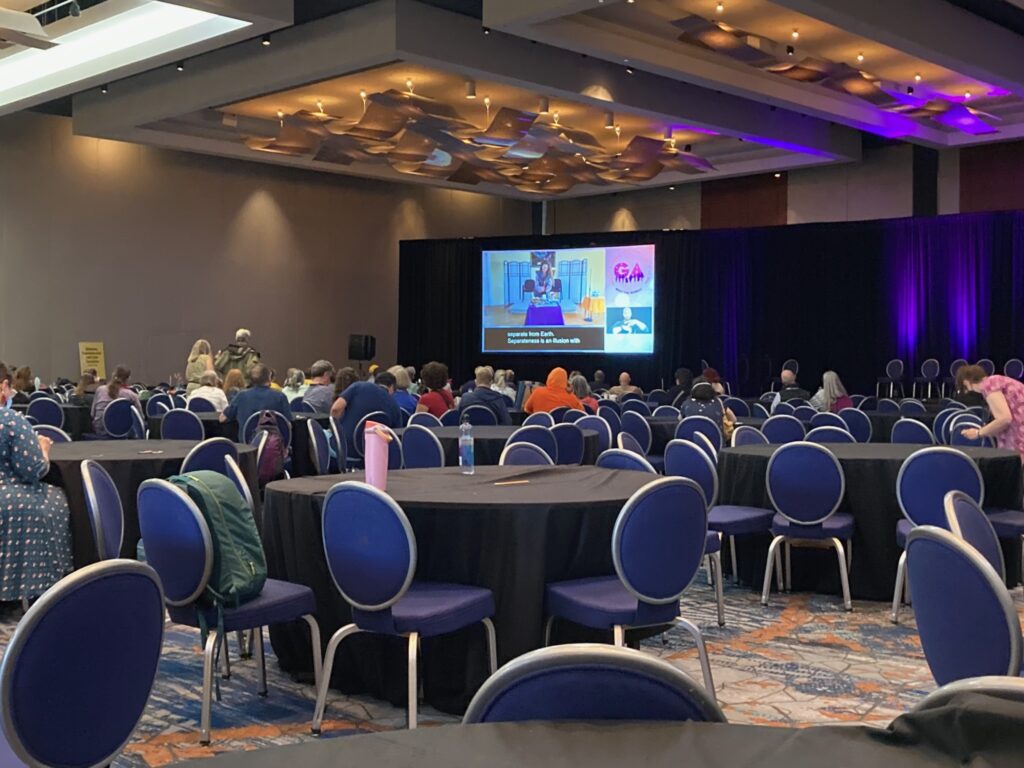
Wednesday evening, Carol, Ms. M., Roger, and I joined the watch party for the opening worship service for General Assembly. The video worship service was well done — the script was good, the performances of the individual elements were well done, and the editing as good. But online worship always makes me feel like a passive consumer, whereas live worship (if it’s done right) makes me feel like an active participant.
Not that many people showed up for the watch party. A few hours earlier, the room looked nearly full, with a few hundred ministers and family members. But for this watch party, the room felt empty.
I also noticed how the audio system boosted the lowest audible frequencies. If you record your audio with a mediocre microphone, your audio track can be filled with low frequency rumble. When you listen to that audio on your laptop, you’re not going to hear that rumble (unless you have really good headphones). But when you pump that audio through speakers big enough to fill a hotel ballroom, that rumble is going to be noticeable. This is something I’m going to remember to be aware of if I ever produce video/audio content that will be heard in a large room.
On Thursday morning, I started walking to the convention center from our hotel. I got almost all the way there when I realized that I had forgotten my face mask. So I walked back to the hotel, and then back again to the convention center, by which time the “Meet the Moment” programming had already started. I tried to figure out which programs were in which room, but I found the Whova event app so user-unfriendly that I gave up and downloaded the PDF program from the UUA website. Then I saw that we are supposed to commit to a single “Meet the Moment” program track for all three days. Frustration set in. Just then, Jen, an old friend, walked up. Jen said she was going to several different “Meet the Moment” tracks, because she was the only person from her congregation and she wanted to be able to go to as many tracks as possible. Yay! I had permission to ignore the rules!
At lunch, I walked through the Baltimore heat to a ramen place about ten minutes away. I was joined by Jen and Abby, who belongs to a UU congregation near my congregation. Abby and I talked about ways our congregations could cooperate. (It’s a little weird that I had to travel all the way to Baltimore to meet someone from a nearby congregation.) Then Jen reminded us both that Spirit Play would be a great kids program for small congregations like ours. So far, this lunchtime conversation is the most valuable thing I’ve gone to at this General Assembly.
Now I’m sitting in the meeting room listening to this year’s Congregational Study/Action Issues (CSAI). Somewhat to my surprise, there’s a CSAI that is fully aligned with one of the big priorities of our congregation — “Housing: Diversity, Equity, and Inclusion.” And one of the speakers in support of this CSAI actually mentioned classism (she’s affiliated with UU Class Conversations). The other two CSAIs are also worthy projects, but as the only delegate from our congregation, I’m going to vote for the issue that I think will be of the greatest interest to us.
It was nine o’clock by the time we checked into our hotel, so I gave up on any notion of attending the last activities at Ministry Days, the annual meeting of the Unitarian Universalist Ministers Association. In the morning, I walked the four blocks to the convention hotel in time for the opening worship service at Ministry Days. The service was fine, but marred both by the horrible acoustics and dreary aesthetics of the hotel ballroom (I never understood why they call it a “ballroom” when no one holds balls any more), and the uncomfortable chairs that always seem to plague hotel ballrooms.
I went for a long walk during our lunch break, and arrived back in time for the afternoon program. The program tracks included “Joy and Creativity,” “Rest Is Resistance,” “Organizing” (community organizing, not organizing your job better), and identity caucuses. None of these seemed like a good match for my professional development needs, so I sat outside the meeting rooms and waited to see if I’d wind up in an interesting conversation. Sure enough, Jay Atkinson sat down and started to tell me about a research project he’s working on. Our Unitarian Universalist leaders, said Jay, often talk about “our theology” as that which unified Unitarian Universalism. But what is that theology? Do we even have a distinctive Unitarian Universalist theology? I especially liked the distinction between “scholarly theology” and “vulgar theology.” Jay told me the name of the scholarly theologian who coined those terms, a name which I promptly forgot, but it’s a useful distinction, analogous to the distinction that sociologists make between “lived religion,” the religion of ordinary people, as opposed to the religion of elite practitioners.
Carol and I had dinner with Ms. M and Roger. Fortunately the restaurant wasn’t crowded, because we were there for two hours catching up with what was going on in each other’s lives.
This morning, I went back to the convention center hotel for the opening worship at Ministry Days. But I just wasn’t in the mood for sitting in a dreary hotel ballroom with a few hundred other people, passively consuming the excellent music, the dance performance, and the spoken word. I ducked out and now I’m headed up to the Walters Art Museum to meet Carol.
I’m leaving tomorrow for “Ministry Days,” the annual gathering of the UU Ministers Association, and after that I’ll be at General Assembly (GA) until Saturday morning. This year, I’ve done very little advance planning. The only session I know I want to attend is the session on Thursday afternoon on ending poverty. I have train tickets, I have a hotel room, I’m registered — beyond that, I’ll be making it up as I go along.
Back in 2018, I wrote about some of the challenges the Baby Boomers face — including financial challenges. We hear over and over again how the Boomers are inheriting a ton of money from their parents, so of course all Boomers must be financially secure. Well, not exactly true…
“Adults 50 and older are the fastest-growing age group experiencing homelessness, comprising nearly half of the country’s homeless population, according to the US Department of Health and Human Services. Federal data show a 17 percent jump in the number of Massachusetts adults ages 55 and older counted as homeless from 2023 to 2024, the most recent numbers available. Nationally, that increase was 6 percent.”
This reminds me of a book by Elizabeth White titled 55, Underemployed, and Faking Normal: Your Guide to a Better Retirement Life. White’s book, published a decade ago, showed that many 55 year olds simply didn’t have enough money to retire — and that included people like White herself, a highly educated woman who at age 55 found herself working low-paying jobs because that’s all she could get.
White’s book is still in print — because it’s still relevant. White wrote: “This is why the budget battles on Capitol Hill — which until recently only threatened to cut social security and other social-insurance programs like Medicare and Medicaid — are so ludicrous. What we’re really talking about is dooming millions and millions of women to misery and destitution.” And here we are, ten years later, hearing exactly the same claptrap from political leaders, including from our elderly (78 years old) president. Yes indeedy. I’m so glad we live in a Christian nation where our leaders devoutly follow the teachings of Jesus: “If you want to be perfect, go, sell your possessions and give to the poor, and you will have treasure in heaven. Then come, follow me.” (Matt. 19:21, NIV) I’m just so glad we have good Christian leaders who read their Bibles and decide to cut aid to poor elders so they can doom millions and millions of women to poverty and destitution.
OK, that’s enough sarcasm for now.
My real point is that the current culture wars are actually being fought over whether we help poor people move on up out of poverty, or whether we push more people into poverty. Rev. William Barber and the Poor People’s Campaign make the point that there are 140 million Americans who are functionally living in poverty. Nor do I see either major political party facing up to the magnitude of this issue. Actually, I don’t see Unitarian Universalists at the national level facing up to the magnitude of poverty in this country.
Back to the Boston Globe article for some insight into just how bad the problem is:
“‘I am finding more seniors living in their cars,’ said Sheri Miller-Bedau, a city health inspector in Attleboro. ‘We are in Massachusetts. We have great schools. We are supposed to be leading edge. How is this happening?’ She said local shelters were so full this past winter that even older adults living in their cars were not considered an emergency and were told they had at least a six-month wait.”
And to drive the point home, here’s another quote from the Globe article:
“[Julian] Cyr [D, Provincetown], whose district — Cape Cod, Martha’s Vineyard, and Nantucket — is home to the state’s oldest population, said it’s becoming increasingly common to see seniors living in their cars. ‘It’s a housing crisis on steroids,’ he said. ‘When I stop at a park or restroom [on the Cape], I will often see a car, a sedan packed to the gills, and there is an older person, usually an older woman, who is living in the car.'”
And it just might be that the biggest problem of this political moment is not fascism, or racism, or sexism, or homophobia, or immigration, or global climate change — the biggest problem of this political moment just might be poverty.
It’s a stressful time in the world right now — what with brutal wars in Ukraine, Israel/Gaza, Sudan, Myanmar, and elsewhere — and with economic uncertainty and political instability in the U.S. — and a host of other problems, like looming ecological collapse.
As a result of all these stress-filled events, there are lots of pundits telling us how we can reduce our stress. Recently, I’ve heard a number of pundits tell me that if I want to reduce my stress I should take a walk in the woods. (Before you get all snarky, yes I know this advice makes unwarranted assumptions: that I live in a bioregion where there are woods to walk in; that I live in a human place where enough woodlands remain to walk in; that if there are woods to walk in, they’re safe enough that you can walk in them; that I don’t have physical limitations that preclude walking in the woods. As it happens, I do live in a bioregion which does have woodlands, I’m fortunate enough to live near a 3,000 acre state park which is mostly wooded and mostly safe, and I am physically able to walk in the woods.)
I hate to tell those pundits, but taking a walk in the woods is not going to reduce my stress.
Yesterday, I took a walk in our nearby state park. In many places in that park, American Beech (Fagus grandifolia) are the predominant tree species. But our American Beeches are under attack, and most of the beech trees I saw appeared to be in poor health. To be blunt, beech trees are being killed off by invasive organisms.
First, there’s Beech Bark Disease (BBD):
“BBD is an insect-fungus complex that involves the beech scale insect (Cryptococcus fagisuga Lind.) and the fungi Neonectria faginata and Neonectria coccinea…. It is predicted that BBD will spread across the entire range of American beech in the United States in the next 40–50?years.” (Catalina Salgado-Salazar et al., G3 (Bethesda) [Genes, Genomes, Genetics]. 2021 Mar 9;11(4). https://doi.org/10.1093/g3journal/jkab071 )
The scale insect, which arrived in North America in the early twentieth century, spreads the fungus. The fungus infects the tree causing unsightly canker sores on the bark:
Beech Bark Disease on an American Beech tree in Wompatuck State Park
There is no known cure for Beech Bark Diseases. It often proves fatal.
Second, beech trees are also under attack from Beech Leaf Disease:
“Symptoms of beech leaf disease (BLD), first reported in Ohio in 2012, include interveinal greening, thickening and often chlorosis in leaves, canopy thinning and mortality. Nematodes from diseased leaves of American beech (Fagus grandifolia) sent by the Ohio Department of Agriculture to the USDA, Beltsville, MD in autumn 2017 were identified as the first recorded North American population of Litylenchus crenatae (Nematology, 21, 2019, 5), originally described from Japan.” (Lynn Kay Carta et al., “Beech leaf disease symptoms caused by newly recognized nematode subspecies,” Forest Pathology, 27 Feb. 2020 https://doi.org/10.1111/efp.12580 )
Here’s what the leaves look like after the nematodes have attacked them (I took this photo last May):
Curled leaves of American Beech, showing damage by Beech Leaf Disease
As I understand it, foresters and dendrologists are still learning about Beech Leaf Disease. But it’s very clear that Beech Leaf Disease causes trees to lose most of their leaves, and it’s equally clear that Beech Leaf Disease eventually leads to the death of the tree.
As with Beech Bark Diseases, there is no known cure.
The upshot is that we’re going to lose all, or nearly all, of our American Beech trees in the next decade or so — just as we lost nearly all of our American Chestnut trees in the early twentieth century (due to Chestnut Blight, an invasive fungus), and just as we lost nearly all of our American Elm trees in the mid-twentieth century (due to Dutch Elm Disease, an invasive fungus), and just as we lost nearly all of our ash trees in the early twenty-first century (due to Emerald Ash Borer, an invasive insect).
Invasive organisms are predicted to be one of the major causes of the calamitous decrease in biodiversity that we’re now facing. I suppose you could go for a walk in the woods and willfully ignore these evidences of global environmental disaster. If you’re going to do that, you might as well engage in one of those chic mindfulness practices that helps you forget that anything bad is happening. And what the hell, if you need to be in denial — if that’s what it takes to reduce your stress and keep your sanity — then I say, go for it. But please don’t tell me that I should take a walk in the woods to reduce my stress — what works for you doesn’t necessarily work for me.
One hundred days into Donnie Trump’s second reign — er, second term — which religious groups approve of him most?
No surprise — Trump continues to have high approval ratings among White evangelicals. In a recent poll, Pew Research found that 72% of White evangelicals approve of King Donnie — er, President Trump.
Here are the approval ratings for other religious groups in the Pew poll:
72% — White Protestant Christian, evangelical
51% — White Protestant Christian, not evangelical
51% — White Catholic Christian
40% — All US adults
26% — Hispanic Catholic Christian
26% — Religiously unaffiliated
10% — Black Protestant Christian
I was a bit surprised that these approval ratings are very similar to Trump’s first term. In their report, Pew Research says: “Both among the U.S. public as a whole and among major religious groups, Trump’s current approval ratings are on par with what they were around the same time in his first term (April 2017).”
Not surprisingly, White Evangelicals support Trump’s extensive use of executive orders — 53% of them feel that Trump is doing about the right amount by executive order. Only 27% of White evangelicals think Trump is doing too much by executive order, 15% are unsure, and 5% feel he’s doing too little by executive order.
I’d be jumping to conclusions if, based on this one survey, I said that White evangelicals are OK with a president who’s seems to be trying to operate like a king. But I’m keeping that in mind as a possibility.
“As we mark the fifth anniversary of the COVID-19 pandemic, the Hartford Institute for Religion Research’s ‘Exploring the Pandemic Impact on Congregations’ (EPIC) project offers a unique window into how American religious communities navigated this unprecedented crisis. What began as an emergency response to immediate challenges evolved into a profound transformation of congregational life in America. Our longitudinal research, spanning from mid-2021 to present day, tells a story of resilience, adaptation, and, ultimately, renewal.”
After summarizing some of their earlier research, HIRR says that the financial news for congregations isn’t great, but it is good:
“Our latest financial report reveals surprising stability. The median income of congregations has reached a 25-year high, though not keeping pace with inflation. Nearly half of congregations now report extensive use of digital donation platforms.”
You can view a PDF of the financial report here. Mind you, it would have been nice if we’d kept up with inflation. But still, this is better financial news than I expected.
Then HIRR outlines other, more serious, challenges:
“Five years after COVID-19 … persistent challenges remain: fluctuating congregation size, aging demographics among both clergy and members, reluctance to embrace change in some traditions and questions about meaningful engagement with primarily virtual attendees.”
The last three items seem a pretty good summary of the problems I’m seeing — aging demographics, reluctance to embrace some changes, questions about how to remain engaged with virtual attendees. No, I don’t have any answers, but I find it very helpful to list the major challenges we’re facing.
Over the past week, I’ve been writing a series of posts about bullies in the workplace —although I prefer the terminology of Robert I. Sutton, professor of business at Stanford University, who calls them “assholes,” not “bullies.” Now I’d like to consider the opposite of assholes. And what, you ask, is the opposite of an asshole? — it’s a boss who’s nice but incompetent.
Back in 2012, Sutton wrote a blog post titled “Are incompetent and nice bosses even worse than the incompetent assholes?” This post is based on a chapter from his book Good Boss Bad Boss, in which he describes in some detail what a good boss looks like. Sutton says that “one of the most personally troubling lessons I’ve learned (or at least am on the verge of believing)” is this:
“I am starting to wonder… if nice but incompetent bosses are even worse (at least in some ways and at certain times) than competent assholes.”
Sutton then includes an excerpt from his book Good Boss Bad Boss which gives a vivid portrait of a nice-but-incompetent boss:
“People may love that crummy boss so much they constantly excuse, or don’t even notice, clear signs of incompetence. For example, there is one senior executive I know who is utterly lacking in the necessary skills or thirst for excellence his job requires. He communicates poorly (he rarely returns even important e-mails and devotes little attention to developing the network of partners his organization needs), lacks the courage to confront — let alone fire — destructive employees, and there are multiple signs his organization’s reputation is slipping. But he is such a lovely person, so caring and so empathetic, that his superiors can’t bring themselves to fire him.”
So does this apply to Unitarian Universalist clergy? You bet it does. If you’ve been around Unitarian Universalism long enough, you’ll be able to think of clergy who were kind, gentle souls whom everyone loved — and who drove their congregation into the ground because of their incompetence. I started working as a Director of Religious Education (DRE) in 1994, and I remember hearing from other DREs about ministers who were good and nice people, but who were horrible to work for because they lacked necessary skills, had no thirst for excellence, communicated poorly, lacked the courage to confront poor employees, didn’t develop the network of partners the congregation needed, etc. — just like the senior executive that Sutton writes about.
But remember that the ultimate boss of a Unitarian Universalist congregation is the board. And in my experience, boards of congregations can also be nice-but-incompetent. Back in the 1990s, I remember one board that was so nice that they refused to terminate a destructive employee, even though that one employee was causing massive turnover in every other staff position. I’ve also seen boards that were poor communicators, that neglected to develop a network of partners, etc.
Whether it’s a nice-but-incompetent board, or a nice-but-incompetent minister, it can be very unpleasant to work under them — ask any DRE who has worked under a nice-but-incompetent boss. Sure, they’re really nice people. But they will not protect you from another staff person who’s destructive. They will not communicate effectively with you. They do not have the skills they need to lead effectively. They will not develop networks that bring in resources that will help you do your job. And because they’re so nice, they will never get fired. Finally, to point out the obvious, whether you’re paid staff and to volunteer staff, it’s equally painful to work under a nice-but-incompetent boss (it might even be worse for volunteer staff, because you’re not even getting a salary).
Sutton concludes his blog post with some advice:
“There are two lessons here. The first is for bosses. If you are well-liked, civilized, and caring, your charms provide protective armor when things go wrong. Your superiors are likely to give you the benefit of the doubt as well as second and third chances — sometimes even if you are incompetent. I would add, however, that if you are a truly crummy boss — but care as much for others as they do for you — stepping aside is the noble thing to do.
“The second lesson is for those who oversee lovable losers. Doing the dirty work with such bosses is distasteful. But if rehabilitation has failed — or things are falling apart too fast to risk it — the time has come to hit the delete button.”
“…if rehabilitation has failed…the time has come to hit the delete button….”
“In all the conversations I had with clergy on bullying, the pattern was identical: one congregant takes the lead and levels small, unrelenting criticisms against the minister that grow over time. Clergy are confused, and the congregation often has no idea what is happening until it is too late. The regions or Office of Vocation get involved in what is perceived as a ‘conflict’ and bring to the task a set of policies and procedures that are inadequate for bullying. The problem goes unresolved, and bullying remains unchecked in congregations, impacting minister after minister.”
As it happens, I’ve been bullied by congregants a couple of times. The first time it happened, I lucked out — the bully (who was also bullying other staff and lay leaders) left the congregation soon thereafter. And by the time it happened to me again, I knew exactly what was going on, so it had less impact on me. It was still extremely unpleasant.
Perhaps the most important part of the article is the brief section on why bullying seems to be on the increase:
“Alison Miculan has been on the front lines of supporting bullied clergy as the organizing chair of Unifaith. She believes the problem is ‘pretty rampant right now.’ Miculan says the COVID-19 pandemic led to an increase in bullying due to the frustration, fear, and anxiety in congregations today. ‘We are an angry society, and that’s been reflected in the church.’ …”
Note that the article is about congregations in Canada. I’d say that the United States is even more angry than Canada right now, which I guess means our congregations can expect more bullying and bullies than usual.
Mind you, I still don’t care for the term “bully.” I still prefer the term “asshole,” as defined by business professor Robert Sutton in his book The No Asshole Rule. Using Sutton’s term helps me remember that assholes have a negative impact on organizational performance. That is, it’s not just about one bully making the life of one target absolutely miserable — it’s about how an asshole not only makes life miserable for their targets, but they can also drag down the entire organization.