Follow up to a clergy misconduct allegation

Back in 2022, I mentioned in a year-end blog post that Rev. Kathryn J. Rohde had been removed from fellowship by the Ministerial Fellowship Committee (MFC) of the Unitarian Universalist Association (UUA). Now it turns out there’s a (publicly available) sequel.

The following year, 2023, Rohde sued the UUA for removing her from fellowship, and further for ending the retirement stipend she received from the “Unitarian Service Pension Society” (an organization I didn’t even know existed). You can read the basic court documents here, but I read about the case in a blog post by Daniel Dalton on the website of Dalton-Tomich, a law firm specializing in “religious properties” (a legal speciality I didn’t even know existed).

According to the court filings, and Daniel Dalton’s blog post, Rohde got in trouble because of a social media post made in 2020:

[Parenthetical note: “private Facebook group” is an oxymoron; social media is never private.]

[Another parenthetical note: Both the court filing and the Daniel Dalton blog post state that Rohde alleged she was the victim of sexual harassment early in her ministerial career — an allegation I would expect to be true, based on what older women ministers told me about the way they were treated by male ministers and denominational officials in the late twentieth century.]

Daniel Dalton goes on to reveal what the court decided; or rather, didn’t decide:

I have not been able to find out whether Rohde filed an amended complaint. I did find out that the usual vocal critics of the UUA — the Fifth Principle Project, the North American Unitarian Council, etc. — have been trumpeting Rohde’s case as another example of how “wokeness” has overtaken the UUA. Rupert Murdoch’s New York Post also picked up the story, using it to castigate so-called cancel culture.

Daniel Dalton, however, draws different conclusions from this case. First, he points out that most of Rohde’s claims were dismissed, not necessarily on their merit (or lack of merit), but rather on the legal notion of “ministerial exception.” As I interpret this, the dismissal, then, does not necessarily represent a judicial judgement (for or against) on Rohde’s claims.

Second, he notes that the Rohde case “prompts questions” in the area of “governance and accountability” regarding disciplinary procedures. Such question could lead to “greater transparency in internal investigations.” While Dalton seems to direct this comment at the UUA, I would imagine that local congregations should also pay attention to this — disciplinary procedures should always be clear and transparent.

Among other conclusions, Dalton points out that this case highlights the need to balance freedom of expression over against “community values.” Dalton suggests: “UU congregants and leaders may need to find ways to balance inclusivity with respecting diverse viewpoints.”

Dalton also highlights “ideological splits within the denomination,” and he then speculates if this might prompt “wider discussions on political polarization, identity politics, and theological diversity” within Unitarian Universalism. I think we Unitarian Universalists try to ignore the divisions among us, but Dalton shows us just how visible those divisions are to outsiders.

So that’s the inconclusive sequel to the 2022 removal of Kate Rohde from ministerial fellowship. Yet even though this sequel is inconclusive, there’s one conclusion I’d like to draw. Expanding on what Daniel Dalton says, I think it would be good to have additional clarification on Unitarian Universalist disciplinary policies for ministers (at both the denominational and local levels), as well as “greater transparency in internal investigations” (again, at both the denominational and local levels). The problem is that I don’t know how to make that happen. Our individualism means we find it hard to work together. 25 years of budget cuts have left the UUA understaffed in some key areas. Wider American society has grown polarized, and people are tender and raw. All these factors are going to make it extremely hard to come together to talk openly about a difficult topic like how we discipline clergy.

12 Oct. 2025: Minor edit made that didn’t change basic content (added brackets and intro phrase to the second parenthetical note).
Quaker Checkers revisited

Back in 2012, I posted a game board and rules for playing “Quaker Checkers.” Photocopies of that game had been passed around for years between Unitarian Universalist Sunday schools. I decided to create a clean copy, and put it online where maybe more people could access it. And if you read the comments on that 2012 post, you’ll see that Quaker Checkers has been played with great success in Unitarian Universalists Sunday schools (and maybe in one or two Quaker First Day Schools as well).

This week, I received email from Sally Q Campbell, who invented the game. Sally said she’s currently talking with a friend of hers about developing an online version of Quaker Checkers. Actually, I would have loved to have an online version during the pandemic when Sunday school had to meet online.

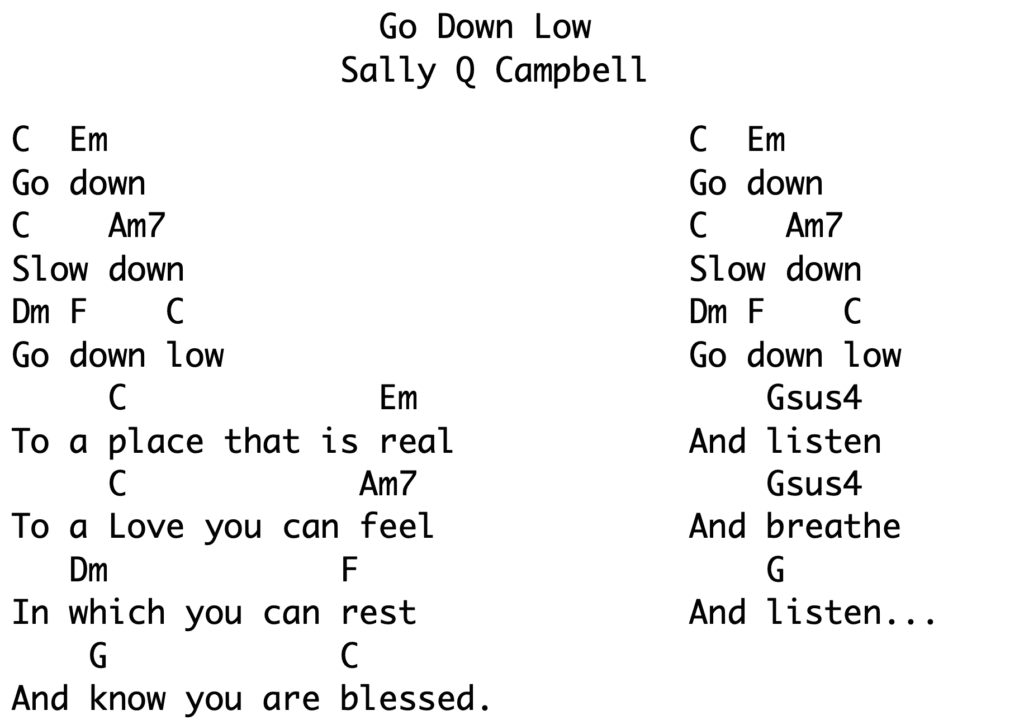
It appears that Sally is one of those endlessly creative people. She is also a songwriter, with a number of songs about peace and spirituality to her credit. On her her Youtube channel, she writes: “I’m a Quaker Singer/songwriter. Many of my songs are given to me in the silence if I will S l o w D o w n.” In fact, I especially like her song “Go Down Low,” which is all about slowing down and centering down. She hadn’t come up with chords for it, so I did. Here’s the standard warning for online chord/lyrics sheets: this is my interpretation of someone else’s song, posted here for educational purposes only; the songwriter Sally Campbell retains the copyright.

Graphic with lyrics and chords

(N.B.: she sings “Go Down Low” in B flat.)

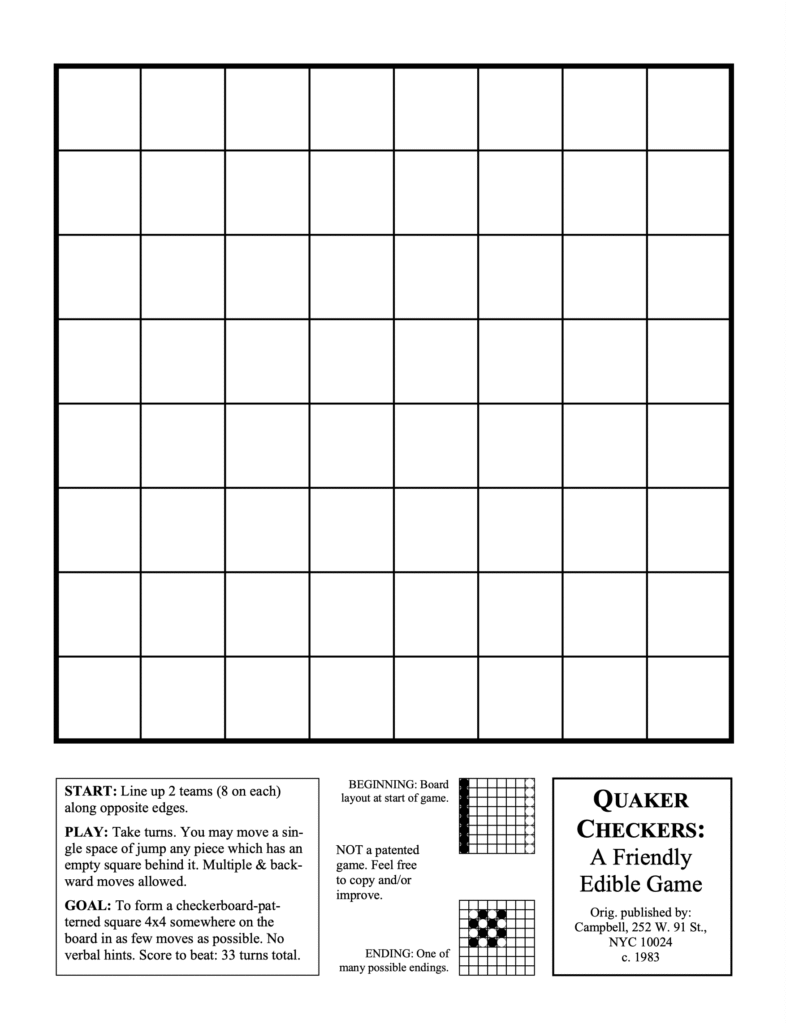
All the above is by way of digression. My real point in writing this blog post is to correct something Sally pointed out in her email. She said: “You did make one error when you tidied it up. My board does not have dark and light squares, it’s just a grid. Makes it more of a challenge.”

She’s absolutely right. To make amends, here’s a corrected version of the game board:

Graphic of the game board for Quaker Checkers.
Click on the image above for a printable PDF of the game.

Christian Socialism in 1935

I’ve been reading Capitalism and Its Critics by John Cassidy. According to Cassidy, Karl Polanyi criticized capitalism as being essentially undemocratic. After watching the rise of fascism in Europe, in 1935 Polyani wrote:” The mutual incompatibility of Democracy and Capitalism is almost generally accepted today as the background of the social crisis of our time.” Why? Because “only an authoritative State can deal with the contradictions inherent in Capitalism.” (Quoted by Cassidy, p. 283, originally from Polyani’s “The Essence of Fascism.”)

There was a religious side to this. Polyani was a Christian Socialist. Today, Christian Socialism is a concept that would probably cause the heads of many U.S. Christians to explode. (It would also probably cause the heads of Bernie Sanders and the Democratic Socialists of America to explode, but I digress.) Yet Christian Socialism used to be a widely-known option that boasted adherents ranging from Dorothy Day (a Catholic) to Adin Ballou (a Universalist turned Unitarian).

From Polyani’s viewpoint as a Christian Socialist, the rise of fascism not only threatened socialism, it also threatened Christianity. In that same 1935 essay, Polyani wrote: “Victorious Fascism is not only the downfall of the Socialist Movement; it is the end of Christianity in all but its most debased forms.” As a theological point, I think this is true — when people allow a central political authority to make moral choices for them, you’re going to see an attenuation of their individual moral capacity, which will similarly attenuate their religious capabilities.

Another

Email piled up while I was on vacation. I missed the fact that the Ministerial Fellowship Committee sent out another notice back on July 16:

As I’ve said before, I do wonder who the independent investigator was. Does the UUA have enough money to pay for an outside law firm or consulting firm to carry out these reviews? If not, who is the independent investigator? In any case, Kaaren Anderson has her own website, where you can her employment history.

AI and UU sermons

Should Unitarian Universalists use so-called AI (Large Language Models, or LLM) to write sermons?

Since Unitarian Universalists don’t have a dogma to which we must adhere, there will be many answers to this question. Here are my answers:

I/ Adverse environmental impact of LLMs

Answer: No. The environmental cost of LLMs is too great.

First, we all know about the huge carbon footprint of LLMs. And the more complex the answer required from the LLM, the more carbon that is emitted. Deborah Prichner, in a June 19, 2025, Science News article on the Frontiers website, sums up the impact by quoting someone who researched energy use of LLMs:

“‘The environmental impact of questioning trained LLMs is strongly determined by their reasoning approach, with explicit reasoning processes significantly driving up energy consumption and carbon emissions,’ said … Maximilian Dauner, a researcher at Hochschule München University of Applied Sciences…. ‘We found that reasoning-enabled models produced up to 50 times more CO2 emissions than concise response models.’”

Thus, not only do LLMs have a big carbon footprint, but handling something as complex as a sermon could result in a carbon impact 50 times greater than the lowest LLM carbon footprint.

Second, the data centers running LLMs use a tremendous amount of fresh water. In their paper “Making AI Less ‘Thirsty’: Uncovering and Addressing the Secret Water Footprint of AI Models,” Pengfei Li (UC Riverside), Dr. Jianyi Yang (U Houston), Dr. Mohammad Atiqul Islam (U Texas Arlington), and Dr. Shaolei Ren (UC Riverside) state:

“The growing carbon footprint of artificial intelligence (AI) has been undergoing public scrutiny. Nonetheless, the equally important water (withdrawal and consumption) footprint of AI has largely remained under the radar. For example, training the GPT-3 language model in Microsoft’s state-of-the-art U.S. data centers can directly evaporate 700,000 liters of clean freshwater, but such information has been kept a secret. More critically, the global AI demand is projected to account for 4.2 – 6.6 billion cubic meters of water withdrawal in 2027, which is more than the total annual water withdrawal of … half of the United Kingdom.”

Third, on 1 May 2025, IEEE Spectrum reported that “AI data centers” cause serious air pollution. The article, titled “We Need to Talk About AI’s Impact on Public Health: Data-center pollution is linked to asthma, heart attacks, and more,” raises several concerns. The authors write:

“The power plants and backup generators needed to keep data centers working generate harmful air pollutants, such as fine particulate matter and nitrogen oxides (NOx). These pollutants take an immediate toll on human health, triggering asthma symptoms, heart attacks, and even cognitive decline.”

In sum: Because my religious commitments call on me to aim for a lower ecological impact, the environmental impact of LLMs alone is enough to stop me from using them to write sermons.

II/ Sermons as human conversations

Answer: No. I feel that sermons should be the result of human interaction.

You see, for me, a sermon should arise from the spiritual and religious conversations that people are having in a specific congregation or community. As a minister, I try to listen hard to what people in the congregation are saying. Some of what I do in a sermon is to reflect back to the congregation what I’m hearing people talk about. At present, a LLM cannot access the conversations that are going on in my congregation — a LLM can’t know that P— made this profound observation about their experience of aging, that A— asked this deep question about the reality of the death of a family member, that C— made a breakthrough in finding a life direction, that J— took this remarkable photograph of a coastal wetland. Some or all of those things affect the direction of a sermon.

Mind you, this is not true for all religions. Deena Prichep, in a 21 July 2025 article on Religion News Service titled “Are AI sermons ethical? Clergy consider where to draw the line,” states that “The goal of a sermon is to tell a story that can break open the hearts of people to a holy message.” In other words, according to Prichep, for some religions the role of the preacher is to cause other people to accept their holy message. Prichep quotes Christian pastor Naomi Sease Carriker as saying: “Why not, why can’t, and why wouldn’t the Holy Spirit work through AI?” I can see how this would be consistent with certain strains of Christianity — and with certain strains of Unitarian Universalism, for that matter, where the important thing is some abstract message that somehow transcends human affairs.

But that’s not my religion. My religion centers on the community I’m a part of. Yes, there is a transcendent truth that we can access — but as a clergyperson, I don’t have some special access to that transcendent truth. Instead, truth is something that we, as a community of inquirers, gradually approach together. Any single individual is fallible, and won’t be able to see the whole truth — that’s why it’s important to understand this as a community conversation.

As a clergyperson, one thing I can do is to add other voices to the conversation, voices that we don’t have in our little local community. So in a sermon that’s trying to help us move towards truth, I might bring in William R. Jones, Imaoka Shinichiro, or Margaret Fuller (to name just a few Unitarian Universalist voices). Or I might quote from one of the sacred scriptures — i.e., from one of the sources of wisdom traditions — from around the world. Now it is true that maybe a LLM could save me a little time in coming up with some other voices; but given the huge environmental costs, it seems silly to save a small amount of time by using a LLM.

III/ Biases built into LLMs

Answer: No, because of hidden biases.

LLMs are algorithms trained on digitized data which has been input into them. For a LLM, the digitized data is mostly in the form of text. But we know that certain kinds of authors are going to be under-represented in that digitized data: women, non-Whites, working class people, LGBTQ people, etc. The resulting biases can be subtle, but are nonetheless real.

As a Universalist, I am convinced that all persons are equally worthy. I have plenty of biases of my own, biases that can keep me from seeing that all persons are equally worthy of love — but at least if my sermons are affected by my own biases, my community can successfully challenge me about my biases. If I use a LLM model to write a sermon, a model that’s riddled with biases that I’m not really aware of, that makes it harder for my community to help me rid my sermons of my biases.


IV/ Final answer: No

Would I use a LLM to write a sermon?

No. It goes against too many things I stand for.

Should you use a LLM to write your sermons?

I ‘m not going to answer that question for you. Nor should you ask a LLM model to answer that question for you. We all have to learn how to be ourselves, and to live our own lives. Once we start asking others — whether we’re asking LLMs or other authority figures — to answer big questions for us, then we’re well on the road to authoritarianism.

Come to think of it, that’s where we are right now — on the road to authoritarianism. And that’s a road I choose not to follow, thank you very much.

Hammer dyeing for nature journals

“Hammer dyeing” is a technique where you transfer the shape and color of leaves and flowers to cloth or paper by hammering. The process is fairly simple: you place plant material on cloth or heavy paper; cover with cloth, heavy paper, or plastic wrap; then hammer the plant material to release its juices which stain the cloth or paper. This article covers hammer dyeing projects that are intended for inclusion in nature journals.

The technique goes under several different names: “flower pounding,” “hammer printing,” “hammer staining,” “leaf hammering,” “tataki-zome,” “hapa-zome,” “Cherokee leaf pounding,” etc.; but I prefer to call it “hammer dyeing.”

Origins of hammer dyeing

I found no well-documented source giving the origins of hammer dyeing. I suspect the technique arose independently in several cultures.

Some online sources call this technique tataki-zome or hapa-zome, and claim it’s an “ancient Japanese art form,” but without citing any sources. A search on Google Books turns up many references to tataki-zome from 2000 on, but I could find only one reference prior to that date: Rita Buchanan, in Dyes from Nature (Brooklyn Botanical Garden Record, Plants and Gardens, vol. 46 no. 3, autumn 1990), p. 79, says that students learning how to dye in Japan practice tataki-zome: “Using their own plants, they learn dyeing techniques such as batik, itajime — a sort of variegated effect made with wood chips, and tataki-zome, a way of mashing plants on the cloth.” More research is needed to determine if tataki-zome is actually a traditional Japanese art form.

Alabama quilter Bettye Kimbrell (1936-2016), named a National Heritage Fellow by the National Endowment for the Arts, used a hammer dyeing technique she called “Cherokee leaf pounding.” It’s not clear this technique was actually used by the Cherokee people, so it’s best to consider this an American folk art with uncertain historical roots. Kimbrell used this technique in her quilts: “Cherokee leaf pounding is a technique where a fresh green leaf is taped to the backside of muslin fabric with masking tape. Using a hammer, gently pounding the leaf allows the chlorophyll to stain the fabric. After transferring each leaf to the fabric, the stain is set with a vinegar and water solution. The fabric is then dried and entirely hand quilted.” (Kristin G. Congdon and Kara Kelley Hallmark, American Folk Art: A Regional Reference, vol. 1 [Bloomsbury Publishing, 2012], p. 226.) More about her process here.

Screenshot from a video about hammer dyeing.
Screenshot from a PBS video on Bettye Kimbrell, showing her hammer dyeing a quilt. Click on the image to watch the video on the PBS website.

Books and references on hammer dyeing

For a comprehensive reference book on this technique, see Laura C. Martin, The Art and Craft of Pounding Flowers (Mt. Kisco, NY: QVC Publishing, 2001; Rodale Press, 2003). Martin covers which types of flowers, and which types of leaves, produce the best results; mordanting fabrics so the image is perhaps more light-fast; setting the image with a hot iron; etc. Unfortunately the book is now out of print. Used copies can be found on Thriftbooks (please do not buy from evil Amazon). The Internet Archive has a copy online that can be borrowed. The first 32 pages of the book are available on Google Books.

I’ve found references to two other books about the process: (1) Ann Frischkorn and Amy Sandrin, Flower Pounding: Quilt Projects for All Ages (Concord, Calif.: C & T Publishing, 2001); and (2) Linda Rudkin, Flower Pounding (London, U.K.: A & C Black Publishers, 2011). I haven’t seen either book, so can’t comment on them.

PBS has a video with Bettye Kimbrell demonstrating her leaf pounding technique. Sadly, the video does not show her technique for setting the image in vinegar (see below).

My curriculum website has instructions for doing flower pounding with children, using inexpensive watercolor paper. Scroll down to “V/Printmaking,” then go to project “D/Pounding flowers.” The technique I describe has been extensively field tested with children from grade 1-8, and produces reliable results. However, this technique is more focused on process than product (“process art”), and is not suitable for use in a nature journal curriculum.

Cloth with hammer-dyed impression of a fern on it.
Hammer-dyed fern on bleached cotton muslin, 36 inches wide. No mordant or scouring, but the image was set using a steam iron. The darker places are plant material deliberately left on the finished image. Image copyright (c) 2025 Dan Harper.

Hammer dyeing process

Earlier this month, during a week-long family conference at a Unitarian Universalist summer camp, I was leading an ecology workshop that centered around participants recording thoughts, feelings, and observations about the nature in journals (i.e., nature journaling). My co-leader, Rebecca, who is a middle school teacher, contributed to the development of this activity (thanks, Rebecca!). During this workshop, we field-tested a procedure for hammer dyeing. The process, outline below, is easy to set up, and is designed to help participants become more aware of the details of leaves and flowers.

Tools needed

  • Hammer, at least 1 for every 2 participants (see discussion of hammer types below)
  • Disposable foam ear plugs
  • Table with a hard flat surface

Materials

  • Thin cotton muslin cloth, 36 or 45 inches wide
  • Leaves, flowers

A rule of thumb for collecting leaves and flowers: Collect just 1 out of 20 similar leaves/flowers.

A note about fabric: I used to go to Joann Fabric to buy cloth for class projects, but they went out of business this year. Michael’s purchased Joann Fabric intellectual property, and one of the local Michael’s stores does carry 45″ cotton muslin in stock. My preferred online source for fabric is Dharma Trading Post, but as of this writing their popular 45 inch cotton muslin is out of stock.

Continue reading “Hammer dyeing for nature journals”

MFC/RECC action

The Ministerial Fellowship Committee (MFC) and the Religious Education Credentialing Committee (RECC) of the Unitarian Universalist Association (UUA) sent an email dated July 9. It reads:

He was most recently the combined minister and director of religious education at the UU congregation in Honolulu. As always, by posting this I’m making no judgement about the facts of this particular situation. I post these on my blog simply because not everyone gets these emails. In addition, the page on the UUA website where these decisions are listed now appears to be hidden from public view and available only by application to the UUA; presumably this is part of the UUA’s decision to hide names and identifying information from bad actors. While making it more difficult to see this page is probably the right thing to do (in our current tumultuous socio-political moment), it also makes it easier to overlook this important repository of MFC judgements.

There is one thing in this email that I’d like to know more about. The email references a “thorough, independent investigation.” It makes sense to have an independent investigation, but I’d like to know who made this investigation. Identifying the investigating body would increase transparency, and consequently increase trust in the overall process.

On another topic — I don’t remember getting an email from the Religious Education Credentialing Committee before. I didn’t know that they could terminate religious education credentials. It makes sense that they can do so; I just didn’t know about it.

Update 15 July 2025: Added a sentence that got left out by mistake in the editing process.

Secularism stalls? Not so fast…

In the June 14 issue, The Economist reports that the decline of organized religion has seen a mild reversal since COVID. In 2023-2024, according to this report, three different surveys show a decline of “Nones,” those who report no religious affiliation, by four percentage points.

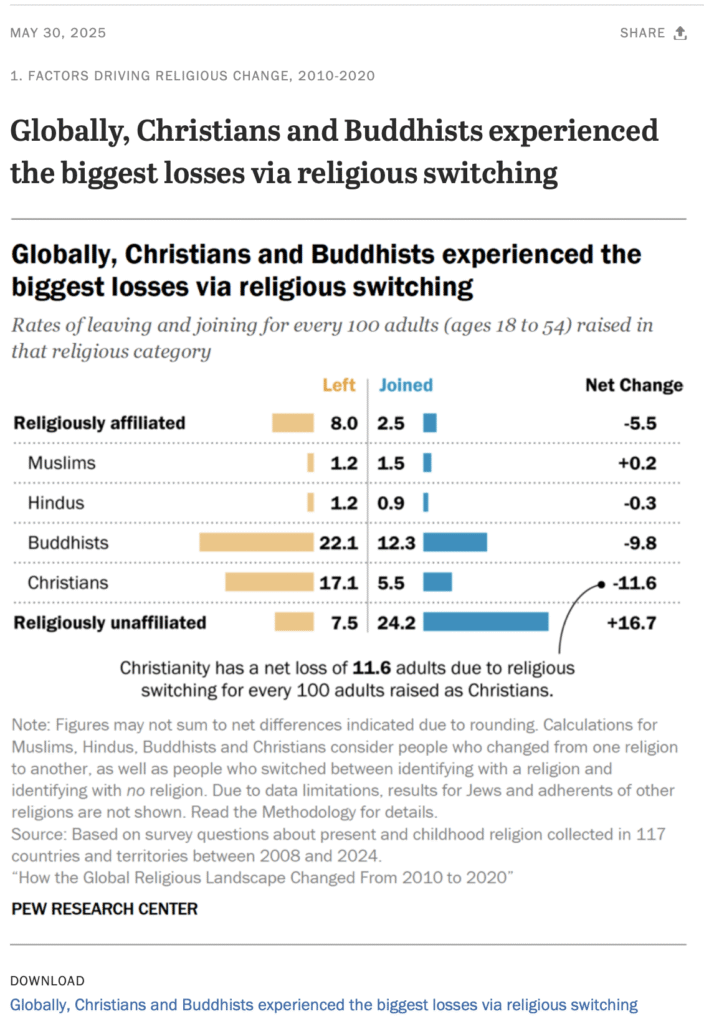
Unfortunately, The Economist neglects to tell us which three surveys report this decline (sadly typical of their reporting). A survey by Pew Research is probably one of them. On January 24, 2024, Pew Research published an online report titled “Religious ‘Nones’ in America,” in which they document a drop in the number of Nones from 2022 to 2023. However, in an analysis published the same day, Pew Research felt that it was “too early to tell” whether drop was significant. In another article published this year, on June 9, Pew Research detailed global religious decline from 2010 to 2020. One of the things they looked at was which religions suffered the greatest losses via “religious switching,” i.e., people switching to another religion or switching to no religion at all. Based on global surveys conducted from 2008 to 2014, Pew found that the biggest religious losers were Christianity (-11.6%) and Buddhism (-9.8%); the biggest gainer was no religious affiliation (+16.7%).

Screenshot of an infographic
Screenshot of web page with the infographic by Pew Research showing global percentage losses over five major religions, plus gains by the religiously unaffiliated. Click on the image above to go to the original.

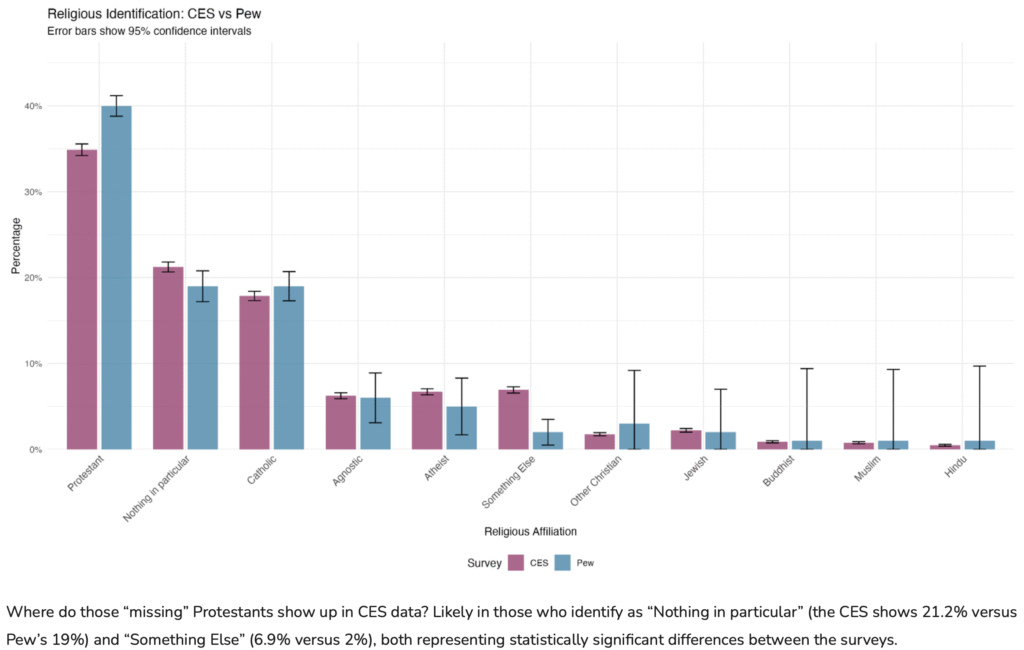
The Cooperative Election Survey (CES), housed at Harvard University, also asks questions about religion, and serves as another good source for data on religious affiliation. The CES tracks the Pew Research surveys within a few percentage points. But there are some curious differences. CES finds 5.1% fewer Protestants than Pew does. There’s also a significant gap in those reporting as “Something else” — which is probably what many Unitarian Universalists would report themselves as.

Screenshot of inforgraphic
Screenshot of web page with infographic showing differences between CES and Pew. Click on the image above to go to the original.

Also of note — in my view, both CES and Pew define “religion” in such a way that Christianity serves as the paradigm, which may not capture the religion of, say, Unitarian Universalists who strongly identify with their religion yet don’t believe in God, don’t pray, and don’t feel the need to attend regular worship services. If you don’t assume that religion centers around Christian-style belief in God and attendance at church, then social atomization and disaffiliation (as reported, e.g., by Robert Putnam in his book Bowling Alone) might be the stronger factors driving so-called secularization.

The Economist does report one possible explanation for the slight increase in religious affiliation from 2022 to 2023:

Time will tell if we’re actually seeing a slight decline in “Nones,” or if this is just a temporary blip. As a Unitarian Universalist, I’m also less worried about secularization — after all, by many definitions we’re already secular — and far more worried about social atomization and disaffiliation. We don’t have to convince people to believe in God. We only have to convince people that being part of a values-based community is a good thing.

GA wrap-up: from Global UUism to administration

On Friday morning, I went to “Global Worship: Celebrating Our Diverse Faith,” led by (among others) Rev. Zsolt Elekes of the Transylvanian Unitarians; Juban Lamar, a member of the Jowai church of the Khasi Hills Unitarians; Vyda Ng, executive Director of the Canadian Unitarian Council; and Liz Slade, chief officer of the General Assembly of Unitarian and Free Christian Churches (United Kingdom). As I understand it, a couple of other primary worship leaders did not receive visas and were unable to attend General Assembly.

I found this worship service to be very moving. Zsolt Elekes talked about how the Transylvanian Unitarians went through some hard times, particularly under the repressive Ceausescu regime; yet they found strength through their international partnerships. All the speakers used the image of a bridge held up by many pillars — the bridge representing worldwide liberal religion, and the pillars representing the various Unitarian, Universalist, Unitarian Universalist, and Free Christian groups that are spread throughout the world.

What holds all these groups together? What, for example, do the distinctly theistic Khasi Hills Unitarians have in common with some of the fundamentalist humanist Unitarian Universalists in the United States? One of the speakers said, half-humorously, that we’re all heretics — but that remark was only half humorous, because in all seriousness our willingness to be heretics is a unifying factor. We also share the symbol of the flaming chalice, which is used by our co-religionists around the world. Zsolt Elekes also pointed out that the Flower Celebration, developed by Norbert and Maja Capek in the Prague Unitarian Church just over a hundred years ago, is something else we hold in common — a religious celebration that symbolizes how we perceive human unity in our diversity.

Continue reading “GA wrap-up: from Global UUism to administration”

Why Are You You?

I’ve got convention brain. What did I do after yesterday’s business meeting? What programming did I attend? With whom did I talk? It’s a bit of a blur.

But I do know that last night I went to a screening of the documentary “Why Are You You?” a new documentary about the now-defunct youth program Young Religious Unitarian Universalists, or YRUU. I was fairly heavily involved in YRUU as an adult advisor from 1995 through about 2003, serving as an advisor in local youth groups, as well as at district and continental “cons” or conventions. As a result, I got to meet youth leaders and youth advisors across the continent, from Alaska to Maine.

The filmmakers interviewed a number of former YRUU youth leaders, and I recognized several of them. I enjoyed hearing their memories of YRUU conferences and programs; I especially enjoyed hearing about how YRUU changed their lives. Given all those hours I spent supporting youth leaders and UU youth institutions, it’s nice to know that those hours weren’t wasted. But the ending of the movie is a little depressing. The Unitarian Universalist Association (UUA) ended funding for YRUU in (I think) 2007. There was no replacement for YRUU — YRUU was a semi-independent organization with youth leadership, not just another department of the UUA.

Not that YRUU was perfect. The documentary touches on some of its problems. What’s missing are the voices of all those teens for whom district and national YRUU programs held no interest, or those for whom YRUU did not feel safe — I knew quite a few of those teens, some of whom were devoted members of a local youth group. What’s also missing is mention of the adult advisors with poor boundaries — I saw a few too many of those; part of the reason I pulled away from district and national youth events was that I felt YRUU didn’t train adults adequately, nor hold them fully accountable.

Yet these were all solvable problems. The solution was not to get rid of the national youth organization; the solution was to reform that organization. For the past twenty years, I’ve had the sense that Unitarian Universalism broadly construed, especially at the national level, just really doesn’t like children and teens. Children and teens are messy, they take up a lot of time and energy, and if you don’t like them that much, it’s easier to shut them out rather than support them and their families. I feel that the death of YRUU is part of this larger trend.


P.S.: If the issues raised by this film are of interest, you might also be interested in childist theology, a new approach to Biblical interpretation that places children at the center of Biblical interpretation. So… What would it mean to place children and teens at the center of a Unitarian Universalist theology?