What ministers didn’t learn in theological school

The Religious Workforce Project has released a report titled “What Clergy Leaders Wish They Had Been Trained To Do: And Why It Matters.”

I think it’s a pretty good report. And I think anyone involved in congregational leadership will find it worth reading.

A key finding detailed in the report is that there are five key skill sets where clergy leaders felt they did not receive adequate training. Those five key skill sets:

  1. Administration and management
  2. Technology skills
  3. Soft skills for leadership, a broad category which includes:
    • inspire others to achieve shared goals
    • set a clear vision and communicate it effectively
    • create a culture of accountability and excellence
    • solve problems
    • coach or mentor others
    • manage conflict well
    • delegate tasks
    • have high emotional intelligence, incl. self-awareness and self-care
  4. Counseling and pastoral care
  5. Facilities management

I encourage you to read the report, which includes many direct quotes from interviews with working clergy about what they wished they had been taught in theological school. One of my favorite quotes in the report starts off like this:

But the real point here — for both clergy and for lay leaders — is pretty simple: clergy do, in fact, need to know these skills. In the Unitarian Universalist tradition, lay leaders of congregation supervise ministers, so lay leaders should be prepared to evaluate whether clergy have these skills or not. When clergy do not have these skills, lay leaders should work with clergy to prioritize which of these skills are most important in their congregation, and then figure out how to get clergy appropriate training for any needed skills. And lay leaders have to realize that learning these skills takes time, which means they have to reduce the clergy workload so that there’s time for the required training.

Furthermore, since lay leaders are pretty notorious for being inconsistent supervisors, clergy have to take it on themselves to hold themselves accountable for learning the high-priority skills. Ideally, clergy will find someone (e.g., a consultant or coach) who will work with them over an extended period as they learn a needed skill.

Another thought [added 15 April 2025]: I’ve been thinking about ministerial bullying recently, and I suspect at least some bullying happens because clergy lack soft skills (esp. inspiring others, coaching and mentoring, managing conflict, delegating tasks well, and having emotional intelligence), and because they lack administration and management skills. I suspect that if you don’t have soft skills, and you don’t know how to manage, it’s much easier to become a bully — because you don’t know any other way to get things done.

One more thing: when lay leaders are in the process of hiring a new minister, they should look over these five key skill sets, and determine which ones their new hire absolutely must have. During the hiring process, both lay leaders and clergy should make a point of discussing these five key skill sets together. Better that everyone has clear expectations right up front.


Part of a series of posts on clergy and bullying — Sigh. Not Again.What ministerial bullying looks likeWhat ministers didn’t learn in theological schoolWhen clergy get bulliedThe opposite of a bullying boss

What ministerial bullying looks like

Last month, there was a dust-up at Winchester Cathedral in England. Not surprisingly, as a cathedral of the Church of England they have an unbelievable music program. The long-time music director and organist was Andrew Lumsden, led the Winchester Cathedral Choir to a Grammy award in 2024 for their soundtrack to a Star Wars video game. Lumsden suddenly resigned last summer with no explanation. At about the same time, half the adult choristers — so-called “lay clerks” — quit. In addition, the boy choristers were also well below the usual number. Upon receiving numerous complaints, including a negative social media campaign, the bishop commissioned an outside review. Very Rev. Catherine Ogle, Dean of the cathedral — the senior management position in the Cathedral organization — announced she would retire in May, 2025, but after the outside review was completed she announced an immediate departure and left in early March.

So why all these departures?

According to Living Church magazine — an international periodical of the Anglo-Catholic wing of the worldwide Anglican communion — the problem was bullying by the Precentor of the Cathedral, Rev. Canon Andy Trenier. Back on July 3, 2024, Living Church reported:

Living Church quotes from other news sources that point to management practices that sound questionable to me, including possible mismanagement of funds:

The idea of start-up choral groups sounds good, but if those start-up groups sued funds earmarked for the main music program, to me that doesn’t sound so good. I’d pay more attention, however, to the decline in the number of choristers. Reportedly, that decline was the result of the alleged bullying. Living Church went on to report what the bullying looked like:

“Ali Kefford of The Mail on Sunday wrote about Trenier: ‘He is said to have berated the Director of Music Dr Andrew Lumsden in front of the boy choristers, and told singers they could leave if they didn’t agree with his approach. Those targeted by his volcanic temper are said to have been left trembling.’ Kefford added: ‘Canon Trenier’s relationship with the eight adult male lay clerks is said to have irretrievably broken down amid allegations that he has been coercive, manipulative, and belittling. They are four short of their usual tally of 12 because, his critics say, working at Winchester is now seen as a poison chalice.'”

These days, the term for people who behave in the way Trenier is alleged to have behaved is “bully.” I often use a different term. Back in 2007 Robert I. Sutton, professor of business at Stanford University, called this kind of manager an “asshole.” In his book The No Asshole Rule, Sutton details how abusive supervisors — bullies, if you will — often prove to be a detriment to the overall performance of an organization. Thus, it’s not just that assholes are a pain to work with, they actually damage the organization.

Best of all, Sutton has a fairly precise definition for what constitutes an asshole. “Bully” often proves to be a vaguely defined term, but Sutton turns “asshole” into a precisely defined term so you can clearly identify who’s an asshole, and who isn’t. According to Sutton, there are two main tests for determining who is an asshole:

From the few reports that I’ve read on the situation at Winchester Cathedral, it does sound like Andy Trenier might pass both tests. If it’s true that he has a “volcanic temper” that leaves underlings “trembling,” then he appears to pass the first test. And according to reports, he yelled at people he supervises, i.e., people who have less power than he, which would mean he passes the second test.

For our purposes, though, we don’t need to try to judge the facts of the Winchester cathedral case. The allegations, whether true or not, give a pretty good feel for what ministerial bullying looks like — it’s “coercive, manipulative, and belittling”; it can leave the target “trembling”; it may include a my-way-or-the-highway demand; and people do in fact leave the organization rather than have to deal with the ministerial bully.

If you’re in a situation where you think you’re seeing ministerial bullying, you might want to check out Robert Sutton’s books on assholes: The No Asshole Rule and The Asshole Survival Guide: How To Deal with People Who Treat You Like Dirt. Or, if you’re a minister or supervisor, you might want to read Sutton’s book Good Boss, Bad Boss: How To Be the Best…and Learn from the Worst.


Part of a series of posts on clergy and bullying — Sigh. Not Again.What ministerial bullying looks likeWhat ministers didn’t learn in theological schoolWhen clergy get bulliedThe opposite of a bullying boss

Sigh. Not again.

I got one of those emails today, informing me that a Unitarian Universalist minister has been removed from fellowship. It read:

A quick web search (including what appears to be his Facebook page) shows John L. Saxon as a professor of public law and government at UNC-CH, retiring from there in 2010. He graduated from Meadville/Lombard Theological School in 2009, serving as hospital chaplain for Alamance Regional Medical Center, beginning c. 2010. He was assistant at the Unitarian Universalist Fellowship of Raleigh, N.C., beginning in 2010, then later lead minister; he left the latter position in 2017. From 2017 to 2020 he was Executive Director of the Unitarian Universalist Social Justice Ministry for North Carolina, and then apparently from 2020 to 2022 he was president of the organization (online sources are not clear). One brief bio of him says he retired in 2022, so it’s not at all clear where he allegedly engaged in the actions that led the Ministerial Fellowship Committee to remove him from fellowship.

As usual when I publish these announcements, I’m making no judgements on the truth of the allegations. I’m publishing these because up until a few years ago the UUA did not maintain a public list of this sort of thing; and since then it has become increasingly difficult to find out where the accused ministers have worked.

I will make one general comment, though, which is that removing a minister from fellowship for bullying now appears to be more common than removing a minister from fellowship for sexual misconduct. Does this mean I believe UU ministers are no longer engaging in sexual misconduct? No, I suspect it’s simply more difficult for victims of sexual misconduct to come forward. [Plus as I outline in a later post in this series, there are societal factors leading to more bullying.]


First in a series of posts on clergy and bullying — Sigh. Not Again.What ministerial bullying looks likeWhat ministers didn’t learn in theological schoolWhen clergy get bulliedThe opposite of a bullying boss

What youth engagement can look like

In the last 1990s, I took Prof. Robert Pazmino’s course in teaching practices and principles, aimed at education in local congregations. One of Bob’s memorable insights was that congregations should have a teen voting member on every church committee, including the governing board. As Bob pointed out, not only is that the best way for teens to learn how congregational governance works, it’s also good for congregations who want to figure out how to meet the emerging needs of the rising generation.

This principle holds true for all nonprofit organizations. In 2014, when the Religious Education Association annual conference was in Boston, I went with a group to visit the Dudley Street Neighborhood Initiative (DSNI). This community group, which served a white-minority low-income neighborhood, had 4 seats on its 25-seat board dedicated to teens. Not only did DSNI benefit from the insights of its teen board members — not only did the teens benefit enormously from this real-life experience — but serving on the DSNI board as a teen provided a direct path into city government for ambitious teens; this helped both the teens, and DSNI, who now had a sympathetic ear in City Hall.

Now Hamilton Ontario is applying this same principle to the public sector:

So… now you have even more motivation to get teens on your congregation’s board and committees.

Questionable quotes

While researching the provenance of quotes from the UUA’s “Wayside Pulpit” quote collection, I’ve uncovered a number of questionable quotes. Some of the quotes are clearly spurious or otherwise wrong. Others, however, may be real quotations, but my research didn’t happen to turn up a firm attribution. Since some of my readers enjoy working on this kind of puzzle, I’ll post some of the results of my research below.

Continue reading “Questionable quotes”

Quotes for the Wayside Pulpit

The “Wayside Pulpit” is a long tradition for Unitarian Universalist congregations (and other houses of worship). In the old days, the Unitarian Universalist Association (UUA) would print up large poster-size sheets with various inspirational quotes on them, and congregations would purchase those sheets, and post them in signboards outside their church or meetinghouse. Nowadays, the UUA provides free PDFs and you print them yourself.

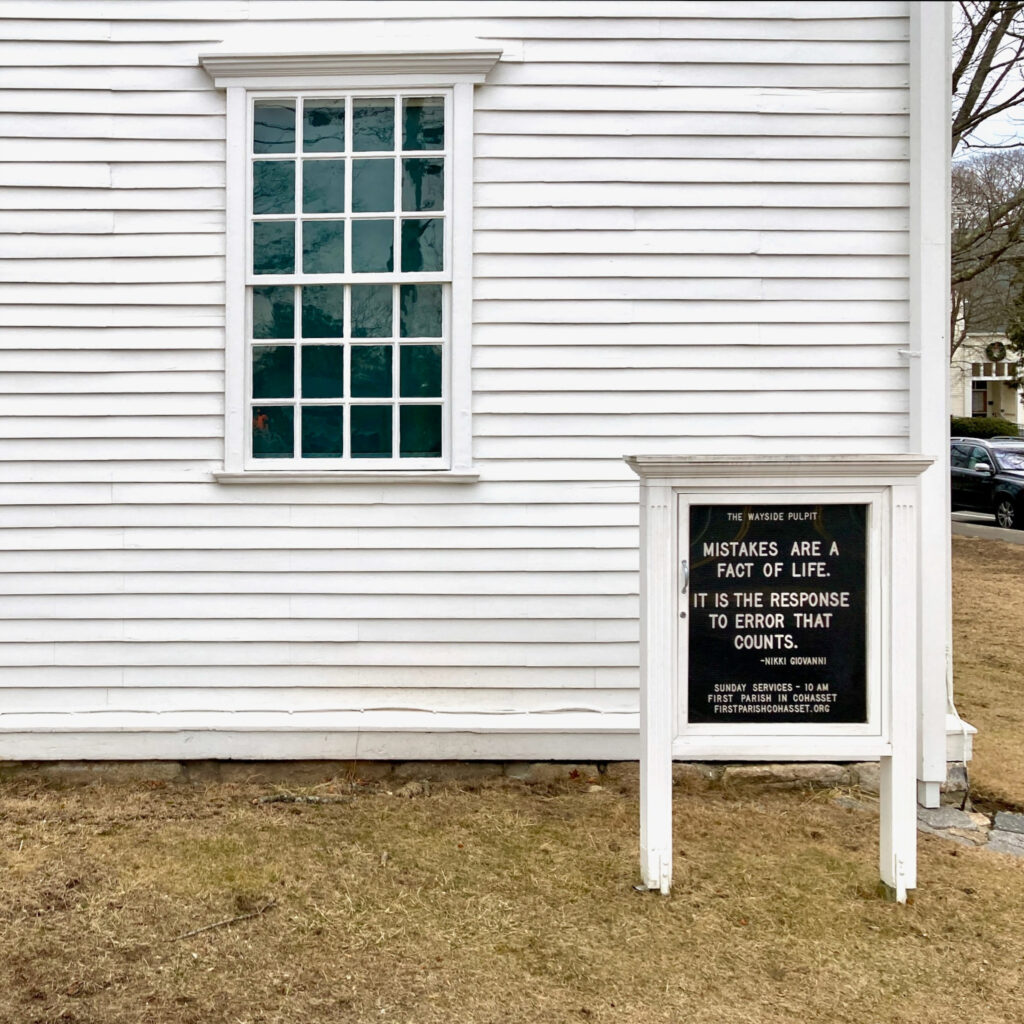
When we installed a Wayside Pulpit outside the meetinghouse of First Parish in Cohasset, Mass., I started looking for some more (and more recent) quotations to add to the ones I found in the UUA website. I quickly discovered that the web is inundated with spurious quotes, and quotes with inaccurate attributions. Then I noticed that some of the quotes provided by the UUA had problems. As an example, the quotation “All that is necessary for the triumph of evil is that good people do nothing” gets attributed to Edmund Burke, but the Quote Investigator website states that this attribution is wrong. Or take the quotation that says “If I cannot do great things, I can do small things in a great way” — the UUA attributes this to James Freeman Clarke, but I couldn’t find it in Clarke’s published works (which are mostly digitized and easily searchable online), and various online sources attribute this same quote to Napoleon Hill or Martin Luther King, Jr.

After many hours of research, I finally came up with 77 quotes [update: now well over 100 quotes] where I had reasonably good evidence that (a) the quote was actually said by the person it’s attributed to, and (b) it represents pretty much the same words that the person actually said or wrote. For each quote, I included attributions showing their source. (In a couple of cases, I shortened quotes so they’d fit into the Wayside Pulpit format; I’ve noted where I’ve done so, and I also give the original wording.)

Several of these quotes date from the past five years, including words from Brene Brown, Joy Harjo, Tricia Hersey, Yara Shahidi, Taylor Swift, and Greta Thunberg. I’ve also added a couple of quotes from non-White UUs including Mark Morrison-Reed and Imaoka Shin’ichiro. [Update: just added a bunch of quotes from scientists, for those of us who are geeks.]

You can see this collection of quotes here.

A sign in front of the corner of a New England clapboard meetinghouse.
The Wayside Pulpit in front of the 1747 Cohasset Meetinghouse.

When to open

Since COVID, I’ve noticed a growing trend among Unitarian Universalist congregations — decisions about whether to close on a given Sunday. Here in New England, that often takes the form of deciding whether to open up when there’s a winter storm on Sunday morning. This has been especially noticeable because we’ve had a winter storm hit on each of the past Sundays.

Typically, three options are considered — (1) Have both an in-person service and a livestreaming option; (2) No in-person service, service available via livestream only; and (3) Cancel the service entirely. Congregations within a couple of miles of each other can wind up making different decisions based on their livestream capabilities vs. their in-person capabilities, as well as the needs and interests of their members and friends. There is no one correct answer. Yet although there is no one correct answer, canceling in-person services carries a significant risk.

Here’s how I explain that risk: Congregations are operating in an increasingly competitive market for people’s leisure time. We used to place based on the assumption that congregations were in competition with one another, e.g., the Unitarian Universalist congregation was in competition with the local Congregational church and Reform Jewish synagogue. But now our primary competition is with other leisure time activities. For many people, our primary value may not be religion and spirituality, but community and interpersonal contact. So here at First Parish in Cohasset, our most direct competition includes both the liberal UCC church across the street, and the local coffee shop a block away.

As it happens, I live above the local coffee shop. The past two Sundays, the coffee shop opened promptly at 7 a.m. as usual, regardless of the winter storms. Because I’ve noticed that the coffee shop is always open, I’m reluctant to cancel in-person services for a winter storm — if we do cancel, we’re essentially saying that we’re less important than a cup of coffee. At the same time, we offer livestreaming for anyone who’s still snowed in, or who feels physically unable to wade through snow and ice to get to services. (And maybe there’s a sense in which livestreaming allows us to out-compete the coffee shop.)

Yes, in-person attendance was low both weeks (on 2/9, 11 in person, 32 livestream log-ins; on 2/16, 20 in person, 20 livestream log-ins). Foot traffic at the coffee shop was also low, from what I could see. But First Parish wants to remain competitive with other leisure time activities, and that’s reason enough to stay open for both in-person and livestreaming during both winter storms. — Mind you, that’s me speaking as someone who’s worked in sales and marketing; I can totally understand why other congregations would think this strange.

Noted without comment

From “The American Taboo on Socialism” by Robert N. Bellah in The Broken Covenant: American Civil Religion in Time of Trial, 2nd Edition (Chicago: Univ. Chicago Press, 1992), chapter 5, pp. 112-138:

Another point of view

My friend Rabbi Michael is a member of the South Jersey Board of Rabbis and Cantors. They just issued a statement about the Trump administration’s proposal to turn Gaza into a luxury condo development. Not surprisingly, they oppose it on several reasonable grounds. But what I especially like is that they call out the Trump proposal as a kind of ethnic cleansing — something that they are adamantly opposed to. Here’s a PDF of their statement.

As politicians spin off into fantasy worlds, it’s nice to see how religious folk can help keep us grounded in reality. Theology has a bad name amongst the elite classes these days, but training in theology and philosophy includes both training in analyzing texts and discourse, and training in moral and ethical analysis. The latter training is especially important — and seems to be almost entirely lacking amongst the elite classes and the politicians these days.

Critiquing the concept of “White privilege”

I’ve long been uncomfortable with the concept of “White privilege,” mostly because I feel that the concept doesn’t really tell White people why they should give up their White privilege. I envision a conversation that goes something like this: “Hey, check your White privilege.” [reply spoken externally] “Oh, right, sorry!” … [reply spoken internally] ((Wow, I got White privilege? that sounds pretty good, I’m gonna hang on to it.))

That’s not a serious critique of the concept of White privilege. It’s just this feeling of discomfort that I have. Yet the feeling is strong enough that I find myself not wanting to use the phrase “White privilege,” due to some kind of nameless fear that it’s just going to reinforce the behavior in us White people that the phrase is supposed to put an end to.

In an essay titled “How ‘White Privilege’ Obscures Black Vulnerability,” Mukasa Mubirumusoke, a professor at Claremont McKenna College, provides a more serious critique of the shortcomings of the concept. Mubirumusoke ends his essay with this rhetorical question:

(Parenthetical note: The essay appears on the Public Seminar website, which I hadn’t seen before. Looks like a lot of good stuff there.)

But wait, there’s more. In a recent post on the American Philosophical Association blog, Lewis Gordon offers a constructive critique of Mubirumusoke’s critique. SCroll way down to find it, and (as I understand it) Gordon’s basic point is that Mubirumusoke’s critique is based on Afropessimism, an intellectual approach that Gordon finds unsatisfactory.

In the course of his longer discussion of Mubirumusoke, Gordon asks a question that may provide a better grounding for a critique of “White privilege”:

Gordon’s philosophically nuanced critique of Mubirumusoke takes the critique of “White privilege” to a whole other level. It’s a level above my pay grade, to be honest. But let’s be clear, Gordon is not some “anti-Woke” political conservative, like the ones who dominate U.S. politics these days. Trump and company cannot take comfort from this philosophical conversation. By the same token, political liberals who get uncomfortable when their White privilege is called out aren’t going to find much comfort in Gordon’s critique, either. Gordon even goes so far as to criticize that idol of liberalism, the individual:

Whoa. Take that, Ralph Waldo Emerson. Gordon is striking at the root of our theological commitment to “the individual.” Because — following Emerson — we Unitarian Universalists really do have this tendency to treat the self as a god. Which is idolatry. And we are fundamentally opposed to idolatry.

Well, as I say, all this is well above my pay grade. But I’d also say both these essays are worth reading. Every time I read Lewis Gordon, I find myself getting insight into problems that have been bothering me. And based on what Gordon says about Mubirumusoke, he might be another one of those thinkers….