Says it right in the Bible

Conservative Christians in the U.S. are lining up to tell us that the Israel Hamas war is a harbinger of the End Times. A number of Bible-based preachers are telling their followers to get ready for the Apocalypse.

Robert Jefress of First Baptist Church, Dallas, Tex., recently said: “We are on the verge of the beginning of the End Times…. Things are falling into place for this great world battle, fought by the super powers of the world, as the Bible said. They will be armed with nuclear weapons….”

Actually, nuclear weapons are not mentioned in the Bible….

Greg Laurie of Harvest Riverside Fellowship, Calif., recently said: “The Bible predicted hundreds of thousands of years ago that a large force from the North of Israel will attack her after [Israel] was regathered and one of the allies with modern Russia, or Magog, will be Iran or Persia.”

Well, actually, Russia is not mentioned in the Bible….

John Hagee of Hagee’s Cornerstone Church, San Antonio, Tex., recently said: “Israel is God’s prophetic clock; when the Jewish people are in Israel, the clock is running. When the Jewish people are out of Israel, the clock stops.”

Um, actually, the Bible says nothing about Israel being a clock….

Each of these three people claims belief in the literal truth of the Bible. I assume each one of them also honestly believes what he preaches. While I respect their belief that they are doing a literal reading of the Bible, looking at what they say from the outside I don’t see that any one of these three people shows evidence of a literal belief in the Bible. From my perspective, they are each engaged in substantial reinterpretation of the Bible. Their interpretations veer farther from the Bible’s text than any of the progressive Christians I know. So I think I would argue that they have actually started a New Religious Movement. While this New Religious Movement was originally based on Christianity, it now includes a large proportion of anachronistic beliefs that have little to do with Christianity.

Finding the sacred for Gen Z

Springtide Research Institute recently published a study of Gen Z titled “The State of Religion and Young People 2023: Exploring the Sacred.” They charge twenty-two bucks for the full report, so you might want to check out Religion News Service’s excellent summary.

A key finding, in my opinion: Gen Z are quite willing to find and define sacred moments outside of traditional religion. Tricia Bruce, executive director of Springtide Research, told Religion New Service:

“‘Certainly, we might expect young people to tell us, “Yes, I’ve experienced the sacred when I attended a religious service or in prayer,” and they do, but they also told us “I experienced the sacred in nature,” “I experienced the sacred when I got into college,” “I experienced the sacred in a virtual connection,”‘ Bruce told Religion News Service in an interview. ‘Creative spaces that we may not think of as sacred themselves, or as religious, or we may not materially construct as such, young people are telling us that, in fact, that’s where the sacred lives for them.'”

Actually, some of us do in fact view “creative spaces” as sacred. (1) I’m one of those people, and I’m not even in Gen Z. I’ve had some of my most intense sacred experiences through the arts — in my case, through things like the visual arts, making music with others, poetry, and so on. (2)

Apparently, the survey also found that 69% of people in Gen Z have experienced a sacred moment in nature. Here again, although I’m not in Gen Z, I’m one of those people who experiences the sacred in nature.

Honestly, I don’t often experience the sacred in a worship service. (When I do, it mostly comes through music or group singing.) For me, the point of a worship service is not to experience transcendent experiences, but to provide a community where I can make sense of the transcendent experiences I have in the rest of my life. And then, once I make sense of those experiences, I want to figure out a way to use them to make the world a better place.In my opinion, transcendent experiences can be justified only if they bend the moral arc of the universe towards justice (otherwise they’re just self-indulgent), and if you want to make justice happen you’re going want to be part of a community.

Note

(1) I actually don’t like the term “sacred experiences.” It sounds too Christian-centric to me, and not in a good way. I prefer to talk about mystical experiences, or better yet transcendent experiences.

(2) I’ve always taken this for granted, but I guess it’s not obvious to others. Maybe I need to write more about how I have transcendent experiences through the arts.

Ecological consequences

Back in 2004, Brian Donahue, an environmental historian, noted:

“Beginning in the seventeenth century England was able to rationalize the production of its own countryside partly by genuine improvements, partly be replacing scarce firewood with boundless coal, and partly by drawing on its new colonies and on trade with the wider world, whether cattle from Ireland and Scotland, sugar from the West Indies, tobacco from the Chesapeake, or cod from the Grand Banks exchanged for Madeira wine. All this marked the birth of twin forces that have since transformed the relationship between people and their environment all around the world and that have remained closely related. The first was the increased substitution, via the market, of imported resources for local resources. The second was the unlocking of fossil energy, which has provided the power to both fetch and manipulate all other resources on the modern industrial, global scale and which has also had enormous environmental consequences.” — Brian Donohue, The Great Meadow: Farmers and the Land in Colonial Concord [Mass., U.S.] (Yale Univ., 2004), p. 72.

The first of Donahue’s twin forces has resulted in the spread of invasive species; the second has resulted in global climate change. Yet as Donahue points out, these twin forces were in part human responses to seventeenth century ecological challenges. Human population in England increased during the seventeenth century, so that humans had to either figure out how to produce more food or face famines. Humans began burning coal in England because there wasn’t enough firewood to keep them warm during the Little Ice Age, and part of the reason there wasn’t enough firewood was because woodlands had been cleared to create more arable land to grow food crops.

England had faced similar problems a few centuries earlier. Donahue says that during the High Middle Ages in England:

“…it appears that a population in the neighborhood of two million (and surely well under three million) in 1086 more than doubled to something like six million by 1300…. The ecological expression of population growth was the steady expansion of the arable fields to produce more grain, at the expense of other important elements in the interlocking agrarian economy. This imbalance resulted in scarcity and degradation….” (p. 65)

In 1346, the bubonic plague put an end to England’s population growth — which temporarily solved the problems of food production and firewood scarcity.

All this is worth remembering when we’re trying to figure out the origins of the current environmental crises: it all comes back to human overpopulation.

Noted without comment

A short excerpt from The Power Worshippers: Inside the Dangerous Rise of Religious Nationalism by Katherine Stewart. In this excerpt, the author and Rev. Chris Liles, a Bible-believing Southern Baptist preacher, have just attended a meeting of the Family Research Council, a Christian nationalist group. Neither one of them felt comfortable at the meeting. As they leave, Pastor Chris begins speaking to Katherine Stewart:

Poll

I received a long email today from a research group called “Exploring the Pandemic Impact on Congregations.” The email began:

“Dear Pastor, Greetings! This past spring, you or your church completed a survey for the national study entitled Exploring the Pandemic Impact on Congregations.  At that time you were willing to be contacted for follow-up questions. In that survey, we found that 51% of clergy had thought about leaving the pastoral ministry. This was a considerable increase from our earlier survey. Because of this finding, we wanted to better understand the challenges clergy were facing. Religious leaders have suffered especially hard due to the pandemic and the many other challenges in our changing society. This short survey specifically addresses clergy health and well-being….”

So I took their survey. First they asked a lot of questions about the congregation (e.g., our average annual attendance went from 68 in 2018 to 48 in 2022). Then they asked questions about me: Am I employed full-time or part-time? How’s my financial well-being? Do I doubt that I am called by God to ministry? (Left that one blank, that’s not my theology.) Am I part of a clergy support group, do I see a shrink or spiritual director, do I still pray as much as I did before the pandemic? (Yes, and yes, and I pray as much now as before the pandemic which is not at all.)

The survey ended with two open-ended questions: What’s the biggest challenge in my ministry right now? and: What do I find most satisfying in my ministry? I was able to say that my biggest challenge, and also the most fun part of my job, is coming up with creative ways to respond to the rapidly changing world around us while maintaining the integrity and traditions of a 275 year old congregation. Then I was able to say that pretty much everything is satisfying, because I love my job.

Yep, I love my job. I was surprised at how positive I felt. I know that quite a few Unitarian Universalist ministers have left pastoral ministry, and that many others are unhappy with the way pastoral ministry has changed. Not me. I feel excited and energized.

Huh. Maybe there’s something wrong with me.

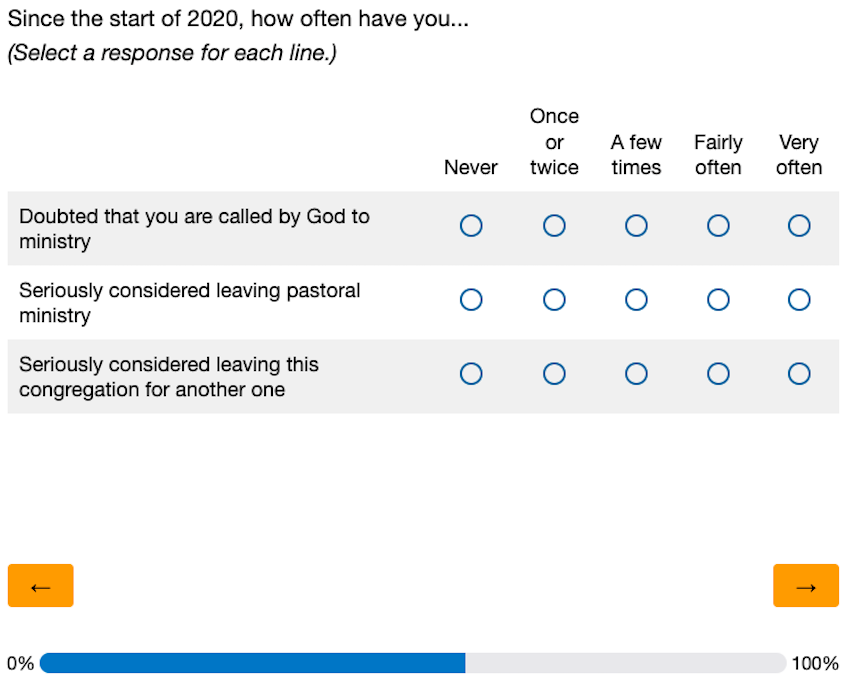
Screenshot of one of the questions from the online survey
Questions from the survey. Have I ever doubted that I was called by God to ministry? I left that one blank. Have I ever seriously considered leaving pastoral ministry? Not since 2020. Have I seriously considered leaving this congregation for another one? This was kind of difficult to answer, since I just started serving this congregation in 2022, and I left my previous congregation for reasons unrelated to COVID — so I answered “never.”

Pure Land

I got interested in the Buddhist Churches of America (BCA) after reading Jeff Wilson’s book Dixie Dharma: Inside a Buddhist Temple in the American South. Ekoji Temple, the one Wilson writes about in this book, was founded by Rev. Takashi Kenryu Tsuji in the 1980s. Tsuji had retired as a bishop of BCA, and Ekoji Temple was one of his retirement projects. In his book, Jeff Wilson quotes Tsuji extensively, and I found I resonated with what Tsuji had to say. As in this passage from Tsuji’s book The Heart of the Buddha-Dharma: Following the Jodo-Shinshu Path:

“Shinran Shonin and the teachers before him explained that the Pure Land was situated in the western corners of the universe, zillions of miles away. It was pictured as a very beautiful place, free of suffering, where everyone is happy. Philosophically speaking, however, the Pure Land does not refer to a specific location out there somewhere. Rather, the Pure Land is symbolic; it symbolizes the transcendence of relativity, of all limited qualities, of the finiteness of human life. In this transcendence, there is Compassion-Wisdom, an active moving, spiritual force. The Pure Land ideal is the culmination of the teaching of Wisdom and Compassion.”

First of all, Tsuji makes Pure Land Buddhism sound a little like Universalism. The old Universalists, coming out of the Christian tradition, said that everyone gets to go to heaven. Similarly, Pure Land Buddhists said that everyone can can enter Buddha’s Pure land, that is, everyone can achieve Buddhahood. We Unitarian Universalists translated the old Universalist ideas into modern terms, and that’s what Tsuji does for Pure Land Buddhism in this passage: “The Pure Land ideal is the culmination of the teaching of Wisdom and Compassion.”

What I like is that both groups have not only translated their religious traditions into Modernity, both groups say that all persons are radically equal. Maybe this is because I know I’m not good enough to be one of those Christians who gets into heaven, and I lack the self-discipline to become one of those Buddhists who reaches Enlightenment. Whatever the reason, I prefer the radically egalitarian religious groups.

Healing from religious trauma

Religion New Service interviews Laura E. Anderson, a psychologist who has written a new book, When Religion Hurts You: Healing from Religious Trauma and the Impact of High-Control Religion. In the interview Anderson makes the obvious point that the cure for religious trauma might not be renouncing all religion:

“[Religion News Service:] Why might it be important for therapists working with religious trauma not to be anti-religion?

“[Laura Anderson:] Anti-religious messages can quickly become prescriptive and fundamentalist. To say all religion is terrible and you just have to get rid of it, or the idea that God is dumb and only for mentally weak people, is incredibly shaming and discouraging. It’s also not necessarily helpful for the healing process. My job as a therapist is not to get you to a belief that I might hold. It is to help you heal and to lean in more to who you are authentically. I think that includes religion or spiritual practices. Now I always say I’m not anti-religion, but I am anti-harm and power and control, and anti-abuse. So if you can find a religion or faith or spiritual practice that isn’t including those things, I think that’s wonderful.”

I call this an “obvious point,” though it might not be obvious to everyone. But think of this analogy: if someone is sexually assaulted, psychotherapists don’t tell them to never have sex again. Instead, the therapeutic goal is healing so that the person who survived sexual assault can go on to have healthy relationships, including health sexual relationships.

The entire interview with Anderson is worth reading, not just for her thoughts about religious trauma, but also for her insights into trauma and healing from trauma.

Confucian quiet-sitting

I’m slowly making my way through a 19,000 word article on Confucian quiet-sitting — “A Study of Cheng Yi’s Quiet-Sitting Meditation and Other Contemplative Practices in the Confucian Context” by Bin Song, Mandala Texts (2023), 1-46 (https://doi.org/10.57010/NCGZ4591. Accessed October 6, 2023.)

Not only is it a fascinating article, it might have a real-world effect on the way I think about my own contemplative practices.

I’ve tried the the usual sitting meditation practices taught in North America, and I haven’t felt comfortable with them. Most of the sitting meditation techniques we learn in North America are based on Buddhist sitting meditation, or less often on meditation techniques from the Indian subcontinent. Both Buddhist and Indian meditation techniques are based on distinct end goals (e.g, nirvana in the case of Buddhism). Buddhist and Indian meditation techniques also presume a certain social orientation, often involving some kind of retreat or separation from society. So if you’re like me, and you don’t buy into the end goals or the social orientation of the usual sitting meditation, you’re likely to wind up not wanting to do sitting meditation.

The Confucian — or, to use scholarly jargon, Ruist — technique of quiet-sitting offers another type of contemplative practice. Quiet-sitting differs significantly from Buddhist sitting meditation. Bin Song writes:

“The term ‘sitting at ease’ is used in Chinese Buddhist texts to refer specifically to the Buddhist style of cross-legged sitting meditation. These two quotations suggest that [Ruist scholar] Cheng Yi had reservations to this style for two reasons: first, it encourages Buddhist practitioners to talk about miraculous but impractical deeds and events, and second, it detaches meditators from their everyday human affairs. Cheng Yi aimed to distinguish his contemplative practices from Buddhism and Daoism….”

In addition, Cheng Yi taught that quiet-sitting was just one of several contemplative practices that would achieve the same goal. Bin Song describes several of these. I was specifically interested in the one called “beholding the vitality of the myriad things,” which Song calls “among the most emblematic of Ru contemplation.” Here’s how Cheng Yi and his brother Cheng Hao describe this practice:

“By beholding pattern-principles in things, one can examine oneself. Once able to illuminate pattern-principles, there is nothing that cannot be understood. All things in the world can be illuminated by pattern-principles; if there is something, there must be a norm, and every single thing must have a pattern-principle.” — Cheng Hao and Cheng Yi, The Collected Works of Cheng Brothers (1981), 193.

Based on this description, “beholding the vitality of the myriad things” sounds like it has a family resemblance to the contemplative practice that Henry Thoreau did while living at Walden Pond. As in this example:

“In front of Cheng Hao’s window, the lush grass covered the pavement. Some people advised him to cut it, but he refused, saying that he wanted to witness the vitality of the creative universe. He also kept a small pond and raised a few small fish, which he beheld from time to time. When asked why, he said he wanted to behold how all things remain content in themselves.” — Huang Zongxi et al., Learning Cased in Song and Yuan —– vol. 14 (the He Shaoji print, 1648): 8, accessed March 30, 2023, https://ctext.org/library.pl?if=gb&file=22359&page=86&remap=gb#%E5%B0%8F%E9%B1%BC

Not the same as Thoreau, but you can see the family resemblance — close observation of the non-human world as a way of deeper understanding.

Bin Song begins the article by pointing out that, in the West, the field of contemplative studies has pretty much ignored Confucian, Jain, Jewish, and Sikh contemplative practices. Popular culture never gets much beyond Buddhist and Christian contemplative practices. Learning more about Confucian quiet-sitting might help all of us better understand the strengths and weaknesses of Buddhist meditation and mindfulness — just as happened a generation ago, when learning about Buddhist meditation helped us in the West better understand the strengths and weaknesses of Christian prayer. Not that we all have to go out and start pretending to be Confucianists — but another perspective might help us better understand ourselves.

Redesign

Back in 2015, the Unitarian Universalist Association (UUA) developed a WordPress theme for congregational websites. It was one of the best things the UUA has done in the past 25 years, because the theme made it super easy to build an excellent website in just a few hours.

Unfortunately, the UUA WordPress theme hasn’t been updated in three years, with no indication that it will ever be updated again. The design is beginning to look outdated. The theme relies on plugins that are now outdated, making it difficult to use the latest improvement in WordPress such as the Gutenberg block editor. We’ve been using the UUA WordPress theme in Cohasset, but it’s getting to the point where we feel like we have to start looking for an alternative.

So I’ve been looking at congregational websites to see what others are doing. I looked at the website of Temple Beth Israel in Northfield, N.J., because an old friend is rabbi there — love the site, but they hired a web design firm to make a custom WordPress template for them, which we can’t afford. Ditto with Grace Cathedral in San Francisco — another great site, but again we can’t afford a custom WordPress template. For a minimalist look, Unity Temple in Oak Park, Ill., uses a customizd version of the Kale WordPress theme. The Kale theme is free, but I’m sure they paid for the customization, which we probably can’t afford. The UU Congregation of Atlanta, Georgia, uses the Divi theme, which costs $89 a year. We can probably afford that, but it looks like Divi is complicated enough that we’d have to hire a WordPress developer, which we probably can’t afford.

Turning to websites we could maybe afford, Second Unitarian in Chicago uses the Cream Magazine theme, giving their site a nice straightforward look. The theme is reasonably priced at $49.

Um. Yeah. That’s it.

That’s the only UU congregational website I’ve found so far that looks good, and seems affordable.

But if you know of a great congregational website using an inexpensive WordPress theme, please put the URL in the comments….

Why we should follow the URJ’s lead

The Union of Reform Judaism (URJ) is in the middle of a restorative justice effort around various forms of misconduct. They released a message for Yom Kippur this year talking about how they will “make amends for the harms endured by victims/survivors” who have experienced “bullying, harassment, discrimination, sexual misconduct, abuse, and more” in URJ congregations and related programs.

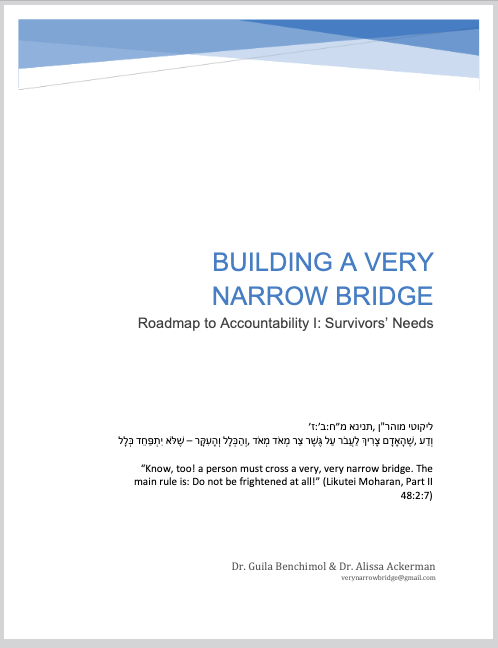
This follows the release and online publication — in full, with no redactions — of a third party investigation into misconduct in the URJ. That report was followed by a restorative justice effort which focused on survivors’ needs. This restorative justice effort began with a written report summarizing a long series of interviews with victims/survivors of misconduct. Additional efforts aimed at meeting the needs of survivors is ongoing through 2023.

The Unitarian Universalist Association (UUA) should follow the URJ’s lead. Just like the URJ, we need a third party to compile as full a report as possible on the decades of misconduct, especially (but not limited to) sexual misconduct, much of it perpetrated by clergy or other persons in power. A UUA report, like the URJ report, needs to name names. And it needs to be published on the UUA website with no redactions.

Then the UUA should follow the URJ’s lead and carry out restorative justice aimed at meeting the needs of victims/survivors. In the past, the UUA’s efforts to address misconduct have, all too often, minimized the impact on the misconductors at the expense of victims/survivors. To give just one example: when Rev. Jason Shelton was disciplined by the Ministerial Fellowship Committee, he was granted the privilege of writing an explanatory email that was sent by the UUA to all UU ministers and congregations; but the alleged victim was not given that privilege.

The UUA took a baby step towards restorative justice when they finally published a chronological list of ministers removed from fellowship. But soon — in a classic example of how the UUA considers the needs and feelings of alleged misconductors more than the needs and feelings of victims/survivors — the UUA changed the list. Now there are two lists on one webpage, one list for ministers removed from fellowship, and one list for the ministers who resigned from fellowship rather than face charges. The message to misconductors is clear — if you get caught, just resign from fellowship, and you get put on the less damning list. And if you resign from fellowship, the Ministerial Fellowship Committee will drop your case and never adjudicate it. Worse yet, from what I’ve seen, male sexual misconductors in particular are carefully protected from having their misdeeds brought to light, while their victims/survivors are tossed to the curb.

I sincerely doubt that anyone in the hierarchy of the UUA (and it is a hierarchy) has the gumption to propose a process like that the URJ has undertaken. For example, can you imagine the UUA publishing a report that names Saint Forrest Church as an alleged sexual misconductor? Neither can I. Patriarchy is still alive and well in the UUA.

As I read the URJ report of their interviews with survivors/victims, this passage stood out for me: “Again and again [the authors of the URJ report say], we heard that the most harmful institutional betrayal is the disjuncture between the direct and indirect harms that occurred despite the stated values the URJ seeks to uphold. One said, ‘You don’t practice what we [in the URJ] preach’…”

I wish we in the UUA would follow the URJ’s lead. Would that we, too, would attempt to practice what we preach.

Cover of the URJ report