A historical materialist looks at the “Jericho March”

There’s no doubt that today’s armed insurrection was driven by white supremacy. The well-publicized photo of a white man smiling as he carried a Confederate battle flag through the Capitol building makes that clear, if we hadn’t already figured it out.

There’s also no doubt that today’s treasonous actions were driven by the idolatrous heresy known as Christian nationalism. This New Religious Movement — maybe we should use the pejorative term, and call it a cult — followers of this cult of Christian nationalism believe that their god is somehow specially aligned with the United States.

The white supremacy, and the heretical idolatry, helped drive these white terrorists. But I think economic desperation is also driving the broader movement that thinks the election was stolen from their populist hero Donald Trump. There’s too much economic desperation, and that desperation is increasing as the pandemic drags on. There’s a growing number of people who can’t work from home, whose businesses have gone under, whose jobs have disappeared. The divide between the haves and the have-nots has been getting bigger for decades; the pandemic has accelerated this trend.

If we’re going to turn our country away from the treasonous armed terrorists, we absolutely have to address white supremacy. We absolutely have to address the idolatry of the cult known as Christian nationalism. And we also must deal with the economic desperation in the U.S.

Let’s hope today will be the end of Trump’s influence. But even if Trump goes away, the underlying problems will still be there. We have learned that white supremacy, idolatry, and economic desperation are a toxic mix, and we must address all three.

What’s in store for UUs in 2021?

My crystal ball is cloudy, so once again I’m unable to predict the future with any accuracy, but I have some guesses about what the new year has in store for Unitarian Universalist congregations.

(1) The pandemic will continue to affect Unitarian Universalist congregations through summer, 2021. Dr. Fauci says we’ll see widespread roll-out of the vaccine by May, but not only will there still be plenty of unvaccinated people in June, most Unitarian Universalist congregations will be heading in to their summer slow-down. And I’m expecting a big slow-down this summer for many congregations. Making the transition back to in-person worship and programs is not going to be easy, as staff and volunteers have to be mobilized in different ways. Key volunteers and staff are also likely to feel a little burned out, and will want some down time in the summer. I’m betting most Unitarian Universalist congregations don’t make a full transition back to in-person worship and programs until September.

And when congregations do return to in-person worship and programs, how many people will come back? On the one hand, people will be eager to see their old friends again face to face. On the other hand, we’ve all slipped in to now routines and habit; how many people will take the time to get up, get dressed, and drive to their congregation, when for the past year and a half all they had to do to attend worship was roll out of bed and turn on the computer?

So I predict we’re never going back to the way things were before the pandemic, but I’m not willing to guess what the future holds.

(2) Money will be tight. Financially, I’m expecting the majority of Unitarian Universalist congregations will be in worse shape after the pandemic than they were before the pandemic. Many congregations that own buildings depend on rental income to some extent, and a year and a half with reduced rental income will wreak havoc with budgets. All congregations will doubtless experience some reduction in income due to the depressed economy. For congregations with staff, I’m expecting staff cuts, layoffs, and/or salary reductions.

For staff, this has the potential to get ugly. Some hypothetical scenarios: Instead of seeing their position get slashed to part time, parish ministers will convince congregations to cut religious educators and administrators instead; good potential for inter-staff conflict here. Employees will watch their benefits erode; potential for conflict between staff and lay leaders here. Custodial staff will get laid off, and contracted cleaning services brought in to partially replace them; the loss of hands-on services provided by dedicated custodians could prompt conflict between lay leaders and members of the congregation.

So I predict we’ll see cuts in programs and services, along with an associated increase in the number of congregations in conflict.

(3) Generational conflict looms. Baby Boomers (my generation) have been running most Unitarian Universalist congregations for the past decade or two, after they took over power from the G.I. Generation. It’s been a good run for the Baby Boomers, but increasingly I’m seeing the Millennials questioning the way things get done in Unitarian Universalist congregations. Here are two obvious ways to question the Baby Boomer way of doing things: We all have a growing awareness of just how white our congregations are, and the old familiar answer we Baby Boomers gave for years — “There are so few people of color who live near our church” — just doesn’t seem adequate any more. We Baby Boomers have been dragging their feet about livestreaming worship services and other programs, and now that we’re all livestreaming it’s become obvious just how backwards we were.

Here’s a less obvious way we should all be questioning the Baby Boomer way of running our congregations: We Baby Boomers watched as second-wave feminism reshaped big chunks of American society. Unitarian Universalism got radically reshaped by second-wave feminism — with the seven principles and the flaming chalice and two new hymnals — and we Boomers were right in the thick of that reshaping. But now we’re all beginning to realize that second-wave feminism, while admirable in many ways, was also an elitist movement driven by a myth of hyper-individualism and a racist movement that left out women of color. We’re also beginning to realize that second-wave feminism sometimes has transphobic tendencies.

Will we Boomers be able to address the deep flaws of second-wave feminism? Given how defensive we are as a generation, I have my doubts. I’m looking to an alliance between Gen X and the Millennials to find creative, productive ways to move forward. But given how we Boomers cling to power (e.g., every U.S. president since 1992 has been a Boomer), I’m not expecting that the creative solutions proposed by the Millennials and the Gen Xers will suffer from either passive or active resistance by us Boomers.

No prediction here; in my view, this is a long-term trend to keep an eye on.

(4) The number of children and youth will continue to drop in most Unitarian Universalist congregations. The number of UU kids has been dropping steadily since 2005; and denominational and district/regional staffing and support for children’s programming has been dropping over the same time period. As children and youth programs shrink, congregations feel justified in cutting funding, leading to a nice strong feedback loop. Pandemic-induced budget cuts will only accelerate this trend.

There’s a bigger problem here. Families today want more options for their kids. Because of this, one-size-fits all programs are a non-starter. Yet that’s what Unitarian Universalist congregations mostly offer: one-size-fits-all programs for kids. The “conservative” congregations offer Sunday school, the “progressive” congregations offer intergenerational worship; but really both these approaches are hopelessly conservative, because they’re both the kind of one-size-fits all program that worked in the 1990s, but won’t work today. If we don’t offer choice in programming, fewer families will bother to show up.

So I predict the number of Unitarian Universalist children and youth will decline even more steeply over the next couple of years.

(5) Livestreaming worship services will continue. This is my only positive prediction this year: most congregations are going to keep livestreaming once the pandemic is over, and that has the potential for extending the reach of Unitarian Universalist in some really interesting ways.

I predict that congregations that devote some serious effort to continuing and improving livestreaming of worship and programs are going to reap major — but unpredictable- benefits.
Notable year-end quote

“Black critics have pointed out some evangelicals use abortion as a way to recuse themselves from the movement for Black lives and the injustices that disproportionately harm Black people. The claim of banning abortion often masks a commitment to white power. I’m wondering how that’s going to work in the future.”

— Andre Henry, program manager, Racial Justice Institute at Christians for Social Action; from Religion News Service, “What to expect on the religious scene in 2021: Experts cast their sights on the year ahead.”

Please note that Henry does not say that banning abortion always masks a commitment to white power. Nevertheless, this is still a very useful insight.

Christmas Eve

It was a strange Christmas Eve. We did the usual Christmas Eve candlelight service in the Main Hall of the Unitarian Universalist Church of Palo Alto (UUCPA) — but the only people there were Amy, the senior minister; Paul, the camera operator; and me. The music all had to be pre-recorded, and I set up my laptop next to my lectern (Amy and I each had our own lectern, about twenty feet apart from each other) so that I could join the Zoom call and be able to hear the music. The strangest part was not being able to see anyone: the whole point of Christmas Eve for me is seeing being able to see people, including the young adults who come back to Silicon Valley for the holidays.

Yes, it was a strange Christmas Eve.

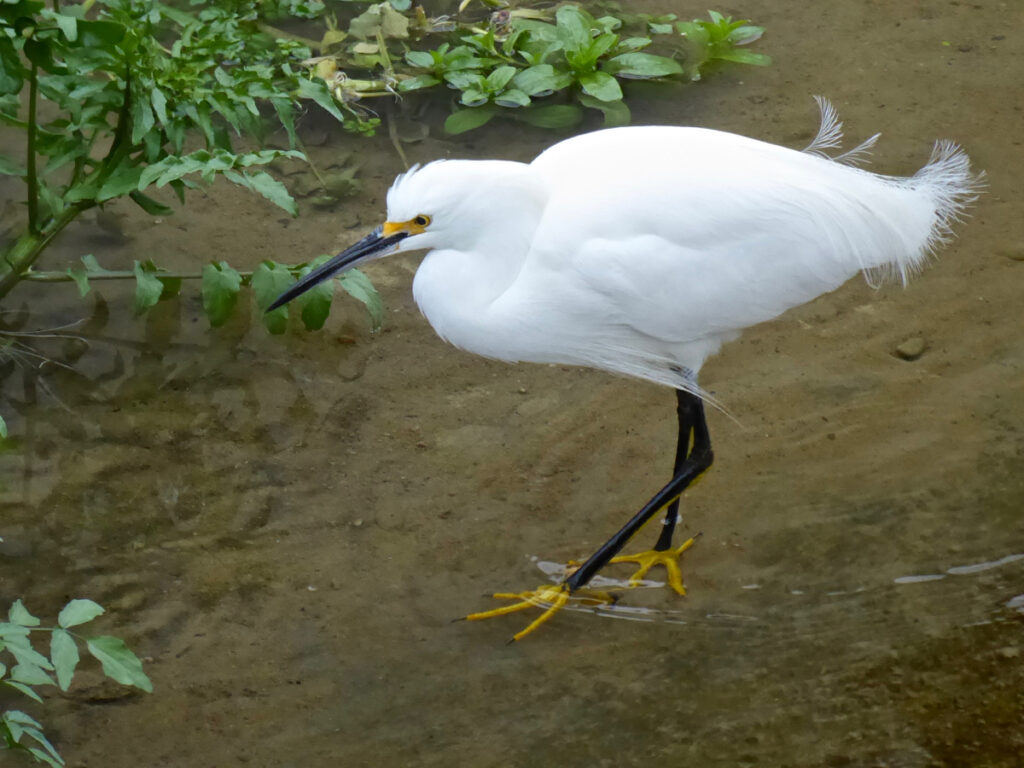
But something that happened in the afternoon made the rest of the day bearable. I was taking a break from checking email, and walked out to the edge of UUCPA’s campus to look down into Adobe Creek, which is routed into a large concrete channel for the last mile or two before it reaches the Bay. By fall, there’s always sediment that has accumulated during the summer, when not much water flows through the channel. This year, there was a luxuriant growth of what was probably water cress, and the last rain had been enough to cut some winding channels through the greenery, without washing everything down stream. The usual Mallards were paddling around, and then I noticed a Snowy Egret crouched behind a thicket of greenery; it lashed out with its bill, and appeared to spear something from the water.

I know Snowy Egrets are good at finding food anywhere, but I was a little bit surprised to see one in that particular urban channelized stream. There must have been enough prey to make it worth the bird’s time and effort; it’s a fairly sterile environment, so perhaps it was finding organisms washed down from upstream. Whatever drew it there, it certainly gave me a lift to see it.

Diversity

Because I’m currently taking the California Certified Naturalist class, I’m spending more time than usual looking at and photographing various organisms. I’m astonished at the diversity of organisms that I saw this week within a 45 minute drive of our house. I managed to see organisms from four kingdoms — plants, animals, fungi, and Chromista (which includes brown algae). Going down one taxonomic level, I saw organisms from over a dozen different phyla (for animals) or divisions (for the other three kingdoms).

This represents an astonishing evolutionary diversity: green algae, red algae, vascular plants; sac fungi and allies, mushrooms and allies; brown algae; sea anemones and allies, molluscs, sea stars and allies, arthropods, ringed worms, flatworms, chordates. And I saw eight of these taxonomic groupings within a five minute walk from my desk.

I have a tendency to focus on flowering plants and vertebrates, while ignoring other organisms. Sometimes it’s good to remind myself how much biological diversity is in my own back yard.

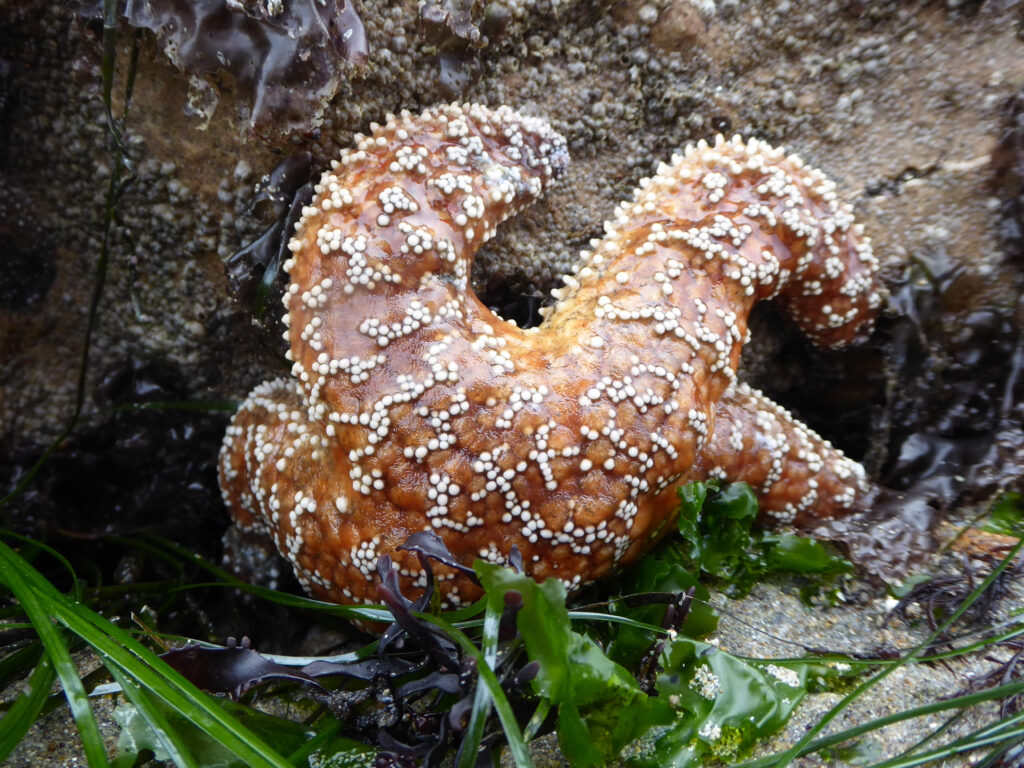
Ochre Sea Star (sea stars and allies), Sea Lettuce (green algae), Surf Grass (vascular plant), and unidentified red algae at Pescadero State Beach on Friday — that’s four phyla/divisions in one photograph.

Field journal

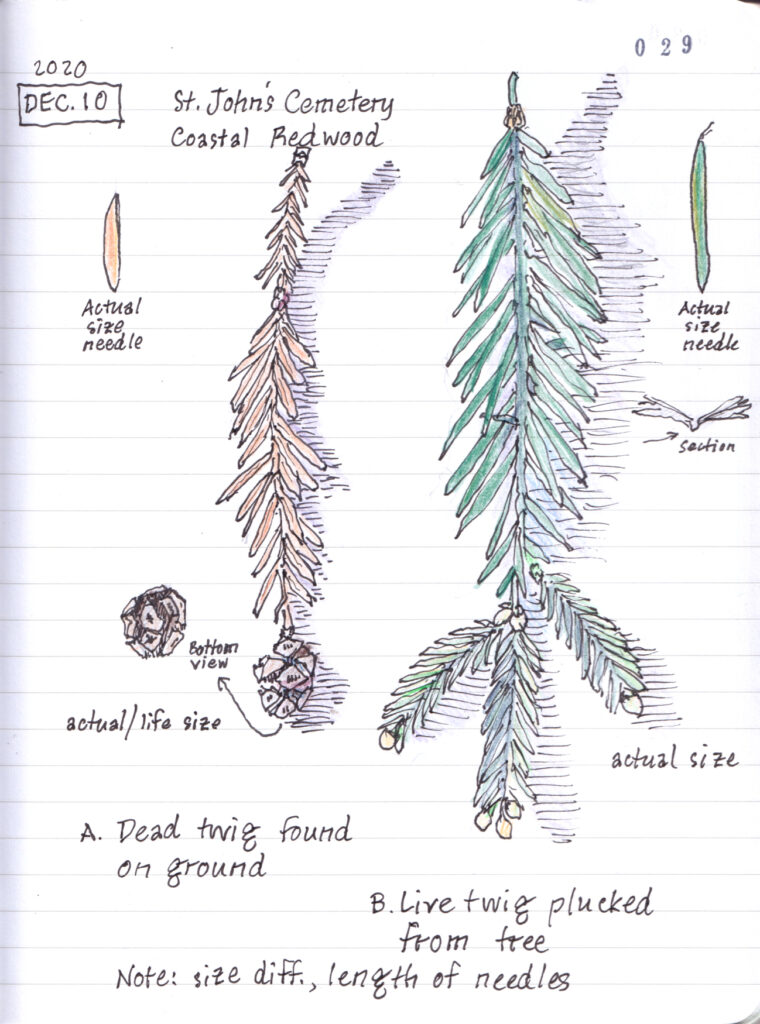
I’m currently taking the California Certified Naturalist class, with a curriculum developed by the University of California, and offered through a local environmental nonprofit, Grassroots Ecology. One of the ongoing assignments is to keep a field journal of observations of the natural world.

Keeping a field journal feels like a kind of spiritual practice to me. It’s a way to keep connected with the non-human organisms around us, and helps me pay attention to the abiotic components on which life depends. It forces me to get away from the computer and get outdoors, which is something I need to do more of. And it’s very calming, probably because I stop thinking about myself, and think about something larger than myself.

Phenology

Tonight was the first class in the California Naturalist course I’m taking, a course offered by a local nonprofit, Grassroots Ecology, and University of California Agriculture and Renewable Resources.

Tonight I learned that we’ll be participating in “Nature’s Notebook,” a citizen science project of the USA National Phenology Network, in cooperation with the US Geological survey. The Web site says, “Nature’s Notebook gathers information on plant and animal phenology across the U.S. to be used for decision-making on local, national and global scales to ensure the continued vitality of our environment.”

Put into plain English — With global climate change, spring arrives earlier and winter starts later. Ordinary people like you and me can help gather data on these changes by observing key species of animals and plants. They make it easy; you submit your observations using either a smartphone app or a Web site.

And I learned a new word, phenology, which the OED defines as “the study of times of recurring natural phenomena.”