I just finished an update of an 8-session curriculum (with an additional ninth alternate session) titled “From Long Ago.” This curriculum is based on stories from the old Sophia Fahs book From Long Ago and Many Lands. To avoid some of the biases Fahs had, I went back to the original sources she used, and referred to other translations and sources, to completely rewrite all the stories.
Version 2.0 of the curriculum has now been released — see it here. In addition to cosmetic changes and light editing throughout, I’ve added more illustrations. I also added several stories; version 1 of the curriculum required access to the 1948 Fahs book, but with the addition of these stories, Version 2 is now completely independent of the Fahs book.
I’m planning to release additional over the next few months. These new releases will be numbered as Version 2.x. I’ve already rewritten some other stories from the Fahs book, and am working on new session plans for those stories.
To allow for updates, this is an online-only curriculum for now. Someday if I have time, I may create a print-on-demand version, for those who prefer a hard copy (it’ll be expensive, though, due to the numerous color illustrations).
An excerpt from a book I’m writing about early Unitarian congregations in Palo Alto, Calif., 1895-1934. It’s also part of my series of posts on obscure Unitarians. The first biography is of Sylvie Thygeson, an early birth control activist. Birth control activists in the early twentieth century deserve greater attention, and hopefully her biography helps expand the amount of information in this area. Sylvie’s daughter Ruth was also a birth control activist, but since her life was short and outside the scope of my main research, I only have a brief biography of her.
An advocate for woman suffrage, and an early birth control activist, she was born June 27, 1868, in the small town Forreston, in north central Illinois. Progressive activism had a long history in her family. Even her name “Sylvie,” a French name, came from the family’s activism. Her paternal grandfather, a Presbyterian minister, and her grandmother were abolitionists and conductors on the Underground Railroad. When Sylvie’s father was a boy, he met an African American girl named Sylvie who was part of a family of fugitive African Americans escaping from slavery in Louisiana. When his own daughter was born, he named her after that African American girl.
Late in her life, Sylvie told the story that even though her paternal grandfather had been a Presbyterian minister, in the town she grew up in “we were the only family that were atheists.” Although their precise beliefs about the non-existence of God are unclear, they apparently had no formal religious affiliation.
She entered high school at age twelve and graduated at sixteen, after which she taught in a country school. But her teaching career only lasted for a month, until her father died. After his death, she was sent to live with an uncle in St. Louis, Mo. Her uncle, an appellate judge, gave her a job as a stenographer. She later recalled her time in St. Louis as a broadening experience, one that made up in part for her family’s inability to send her to college. As it happened, her uncle also gave her the beginnings of a solid legal education, and she learned enough about law in her two years in St. Louis to later gain her admission to law school as a second-year student.
Practical Theology Hub is a website that says it’s “a space for anyone with an interest in practical theology to share their reflections and explore new ideas.” It’s “not an academic website” but rather publishes short articles from partitioners, academics, students, and “retirees.”
Here are some of the titles of recent articles that caught my eye: “Growing closer to God through stained-glass windows: A dyslexic autistic perspective” (Christianity); “Neoliberalism, Social Inequality, and Christianity of Liberation” (Christian); “Food and interdependence: Responsibility in food donation” (Buddhist); “Avatar Discipleship – Who am I engaging with the avatar or the person?” (Christian); “My Friend, Siddhartha” (Indic religions); “Two Peoples Living in This Land” (Judaism); “Armed Resistance, Islam, and the Limits of Secular Approaches” (Islam).
The Religious Education Association is holding an online talk this evening. One of the presenters will be on ecological board games:
“Paul H. Van Straten, Memorial University of Newfoundland: ‘Anticipating the Opportunities and Challenges of Using Commercial-off-the-Shelf Games to Educate People on Environmental Sustainability in a Christian Context.’ Some studies show that digital games and board games can be used to facilitate religious learning in Christian post-secondary settings. Would game-based learning be a viable option for educating Christians on environmental sustainability in a congregational church environment? This paper analyzes several commercially-available ecological digital games and board games to explore potential learning opportunities and challenges for integrating such games in a Christian small-group study environment.”
Although the paper will tell about games in Christian communities, I imagine the findings will be applicable to Unitarian Universalist communities as well (perhaps with some tweaking and language changes).
This is actually a topic that I’ve been working for some years now. I’ve used various ecological games in Unitarian Universalist religious education for children and teens since at least 2006. Recently, I’ve been working on ecology games for adults. To this end, I recently attended an online talk by Thomas Maiorana, professor of design at U.C. Davis, where he introduced a board game he’s developing that’s intended to promote wildfire resiliency in local communities. (You can watch a recording of the talk here.)
Local congregations and faith communities should be ideal settings for ecology board games. So I’m looking forward to tonight’s presentation, in hopes that I’ll learn about some new games, and more importantly learn about implementation strategies.
For the record, some of the ecology board games I’ve used in UU settings include:
Wildcraft: A Cooperative Herbal Adventure Game teaches players about some common wild herbs. It plays well with mixed age groups, and in my experience kids up through middle school have fun with it. At approx. $50, it’s expensive.
NOAA’s Carbon Cycle Game shows how burning fossil fuels affects the carbon cycle. You can play this as a tabletop game, or as a run-around game.
Family Pastimes publishes several board games with ecological themes. I’ve played three of their games — A Beautiful Place, Earthquake, and Dragonfly with young children, and all three were fun and well-designed. Better yet, they were inexpensive, just $12-15 each. (But these aren’t adult-friendly games.)
Promoting Wildfire Resilience. Thomas Maiorana hasn’t yet made the board game publicly available, but will do so soon on this website.
In addition, the following are run-around games, not board games, but worth playing:
Lynxes, Hares, and Leaves is an active run-around game I got from environmental educator Steve van Matre’s book Acclimatizing. I’ve played this successfully with mixed age groups including adults and kids. Here’s an old version of my adaptation of this game. Someday I’ll get around to posting my updated rules.
The Food Chain Game is another run-around game that I’ve played successfully with mixed age groups. This is my heavily adapted version of a game from the old Project WILD curriculum. Again, one of these days I’ll post my rules.
Other games I’m intrigued by, but haven’t yet played, include the following:
Well, sadly the Ministerial Fellowship Committee (MFC) of the Unitarian Universalist Association (UUA) just sent out another notice of a minister removed from fellowship.
I keep on posting these notices here, just so there’s more of an online record of these events. By posting this, I’m not making any judgement about the minister in question, nor about the MFC’s decision. Since I’m not privy to the facts of the case, there’s no way I could make a judgement. My only purpose in posting this is to hopefully increase transparency just a teeny bit when ministers are removed from fellowship.
Here’s what the email from the MFC said:
“The Ministerial Fellowship Committee voted recently to remove the Rev. Kelly Spahr from fellowship for violation of MFC Rule 26, which requires ministers to notify the MFC immediately of any complaint of abuse and/or neglect of a child or any other person brought against the minister, and/or any complaint of domestic violence, harassment or request for a restraining order brought against the minister.”
Note that Rule 26 doesn’t appear to mean that a minister has engaged in, or been convicted of, abuse, domestic violence, etc.; the rule merely says that a minister must notify the MFC if such a complaint is lodged against them; i.e., even if there’s a false accusation, a minister still has to notify the MFC. This makes sense. But this also makes me realize that I haven’t read the MFC rules in a couple of decades, and if I ever knew about this rule I’ve long since forgotten it. Now I feel ignorant. And it looks like I had better review the MFC rules in the very near future.
Update, 10/23: Another email from the MFC came in at 7:56 yesterday evening: “The Ministerial Fellowship Committee voted recently to remove the Rev. David Kohlmeier from fellowship for egregious violation of the MFC’s rules and UUMA Guidelines, as well as our fundamental Unitarian Universalist values.” Kohlmeier had already been suspended from fellowship in 2022. Online, you can find plenty of news stories about Kohlmeier, but here’s a quick summary: In September, 2022, he was arrested in a sting operation and charged with using social media to solicit sex from minors. In March, 2024, he pleaded guilty to “felony attempted involuntary deviate sexual intercourse with a child under 16.” To make an obvious point: in this case, the legal facts are clear. Kohlmeier worked at the Falmouth, Mass., UU congregation from 2017 to 2021, and at the Harrisburg, Penna., UU congregation from 2021 t0 September, 2022.
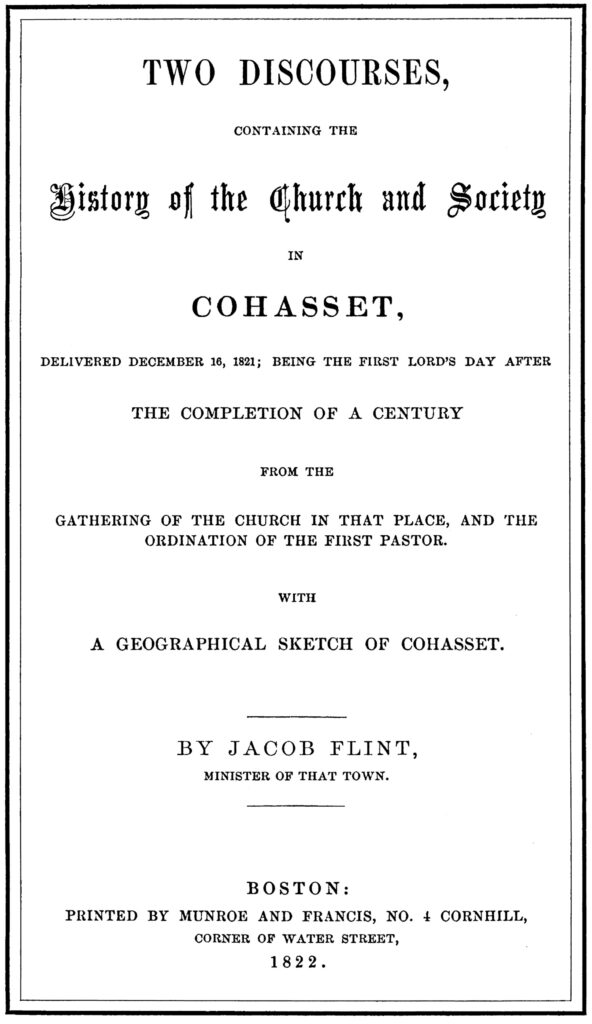
Below you’ll find the text of two sermons (with some annotations) published in 1822 by Rev. Jacob Flint of Cohasset, Massachusetts. While these sermons might appear to be of little interest to anyone except students of Cohasset history, they also contain some interesting theological content for those interested in the battles between the Unitarians and Trinitarians in 1820s Massachusetts.
Two years after Flint gave these two sermons, in December of 1823, he preached two sermons stating in no uncertain terms that trinitarian beliefs were supported neither by the Bible nor by human reason. The 1823 sermons precipitated a split in the Cohasset congregation. In the present sermons, preached in December of 1821, Flint claims that a couple of his predecessors were Unitarians in thought if not in name; in addition, he makes it clear that he agrees with his allegedly Unitarian predecessors. Anyone who heard the 1821 sermons could not have been surprised by the 1823 sermons.
Interestingly, the second of the 1821 sermons includes a long footnote in which Flint carefully outlines how the Cohasset congregation had lived in unanimity for most of a century. He must have been aware of the trinitarian leanings of some of his congregants; was this his way of trying to keep them from splitting the congregation?
I also noticed the way Flint erases the Indians from his account of Cohasset history, confining any mention of them to a short section labelled “Curiosities.” He never mentions how there were Indians who were members of the church in the mid-18th century. As it happens, I’ve just been reading Jean O’Brien’s book Firsting and Lasting: Writing Indians out of Existence in New England (Univ. of Minnesota: 2010), which examines the ways in which the authors of local histories in New England created the myth of the “vanishing Indian.” Flint’s sermons are early examples of that myth.
So there’s more going on in these two sermons than just boring local history!
Notes on the text: OCR-generated text found online was checked against a physical copy of the sermons in the archives of First Parish of Cohasset, and a number of corrections were made. Footnotes in the original have been numbered consecutively, with numbers enclosed in square brackets, and moved to the end of each section (Discourse I, Discourse II, and Geographical Sketch). A few editorial notes have been added, enclosed in square brackets. Pages breaks in the original have been indicated by enclosing “page X” in square brackets. One or two long quotations have been placed in separate paragraphs.
The 1823 sermons: Earlier this year, I put Flint’s 1823 Unitarian sermons (the ones which precipitated the split with Second Congregational Church) on this blog: the first sermon — the second sermon.
In an earlier post, I published the first of a series of two sermons preached by Rev. Jacob Flint here in Cohasset in December, 1823. In these sermons, Flint proclaimed publicly that he supported the Unitarian side of the Unitarian / Trinitarian controversy then raging through eastern Massachusetts churches of the Standing Order. Not surprisingly, once their minister openly espoused Unitarianism, the Trinitarian sympathizers in the congregation left to form their own Trinitarian church.
I’m finally getting around to publishing the second sermon, the one that Flint preached in the afternoon. I can’t help wondering how the Trinitarian sympathizers responded after hearing the first sermon, the one in the morning. Did they gather together during the lunch break to talk? Did some of them refuse to return for the afternoon sermon? If they did return, were they angry as they sat there listening to their minister tell them that their cherished theological beliefs were irrational, non-Biblical, and even unchristian? And how did the Unitarian sympathizers in the congregation feel? — were they perhaps relieved that at last their minister came out and stated openly the beliefs that probably everyone in the small town of Cohasset knew he held?
It turns out to be a fairly well written sermon. Today’s Unitarian Christians might even find it to be of mild theological interest.
But I suspect most of the interest this sermon holds today is its historical interest. It’s a sermon that cause an open rupture between Unitarians and Trinitarians in one small town. It is in a sense a microcosm of the larger theological and institutional battle raging through organized religion in eastern Massachusetts. Flint was not arguing about abstract theological issues; he was arguing with people that he knew well, people he saw every day. His sermon might even cause us to reflect on the power of words and the power of thought, and how words and thought can lead to open conflict and (according to tradition) acrimony as well.
Original page breaks are noted in square brackets, like this: [p. 14]. Footnotes from the original have been numbered and placed as endnotes. A few editorial notes have been included, always enclosed in square brackets.
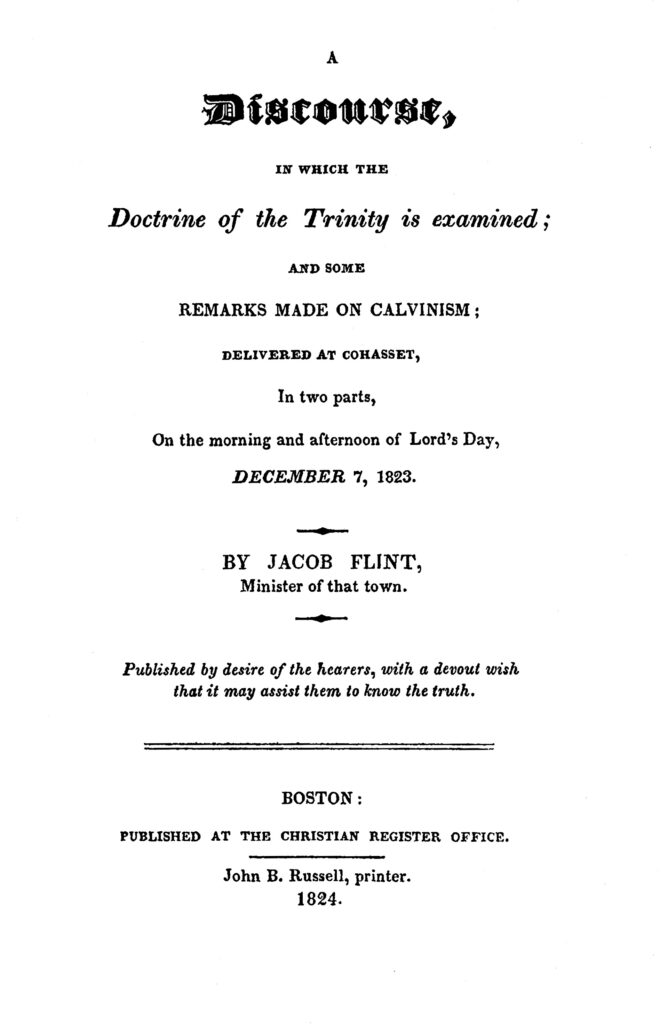
Discourse in which the Doctrine of the Trinity is examined…
by Jacob Flint (Christian Register: Boston, 1824).
[p. 11] PART II
[1] Thes[salonians] v. 21. — “Prove all things; hold fast that which is good.”
The Scriptures, given by inspiration of God, contain, as I attempted to show you in the morning, a system of doctrines and morals admirable for their simplicity and truth, and a most necessary guide for men to faith, duty, and happiness. They are in the highest degree profitable for doctrine, reproof, correction, and instruction in righteousness. But I had to remark, that unhappily for the peace of society, and good will of christians towards each other, these sacred writings had not long been in the hands of fallible and and erring mortals, before they were made to teach, for doctrines, the inventions and commandments of men. These inventions, or spurious doctrines, became the source of almost endless dispute, animosity and persecution among christians. For these dreadful effects, however, there is no blame that can justly be attached to the gospel, because that every where inculcates forbearance, charity, and good will in all men.
Our congregation’s Ecojustice Camp, a week-long summer camp, just finished its overnight. We left no trash ourselves, but we scoured our campsite for trash that might have been left by others. The campers carefully arranged the trash on a picnic table. Here’s a photo of all the trash we found:
The Ministerial Fellowship Committee (MFC) of the Unitarian Universalist Association (UUA) just sent an email to congregational leaders saying:
“The Ministerial Fellowship Committee voted recently to remove the Rev. Dr. Marian Stewart from fellowship for violating the terms of her probation. These terms were set in 2023 by the Committee based upon a complaint against Rev. Dr. Stewart. Refusal to adhere to those terms violates Rule 21 of the Ministerial Fellowship Committee, which requires ministers in fellowship to fully cooperate with the terms of their probation.”
Marian Stewart has already been removed from the online UUA database of professional staff. But her name is not listed on the UUA webpage “UUA Clergy Removed of Resigned from Fellowship with Completed or Pending Misconduct Investigations.” So maybe this is not misconduct? If so, then what’s this all about? Your guess is as good as mine as to why she was removed from fellowship.
Another website says that Stewart is retired from active ministry. So the violation of MFC probation could be anything from she just didn’t bother filling in MFC paperwork (because: retired), to — who knows what.
I understand the desire for transparency has to be balanced with the need for privacy and confidentiality. But somehow this email makes me feel that the balances have tipped well away from transparency in this case.
I also understand how hard it can be to come up with a process that covers all eventualities, so I’m willing to cut the MFC a fair amount of slack. But still, this email feels like it’s aimed at insiders, people who are already in the know — and those like me who are not insiders are left outside wondering what’s going on.
Part of my angst here is that I’ve spent a good part of my career in Unitarian Universalism cleaning up after clergy misconduct (and misconduct by other paid professionals). Clergy misconduct, in my view, thrives in secrecy and ambiguity. Thus when I see ambiguous statements like this one coming from the UUA, it bothers me.
Oh well. Listen to me whining. Heck, lots of things bother me. Just because something bothers me, don’t let it bother you.
Not many blog posts recently, as my spare time has been taken up with revising religious education curriculum.
I just completed a version of my full-year middle school “Ecojustice Class” curriculum for southern New England. Congregations in similar climates in the eastern U.S. should probably be able to use this curriculum as well. This is a beta test version — entirely teachable, but the curriculum is still a little rough around the edges.
Much of this is adapted from the northern California version of the curriculum, which we developed over ten years at the UU Church of Palo Alto. For New Englanders, I adapted this curriculum to a four-season climate. I added several proven session plans which have been adapted from Ecojustice Camp, as well as from my summer eco-spirituality workshops that I’ve led off and on since 2006 (mostly at Ferry Beach Conference Center).