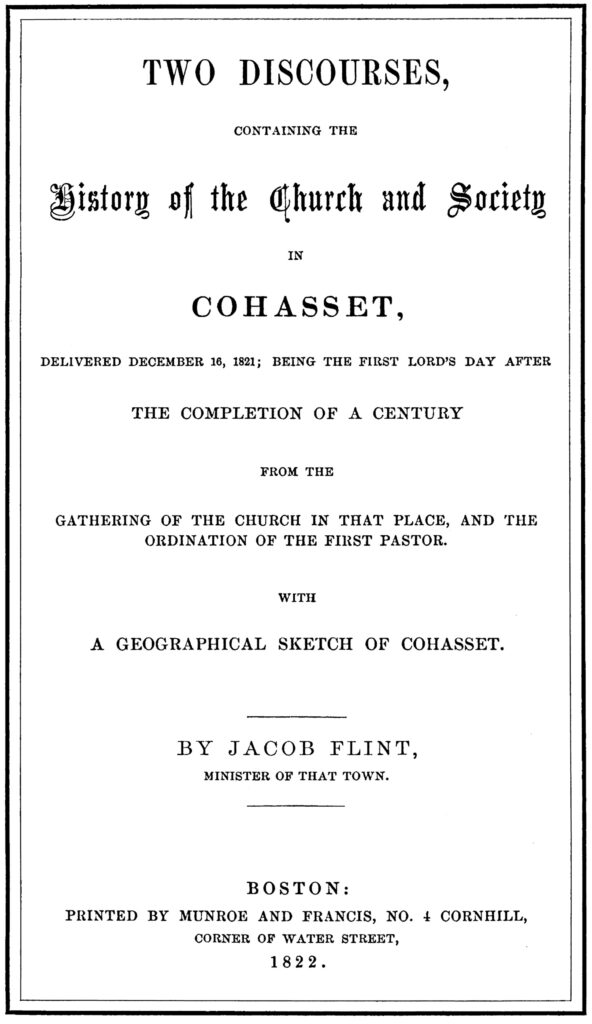
Below you’ll find the text of two sermons (with some annotations) published in 1822 by Rev. Jacob Flint of Cohasset, Massachusetts. While these sermons might appear to be of little interest to anyone except students of Cohasset history, they also contain some interesting theological content for those interested in the battles between the Unitarians and Trinitarians in 1820s Massachusetts.
Two years after Flint gave these two sermons, in December of 1823, he preached two sermons stating in no uncertain terms that trinitarian beliefs were supported neither by the Bible nor by human reason. The 1823 sermons precipitated a split in the Cohasset congregation. In the present sermons, preached in December of 1821, Flint claims that a couple of his predecessors were Unitarians in thought if not in name; in addition, he makes it clear that he agrees with his allegedly Unitarian predecessors. Anyone who heard the 1821 sermons could not have been surprised by the 1823 sermons.
Interestingly, the second of the 1821 sermons includes a long footnote in which Flint carefully outlines how the Cohasset congregation had lived in unanimity for most of a century. He must have been aware of the trinitarian leanings of some of his congregants; was this his way of trying to keep them from splitting the congregation?
I also noticed the way Flint erases the Indians from his account of Cohasset history, confining any mention of them to a short section labelled “Curiosities.” He never mentions how there were Indians who were members of the church in the mid-18th century. As it happens, I’ve just been reading Jean O’Brien’s book Firsting and Lasting: Writing Indians out of Existence in New England (Univ. of Minnesota: 2010), which examines the ways in which the authors of local histories in New England created the myth of the “vanishing Indian.” Flint’s sermons are early examples of that myth.
So there’s more going on in these two sermons than just boring local history!
Notes on the text: OCR-generated text found online was checked against a physical copy of the sermons in the archives of First Parish of Cohasset, and a number of corrections were made. Footnotes in the original have been numbered consecutively, with numbers enclosed in square brackets, and moved to the end of each section (Discourse I, Discourse II, and Geographical Sketch). A few editorial notes have been added, enclosed in square brackets. Pages breaks in the original have been indicated by enclosing “page X” in square brackets. One or two long quotations have been placed in separate paragraphs.
The 1823 sermons: Earlier this year, I put Flint’s 1823 Unitarian sermons (the ones which precipitated the split with Second Congregational Church) on this blog: the first sermon — the second sermon.
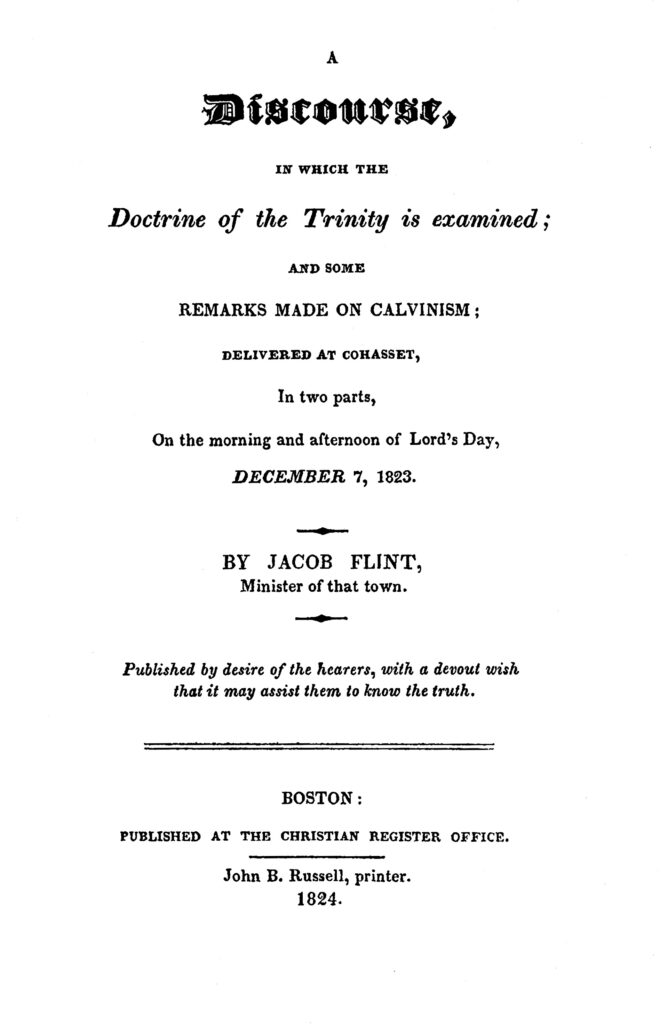
In an earlier post, I published the first of a series of two sermons preached by Rev. Jacob Flint here in Cohasset in December, 1823. In these sermons, Flint proclaimed publicly that he supported the Unitarian side of the Unitarian / Trinitarian controversy then raging through eastern Massachusetts churches of the Standing Order. Not surprisingly, once their minister openly espoused Unitarianism, the Trinitarian sympathizers in the congregation left to form their own Trinitarian church.
I’m finally getting around to publishing the second sermon, the one that Flint preached in the afternoon. I can’t help wondering how the Trinitarian sympathizers responded after hearing the first sermon, the one in the morning. Did they gather together during the lunch break to talk? Did some of them refuse to return for the afternoon sermon? If they did return, were they angry as they sat there listening to their minister tell them that their cherished theological beliefs were irrational, non-Biblical, and even unchristian? And how did the Unitarian sympathizers in the congregation feel? — were they perhaps relieved that at last their minister came out and stated openly the beliefs that probably everyone in the small town of Cohasset knew he held?
It turns out to be a fairly well written sermon. Today’s Unitarian Christians might even find it to be of mild theological interest.
But I suspect most of the interest this sermon holds today is its historical interest. It’s a sermon that cause an open rupture between Unitarians and Trinitarians in one small town. It is in a sense a microcosm of the larger theological and institutional battle raging through organized religion in eastern Massachusetts. Flint was not arguing about abstract theological issues; he was arguing with people that he knew well, people he saw every day. His sermon might even cause us to reflect on the power of words and the power of thought, and how words and thought can lead to open conflict and (according to tradition) acrimony as well.
Original page breaks are noted in square brackets, like this: [p. 14]. Footnotes from the original have been numbered and placed as endnotes. A few editorial notes have been included, always enclosed in square brackets.
Discourse in which the Doctrine of the Trinity is examined…
by Jacob Flint (Christian Register: Boston, 1824).
[p. 11] PART II
[1] Thes[salonians] v. 21. — “Prove all things; hold fast that which is good.”
The Scriptures, given by inspiration of God, contain, as I attempted to show you in the morning, a system of doctrines and morals admirable for their simplicity and truth, and a most necessary guide for men to faith, duty, and happiness. They are in the highest degree profitable for doctrine, reproof, correction, and instruction in righteousness. But I had to remark, that unhappily for the peace of society, and good will of christians towards each other, these sacred writings had not long been in the hands of fallible and and erring mortals, before they were made to teach, for doctrines, the inventions and commandments of men. These inventions, or spurious doctrines, became the source of almost endless dispute, animosity and persecution among christians. For these dreadful effects, however, there is no blame that can justly be attached to the gospel, because that every where inculcates forbearance, charity, and good will in all men.
Our congregation’s Ecojustice Camp, a week-long summer camp, just finished its overnight. We left no trash ourselves, but we scoured our campsite for trash that might have been left by others. The campers carefully arranged the trash on a picnic table. Here’s a photo of all the trash we found:
The Ministerial Fellowship Committee (MFC) of the Unitarian Universalist Association (UUA) just sent an email to congregational leaders saying:
“The Ministerial Fellowship Committee voted recently to remove the Rev. Dr. Marian Stewart from fellowship for violating the terms of her probation. These terms were set in 2023 by the Committee based upon a complaint against Rev. Dr. Stewart. Refusal to adhere to those terms violates Rule 21 of the Ministerial Fellowship Committee, which requires ministers in fellowship to fully cooperate with the terms of their probation.”
Marian Stewart has already been removed from the online UUA database of professional staff. But her name is not listed on the UUA webpage “UUA Clergy Removed of Resigned from Fellowship with Completed or Pending Misconduct Investigations.” So maybe this is not misconduct? If so, then what’s this all about? Your guess is as good as mine as to why she was removed from fellowship.
Another website says that Stewart is retired from active ministry. So the violation of MFC probation could be anything from she just didn’t bother filling in MFC paperwork (because: retired), to — who knows what.
I understand the desire for transparency has to be balanced with the need for privacy and confidentiality. But somehow this email makes me feel that the balances have tipped well away from transparency in this case.
I also understand how hard it can be to come up with a process that covers all eventualities, so I’m willing to cut the MFC a fair amount of slack. But still, this email feels like it’s aimed at insiders, people who are already in the know — and those like me who are not insiders are left outside wondering what’s going on.
Part of my angst here is that I’ve spent a good part of my career in Unitarian Universalism cleaning up after clergy misconduct (and misconduct by other paid professionals). Clergy misconduct, in my view, thrives in secrecy and ambiguity. Thus when I see ambiguous statements like this one coming from the UUA, it bothers me.
Oh well. Listen to me whining. Heck, lots of things bother me. Just because something bothers me, don’t let it bother you.
Not many blog posts recently, as my spare time has been taken up with revising religious education curriculum.
I just completed a version of my full-year middle school “Ecojustice Class” curriculum for southern New England. Congregations in similar climates in the eastern U.S. should probably be able to use this curriculum as well. This is a beta test version — entirely teachable, but the curriculum is still a little rough around the edges.
Much of this is adapted from the northern California version of the curriculum, which we developed over ten years at the UU Church of Palo Alto. For New Englanders, I adapted this curriculum to a four-season climate. I added several proven session plans which have been adapted from Ecojustice Camp, as well as from my summer eco-spirituality workshops that I’ve led off and on since 2006 (mostly at Ferry Beach Conference Center).
I just updated my story-based curriculum “Beginnings,” aimed at middle and upper elementary ages. This is a “light revision,” mostly cosmetic but with a few major changes.
This eight-session curriculum features explorations of truth — what is true, how do we know what truth is? This topic seems quite relevant in this presidential election year.
“Effect of the Edge on Eastern Cottontail Density: Urban Edges are Harder than Agricultural” studies Eastern Cottontail density in urban preserves in Mexico City, and concludes that this species of rabbit avoids the edges of urban preserves (perhaps due to noise, light, etc.). This effectively reduces the amount of land habitable by these rabbits in an urban preserve.
“The Bee (Hymenoptera: Apoidea) Fauna of a Transmission Right-of-Way in a Highly Developed and Fragmented Landscape of Central New Jersey” sampled bee populations in a power line right-of-way. The authors conclude that power line rights-of-way probably offer habitat for bees that would otherwise be lacking in a highly developed landscape. Unfortunately, 13% of the species found by the researchers were introduced or invasive bees. I was also struck by the observation that highways result in high bee mortality: “Roads can be substantial barriers to the movement of bees, and can cause high mortality that increases as roadway speed and traffic volume rises….”
As urban areas increasingly dominate our landscapes, obviously this kind of research is increasingly important. Since most of you reading this live in an urban or suburban area, it’s worth dipping into this journal to learn about some of the unforeseen effects our urbanized lifestyle has on other organisms…if we’re gonna feel guilty about eating meat, maybe we should also feel guilty about contributing to worldwide bee decline every time we drive on a highway.
I wrote this post while I was experimenting with cyanotype as a way to get people to look more closely at plants. I updated it several times, with the final revision on 21 August 2025.
(Updates: 30 May; 12 July 2025; 17 July; 20 July 2025. Final revision, 21 August 2025.)
Cyanotype books
Many of the books on cyanotype available online are self-published. The following two books come from reputable publishers.
Cyanotype: The Blueprint in Contemporary Practice by Christina Anderson (Focal Press, 2019), covers everything you need to know about cyanotypes — setting up a “dim room”; how to coat your own cyanotype paper; recipes for classic cyanotype, new cyanotype, and other formulas; how to tone prints; and more. Anderson tested over 100 different papers to see which worked best for cyanotype, and there’s a whole chapter on paper. The last chapter of the book showcases artwork by contemporary cyanotype artists. This is a must-have book.
Finding paper that’s good for cyanotype can be a challenge, since not only must the paper stand up well to repeated wetting, but the pH of the paper is also important. See Christina Andersons’ book for comprehensive information on papers.
One of the inexpensive papers Anderson recommends is Canson XL Watercolor paper. This is currently my go-to paper, and I can recommend it. Widely available at places like Michael’s and Dick Blick.
At a week-long summer art workshop, three of us loved Fabriano Medievalis paper. It’s slightly cream-colored, which sets off the Prussian blue of the cyanotype nicely. However, it does not stand up well to toning, or long wash baths.
I’ve also used Yasutomo “Sketch,” which produces similar results to Hahnemuhle Sumi-e, but is much less expensive. However, it’s very fragile in water and tears easily during the developing process — you can forget about bleaching and toning this paper. If you’re on a budget and very patient, maybe give it a try.
Cyanotype in the classroom
Lawrence Hall of Science sells “Sunprint Kits” with 12 pieces of 4 inch square cyanotype paper and a clear acrylic overlay sheet. Cost buying direct from them is US$5.99 per kit (do not buy from Amazon where the price is higher). This cyanotype paper develops quickly and requires little water to develop — perfect for classroom use. They also sell refill packs of 12 sheets of cyanotype paper for US$3.99, as well as 8-1/2 by 11 inch cyanotype paper. The kits and refills are ideal for class use — inexpensive enough to allow people to experiment.
My younger sister the children’s librarian uses 5×7 inch “Nature Print” cyanotype paper from Dick Blick. It’s just as good, but I’ll stick with the Lawrence Hall of Science paper, because my purchase helps support their science education mission.
Cyanotype websites
Many of the cyanotype websites appear to be “AI”-generated slime. Others are too basic (“Expose the cyanotype paper, put it water, look at the result!”). But I found the following websites to be worth a look.
Cyanotypes with plants
Cyanotype by Angela Chalmers, a PDF, gives instructions on making cyanotype photograms using plants. Great ideas, and the author’s photograms are gorgeous.
The “Koraks Tinkers” blog has a post pointing out the difference between collimated vs. diffuse light when exposing cyanotypes. Direct sunlight provides collimated light, while an overcast day provides diffuse light. This difference is less important when making contact prints from a negative, but will produce quite different results with 3-D objects. Cloudy skies = diffuse light, and blurred edges. Clear skies = collimated light, and sharp edges.
UV light boxes
A UV light box allows you to expose cyanotypes indoors, or at night. I finally decided not to build a UV light box (no room for one in our tiny apartment), but here’s some info I collected while researching them.
Cyanotype of two mullein leaves. The leaves were dampened before placing on the paper, so this is a partially wet cyanotype process — this yields the greenish hues seen above — and a longer exposure would have revealed more details of the veins in the leaf.
Because Yvonne asked me to, I put together a timeline of UU history. Instead of focusing on White male ministers from wealthy urban areas, my timeline includes people and events from outside the mainstream of UU history.
13 October 2025: Updated in an attempt to give at least one entry for every decade
Timeline of Unitarians and Universalists (mostly North American)
Because race is so important in the U.S., racial identities of U.S. individuals are generally given. I note with sadness that there are very few working class people mentioned on this timeline.
18th century
1736 Naomi Isaac, an “Indian” (possibly Massachusett) joins the liberal church in Cohasset, Mass., which later became Unitarian
1773 Caleb Rich (White) becomes minister of a new church in Warwick, Mass., that has a universalist theology
1775 John Murray (White), Universalist minister, serves as a chaplain in the Revolutionary army
1779 The Independent Christian Church (Universalist) organized in Gloucester, Mass., one of the earliest Universalist congregations in the U.S.
1785 King’s Chapel is the first Unitarian congregation in the U.S.
c. 1795 The scientist Joseph Priestley (White) holds Unitarian services in Northumberland, Penna.
c. 1795 Prince (no last name), a Black man, joins the church in New Bedford, Mass., as a full member
19th century
1823 Mary Rotch, a White Quaker in New Bedford, Mass., is expelled from Quakerism for being too liberal; she joins the Unitarian church, where she later influences Ralph Waldo Emerson
1838 Nathan Johnson, a Black Universalist in New Bedford, Mass., shelters Frederick Douglass on the latter’s first night of freedom
1843 Adin Ballou, a White Universalist, founds the Hopedale community, a utopian pacifist community in Mass.
1859 Elizabeth Palmer Peabody, a White Unitarian, opens the first kindergarten in the U.S.
1860 Samuel Jackson, a Black Baptist minister, asks to bring his entire congregation into the American Unitarian Association, but because he and his congregation are Black, he is ignored
1863 Olympia Brown, a White woman, ordained by the Universalist General Conference, the first woman to be ordained by a denomination (rather than just a congregation) in the U.S.
1871 Magnús Eiríksson, an Icelandic theologian living in Copenhagen, openly espouses Unitarian theology; this eventually led to the Icelandic Unitarian movement
1876-1878 The U.S. government invites Protestant denominations to manage American Indian reservations; the Unitarians receive the charge of Ute tribes in Colorado
1883 Poet William Carlos Williams, a Hispanic Unitarian, is born
1887 First Unitarian service is held in the Khasi Hills of India, led by Kissor Singh (South Asian)
1894 Watari Kitashima (Japanese) ordained by the Unitarian church of Vineland, NJ
1895 Eliza Tupper Wilkes, a White Universalist minister, is the first woman to preach in Stanford University’s nondenominational chapel
20th century
1902 The American Unitarian Assoc. publishes an essay promoting eugenics, written by David Starr Jordan, the White president of Stanford Univ. (Jordan was a member of the Palo Alto Unitarian church)
c. 1915 Sylvie Thygeson, a White Unitarian, helps open a birth control clinic in St. Paul, Minn.
1917 Adeniran Adedeji Isola (Black) founds the Unitarian Brotherhood Church (Ijo Isokan Gbogbo Eda) in Lagos, Nigeria
1918 Unitarian minister William Short Jr. is arrested for draft evasion, because he’s doing peace activism; when he appeals to the American Unitarian Association to confirm that he’s a minister, they throw him under the bus
1922 Abigail Eliot (White), an LGBTQ Unitarian educator, brings the nursery school concept to the U.S.
1923 The first Flower Celebration is led by Norbert and Maja Capek, ministers at the Unitarian church in Prague, Czechoslovakia. This ritual is later wrongly called a “flower communion.”
1930s Probably a third of all Unitarian and Universalist churches close due to the Great Depression
1932 Poet Sylvia Plath, a White Unitarian, is born
1935 Utah Phillips is born; a member of the Industrial Workers of the World labor union and a musician, he became Unitarian Universalist as an adult
1937 Unitarians and Universalists cooperate to create a new hymnal
1937 Concerned that Leila Thompson, an ordained Unitarian minister, is running for city council in Berkeley, Calif., as a Socialist, American Unitarian Assoc. officials do their best to disavow her
1942 Unitarian minister Norbert Capek dies in the Auschwitz concentration camp
1947 Stephen Fritchman, a White minister, is forced out of his job editing the denominational magazine due to accusations that he is Communist
1948 Imaoka Shin’ichiro (Unitarian) and Shigetaro Akashi (Universalist) found the Japan Free Religious Assoc. in Tokyo
1950s (date uncertain) UU ministers officiated at some of the earliest UU same sex weddings
1956 Christopher Moore, a White minister at First Unitarian in Chicago, founds the Chicago Children’s Chorus, an interracial chorus which rapidly became one of the best children’s choruses in the U.S.
1950s Religious liberals in the Philippines affiliate with the Universalist Church of America
1961 Unitarians and Universalists consolidate into one denomination; the new UUA bylaws have six principles
1964-1976 Rev. Andrew Yoshinobu Kuroda leads Japanese language services at All Souls Unitarian church in Washington, DC
1965 Year with highest Unitarian Universalist membership in the U.S.
1965 Victor Carpenter, minister in the Cape Town Unitarian church of South Africa, delivers sermon opposing apartheid
1965-1970 Unitarian Universalism loses half its Black members during the Black empowerment controversy
1977 Ysaye Maria Barnwell founds the Jubilee Singers, a gospel choir, at All Souls UU church in Washington, D.C., the first Black-led UU gospel choir
1977 First Unitarian of Los Angeles publishes the first Unitarian hymnal with Black and working class music in it
1980 The first Water Ritual takes place at a feminist gathering of women; later, it was wrongly called a “Water Communion”
1985 The UUA adopts new non-sexist bylaws with seven principles
1991 Cheng Imm Tan, an Asian immigrant, ordained as a UU community minister
1993 The UUA publishes a hymnal containing Black spirituals, the first official denominational hymnal (Universalist, Unitarian, or Unitarian Universalist) with non-White music
21st century
2004 Unitarian Universalist Association of Uganda is formed
2005 Last year of growth in U.S. Unitarian Universalism
2008 Carleton Pearson, a Black Pentecostal minister who became a Universalist, brings his congregation to the Unitarian Universalist church in Tulsa, Oklahoma
From about 2010 on, enrollment in UU children and youth programs declines steeply
2017 Peter Morales, the Hispanic president of the UUA, is forced out over allegations of racism
Last year, Dr. Vivek Murthy, the U.S. Surgeon General, issued an advisory report on social media and the mental health of kids:
“The current body of evidence indicates that while social media may have benefits for some children and adolescents, there are ample indicators that social media can also have a profound risk of harm to the mental health and well-being of children and adolescents….” — Social Media and Youth Mental Health (U.S. Surgeon General’s Office, 2023)
This is not just a public health concern. It’s also a religious concern, or should be. In a recent opinion piece, Rabbi Jeffrey Salkin writes:
“A religious temperament might mean questioning our utter reliance on such technology: creating islands of time, like the Sabbath or Sunday, when we would liberate ourselves from technology and being more self-aware of how we use our tools, which have become our toys…. That [old] rabbinic statement that has become a cliche: ‘Whoever saves one life, it is as if they have saved the entire world.’ If regulating access to social media will save the life of one kid, it will be worth it.”
We now know that social media has serious adverse effects on adolescent and pre-adolescent health. So let’s do something about it.