
The Ten-minute Wedding

Over the years, I’ve performed a number of ten-minute weddings. What’s the point of a ten-minute wedding? I’ve done these weddings for couples who had a friend officiate at their wedding ceremony then needed a legal wedding, and for other couples whose wedding ceremony was not, for some reason or other, a legal wedding. These weddings are also useful for those who want a courthouse-type wedding, but who prefer not to go to city hall to be married. Mostly I’ve done this type of wedding in my office at church, but memorably I did one for a couple at a restaurant where the waitress was one of the witnesses (the couple gave her a really big tip).

I realized I’ve never put this ten-minute wedding on my Web site. In case it might be useful to someone else, here’s the form I use:


The Ten-Minute Wedding

Intention: A and B, it is now time to begin your passage into marriage, by declaring your intent to marry and then by making your vows to each other. Are you now ready to begin your passage into marriage? [Answer “I am.”]

Vows:

I, A, take you, B, to be my spouse,
to join our visions for a better future,
to join our voices for equality and love,
to have and to hold,
from this day forward,
as long as we both shall live.

I, B, take you, A, to be my spouse,
to join our visions for a better future,
to join our voices for equality and love,
to have and to hold,
from this day forward,
as long as we both shall live.

[Or use these more traditional vows: “I, A, take you, B, to be my spouse, / to have and to hold, / from this day forward, / as long as we both shall live.”]

Declaration: Inasmuch as A and B have agreed in their desire to go forward in life together, seeking an ever richer, deepening relationship, and because they have pledged themselves to meet sorrow and joy as one, we rejoice to recognize them as married.

CC0


As far as I know, all these words are in the public domain, so I slapped a Creative Commons CC0 “No rights reserved” label on the wedding above (the words in blue type). That means it’s in the public domain, so you can use it, modify it, etc.

Here are some thoughts on this wedding from:

(1) Obviously, other vows may be used.

(2) While I’m pretty insistent on making weddings absolutely gender-neutral —I feel vows should be the same for both persons in the couple, and I use the gender-neutral “spouse” — you may have different views on gender neutrality. Feel free to use words like “husband” and “wife,” or to have one spouse to say they’ll “honor and obey” the other spouse (just so long as I don’t have to attend the wedding).

(3) An unspoken assumption in this wedding form is that both persons involved know exactly what they’re getting into, and both freely consent to the marriage. I wouldn’t perform a wedding unless both parties are fluent in English, or unless there’s a certified interpreter — many courthouse officiants have similar requirements. All the usual criteria for consent also apply: e.g., I won’t perform a wedding where one member of the couple appears to be dominating or abusing the other, or where one member of the couple appears to be intoxicated, or where one member of the couple is under the age of consent.

(4) I feel it’s archaic and ridiculous for the officiant to say, “You may now kiss.” (And no way would I ever utter the sexist words, “You may kiss the bride.”) If both members of the couple are above the age of consent, why do they need my permission? But at the end of the brief ceremony, I might remind them that this a a time when couples often kids each other, if they choose to do so.

(5) Although I call this a Ten-minute Wedding, if you’re the officiant you’ll want to schedule at least 15 minutes. You’ll need five minutes to check the marriage license, and get the couple settled down. The actual wedding takes about five minutes. Then another five minutes for you to sign the marriage license, and to have any witnesses sign as well (if your state requires witness signatures).

Finally — yes, I can do a Ten-minute Wedding for you if you need one. Email me to schedule a time to meet in my office. If I don’t know you, I’ll require a minimum $50 donation to LifeMoves, a nonprofit that provides services and housing to homeless people; if you can’t afford $50, let me know and we’ll work out a sliding scale. (Also, if you want anything more than the wedding shown above in blue — that means any customization, including writing your own vows — my fee immediately goes to $500, because customization requires more time from me.)
Many conservative Christians are appalled by anti-vaxxers

Steve Hassen, a conservative Christian, has written a blog post that explains why conservative Christians should get vaccinated. The blog post is based on a podcast interview with Professor Warren Throckmorton, a psychologist. Here’s an excerpt from the blog post:

“I asked Throckmorton for his view on the COVID-19 pandemic and what he thinks about vaccination? He and his family are vaccinated. When I asked him about Christianity and science, he told me Biblical sources provide believers guidance. He pointed out that Timothy, a disciple of St. Paul, had a stomach ailment. He was not advised to pray or just have faith but to take a little wine (that is, treat the ailment). Luke, who wrote one of the Gospels, was himself a physician. God gave us incredible gifts: our minds, intelligence, and curiosity. Certainly, we are meant to use our minds and think and not allow irrational fears to cause harm and death.”

Hassen covers a lot of ground in his blog post. He takes on Trump: “How can anyone [who’s] religious think God is using Donald Trump?” He explains how science and conservative Christian faith are compatible. He critiques Christian nationalism and dominionism, two of the biggest threats to U.S. democracy today. And he touches on the problem of narcissism in the pastors of mega-churches (some of what he says there reminds me of one or two people who used to be ministers of some of our largest UU congregations).

Hassen reminds me of the conservative Christians I used to know back in the day: people whose intelligence, morals, and ethics I held in great respect, even while disagreeing with them on some theological points. Unitarian Universalists who like to demonize white evangelical conservative Christians might want to read this post, and expand their horizons a little bit. If we’re going to stop the threat to democracy represented by QAnon and Trumpism, we need all the allies we can get.

Reforming police, 1969

In July, 1969, Jules Siegel interviewed several Black Panthers for an article he was writing. The Panthers he spoke to talked quite a bit about a topic that has been very much in the news over the past year — reforming the police. Field Marshal “D.C.” [Donald Cox] of the Black Panthers laid out the fundamental problem:

“It has been called police brutality. It’s a matter of educating people to the fact that yes, it’s brutal, but the term for it is fascism. Black people already know, because they’ve lived under fascist terror ever since we’ve been in this country. Fascism is the police running amok in the black community.”

“Poison,” a field lieutenant from the Chicago Black Panthers, outlined the Panthers’ solution — community control of police:

“Lots of people don’t understand what community control means. It means giving the people a voice. Right now they have no voice because it is a centralist form of government. Community control of the police doesn’t mean that the community would take over the present pig [i.e., police] department. It means that people will have people from within that community policing that community. If one of these police would commit a crime against the people, he [sic] would have to come home at night. It’s a hard thing to go home if you’ve committed a crime against your own people. Before you commit that crime, you begin to think.”

It’s also important to note that Field Marshal D.C. asserted that the fascism of the police was not rooted in race and racism per se:

“It’s in the interest of the power structure to propagate the idea that it’s a race struggle rather than a class struggle. As long as they can keep people divided into ethnic groups, the masses are not going to join together to form a united front against the exploiter who is oppressing everyone.”

In short, the Panthers saw that the real problem was not the police, but the power structure that the police represented.

The Black Panthers had many problems, including rampant sexism. But I still find much of their vision for society compelling. They saw that U.S. capitalism was upheld by a form of fascism, and that police brutality was one manifestation of that fascism. They wanted to wrest social control away from “the oppressor,” and put that control back in the hands of the people. And they combined grand theory with practical action: by July, 1969, the Panthers’ “Breakfast for Children” program was feeding 50,000 children a week across the U.S. In spite of their flaws, theirs was a grand vision for a more just and egalitarian society. This vision provides a necessary context for their proposals for police reform.

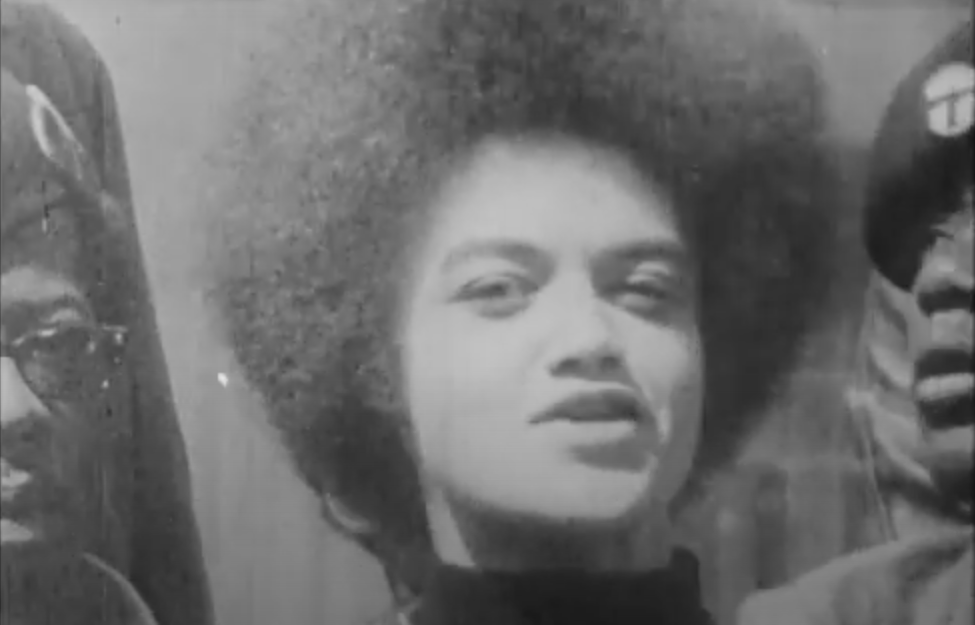
A screen grab from a National Archives video of the Black Panthers, c. 1966-1969, showing Party leader Kathleen Cleaver (?) speaking at Hutton Memorial Park, Oakland.

Notes: Interview excerpts from “The Black Panthers” by Jules Siegel, from his book Record (San Francisco: Straight Arrow Books/Rolling Stone, 1972). More about the Black Panther Party at the National Archives, including vintage video footage, and brief biographies of prominent women Panthers.

The big divide in U.S. religion today

U.S. Catholic bishops have voted 155 to 55 (with 6 abstentions) to deny holy communion to U.S. politicians who support abortion rights. Elected officials who openly support the death penalty will still be allowed to receive communion, even though the church’s catechism states, “the death penalty is inadmissible because it is an attack on the inviolability and dignity of the person.” Elected officials who deny climate change will still be able to receive communion, even though Pope Francis has said, “We need to act decisively to put an end to all emissions of greenhouse gases by mid-century at the very latest, and to do even more than that.” This is typical of U.S. religion today.

I have come to believe that the big divide in U.S. religion these days is actually politics, not theology. Do you support the Republican party line, or the Democratic party line? — that’s how the U.S. religious divide is defined. The U.S. Catholic bishops voting to deny communion to politicians who support abortion rights, yet taking no action on politicians who support the death penalty, may not seem logically consistent. Nevertheless, their stance is entirely consistent with Republican politics.

I’m pretty sure that Unitarian Universalists suffer from the same problem, on the other side of the political divide. Unitarian Universalism is doing its best to stand up against racism, sexism, transphobia, ableism (to some extent), and other forms of systemic injustice. Classism, however, is mostly dismissed or ignored within Unitarian Universalism. Nor does Unitarian Universalism engage in systematic critique of capitalism. Our stance may not be logically consistent, but it is entirely consistent Democratic politics.

Therefore, fellow Unitarian Universalists, before you speak scornfully of the Catholic bishops, first reflect on how Unitarian Universalism hews so closely to the Democratic party line. Instead of speaking of another religion with scorn, we might instead reflect on the words of a wise ancient Jewish teacher who said, “How can you say to your brother, ‘Let me take the speck out of your eye,’ when all the time there is a plank in your own eye?” In other words, I do hope we Unitarian Universalists don’t become merely a special interest group of the Democratic party.

A naturalist’s field journal

I’ll be leading a workshop on ecological spirituality at Ferry Beach Conference Center in Main this summer. One of the ecological spiritual practices I’m going to explore with participants is keeping some kind of nature journal. Although most nature journals focus on musings and emotions, it’s also possible to keep a nature journal rooted in the practices of field biologists. An example of the first type of journal might be Henry Thoreau’s early journals, where he relates his philosophical musings to his observations of the natural world. An example of the second type of journal might be Henry Thoreau’s later journals (1853 and later), where his close observations of the natural world lead to deeper insights into non-human organisms.

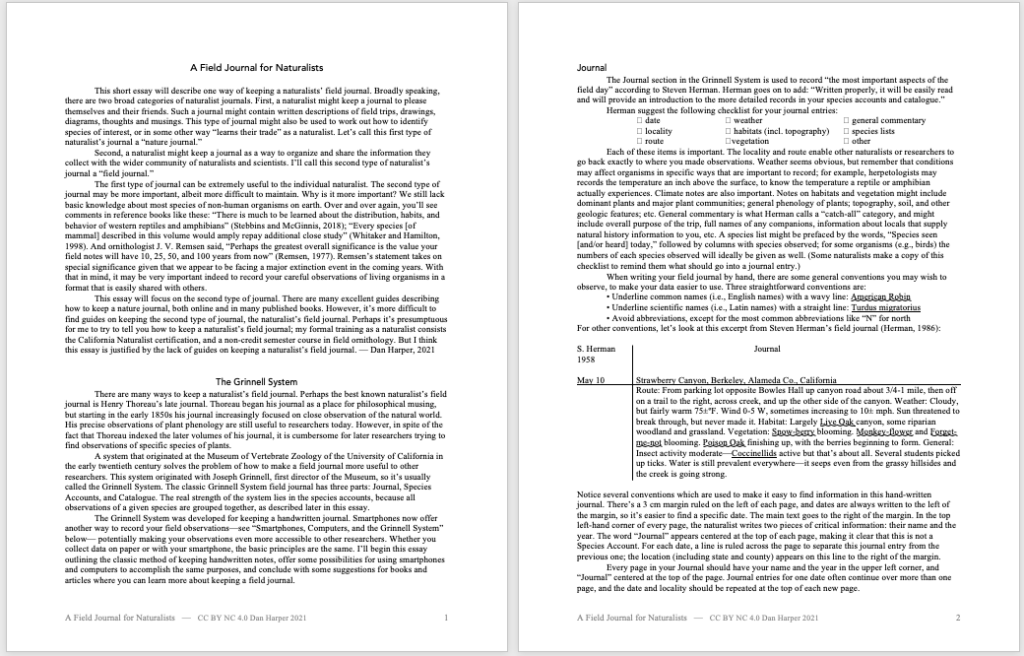
I’ve found lots of books and online resources that tell how to keep the first type of journal, but it’s more difficult to find accessible books and resources that teach people how to keep the second type of journal. So I wrote an eight-page introduction to the topic to share with the participants in the upcoming workshop. Click on the image below to read a PDF of “A Field Journal for Naturalists.”

The 2021 Stuffed Animal Sleepover

Birago Lion and Belinda Sheep introduce the 2021 Stuffed Animal Sleepover at the UU Church of Palo Alto. Dr. Sharpie and Elephant are going to help out, too.

Click on the image above to view the video on Vimeo.

Full script is below.

Continue reading “The 2021 Stuffed Animal Sleepover”

Black Wall Streets

The centennial of the destruction of Tulsa’s Greenwood district, known as “Black Wall Street,” has got me thinking about other Black Wall Streets that once existed in the U.S. — places where black entrepreneurs could find success more easily, places where African Americans could accumulate wealth. What happened to them?

Richmond, Virginia, had Jackson Ward, another Black Wall Street, a locus for black-owned businesses. In the 1950s, urban renewal — a turnpike cut through the middle of the neighborhood — was a major factor in destroying Jackson Ward as an economic center.

The Hayti neighborhood of Durham, North Carolina, is considered a Black Wall Street. Although much of the financial growth was driven by a couple of large black-owned businesses, the neighborhood launched a significant number of African Americans into the middle class. In the 1960s, it was destroyed by an urban renewal scheme.

The Fifteenth Ward of Syracuse, N.Y., was a Black Wall Street. Guess what killed off the Fifteenth Ward? If you guessed “urban renewal,” you guessed correctly.

What killed these Black Wall Streets? White mob violence (with the connivance of local government and even the National Guard) in Tulsa — government-decreed urban renewal in Richmond and Durham. The methods might have changed, but the outcome was the same, thus demonstrating yet again that capitalism in the U.S. gives preference to certain classes of people, while blocking others from achieving wealth through entrepreneurship.

In a number of places, local groups are starting their own initiatives to promote black entrepreneurship. I did quick Web search and turned up Black Wall Street organizations in St. Louis, Mo., Asheville, N.C., and Kalamazoo, Mich. There are other organizations that don’t use the “Black Wall Street” name, but promote a similar ethic, such as Black-Owned Brooklyn.

Many of us are skeptical of capitalism these days; there’s a growing suspicion that systemic racism may actually be a core part of capitalism’s feature set. Nevertheless, capitalism and entrepreneurship are just about the only way to get into the middle class these days. That being the case, maybe the best way to memorialize the demise of Tulsa’s Black Wall Street is to do business with local black-owned businesses.

Except that Amazon has eviscerated local retail business, Big Tech is degrading local businesses into the gig economy, banking and insurance and manufacturing are dominated by huge multinational white-owned companies which have destroyed local businesses…the methods keep changing, but somehow many African Americans still find themselves shut out of the middle class. As Mariahdessa Ekere Tallie puts it in her poem “Global Warming Blues”:

seem like for Big Men’s living
little folks has got to die.

Hafiz, Kalidasa, or Anonymous?

Two readings in Singing the Living Tradition, the 1993 Unitarian Universalist hymnal, have been bothering me. I’m not sure I believe their attributions.

(1) The first, #607, is a reading attributed to Khwaja Shams-ud-Din Muhammad Hafez-e Shirazi, better known by his pen name Hafiz (or Hafez):

“Cloak yourself in a thousand ways, and still I shall know you, my Beloved.
Veil yourself with every enchantment, and yet I shall feel your Presence, most dear, close and intimate.
I shall salute you in the springing of cypresses, and in the sheen of lakes the laughter of fountains.
I shall surely see you in tumbling clouds, in brightly embroidered meadows.
O beloved Presence, more beautiful than all the stars together,
I find your face in ivy that climbs, in clusters of grapes, in morning sun on the mountains, in the clear arch of the sky.
You gladden the whole earth and make every heart great. You are the breathing of the world.”

I didn’t find this poem searching either Google Books or Archive.org. Admittedly, Hafiz wrote hundreds of poems, so I can’t say that I’ve made a definitive search. However, I did notice that when searching the Internet for specific phrases from this reading, what comes up are mostly Unitarian Universalist Web sites.

I have no idea where this reading came from. It sounds somewhat like Hafiz. But who’s the translator? Where’s the reference to the Persian original? And then when I do a Web search for the final phrase, “breathing of the world,” there’s a lot of Unitarian Universalist sources that turn up. I wouldn’t be surprised if this turned out to be a Unitarian Universalist interpretation of a genuine Hafiz poem. I also wouldn’t be surprised if this turned out to be another poem by that most prolific of American poets, Anonymous. Given all this, the best attribution for this reading is probably “Unknown.”

But a big part of the attraction of this poem is that it’s supposed to be a Sufi poem. Many American Unitarian Universalists get their God fix by finding a non-Western author who expresses theistic sentiments; God seems less threatening when it comes from the non-Western world. I have to wonder if some Western religious liberal wrote this, using a pastiche of Sufi-sounding sentiments, to safely express their theism — which sounds like a kind of religious colonialism that I don’t want to have any part of. With that ugly possibility in mind, until someone can prove to me that this is a genuine translation of a Hafiz poem, I don’t think I want to use it.

Update, 5/31: Lisa identified this as a quote from Goethe; see the comments.

(2) The second reading which has been bothering me is #419, the one that begins begins “Look to this day!” The hymnal says, “Attributed to Kalidasa.” But should it really be attributed to the ancient Sanskrit poet? The first appearance of this quotation on Google Books appears in the 1895 Cornell University class book; thereafter, it appears in many different popular publications. But a search of Google Books and of Archive.org brings up no instance of this reading appearing in any translation of Kalidasa’s work, nor in any translation of any Sanskrit poems. To me, it doesn’t sound much like Sanskrit poetry, but it does sound a lot like one of those late nineteenth century American verses used as fillers by editors of periodicals.

Here’s the version reprinted in the April, 1911, newsletter of Bullfinch Place Church (Unitarian), Boston:

“Look to this day!
For it is life, the very life of life.
In its brief course lie all the verities and realities of your existence:
The bliss of growth—the glory of action—the splendor of beauty.
For yesterday is but a dream,
And tomorrow is only a vision,
But today well-lived, makes every yesterday a dream of happiness, and every tomorrow a vision of hope.
Look well, therefore, to this day.
Such is the salutation of the dawn.”

In the absence of proof that this really is a Sanskrit poem, the best attribution for this is “Anonymous.” With that attribution, this is still a good inspirational reading — no need to dress it up by calling it Sanskrit.

Saul and David

Another look at David’s story, part of a series of stories for liberal religious kids.

Once upon a time there lived a good and holy man named Samuel. Samuel lived in the land of Israel. He knew that Israel needed a good and strong leader. Samuel decided that Saul, son of Kish, would be the best person to rule over Israel, and so he anointed Saul king, and then served Saul as a holy man and an advisor.

Saul was a handsome man. There was not a man among all the people of Israel who was as handsome as he, and he was so tall that he stood head and shoulders over everyone else.

Saul was a likeable man. When he was a boy, he was easy-going and treated his parents with respect. When he became a man, he remained easy-going and friendly.

But even though he was handsome and likeable, every once in a while Saul would fall into a dark mood. It was more than just a bad mood. When Saul fell into one of these dark moods, the light went out of his eyes. When he was in one of his dark moods, he didn’t want to talk with anyone, he just wanted to stay by himself in his throne room. When he was in one of his dark moods, sometimes he would do things that were dangerous or foolish.

One day Samuel sent Saul off to do battle with the evil tribe of the Amakelites. Samuel warned Saul that if he won the battle, he must slaughter all the Amakelites’ cattle. This was because their cattle was diseased, and if Saul brought the diseased cattle back to Israel, all the cattle of Israel would grow sick and soon die.

Saul fought the battle, and he won. But unfortunately, after the battle he fell into one of his dark moods. He forgot what Samuel had told him, and he brought all the diseased cattle back to Israel.

Samuel met him, and cried out, “What is all this lowing of cattle that I hear?”

Suddenly Saul remembered what Samuel had him — but it was too late. The cattle were already in Israel. Sail felt terrible. He worried that Samuel could no longer trust him, and his mood grew even darker.

Samuel saw that Saul kept falling into these dark moods. He feared that Saul’s moods were growing worse and worse, and might some day overcome Saul entirely. So he decided to find a successor for Saul.

Samuel found David, the son of Jesse. David was a shepherd, he was short and cheerful, with red hair and bright eyes. Samuel anointed David in secret, and told David that soon he be the next king of Israel.

Saul knew none of this. But soon he fell into one of his dark moods again. His servants said, “One of your dark moods has come again! Command us to go and find someone to come an play beautiful music for you. The music will ease your pain and lighten your mood.”

One of the servants said, “I know a young man named David, the son of Jesse. He plays beautifully on the harp. He is also a warrior, and he doesn’t gossip.”

“Fetch him here,” said Saul.

So David came to live with King Saul, and his music helped to soothe the king when one of his dark moods came upon him.

But Saul’s dark moods got worse and worse, and they came more and more frequently. Sometimes Saul wouldn’t recognize David, and several times he attacked David.

Finally, it got so bad that David had to leave the king, and go live in the wilderness….

To be continued…

Source: Hebrew Bible, 1 Samuel 10-16, 31; 2 Samuel 1-3. The suggestion that Saul’s dark moods might have been a manifestation of mental illness comes from lectures given by Carole Fontaine, professor of Hebrew Bible, at Andover Newton Theological School in 1997.

The Story of David: David and Goliath

Going through my archives, I found my retelling of this classic story. I’m posting it here as part of my series of stories for liberal religious kids.

Once upon a time there was a shepherd named David. His three older brothers went off to fight in the army of Israel, under the command of King Saul. But David stayed behind with their father, Jesse, in the town of Bethlehem.

One day after his brothers had been gone for forty days, David’s father said to him, “Go take some bread and cheese and corn to the camp where your brothers and the rest of the army are — give this food to the captain of their company.”

When David got to the place where the army of Israel was, they were just getting ready to go to battle with the army of the Philistines. A great warrior, a man named Goliath, had just come out of the Philistine camp. He was over nine feet tall. He wore a helmet of brass on his head, he was armed with a coat of mail, and he wore brass armor on his legs and back. He carried a long spear, with an iron tip that weighed six hundred shekels.

Goliath stood in the valley between the two armies, and called out to army of Israel. “Why have you come to set your battle in array?” he shouted. “Am I not a Philistine, and are you not servants of Saul? Choose a man from among you, and let him come down to me. We will fight, and if he can kill me, then we will be your servants. But if I prevail against him, and kill him, then you shall all be our servants.”

David came up to the camp of the army of Israel right after Goliath had issued his challenge. All the men in the army were talking about it. “Have you seen this man who has come up from the army of the Philistines?” they said. “King Saul has promised that if any man dares to take Goliath’s challenge, and also manages to kill Goliath, the king will give that man great riches, and give him the princess in marriage.” But Saul and all his army were afraid of Goliath.

Eliab, David’s eldest brother, saw David just then. “What are you doing here?” said his brother angrily. “You’re proud and your heart is naughty. You just came down so that you could watch the battle.”

“No,” said David to Elia. “Our father sent me. But now that I’m here,” he went on, “I’m going to go fight this Goliath.”

Saul heard that David wanted to fight Goliath. Since no one else seemed willing to take on Goliath’s challenge, Saul sent for David. But when he saw how young David was, Saul said, “You’re not able to fight Goliath.”

“I have watched my father’s sheep,” said David, “and when a lion and a bear came and took a lamb from the flock, I went after them. I took the lion by his beard and killed him. And I killed the bear. And I can kill this Goliath, too.”

Saul decided to let David try. He tried to give David a helmet made of brass, and a sword to buckle around his waist. But David took off the helmet and the sword. Instead, he took his shepherd’s staff, and he took five smooth stones from the brook, and he took his sling.

When Goliath, the Philistine, saw David, the young shepherd, he laughed. “Come to me,” said Goliath, “and I will give leave you dead for the vultures to feed upon.”

“You come with a sword and a shield,” said David. “But I come in the name of Adonai, the god of Israel. Adonai will deliver you into my hand, and I will leave you dead for the vultures to feed upon.”

Goliath got up and started walking forward to meet David. David put his hand in his bag and took one of the five smooth stones. He ran ahead to meet Goliath, put the stone in his sling, and flung the stone so it hit Goliath right in the forehead. Goliath fell down dead.

When David returned to the camp of the Israelites, the soldiers took him to Saul. Saul adopted him as one of his own sons. And David became best friends with Saul’s own son, Jonathan.

To be continued…

Source: Hebrew Bible, 1 Samuel 18.