[An excerpt from my forthcoming book on Unitarians in Palo Alto:]
A minister and a professor at Stanford University, Burt Estes Howard was born February 23, 1863, in Clayton, N.Y. He went to school at Shaw Academy, Cleveland. He graduated from Western Reserve University in 1883, received a masters’ degree from Lane Theological Seminary, and was ordained a Presbyterian minister in 1886. He served as a Presbyterian minister in Michigan and Ohio from 1887 to 1892.
He married Sarah Gates 1890, and they had three children: Grenville (b. 1891), and twins Graeme and Emily (b. 1896). Sarah was a college graduate, having received her A.B. from Vassar in 1869.
He became the pastor of First Presbyterian Church, Los Angeles, in 1892, moving his wife and infant son to California. He only remained a pastor of that church for three years. In 1895, Burt was convicted of “insubordination” by the Los Angeles Presbytery, on what some considered to be trumped-up charges. The presbytery stripped him of his ministerial authority. Burt and his supporters appealed the conviction to the judiciary commission of the Presbyterian Synod in San Jose, which reversed the local decision. But then he was brought up on charges of heresy and insubordination again a few months later. On January 25, 1896, the Los Angeles Herald reported in a page two story:
“The Rev. Howard is to be charged with high crimes and misdemeanors innumerable. The bill of particulars, it is said, will allege that he has been guilty of denying the atonement. It will furthermore be alleged that he also questioned the integrity of the scriptures. This is not all. It will be claimed that the doughty pastor has advanced, stood by and defended the doctrine of evolution. He will also be accused, in all probability, of pantheism. This is something new, but it means that he has enunciated that all nature is good. Not content with this, an endeavor will be made to show that Mr. Howard has stood up for Unitarianism. These charges will be made, so it is claimed, by some of the members of Mr. Howard’s congregation. The congregation split, and those who withdrew formed another church.”
This second heresy trial finally drove him away from Presbyterianism. In 1897, while also serving as a lecturer in professional ethics at Los Angeles Law School, he organized the Church of the Covenant, a congregation independent of any denomination. He served as the minister of that congregation for three years.
“Tom Johnson loves baseball. And he loves the [Christian] church. Both, said Johnson, a former Minnesota Twins pitcher turned pastor, are in trouble. They’ve lost touch with their past and with ordinary people. They’ve become too much of a show, their leaders too disconnected from their audience, he said. Both religion and baseball see the people in the pews and the fans in the seats as sources of revenue rather than valued partners or supporters. They’ve betrayed the people’s trust, he said, and trust is hard to regain.”
The article goes on to talk about how boring baseball has become “boring and joyless.” That’s one of the reasons I no longer follow baseball — it’s not longer a game, it’s all about algorithms and analytics. My reaction to the postponement of Opening Day — yawn.
As for organized religion, in addition to religious leaders becoming disconnected from the people in the pews, Johnson offers this pointed critique:
“‘The [Christian] church has shot itself in the foot by not adhering to the values that have attracted it to people down through the centuries — that is, caring about the poor and those who are on the margins,’ said Johnson….”
Johnson may be on to something here. Organized religion does sometimes feel as boring and joyless as baseball, with leaders who only see the people in the pews as sources of revenue. This is even true for non-Christian religions like Unitarian Universalism. All too often, I’ve heard UU leaders saying, “We need to grow our congregation in order to increase revenue.” All too often, I’ve seen UU congregations very concerned with their own bottom line, yet with little energy left over to help unhoused persons find food and shelter.
Maybe this is the real reason behind the rise of the Nones (those with no religious affiliation) — religion has become too much like baseball.
A new study from Public Religion Research Institute (PRRI) looks into religious affiliations of QAnon devotees. QAnon devotees believe that governments, media outlets, and world finances are in the control of pedophiles who worship Satan. They also believe that there’s some kind of big convulsion coming that will get rid of all the powerful elites, allowing the world’s true leaders (like Donald Trump) to return to their rightful positions of power. And QAnon devotees believe that real American patriots are gonna have to get their guns and use violence to save America.
41 million Americans believe in QAnon — roughly 16% of the population. We usually think of QAnon devotees as white Protestant evangelicals. But you can find QAnon devotees in many different religious groups. For example, 17% of all QAnon believers are “Nones,” religiously unaffiliated Americans.
PRRI also looked at specific religious groups to determine what percentage of each religious group were QAnon devotees. So while 17% of QAnon devotees are Nones, only 11% of Nones are QAnon devotees. Hispanic Protestants had the highest percentage of QAnon devotees, at 27%. Interestingly, 17% of all Buddhists are QAnon devotees, whereas only 14% of white mainline (non-evangelical) Protestant Christians were QAnon devotees. And 7% of Unitarian Universalists are QAnon devotees.
Wait, what?!
7% of us are QAnon devotees. So if there are roughly 200,000 Unitarian Universalists, that means there are 14,000 Unitarian Universalists who are QAnon devotees. Well, I guess we can take comfort that there’s only one group — Jews — with a smaller percentage of QAnon devotees (5%).
Within the past couple of hours, Religion News Service has posted an article titled “Reform movement publishes extensive report on sexual misconduct in its youth programs.” The Union for Reform Judaism (URJ) commissioned an outside law firm to investigate sexual misconduct in their movement’s youth programs and summer camps over the past half century. Then URJ published the report in its entirety, with no redactions whatsoever, on their website.
I’m impressed that URJ has both commissioned this investigation, and that they’re being completely open and transparent about the results. Really impressed. Really, really impressed. Mind you, this investigation didn’t extend to individual congregations; that would have been a much more difficult task. Nevertheless, by commissioning this investigation, the URJ has set the standard for individual congregations.
It’s time for the Unitarian Universalist Association to commission a similar investigation into our denominational youth ministries. I was very active in denominational youth activities in the late 1990s and early 2000s, and I heard enough stories back then to make me think that an investigation would turn up more sexual misconduct than anyone would feel comfortable with.
If the UUA were to commission a law firm to carry out this kind of investigation, what should we look for? We should look for exactly what the URJ looked for: sexual misconduct by adults (anyone over age 18) against minors (anyone under age 18); sexual misconduct between minors; and sexual misconduct between adults at youth activities. As I look back 50 years to 1972, at a minimum the following programs should be investigated: “ConCon,” the former continental youth conference; district youth conferences; and any other programs or summer camps run by Liberal Religious Youth (LRY) or its successor Young Religious Unitarian Universalists (YRUU).
The UUA doesn’t have a great track record of investigating and publicly admitting the sexual misconduct that’s happened in our denomination. This is a grand opportunity for us to do the right thing. I hope our denominational leaders will follow the shining lead of the Reform Jews.
Someone pointed out to me that Star Island has posted an interesting job opening. Star Island, for those of you who aren’t familiar with it, is a retreat center off the coast of New Hampshire that was founded by Unitarians and liberal Congregationalists, and remains affiliated with the United Church of Christ and the UUA.
The position, titled “Island Minister/Beloved Community Project Manager,” will “work to further Star Island Corporation’s Beloved Community Project — a diversity, equity, and inclusion initiative that is a core strategic priority of the Star Island Corporation (SIC).” This is a laudable goal, and it’s simply amazing that a nonprofit would hire a full-time year-round staffer to oversee diversity, equity, and inclusion.
There’s just one problem. The job posting does not list the salary range. Instead, applicants are told to submit their “salary requirements.”
I call bullshit.
The reason I call bullshit — and the reason that I use such a strong word to describe their action — is that refusal to include a salary range in a job posting is in itself a discriminatory act. In fact, in some jurisdictions, it is now illegal to post a job with no salary range: BBC news recently reported that Colorado now requires all job posting to include the hourly wage or the salary range. Similarly, SHRM recently reported that New York City will require all job posting in the city to include salary ranges. Why? Manhattan Councilwoman Helen Rosenthal says, “Failure to include a salary range would be considered a discriminatory practice.” That’s right, a discriminatory practice.
BBC has also reported: “Research shows that the pay gap, which is well documented, partly stems from the ‘ask gap’: the difference in salary expectations between groups, which undercuts women and minorities in particular. Closing this gendered and racialised ‘ask gap’ can pay major dividends for careers, reducing long-term salary inequality.”
Star Island is engaging in a discriminatory hiring practice — a practice that’s illegal in Colorado and New York City — in order to hire a staffer who will oversee diversity, equity, and inclusion. Oh, the irony. If you’re someone who has connections to Star Island (especially if you make donations to them), please contact their board and CEO and call them out on this racist, sexist practice.
We also need to call out all the UU congregations that post jobs with no salary range. Some day if I ever have time, I’m going to go through the job postings on the UUA “Jobs Board” and the LREDA employment postings and make a list of all the congregations that post jobs with no salary range — a sort of “Hall of Shame,” showing which congregations have racist, sexist hiring practices.
This is an equity issue that’s easy to fix. Let’s fix it.
Thich Nhat Hanh, a Vietnamese Buddhist monk known for popularizing the concept of “Engaged Buddhism,” has just died. (He died Jan. 22 in Vietnam, on the other side of the International Date Line, which was Jan. 21 here in the U.S.) He had been incapacitated by a stroke in 2014, and in 2018 finally received permission from the Vietnamese government to return to his home temple to spend his final days. His name is more properly rendered as Thích Nh?t H?nh, but I’ll use the more common romanization without tonal indications.
Thich Nhat Hanh is probably best known for his series of popular books on Buddhism. Worldcat lists the following titles as the five “most widely held works” in libraries: The Miracle of Mindfulness; Living Buddha, Living Christ; Peace Is Every Step: The Path of Mindfulness in Everyday Life; Anger: Wisdom for Cooling the Flames; and Being Peace. Nhat Hanh arguably did more than anyone else to popularize the concept of mindfulness in the West.
The book of his that I found most interesting, though, one to which I’ve returned a number of times, is The Sutra of the Full Awareness of Breathing (Parallax Press, 1988). This book includes Nhat Hanh’s translation of the ?n?p?nasati Sutta, along with his commentary on the text. This Sutra is no. 118 of the “medium length” sutras that have been collected into the Majjhima Nik?ya. (A later revised version of his translation is now freely available on the website of his Plum Village Buddhist community here.) Nhat Hanh translated the text into French, which was then translated into English; I found the English translation to be lucid, readable, and non-technical. I also liked his The Heart of Understanding: Commentaries on the Prajnaparamita Heart Sutra; I find Buddhist scriptures difficult to understand, and Nhat Hanh’s commentary helped me understand a little bit about this complex text.
But I think Thich Nhat Hanh’s real impact as a writer and teacher was through his many popular books which give good sound advice for living life. I’ve read a little bit in some of his many books on mindfulness, and was impressed by the good common-sense tone of these books. Unfortunately, mindfulness grew into a fad, and big corporations have learned how to use mindfulness as an opiate to drug their workers into submission. But what Nhat Hanh said about mindfulness had nothing to do with submission to a corporate overlord. Quite the contrary: Nhat Hanh’s writings are permeated with the spirit of Engaged Buddhism, and mindfulness connects one fully with the fate of all beings; instead of quietism and retreat from the world, Nhat Hanh’s mindfulness moves us to become engaged in seeking justice.
If your corporate overlord forces you to do mindfulness — or if your school forces you to do mindfulness — try reading Nhat Hanh’s The Miracle of Mindfulness. You’ll find out that mindfulness is not a drug forcing you to submit to your employer or your school. Nhat Hanh used mindfulness as a way to advocate for peace during the long-running war in Vietnam. Mindfulness helped empower him to criticize both South Vietnam and North Vietnam, and also to stand up against U.S. involvement in Vietnam, at great personal cost. Mindfulness helped bring Nhat Hanh to the U.S. in 1966, where he helped convince Martin Luther King, Jr., to speak out against the injustices of the Vietnam War. In short, unlike the mindfulness that corporations and schools teach, which seems designed to ensure passive compliance with tyranny, Nhat Hanh’s mindfulness is designed to resist tyranny, oppression, and injustice.
I’m less interested in Nhat Hanh’s teachings on mindfulness — personally, mindfulness does nothing for my spiritual self — and far more interested in him as a teacher. Everyone I’ve talked to who saw him in person has said he was a riveting teacher. Apparently, his English skills weren’t great — I’m told Vietnamese and French were his main languages — but even through an interpreter his teaching was compelling. I get the sense that it was his presence as a teacher that most impressed those who went to hear him. This has been true of the best teachers I’ve known: there’s something about the way they move, the way they hold their bodies, it is their very being that teaches us. The best teachers, I think, cultivate their persons — or as we might say in the West, cultivate their souls — and it is this cultivation of the person which shines through in their teaching. While I never experienced Nhat Hanh in person, I can catch glimpses of this cultivated soul in his writings. I would unhesitatingly call him a brilliant teacher.
Our troubled world needs brilliant teachers like him, teachers who can empower us to stand up for justice and peace. Thich Nhat Hanh will be sorely missed.
I’m watching the case rates in Santa Clara County, where the Palo Alto congregation is located. The 7-day rolling average is over 4,000 — yikes, that’s high. On the other hand, preliminary figures for mortality seem to show a low death rate — probably due in part to the fact that 82.8% of county residents have been fully vaccinated (thought only 58.2% of eligible residents have received boosters). But on the other other hand (that’s three hands, if you’re keeping track), anecdotal evidence from health care professionals says that ICU beds are getting full again, and elective surgeries and procedures that require an overnight stay in the hospital are being postponed.
Obviously, this is not where we hoped to be. But rather than feeling discouraged, I suggest we consider this as another problem in planning. So, how do we plan for next steps in our congregations?
First, just to say the obvious — any plan we make has to be flexible, to account for changing circumstances.
Second, to say something else that’s obvious — we’ve discovered that the big thing that draws many people to UU congregations is the community. Sure, we like the theology, but the big draw is a chance to be a part of a community with shared values. And many people want to get a regular dose of UU community in person.
Third, something else that’s obvious — we’re gaining a pretty good sense of what’s safest, and less safe. It’s safest to do in-person gatherings that are outdoors, distanced (or small groups), and masked. It’s less safe to do indoors events, but some indoors events are still possible in some circumstances. Instead of saying, “Oh we can’t do what we used to do, waaah!” we probably need to start saying, “Gee, what are our present options for fun and engaging communal events?”
So here’s one obvious thing I believe we should be doing: we should be planning outdoors events. Whatever that might be: outdoors worship services, outdoors small group meetings, outdoors classes. (And I know what those of you are going to say who live where winters are really cold — you’re going to say this doesn’t apply to you. Well, my-sister-the-children’s-librarian, who lives and works in Massachusetts, is doing outdoors story time for kids in the winter; sure, her attendance is lower, but people still show up.) It’s true that not everyone in your congregation is going to come to outdoors events, but I suspect enough people are hungry for in-person interaction that it’s worth doing.
Another thing I believe we have to do: start planning like COVID is not going away. I would love it if COVID suddenly decided to go away next month. But it now looks like there’s a good chance that COVID is going to become endemic. If it has become endemic, then we’re going to have to learn to live with it. So maybe we should start thinking about one or more of the following: requiring proof of vaccination; think about shorter indoor worship services (e.g., 45 min., to limit time spent indoors); adding more worship services (so you can have more smaller indoors services); creating permanent spaces for outdoor programs where possible; improving ventilation in indoor spaces; and/or many other things.
Another obvious thing we should do: for our online offerings, keep improving community interaction. I’ve been noticing that many people are getting better at participating in online events — video conferencing is a learned skill. Similarly, I believe many of us are getting better at facilitating online communal interactions. In my own case, I’ve become much better at teaching online, and at facilitating online meetings — again, these are learned skills. As we continue to get better at participating in and leading online events, one of our goals should be improving community interaction.
One final thing I believe we should be doing: we should go easy on ourselves. Yes, the pandemic is probably going to kill off some UU congregations; but if you start thinking that way, you’re liable to either get tense and stressed out, or sad and filled with grief, neither of which is going to help keep your congregation going. Of course, getting overwhelmed and doing nothing is also not helpful; my point here is that we do need to do something, we just don’t need to be overachievers. My primary rule for congregational life has always been: if it’s not fun, let’s not do it. This still holds true during the pandemic!
I’m actually feeling pretty positive about congregational life in the immediate future. Yes it’s different from what I’m used to, and yes it’s hard to let go of a lifetime of past expectations, and yes change is annoying and difficult. But new possibilities are opening up, and I’m actually feeling quite positive about the future of our congregations.
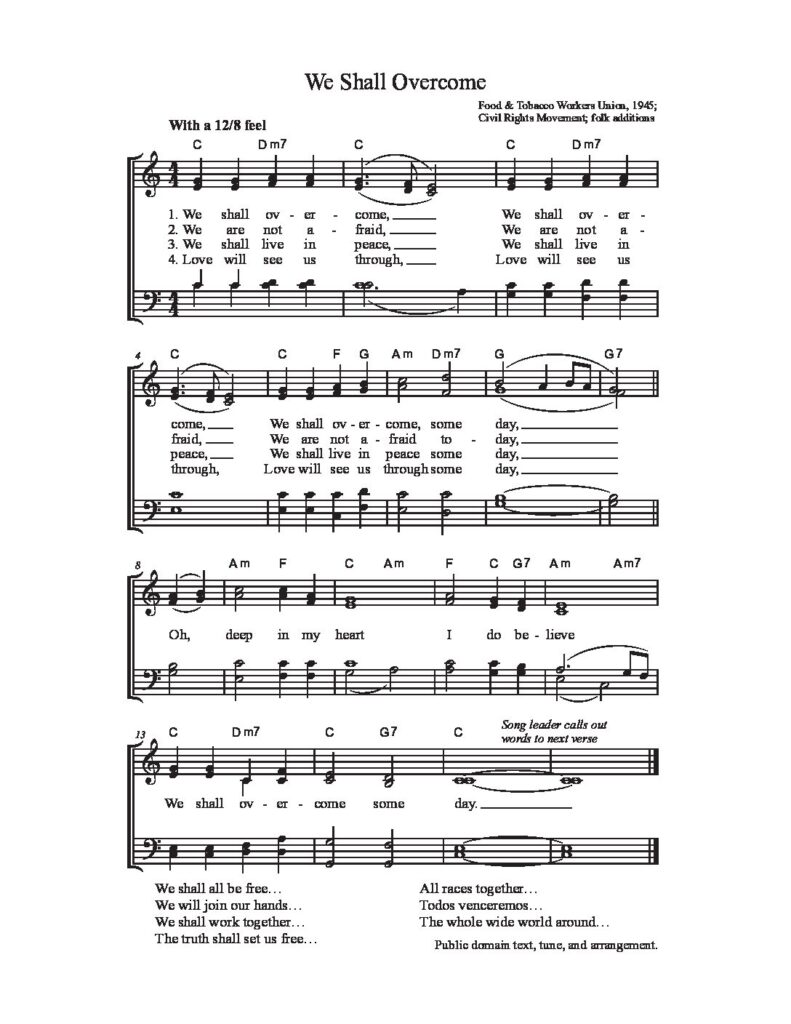
I recently learned that the song “We Shall Overcome” is now in the public domain, due to a 2017 court ruling and a 2018 settlement. A lawyer tells the whole story in some detail here.
The short version: In 2017, a federal court ruled that the tune, arrangement, and first verse of “We Shall Overcome” are in the public domain (We Shall Overcome Foundation v. The Richmond Organization, Inc., 2017 WL 3981311 [S.D.N.Y. Sept. 8, 2017]). In addition to the court ruling, the defendant and plaintiff subsequently entered into a settlement agreement which said, in part, that TRO would not “claim copyright in the melody or lyrics of any verse of the song ‘We Shall Overcome’”; furthermore, TRO agreed that all verses of the song were “hereafter dedicated to the public domain” (We Shall Overcome Foundation v. The Richmond Org., 330 F. Supp. 3d 960 [S.D.N.Y. 2018]).
This is very good news indeed. Sure, now the song can be used in all sorts of horrible advertising. At the same time, now you cannot be slapped with a royalty fee for using “We Shall Overcome” in your worship service, in the video that you made of some rally or demonstration, or in the audio recording of you singing at a coffeehouse.
Of course, just about all the piano or choral arrangements out there are copyright protected, including the one in the current UU hymnal. So here’s a very basic arrangement of “We Shall Overcome” which I’m releasing into the public domain; and hey, if you don’t like my version, it’s a public domain song so you can write your own! (I’ve changed a couple of the usual verses so they’re less ableist.)
Click the image above for sheet music.
By the way, I’m finding that it’s a good song to sing around the house now that we’re hunkered down because of the Omicron surge.
Part Six of a history I’m writing, telling the story of Unitarians in Palo Alto from the founding of the town in 1891 up to the dissolution of the old Unitarian Church of Palo Alto in 1934. If you want the footnotes, you’ll have to wait until the print version of this history comes out in the spring of 2022.
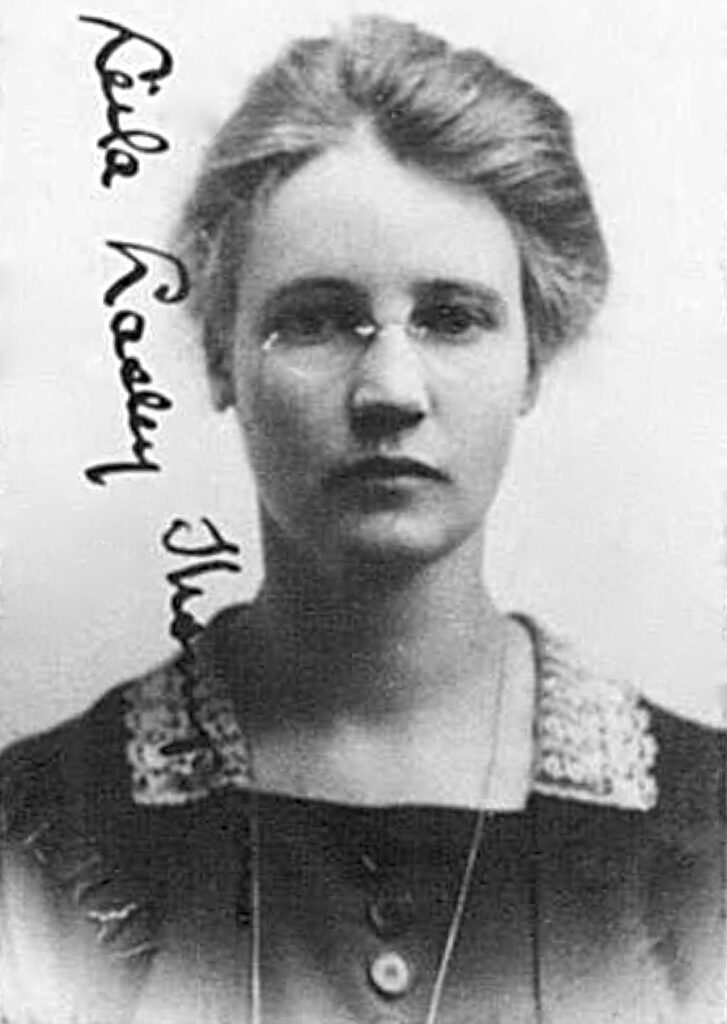
In late 1925, Elmo Robinson could look back on “four happy years, profitable to me, and I hope to the church.” But he had grown restive. He received a grant so that he could study for a semester at Harvard University in the first half of 1926. He found, or the church found, Leila Lasley Thompson to fill in for him while he was away. Thompson had married a soldier in 1918 who then was killed in action a few months later, leaving her a war widow. She then studied for the ministry at Manchester College, Oxford, England, a Unitarian theological school; was fellowshipped as a Unitarian minister by the American Unitarian Association; and pursued post-graduate study in 1925 at the Pacific Unitarian School for the Ministry.
Robinson departed at the end of 1925, leaving Leila Thompson in charge of the congregation. The congregation ordained her on Sunday, February 7, 1926. A month or so later, Robinson decided that he wasn’t going to return to the church. He apparently decided to pursue an academic career, although a note from him dated April 5, 1926, has a cryptic reference about protecting himself from “the charge of using this leave of absence as an opportunity of running away from an unpleasant situation without giving everyone a chance to be heard.” The “unpleasant situation” may well have been the long-standing conflict between the pacifist faction and the pro-war faction. Not even Robinson, with his skill and experience, had been able to heal that conflict.
After going east, Robinson never returned to Palo Alto — which sounds a little too much like Bradley Gilman’s departure from the church. In September, 1926, the church called Leila Thompson as the sole minister of the church. She was reportedly the first regularly ordained woman to serve a minister of a Palo Alto church.
Sadly, Leila Thompson received little support from the lay leaders. Sunday morning attendance dropped even more, from 34 in 1925, down to 27 in 1926, and then to 22 in 1927. Sunday school plummeted from 62 in 1925 down to 25 by 1927. The Young People’s Group continued to be active; Gertrude Rendtorff was still a Stanford student, and perhaps her continued participation kept that group going.
Alfred S. Niles, a lifelong Unitarian, moved to Palo Alto with his wife Florence, also a Unitarian, in the fall of 1927. When they arrived in town, Alfred and Florence sought out the Unitarian church. He found a church that was “still functioning, but rather feebly.” He was told that the church had once been active, “but the minister at the time of World War I had been a pacifist and conscientious objector [i.e., William Short, Jr.], and this had caused a split in the church from which it never recovered.”
Attendance got so low that the congregation tried moving the services to the evening, but that didn’t help matters. At the end of December, 1927, Leila Thompson resigned. It appears from the extant records that everyone became aware that there really wasn’t enough money to pay her salary any more, not even with the assistance the church still received from the American Unitarian Association. The church got Clarence Vickland, a student at the Pacific Unitarian School for the Ministry, to come preach to them in 1927-1928. Sunday morning attendance continued to drop, down to an average of 21, and by December, 1928, the Sunday school had closed “as there was not sufficient interest manifested to justify continuing the work.”
Finally, in 1929, the church stopped holding services altogether. Clarence Vickland wrote to the Women’s Alliance asking if they would like to host a visiting Unitarian minister on March 3, but they replied that “it would be impossible to get the congregation together.” 1929 was also the year that Karl and Emma Rendtorff retired to Carmel. With the Rendtorffs about to leave town, there was no real hope for the church. In May, 1930, Rufus Hatch Kimball reported to the Women’s Alliance that the Board of Trustees had turned the church building over to the American Unitarian Association. The church had finally dissolved.
The Women’s Alliance was declining, too. They continued to work on charitable projects — at their June, 1932, meeting, they worked on sewing for the Needlework Guild — but their numbers were shrinking. By May, 1930, the membership list had only nineteen names, and after Anna Probst Zschokke’s name appeared the notation, “Died May 30, 1929.” Like the church, the Alliance was slowly winding down and dying away.
The building sat vacant until early 1931. Then in February, 1931, Mary Engle reported to the Alliance that the American Unitarian Association had begun fixing up the building, and it was “now all in good repair and new locks have been put on the doors so that no invading hands could open them and…have access to Church of Alliance property.” By Easter Sunday, services were once again being held in the church, and Merrill Bates, the theological student who had been given charge of the church, had started up the church school once again.
The Alliance tried to help with the revived Sunday school, but grew discouraged with the tiny attendance, leaving Merrill Bates to manage on his own. Merrill Bates, Berkeley Blake, regional field secretary for the American Unitarian Association, and William S. Morgan, president of the Pacific Unitarian School for the Ministry, each preached to the church once a month, with Bates arranging supply preachers for the other Sundays.
Bates continued in the Palo Alto church until he graduated in spring of 1934. It’s hard to know how many of the old-time members still participated in the church. On March 27, 1932, Henry David Gray, who had become a member of the church in 1905, preached the Easter sermon. But most of the old members had either died, or moved away, or given up on the church. The Alliance held its last meeting on October 11, 1932, without even coming to a conclusion as to whether they should formally dissolve or not.
In April, 1934 — a month or so before Merrill Bates graduated from the Pacific Unitarian School for the Ministry — the American Unitarian Association put a “For Sale” sign up in front of the building. The building soon sold, for less than its mortgaged value. The American Unitarian Association retained possession of the organ, however, and gave it to the Unitarian church in Stockton, Calif. on permanent loan (Clarence Vickland was then the minister in Stockton). As Alfred Niles put it, there would be “no more organized Unitarianism in Palo Alto for several years.”
Interregnum, 1934-1947
Indeed, there was no organized Unitarianism in Palo Alto for almost exactly thirteen years. In 1936, the liberal Quaker Elton Trueblood became the chaplain at Stanford University, and some Unitarians — like Alfred and Frances Niles — found Stanford’s Memorial Church a congenial place to go on Sunday mornings. Other Unitarians found other religious homes. Josephine Duveneck became active with the American Friends (Quaker) Service Committee, and eventually became a Quaker herself. Alice Locke Park also became a Quaker. Several Palo Alto Unitarians gave up on organized religion altogether.
Even for the Unitarians who went to hear Elton Trueblood preach each week at Stanford, there was no Unitarian Sunday school for those with children, and there was no Unitarian minister to officiate at rites of passage such as weddings and funerals. Perhaps more importantly for many, there was no Unitarian community of which to be a part. Then when Elton Trueblood left Stanford in 1945, there wasn’t even any liberal preaching in town.
In May, 1944, the American Unitarian Association organized the Church of the Larger Fellowship to serve Unitarians who didn’t have a nearby Unitarian church that they could belong to. This was a sort of mailorder church which sent monthly newsletters with sermons and other material of interest to Unitarians; it was, in a sense, an expansion of the old Post Office Mission. The Church of the Larger Fellowship grew quickly, and within three years, a dozen or so Palo Alto Unitarians had already joined.
A New Congregation, 1947
In November, 1946, Alfred Niles saw a notice in the Christian Register, then the name of the denominational periodical, that the American Unitarian Association had appointed Rev. Delos O’Brian to be the the Regional Director for the West Coast, with an office in San Francisco. In February, 1947, Alfred Niles made an appointment to visit Delos O’Brian, who showed him two lists of names from the Church of the Larger Fellowship, one with a dozen names from the Palo Alto area, and another with a dozen names from San Mateo. Delos O’Brian was still undecided whether to organize a new Unitarian church in Palo Alto or San Mateo, and Alfred Niles later claimed that it was his visit that helped tilt the balance to Palo Alto. And on April 6, 1947, Delos O’Brian held an initial meeting to organize a new Unitarian group in Palo Alto. The Palo Alto Unitarian Society, as it was first known, grew quickly. Organized Unitarianism had finally returned to Palo Alto.
But even though many of the members of the old Unitarian Church of Palo Alto still lived in the area, most of them did not join the new congregation. Ruth and Everett Calderwood, who were only in their fifties, first claimed they were too elderly to take part, though later they did make financial contributions to the church. Katherine Carruth, who was then seventy-one, said she was sorry but she was too old to participate.
Edna True, on the other hand, who at seventy-two was older than the Calderwoods or Katherine Carruth, attended the very first meeting of the society, and became a member of the congregation. Clearly, while some Palo Alto Unitarians retained their enthusiasm for being part of a Unitarian church, others had lost all such enthusiasm. When Dan Lion arrived in Palo Alto as the first full-time minister of the new church, he made contact with some of the former Palo Alto Unitarians. He made an audio recording of his memories of calling on some of those former Palo Alto Unitarians, and while that recording has been lost, nevertheless, we can make a pretty good guess why those former Palo Alto Unitarians stayed away — the bitter conflicts that split the church, the incessant lack of money, the sense that they had been betrayed by some of their ministers and by the denomination, all contributed to drive these people away from any Unitarian congregation.
Other former Palo Alto Unitarians were happy to join the new congregation. Alfred and Frances Niles were central figures in the new congregation. Edna True was a member of the congregation up until she died, when she left a large bequest to the church. Rufus Kimball was integral in helping the new congregation claim its tax-exempt status. Ruth Steinmetz, a graduate of the old church’s Sunday school, joined the new church and remained active in it the rest of her life. Cornelis Bol, who had moved to Holland before the First World WAr, returned to Palo Alto in time to join the new congregation. Walter Palmer, who lived in Oakland by then, heard about the new church, and contacted them saying that he had been one of the charter members of the old church, and would like to be on the mailing list, though he wouldn’t be able to participate. Gertrude Rendtorff, living in Monterey, also heard about the new church in Palo Alto and asked to be on the mailing list.
Then too, as time went on, descendants of some of those former Palo Alto Unitarian families resumed a connection to the church. Guido Townley Marx, grandson of Palo Alto Unitarians Guido H. and Gertrude Marx, was married in the new church. Candace Longanecker, granddaughter of Errol and Laura Longanecker, was another grandchild who was married in the new church. And over the years, Dan Lion officiated at the memorial services of a handful of those former Palo Alto Unitarians.
The new congregation, renamed the Palo Alto Unitarian Church in 1951, was wildly successful. By 1965, they had three worship services each Sunday, and the Sunday school had some six hundred children enrolled. In less than twenty years, the Palo Alto Unitarian Church became one of the largest Unitarian congregations on the West Coast. So why did the old Unitarian Church of Palo Alto die, and the new Palo Alto Unitarian Church succeed?
Partly, it was a matter of demographics and the economy. Before the Second World War, Palo Alto was a small town, probably too small to support a viable Unitarian church. After the war, both Palo Alto and the surrounding area gained population rapidly while at the same time the economy was booming. This meant the new congregation could grow quickly so it didn’t need to be subsidized by the denomination, and furthermore the new congregation could attract, and pay for, excellent professional leadership. But then when the new congregation faced financial stress in the late 1960s and early 1970s, due both to demographic decline and a declining economy, conflict erupted and membership and participation plummeted. Demographics and the economy are major influences on congregational growth and decline.
It was also partly because the old Unitarian Church of Palo Alto was unable to integrate new leadership. It’s no coincidence that the congregation died within a year after Karl and Emma Rendtorff retired to Carmel. By the 1920s, the Women’s Alliance consisted solely of elderly and middle-aged women; the older women had not made room for young women to be part of the Alliance. As they aged, the small core of leaders that ran the old church was reluctant to share power with younger people.
Then too, the conflicts that engulfed the old church never healed. Marion Alderton, Alice Park, Josephine Duveneck and others never really forgave their fellow Unitarians. And there were others who didn’t formally resign from the church, but nor could they ever quite forgive. The old Unitarian Church of Palo Alto proved unable to deal effectively with the conflict between the pro-war faction and the pacifists.
Perhaps most importantly, though, the old Unitarian Church of Palo Alto didn’t have a compelling vision for itself. For much of its history, it was little more than a social club that happened to own a beautiful little building. This was part of the reason they couldn’t overcome their conflicts — when a congregation is little more than a social group, with no big purpose, there is nothing larger to inspire people to move past the conflict. Because the congregation was little more than a social group, when Elmo Arnold Robinson came along and welcomed people of different classes and ethnic groups into the church, the long-time members didn’t even bother to engage with the newcomers. As a result, they were unable to retain the newcomers who could provide new leadership, and help pay the bills. Indeed, by the late 1920s the long-time members seemed to have lost interest in Unitarianism, and to have lost interest in figuring out how their Unitarian church could affect the wider community.
In late 1947, Rev. Nat Lauriat ran into a similar problem, with a new generation of Palo Alto Unitarians. Lauriat was the dynamic minister of the San Jose Unitarian church who drove up to Palo Alto each week to preach to the new Palo Alto Unitarian Society, and to help them get organized. He wrote to denominational officials that “the general feeling was to proceed with great caution, and just have a pleasant little group.” However, Nat Lauriat found younger Unitarians who “wanted more action and growth,” and with his encouragement, these younger Unitarians were the ones who took over leadership, and built a thriving new congregation on their vision of Unitarianism as a force for good in the world. Nat Lauriat challenged the Palo Alto Unitarians to think of liberal religion as more than just a social club.
This is a perennial challenge for any Unitarian Universalist congregation. It is a challenge that Palo Alto Unitarian Universalists face today. There is still a feeling among some of today’s Palo Alto Unitarian Universalists “to proceed with great caution, and just have a pleasant little group.” But when we hear the story of the old Unitarian Church of Palo Alto, we find that proceeding “with great caution” and having “a pleasant little group” ultimately leads to decay and dissolution. It’s the congregations with a larger vision — the congregations that hunger for “more action and growth” — that grow and thrive, that nurture the growth of their members, and that ultimately change the world around them for the better.