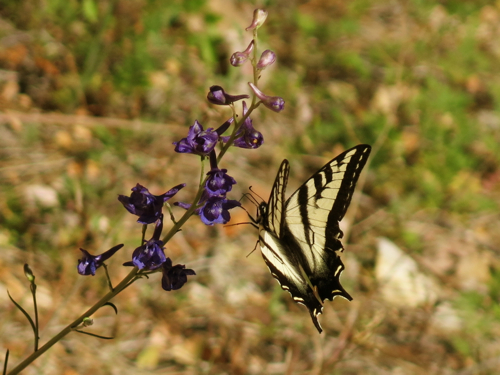
I took a break from curriculum development on Tuesday and drove down to Pinnacles National Park. Of course I looked at the incredible rock formations for which the park is famous. But as spectacular as the scenery was, the highlight of the trip was watching butterflies in Bear Gulch. In particular, I spent about ten minutes watching one Western Tiger Swallowtail visiting larkspur blossoms. I took a great many photographs of this one butterfly, getting as close as I could. With a photograph, you can capture narrow slices of time: the position the butterfly’s wings take as it balances on a flower; the way it clings to the flower with its legs and arches its head towards a blossom; the moment when the butterfly is just approaching the flower:
But sometimes what sticks in your memory is not what you actually saw, but the photographs of what you saw. After I left Pinnacles, I drove to Elkhorn Slough National Estuarine Research Reserve. When I saw butterflies there, I made a point of trying to sketch them in my field notebook rather than just photograph them, like this common butterfly:
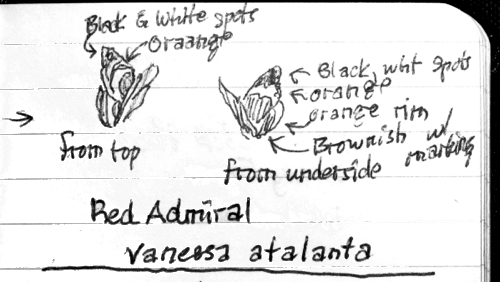
This sketch, as an end product, is not nearly as attractive as a photograph (and I did take a photograph of this insect as well) — it’s not as attractive, but I learned more about butterflies by making this sketch. By comparing my sketch to a field guide, by seeing what I left out, I learned what I don’t see when I look at butterflies. I suspect making less attractive sketches like this does more towards sharpening my powers of observation than does taking a great many very attractive photographs.


 “Whenever the pulpit is usurped by a formalist, then is the worshipper defrauded and disconsolate. We shrink as soon as the prayers begin, which do not uplift, but smite and offend us. We are fain to wrap our cloaks about us, and secure, as best we can, a solitude that hears not. I once heard a preacher who sorely tempted me to say, I would go to church no more. Men go, thought I, where they are wont to go, else had no soul entered the temple in the afternoon. A snow storm was falling around us. The snow storm was real; the preacher merely spectral; and the eye felt the sad contrast in looking at him, and then out of the window behind him, into the beautiful meteor of the snow. He had lived in vain. He had no one word intimating that he had laughed or wept, was married or in love, had been commended, or cheated, or chagrined.”