The third installment of the Contestants on a Game Show! series:
A postmodern heretic's spiritual journey.

The third installment of the Contestants on a Game Show! series:
This is a major revision of an earlier short biography of Bertha Cady Chapman.
A writer, biologist, and sexuality educator, Bertha Louise Chapman was born July 5, 1873, in Santa Barbara, Calif., the daughter of Truman (sometimes given as “Freeman”) Fletcher Chapman and Mary Elizabeth Furlong Chapman; Bertha’s older sister Elizabeth Corinne Chapman had been born in the same place in 1870. By August, 1873, the family was living in San Buenaventura (now known as Ventura), Calif., where Truman worked as a druggist.
After Bertha was born in 1873, Truman became involved in mining, and he moved the family to New Mexico to operate mines there. In 1880, Bertha, her parents, and both siblings were living in Las Vegas. Truman was the postmaster of Las Vegas, New Mexico, from Jan., 1878, to Sept., 1880. In 1880, he owned the St. Nicholas Hotel on the Plaza. Las Vegas had grown into a bustling town with the coming of the railroad in 1878, but the Plaza retained a distinctly Southwestern flavor:
“The Plaza is in the center of the town.…About the center of the Plaza is the relic of the old well, the windmill having been torn down, and the well long out of use. It was the scene of [a] horrible sight this Spring, as on the night of February 9th the vigilantes hung one cowboy to the windmill, and laid his two companions out beneath him, riddled with bullets, because of their murder of Joe Carson, a few weeks previous. The Plaza is the principal market for the produce of the farmers.… Almost daily one will see large droves of burros standing about, loaded with wools, hides, or pelts.…Little, narrow, crooked streets lead out from the Plaza, and on all side of the town are scattered those queer little adobes, which give the place its ancient and foreign appearance to strangers.” (H. T. Wilson, Historical Sketch of Las Vegas, New Mexico [Chicago: Hotel World Pub., 1880?], p. 18)
This is the town where Bertha lived when she was perhaps 5 to 8 years old.
Continue reading “Obscure Unitarians: Bertha Louise Chapman Cady”The second installment of the Contestants on a Game Show! video series:
A couple of years ago, Carol got some locally-harvested eucalyptus boards from her friend Darrel in Richmond. In addition to being an architect, Darrell runs a side business turning urban trees that need to be cut down into useable boards. We traded a spare router that I happened to have on hand for a few boards.
I finally have the time to do something with these boards. First I made myself a simple workbench. The boards had cupped pretty dramatically, and I had fun scribing the parts to fit to one another. Since this was just a workbench, I nailed the base together, attaching the top with brass screws (brass is softer than steel so it won’t dull sharp tools). Flattening the top proved to be a challenge. Although eucalyptus works like poplar in many ways, the grain is so intergrown that if you plane it you get lots of tearouts. Fortunately, the local Home Despot had a demonstration model belt sander that they sold me for thirty bucks.
When I got done putting a couple of coats of spar varnish on the workbench, it looked pretty good, with the deep red of the wood, the unplaned natural edges, and the organic curving lines of the cupped and warped boards — good enough that we brought it inside, where it provides a little more counter space in our tiny kitchen.
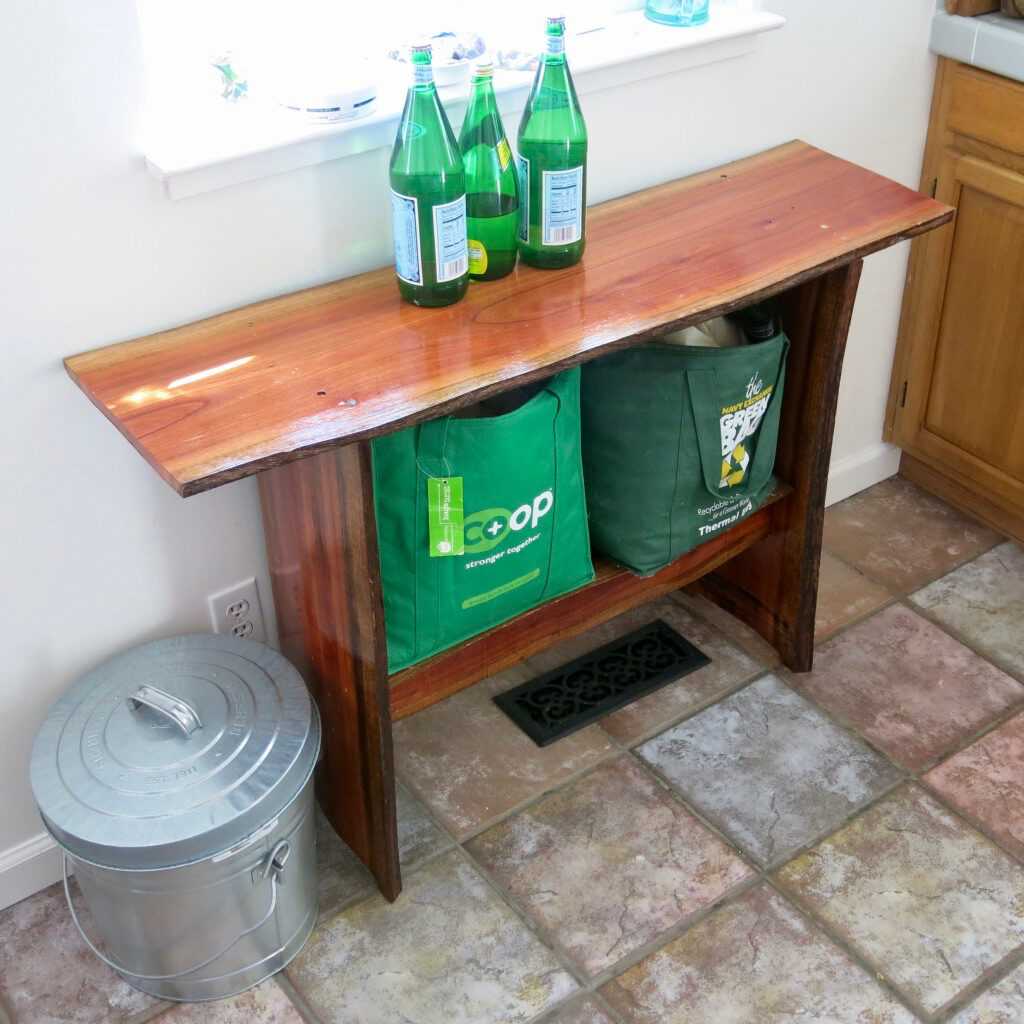
Now I wish I’d taken more care with the joinery. But after all, it was just supposed to be a workbench.
We’ve been having some warm evenings here, warm enough to sit outside in our small back patio. I wanted to sit and the patio and read, so I picked up the LED lantern we have as emergency lighting. We now have to have emergency lanterns on hand because Pacific Gas and Electric (PG&E) has decided that in times of high fire danger, it’s cheaper to turn off power than to actually spend their shareholder’s money to upgrade their crumbling infrastructure.
The problem with LED lanterns is that you have to keep buying batteries. Plus the LED lanterns we have tend to have weird internal reflections and shadows. I looked at Carol’s collection of oil lamp parts, harvested from her scrounging expeditions, but unfortunately there weren’t enough compatible parts to make one working oil lamp.
Surely there must be a way to make a simple oil lamp without buying anything, I thought to myself. A quick Web search revealed lots of DIY plans for a glass jar oil lamp, all of which probably stem from an old Mother Earth News article on the subject.
I took one of Carol’s Mason jars, cut a piece of cotton string for the wick, and bent a piece of wire to hold the wick up, and poured in some olive oil (the only vegetable oil we happened to have on hand). The tiny wick didn’t produce enough light to read by, so I braided three pieces of string together. Now the lamp produced enough light to read by.
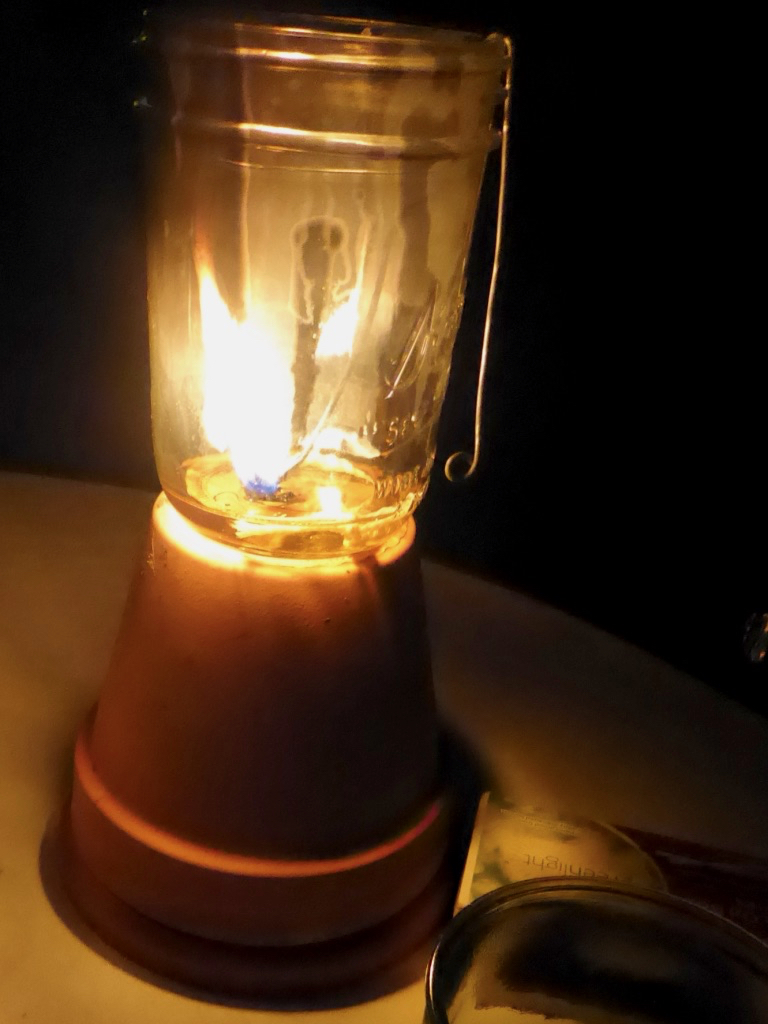
Unfortunately, with the bigger wick, the lamp produced a lot of smoke; I’d never use this lamp indoors. And the glass jar didn’t adequately shield the flame from the evening breezes, so the flame flickered and jumped, making it hard to read; in fact, I had to leave the LED lantern turned on to have enough light to read.
There’s a reason manufactured oil lamps have elaborate glass chimneys, and large flat wicks the height of which can be adjusted by a turn screw. Those technological innovations provide more light, and prevent the lamp from smoking. The glass jar oil lamp is better than nothing, so it’s useful for emergency lighting if you don’t have anything else. But with fire season due to begin soon, and with the continued incompetence of PG&E suggesting that we’re going to have more power outages this fire season, I guess I’d better bite the bullet and buy some manufactured oil lamps, with wide flat wicks and glass chimneys.
In the Black Issues in Philosophy series on the blog of the American Philosophical Association, Josue Ricardo Lopez, assistant professor at the Univ. of Pittsburgh, writes about creolizing schooling:
“The project of creolizing schooling underscores political education as the central project of schooling. It is based on what Jane Anna Gordon in Creolizing Political Theory [Reading Rousseau through Fanon (Fordham Univ. Press, 2014)] argues are at least three principles of creolization: building from the commonalities across our differences, respecting the most salient of our differences, and recognizing that the political is always open to contestation and negotiation.”
I hear echoes of Paolo Friere, John Dewey, and Maxine Greene in what Lopez is saying. Lopez goes beyond Dewey’s concept of educating for democracy, by framing the issue in terms of decolonizing, by considering who American democracy was designed for. As for Friere, he addressed a specific kind of adult education, whereas Lopez is specifically looking at schooling for children and teens.
Also of importance: creolizing is different from multiculturalism. In multiculturalism, cultures exist side by side; creolizing means that cultures change through their interaction with one another. Multiculturalism in education can have the tendency to make non Euro-American cultures invisible; by contrast, creolization
I do have a minor quibble with Lopez’s essay. Lopez rightly points out that “distinct projects will call for different knowledges.” However, the vision of what different knowledges might offer is too narrow. As someone trained in the visual arts, I rolled my eyes when the best Lopez could come up with for the visual arts was “artistic knowledge becomes important for turning brick walls into a canvas for murals that reflects the beauty of the community.” Yet the essay incorporates two infographics that I’ve seen too many times and that actually distract from the main arguments of the essay; if Lopez had cooperated with someone with visual training, there could have been graphics that amplified, rather than distracted from, the essay. Of course, Lopez reflects the bias of the academy: the written word is always considered superior, and the arts are poorly understood and relegated to a minor supporting role. In today’s political struggles, we need digital photographs, videos, animations, infographics, memes, video game design, user interfaces — site-specific murals and other site-specific artworks can be important for local communities, but online media is where young people can make a much bigger impact. (Parenthetical note: when it comes to the arts and education, Maxine Greene’s legacy is worth remembering: she engaged seriously with hip hop and other musicians, artists, etc., and through this engagement acknowledged that music and the arts have something unique to offer in education.)
In spite of this minor quibble, Lopez’s essay is well worth reading. This passage really struck me:
“I worked in Connecticut with Caribbean and Latin American high school students who recently arrived in the United States. There were multiple cultures, languages, religions, and perspectives students brought with them. However, their unique insights, needs, and interests were considered secondary if at all by the school….”
How can the unique insights, needs, and interests become matters of primary importance? How can the school use those unique insights and interests to address real world political issues? John Dewey said, “I believe that education … is a process of living and not a preparation for future living.” And Lopez is expanding that notion for a globalized and multicultural society to include the project of decolonizing.
Now I’m waiting for the book on creolizing schooling….
The first installment of the Contestants on a Game Show! video series:

Just in time for Independence Day, here’s a song about how nobody tells me what to do:
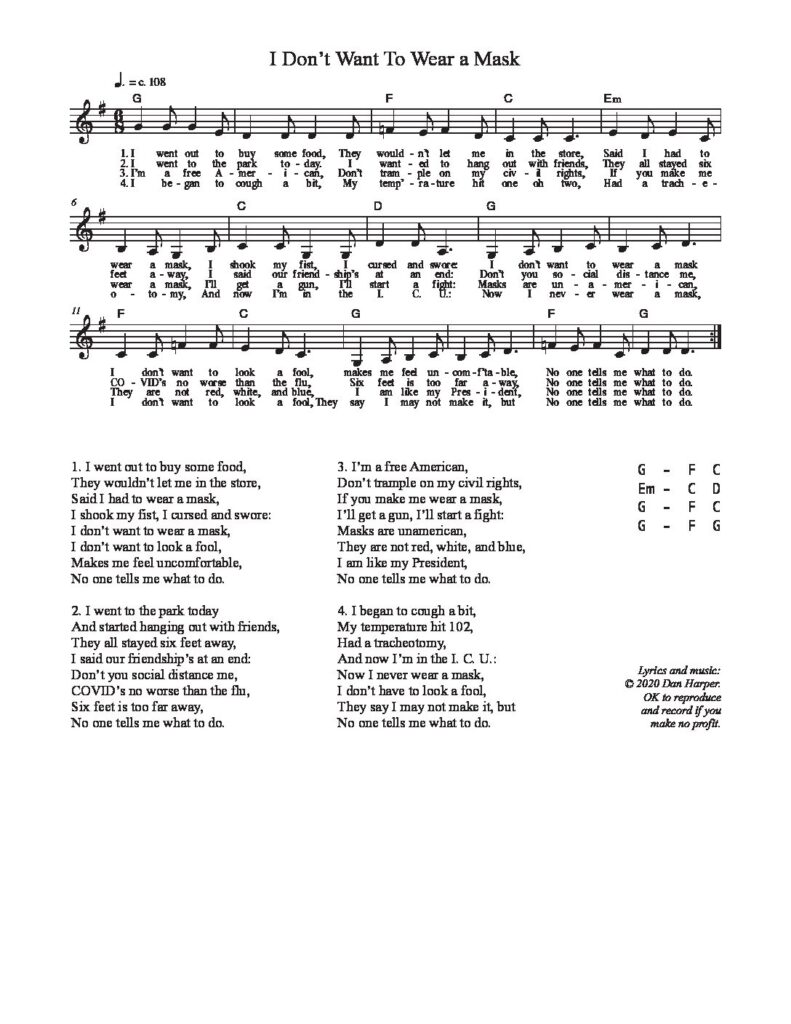
1. I went out to buy some food,
They wouldn’t let me in the store,
Said I had to wear a mask,
I shook my fist, I cursed and swore:
I don’t want to wear a mask,
I don’t want to look a fool,
Makes me feel uncomfortable,
No one tells me what to do.
2. I went to the park today
And started hanging out with friends,
They all stayed six feet away,
I said our friendship’s at an end:
Don’t you social distance me,
COVID’s no worse than the flu,
Six feet is too far away,
No one tells me what to do.
3. I’m a free American,
Don’t trample on my civil rights,
If you make me wear a mask,
I’ll get a gun, I’ll start a fight:
Masks are unamerican,
They are not red, white, and blue,
I am like my President,
No one tells me what to do.
4. I began to cough a bit,
My temperature hit 102,
Had a tracheotomy,
And now I’m in the I. C. U.:
Now I never wear a mask,
I don’t have to look a fool,
They say I may not make it, but
No one tells me what to do.
Update July 8: Revised music and lyrics.
A broad-based interfaith coalition, including Buddhists, Christians, Hindus, Jains, and Jews, has targeted a nightclub chain that uses Buddhist, Hindu, and Jain statues for interior decoration. As reported by Religion News Service, the “Foundation Room” night clubs operated by Live Nation Entertainment in U.S. cities including Boston, Chicago, Dallas, Las Vegas, and New Orleans uses the following religious imagery as decor: statues of Buddha (Buddhism); statues of Ganesha, Hanuman, Shiva, and Rama (Hinduism); statues of Mahavira and Parshvanatha (Jainism).
Live Nation said in a statement that the Foundation Room clubs are (according to them) all about “promoting unity, peace, and harmony.” Before you cynically respond “Bullshit!” — it may be that Live Nation’s management really did see the misappropriation of these religious images as promoting unity. Since they’re based in the U.S., we can assume that they — consciously or unconsciously — see the “Judeo-Christian tradition” as normative; and while “Judeo” is merely a modifier of “Christian” in this formulation, Judaism is still seen as somehow normative. Since Christianity and Judaism are part of mainstream U.S. culture, Live Nation’s management would never think of putting up a cross or star of David in one of their nightclubs.
Why then is it OK to use religious images from Buddhism, Hinduism, and Jainism? Well, part of the answer might well be that “religion” as a concept is a Western concept that only dates back to the Enlightenment. Prior to the Enlightenment, the West did not have a concept that corresponds to our current notion of “religion.” And “religion” as a concept was developed in part as a way to bolster Western colonialist ambitions: “religion” was defined in such a way that only Christianity (and perhaps Judaism, in a debased way) fit the definition; this allowed Western powers to justify domination of non-Western cultures on the grounds Christianizing them. (For more on the link between “religion” and colonialism, see e.g. Timothy Fitzgerald, The Ideology of Religious Studies [Oxford Univ. Press, 2000]; William T. Cavanaugh, The Myth of Religious Violence: Secular Ideology and the Roots of Modern Conflict [Oxford Univ. Press, 2009]).
Not surprisingly, colonized peoples are accorded less respect than the colonizers. This might make more sense if I put this in racial terms, since so many of us are thinking about race these days: in the Western worldview, Christianity is seen as the property of the West, which means it’s a white religion; while Buddhism, Hinduism, and Jainism are generally seen as having adherents who are people of color; while you wouldn’t use white people’s religious symbol in a night club, it would be OK to use the religious symbol belonging to people of color.
However, while colonialism and racism are strongly linked, I find it more helpful to view this dispute over religious imagery in nightclubs as a legacy of colonialism. After all, Buddhism, Hinduism, and Jainism do have white adherents, and there are strong traditions of black and Latinx Christianity. But non-Christian religions are still seen as somehow “primitive” or less advanced than Christianity, and thus may be accorded less respect; and just as in the past, this viewpoint still allows Western nations to see non-Western nations as suitable for colonial domination through both economics and military action.
Maybe I’m making too much out of this. But I do want to explain why Live Nation Entertainment didn’t put crosses or statues of Jesus Christ in their nightclubs; why does Jesus Christ get their respect, but not the Buddha?
I did register for the online General Assembly (GA), but I have to admit I attended very few sessions. I discovered that I have a limit on how much screen time my body will tolerate in any given week, and I had pretty much reached that limit by Thursday. I watched perhaps an hour of the business sessions — long enough to realize that I’m going to miss our current co-moderators. I find them inspiring and visionary in their leadership. And while I’m sure the incoming co-moderators are highly competent people, it was awfully nice to have co-moderators who were younger than I am.
The one session from GA that really stands out in my mind is a session that I missed, but was brought to my attention by Linda H., a member of the curriculum subcommittee in my congregation. This was session 203, “Collaborative Planning of Highly Interactive Family Worship,” with Louise Marcoux of the UU church of Sharon, Mass. I started listening to the recording, and remembered that I heard Louise talking about this concept a couple of years ago. At that time, I had filed the idea away in my memory as very interesting but impossible to do in our physical space at the UU Church of Palo Alto, because we don’t have a room we could use for family worship on Sunday morning. But we’re going to be doing everything online for some time to come, and it looks like Louise’s concept could translate really well to an online setting.