More on Multimedia Era curriculum kits

I’ve been trying to figure out why I’ve grown so interested in the multimedia curriculum kits produced by the Unitarian Universalist Association from 1964 to about 1990. I was first attracted by the integration of texts, audio recordings, and visual materials. But I realized I am also attracted by the existential educational philosophy. And I am attracted by the experimental nature of many of the curriculum kits.

First, some historical background: Continue reading “More on Multimedia Era curriculum kits”

“Multimedia” curriculum

I’m on study leave, in the archives of Meadville/Lombard Theological School, looking at curriculum kits published by the Unitarian Universalist Association under the editorship of Hugo “Holly” Holleroth, during the so-called “Multimedia Era” (c. 1968-1987).

Multimedia Era curriculum kits were packaged in attractive cardboard boxes, which contained the expected leader’s guides, but also included other materials such as audio recordings (long-playing records in the earlier units, cassette tapes in the later units), visual resources (including film strips and photographic slides in earlier kits, videos tapes in one 1989 kit, posters, etc.), written or text resources (including story books, resource books, etc.), and other materials (games, pamphlets, etc.). The earliest Multimedia Era curriculum kit dates from about 1968, and kits were still being published in the late 1980s.

I’m interested in curriculum kits from the the Multimedia Era for three main reasons:
(1) They incorporated audio, visual, textual, and interactive components — not unlike today’s Web-based curriculum
(2) They were developed in a time of rapid social change, and time that questioned organized religion — not unlike the rapid social changes we face today
(3) Many of the kits were founded on an educational philosophy quite different from the usual essentialist or progressive educational philosophies of so much UU curriculum development Continue reading ““Multimedia” curriculum”

Travel and me

Chris Walton, editor of UU World magazine, knew that sometimes I would take the train or drive rather than fly to General Assembly. He asked me to explain why in 500 words, and the result is published in the latest issue of UU World here.

Some trivia that didn’t make it into the published essay:

Yes, I have taken long-distance trains, but it’s only worth it if I’m traveling alone. If you drive a car that gets at least 30 mpg on the highway, and you travel with at least one other person, driving releases fewer greenhouse gases than taking the train. Don’t believe it? If you want to check this for yourself, read Pablo Paster’s 2008 salon.com column on this question. Paster’s column includes a link to the Greenhouse Gas Protocol, an online accounting tool that helps you perform your own calculations on transit efficiency.

Yes, I will be flying to GA in Providence, R.I., this year. I feel I can justify the trip (barely), mostly because I’m also going to visit my father and and other family members, and partly because I’ll be giving a workshop on teaching at the Star Island Religious Education Conference. Even then, I wish I didn’t have to fly, but this year I can’t schedule in the extra time it would take to drive or take the train across the country. Continue reading “Travel and me”

Stupid joke

Hannah and I were standing on the patio greeting people as they arrived. Usually, there’s an audio recording of the bell that is played when it’s time to go into the Main Hall for the service. But the bell recording wasn’t working today, so Chaz had to come out and tell people it was time for the service. A couple of us more childish types started imitating bells by saying, “Dong! Dong! Dong!”

Which reminded me of a stupid joke, which I immediately had to tell. “Hannah,” I said, “What’s brown and sounds like a bell?”

She thought for a moment. “I don’t know,” she said.

“Dung!” I said.

She laughed. But I was kind and refrained from telling her another bell joke: What’s pinches and sounds like a bell? Tongs!

Oh, that explains it

I’ve been reading about the meltdown of the Mt. Gox bitcoin exchange in the mainstream media. It all sounds so Serious and Mysterious — Was it outside thieves or insider embezzlement? — What will this do to online finances? — And, whither the future of bitcoin and similar currencies?

It’s not serious or mysterious, it’s actually stupidity. Charlie Stross, science fiction author and former computer programmer, points out that “MtGox” stands for “Magic: the Gathering Online Exchange.” Then he goes on to add:

“C’mon, folks. Mt. Gox was a trading card swap mart set up by an amateur coder and implemented in PHP! And you expected NSA-levels of trusted computing security, so you trusted your money to it?”

Now that I know all this, the whole story just seems Sad and Sordid. A few Magic card freaks move into amateur banking. A bunch of credulous people trust way too much money to the Magic card freaks. As happens all too often in human affairs, stupidity bred disaster.

I think there’s theology in here somewhere: Something about the essential fallibility of humans. And (more importantly) something about the way humans need to pretend that stupid human mistakes are actually Serious and Mysterious.

New upper elementary curriculum

I’ve been working on developing a curriculum for upper elementary children. The basic idea comes from the old Beginnings: Earth, Sky, Life, Death curriculum developed in the mid-twentieth century by Sophia Fahs. However, much of the content is new, the theological framework has been updated, and the curriculum has been designed to be extremely user-friendly. And now almost the entire curriculum is online for you to use — but before I get to that, let me tell you about several key features of this curriculum.

First, much of the content is completely new. I have included some of the stories from the old “em”Beginnings book, but I have always gone back to primary sources and/or scholarly commentary, and written these stories from scratch. I have also included completely new material, such as the story from the Yoruba tradition — a religious tradition that wasn’t even recognized by most Westerners when the old Beginnings book was written.

Second, the theological framework has been updated. Many UU curriculums of the past have been rightly criticized for assuming that all other religions are not as “advanced” as Unitarian Universalism; this curriculum attempts to avoid that trap of neo-colonialism. A companion curriculum is in development that will present Unitarian Universalist myths and stories in exactly the same way that these stories from other religions are presented. This curriculum also assumes that the possibility of significant diversity, of children coming from multi-religious households; i.e., the children in this UU Sunday school class might also have household members or close relatives who participate in another religious tradition such as Hinduism, Yoruba traditions, Judaism, Christianity, Chinese popular religion, etc. Thus I have tried to avoid any implication that another religion is less “true” or less important than our own religion.

This curriculum is also designed to provide some foundation for our version of the old “Church across the Street” curriculum, in which middle schoolers visit other faith communities. Thus, in some of the sessions, reference is made to religious practices that are related to the story for that session, to relate the mythic or narrative dimension of a religion with the ritual dimension (to use two of Ninian Smart’s seven dimensions of religion). Additionally, the illustrations include some photographs of the material dimension of religion.

Finally, and most importantly, the curriculum is designed to for today’s volunteer teachers. Sunday school teachers today need a curriculum that they can pick up ten minutes before class, and teach successfully with little or no prep time. At the same time, some experienced teachers may want the possibility of going more deeply into the lesson. So this curriculum is designed to provide maximum flexibility for teachers. After two years of use in our congregation, teachers seem to like the curriculum pretty well.

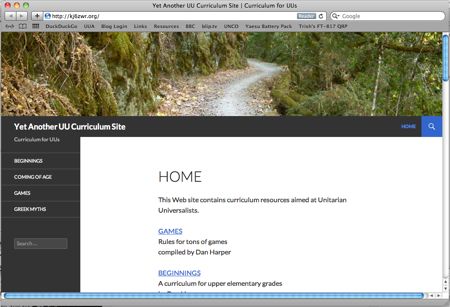
By putting this curriculum online, my goal is to make the curriculum even more user-friendly. The Web site uses responsive design, so that the curriculum will display equally well on a smart phone, tablet, laptop, or even a Web-enabled TV. No need for a book or a three-ring binder: all you need is your smart phone (though the illustrations will be easier to show to kids on a bigger screen). Having the curriculum online should also make it much easier for teachers to let parents know what children are doing in Sunday school.

I would love to hear your comments and reactions to this curriculum.To look at the online version of this curriculum, go here.


An illustration from the curriculum:

Obatala

A statue of Obatala, an orisha common to many of the Yoruba traditions. This statue was photographed in Costa do Sauipe, Bahia, Brazil. Public domain photo from Wikimedia Commons.

The Saturday Bag

Mom got tired of her two children leaving their toys and belongings all over the house, and so she came up with the idea of the Saturday Bag. Mom explained how the Saturday Bag was going to work: If Jean or I left something around the house, she would pick it up and put it in a brown paper bag high up on the top shelf of the closet in the kitchen, where we could not reach it. On Saturday morning, she would bring down the Saturday Bag from its high shelf, open it up, and Jean and I could get back anything of ours that was in it.

Jean and I asked questions about how this was going to work. Would we really have to wait until Saturday morning to retrieve our belongings? Yes, said Mom calmly, we would. But what if we forgot, and left something in the kitchen? Mom said, then it will go into the Saturday Bag. And we won’t be able to get it until the next Saturday? That’s right, said Mom. What if we leave something out that’s too big to go inside the Saturday Bag? Then, said Mom, it will just go up on the top shelf next to the Saturday Bag.

This Saturday Bag idea worried me. I pretty much knew that sometime during the week I would forget and leave a favorite toy where it didn’t belong, and Mom would put it in the Saturday Bag. And of course I did leave things out, and they promptly went into the Saturday Bag. I have a vague memory of saying, Mom, I can’t find something-or-other — and Mom telling me that it was in the Saturday Bag. I have a distinct memory of looking up at the high closet shelf where the Saturday Bag was, knowing that some of my things were up there, in the Saturday Bag, where I couldn’t get them back until Saturday.

I was only about five years old, and so it seemed like it took forever for Saturday to arrive. It was a bright sunny morning. After breakfast, Mom reached up and took down the Saturday Bag. At last I had my toys back! But I knew, I just knew that it would all happen again in the coming week: once again I would forget and leave something out, and Mom would pick it up, and put it in the Saturday Bag.

I don’t think Mom kept the Saturday Bag idea going on for very long. Or maybe it went on for years, but I don’t remember it after the first few months because I got good at putting my toys and belongings away. Kindergarteners can be trained to put things away, and my mother had been a kindergarten teacher for a decade before she got married; if anyone could train a five year old boy and a seven year old girl, it was my mother.

How Doso came to live with Metaneira

Some years ago, I started working on a version of the story of Demeter and Persephone. I put part one of the story on this blog back in 2012; now, finally, here’s part two. No promises when part three will be done.

For part one of the story, click here.

Demeter’s heart was sad at the loss of her daughter, and she was angry at Zeus and Hades. In her sadness and anger, she wandered across the land, until at least she came to the house of wise King Celeus, ruler of the beautiful city of Eleusis.

Demeter sat down to rest on the wayside by the road, in a shady place beneath an olive tree, next to the Maiden Well, from which the women of Eleusis came to get water. She looked like a woman who was too old to bear children, the kind of respectable older woman who might care for the children of a king, or perhaps like one of the housekeepers who clean the echoing halls of a king’s palace.

The four daughters of King Celeus came to Maiden Well with their bronze pitchers, to draw water and carry it to their father’s house. Their names were Callidice, Cleisidice, Demo, and Callithoe who was the eldest of them all. They looked like goddesses in the flower of their girlhood. They saw Demeter sitting there in the shade of the olive tree, but they did not know that she was a goddess — when gods and goddesses roam the earth, it is never easy for mortals to recognize them — and so they spoke to her.

“Old mother,” they said to her, “where do you come from, and what people do you come from? Why have you gone away from the city, and why do you stay away from houses? In many of the shady halls of the houses of our city, there are women of just such age as you, and they would welcome you there.”

Demeter, seeing that the girls were polite, answered them politely. “Hail, dear children,” she said, “whosoever you are. I will tell you my story; for it is right that I should tell you truly what you ask. Here is my story:

“Doso is my name, the name my stately mother gave to me. I have come from the island of Crete, sailing over the wide back of the sea. But I did not come willingly.

“Pirates took me from Crete by force of strength. Continue reading “How Doso came to live with Metaneira”