“Go Down, Moses”

“Go Down, Moses” is a classic spiritual song from the African American tradition. The earliest known publication was in 1862, in an arrangement derived from a song sung by escaped slaves.

This arrangement comes from the Fisk University Jubilee Singers, perhaps the first African American musical ensemble to tour internationally. They published their arrangement in The Story of the Jubilee Singers: With Their Songs (New York: Biglow & Main, 1872). Their version has 24 verses, telling how Moses led the Israelites to freedom (Exodus 12:29 through Exodus 14 in the Hebrew Bible); other verses mention other matters outside of this basic story. See Historical Background below for how this sacred song has been used as a song of freedom.

"Go Down, Moses" thumbnail

Go Down, Moses (PDF, 5-1/2 x 8-1/2 in. for order of service inserts)

Historical background: Harriet Tubman used this as a code song when she was helping enslaved persons escape to the north. Sarah Bradford, in her biography of Tubman, (Auburn, N. Y.: W. J. Moses, 1869), pp. 26-27, wrote: “I give these words exactly as Harriet sang them to me to a sweet and simple Methodist air. ‘De first time I go by singing dis hymn, dey don’t come out to me,’ she said, ’till I listen if de coast is clar; den when I go back and sing it again, dey come out. But if I sing:
‘Moses go down in Egypt,
‘Till ole Pharo’ let me go;
‘Hadn’t been for Adam’s fall,
‘Shouldn’t hab to died at all,’
den dey don’t come out, for dere’s danger in de way.'”

Performance notes: The Fisk Jubilee Singers were first recorded more than three decades after their founding, after many changes of personnel and music directors. In spite of the lapse of time, those early recordings are the best indication we have for the vocal style of the nineteenth century Jubilee Singers. These early recordings reveal a disciplined ensemble with light vibrato, careful enunciation, and precise intonation; a few early recordings are available online at the Cylinder Preservation and Digitization Project, U.C. Santa Barbara. The spare arrangement of “Go Down, Moses” seems to demand discipline, care, and precision in performance. However, the fluid melody is tolerant of the vagaries of congregational singing, and the simplicity of the arrangement means that the average congregation can learn how to sing this song in 4 part harmony.

For an introduction to this sacred song project, including information on copyright, click here.

“50 American Sacred Songs”

If your congregation is going to webcast your worship services, you obviously have to be careful of copyright issues. Music, especially, can cause problems: those who hold rights to music can be especially aggressive at enforcing their copyright.

This is further complicated by the fact that more than one person or entity may hold the copyright to a piece of music you wish to webcast, e.g., there may be one copyright on the music and another copyright on the arrangement, and still a third copyright on the lyrics.

Furthermore, you can’t trust the attributions in hymnals. For example, “How Can I Keep from Singing” is widely credited as an old Quaker hymn when it was composed by Robert Lowry in 1869; some of the arrangements published in hymnals are not by Lowry but are copyrighted; and the verse beginning “When tyrants tremble sick, with fear” is attributed to “Traditional” when it is copyright 1950 by Doris Plenn.

And it’s not just webcasts that cause copyright problems. By law, you cannot photocopy any copyrighted tunes, texts, or arrangements (no, not even for an insert in an order of service); nor can you project them onto a screen during a worship service.

So I decided to come up with fifty or so hymns, spiritual songs, chants, etc., that can be safely used without worrying about copyright issues. The tunes, texts, and arrangements either are in the public domain — either that, or they are my arrangements of text or arrangement to which I hold copyright but which I freely permit nonprofit organizations to perform, webcast, record, or project during services.

Update, October, 2016: The project was getting out of hand, so I decided to limit it to American sacred songs, generally with American texts, tunes, and arrangements (though in a few cases I’m including a little bit of English material).

I chose to retain the copyright for two reasons: first, so someone else can’t slap their copyright on my work and profit from it (and yes, Virginia, it has been done); and second, because Creative Commons did not offer exactly the kind of license I wanted. Note that I also retain copyright of the typesetting for all public domain material.

I had another powerful motivation for producing this collection: it should be quite useful for small congregations and house churches that cannot afford to purchase expensive hymnals. A small congregation with a tiny budget can photocopy as many copies as they want; they can project these sacred songs, record them or webcast them, and the congregation can do it for little or no money.

One caveat: I did not research international copyrights. Those who live in the European Union or elsewhere may find that material that is in the public domain in the United States is still protected by copyright in their jurisdiction.

Over the next year or so, I will be posting draft versions of sacred songs from this collection. You are welcome to use them in your congregation — and if you do, I’d love to hear from you if you liked it, or if you ran into any problems.

  Continue reading ““50 American Sacred Songs””

Type Greek

Every once in a while, I need to type something in ancient Greek. Sure, it’s easy to type Greek letters on most computers, using the Symbol font or equaivalent — but getting the diacriticals right, that’s a real problem. There are rough breathing and smooth breathing marks; and there are oxia (acute), varia (grave), and perispomeni (circumflex) accent marks; and a few other little odds and ends. You can find free ancient Greek fonts (e.g., Brill ancient Greek font), but then you have to change your keyboard settings; not something I want to do when I only need to type in ancient Greek once a year or so.

Then I found this great Web site, TypeGreek. You can learn their simple system for typing accents in about 4 seconds. Then just cut and paste the text into your favorite word processor. And if you can’t get the font to work in your word processor, or if you want to use it on the Web, do a screenshot and insert the image into the document:

Screen Shot 2016-05-08 at 6.14.29 PM

How easy is that?

Obligatory election post

The creators of the Political Compass Web site assert that it is not enough to know whether a political leader is on the left or right; we also need to determine if they are authoritarian or libertarian.

Consider the economic scale first: Those on the far left believe it is best to manage the economy for the greater good of all; the further to the left, the more they believe in managing the economy. By contrast, those on the right believe to a greater or lesser degree in the power of the free market. Now consider the social scale: Those who take an authoritarian position believe that the state is more important than the individual. By contrast, those who take a libertarian view believe in the supreme value of the individual. Both scales are of equal importance.

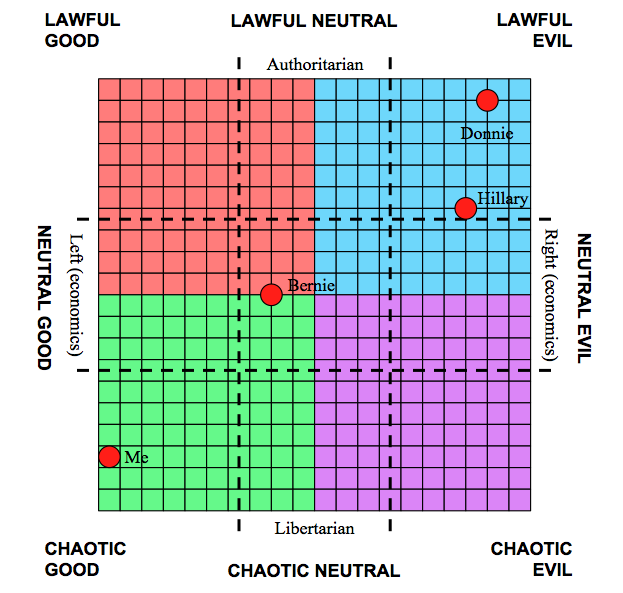
We can put these two axes together in a Cartesian coordinate system to make the “Political Compass,” where the x axis ranges from leftists (negative numbers) to rightists (positive numbers, and the y axis ranges from libertarians (negative numbers) to authoritarians (positive numbers). In this scheme, Stalin would feel at home in the upper left quadrant, which is where you’ll find those who advocate for state-controlled collectivism. Gandhi would feel at home in the lower left quadrant, with voluntary regional collectivism. Pinochet would be happy in the upper right quadrant, with overwhelming state support for the free market. Ron Paul, with his support of libertarian social ideals and the free market, falls in the lower right quadrant. And the Political Compass Web site has a quiz you can take to determine where you yourself fall along the two axes; I scored -9.6 on the economic scale, and -7.6 on the social scale, placing me in the same quadrant as Gandhi.

As much as I like the Political Compass system, I don’t think four quadrants accurately capture the way I perceive political leaders. Therefore, I like to map the Alignment System from role-playing games onto the Political Compass.

The Alignment System describes a creature or character in a role-playing game along two axes: good vs. evil, and chaotic vs. lawful. The chaotic/lawful axis maps neatly onto the libertarian/authoritarian axis of the political compass. The good/evil axis does not map so neatly. But from my perspective, the current political environment privileges either the free market or individual persons; we are given a choice between making a profit, or protecting individual persons. In the Alignment System, “Good characters and creatures protect innocent life” (link), so I choose to map the good/evil axis of the Alignment System onto the left/right axis of the Political Compass, with good corresponding to leftist.

BlogMay0616

The beauty of the Alignment System is that it offers a nuance that does not appear in the Political Compass: there is a middle ground, named Neutral, in both axes. This gives nine possible orientations, as seen on the chart below: Lawful Good, Lawful Neutral, Lawful Evil, Neutral Good, Neutral, Neutral Evil, Chaotic Good, Chaotic Neutral, and Chaotic Evil. Considered in terms of positive attributes, along the Lawful/Chaotic axis, Lawful equates with honorable; Neutral equates with practical; and Chaotic equates with independent. Along the Good/Evil axis, Good equates with humane; Neutral equates with realistic; and Evil equates with determined (link). All this helps me better understand why I feel left out of the current U.S. presidential race: there are no Chaotic Good (independent and humane) characters running for president.

Considered in terms of the Alignment System, Bernie is probably the best overall choice because he is a Neutral character, both practical and realistic: “…neutral characters … see good, evil, law, and chaos as prejudices and dangerous extremes” (link). Fair enough; but because I am a Chaotic Good character myself, I am turned off by Sanders’ claim that he is Chaotic Good when he is so obviously Neutral. If he would just admit that he is Neutral — a moderate Keynesian who is neither authoritarian nor libertarian — I could see my way to supporting him. Of course Lawful Evil characters dominate U.S. political discourse, and so Sanders will never be allowed to claim his true identity as Neutral; he will always be cast as Chaotic Good because that’s how the Lawful Evil characters perceive him.

Now both Hillary and Donnie are both in the authoritarian right quadrant of the Political Compass; i.e., they are both Lawful Evil, or in terms of positive attributes, they are honorable and determined: “Lawful evil creatures consider their alignment to be the best because it combines honor with a dedicated self-interest” (link). The only real difference between the two is that Donnie is significantly more authoritarian. However, since I am Chaotic Good, I am never going to feel comfortable with either one of them.

If you look back at previous U.S. presidential elections, as charted on the Political Compass Web site (2012, 2008, 2004), you will see that Barack Obama started out as Neutral, but after one term in office became Lawful Evil; and George W. Bush was of course Lawful Evil. The Political Compass Web site did not exist during the Bill Clinton years, but given that Hillary Clinton holds positions similar to his, it seems likely to me that Bill was also Lawful Evil. There is little doubt in my mind that Ronald Reagan was Lawful Evil, and so was George H. W. Bush. Thus we have had Lawful Evil presidents in the U.S. since at least 1980.

You know, that could explain a great deal….

Nest building

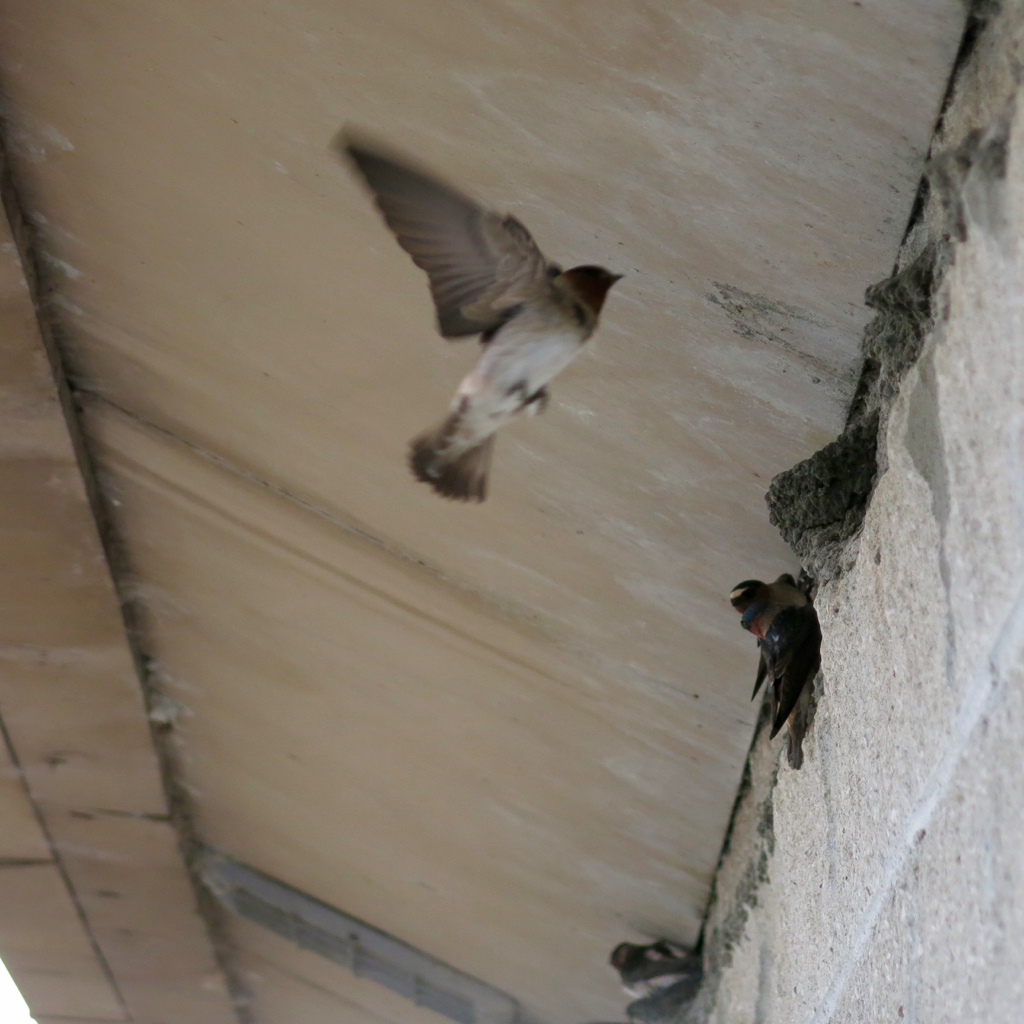
On my dinner break this evening, I made a quick visit to Baylands Nature Preserve, where Cliff Swallows are building nests along the wall of the small building that controls the outflow from Casey Forebay into the flood control basin.

BlogMay0316

Yesterday, I watched as swallows flew down to get a bill-full of mud in the forebay, then up to the building where they clung to the wall with their feet while placing the mud on the growing nest. They worked for about twenty minutes then stopped, presumably to let the mud dry: you could see the layer of wet mud sitting on top of the previously dried mud.

This evening the swallows were again picking up mud and placing it on the nests. The nest have not increased all that much in size since yesterday; this appears to be a fairly slow process.

Habits of a lifetime

We are more likely to remember that which is most vivid, and closer to us in time. When I think of my father, I am most likely to remember him in November of 2014, the time I stayed with him and watched him go from independent albeit slightly confused, to unable to care for himself in less than three weeks; memories of suddenly having to feed and toilet a parent tend to be very vivid. I imagine my younger sister has far more vivid and immediate memories; she visited him several times a week during his last year, watching him lose mobility and weight and speech.

But let’s skip over the vivid and immediate, and go back in time to 1992 when my father retired from his job as a microwave tube engineer. He would have preferred to continue working, but the company he worked for only allowed full time work or nothing. Full time for Dad meant ten hour days, with at least a 45 minute commute on either end, and that was more than he felt up to. So he retired, and posted a sign over his desk in the basement of their house which said: “Retire and Die.”

One summer afternoon, not long after that, he and my mother and my younger sister were sitting in the dining room when lightning struck the house. Next thing they knew, a fire had started in the attic. They got out of the house, the fire department arrived, and my mother went across the street to a neighbor’s house to make some phone calls. One of the calls was to me. “Hi Mom,”I said. “I think your father is not feeling too happy,” she said. “Why?” I said, aware that her voice sounded very strained. “The house is on fire, and the fire department is here,” she said.

By the time I got there, the fire fighters had chopped holes in the roof, and were throwing smoldering boxes out onto the back yard. The fire was mostly out, but they were still pumping water into the attic. Mom was right: Dad did not look very happy. Pretty soon a couple of guys who claimed to be insurance adjusters, or some such, showed up and started walking around the the yard. Dad was watching the firefighters, and (I have no doubt) already planning the rebuilding effort, so I took it upon myself to show the two guys where the property line was. One of them did turn out to be someone who would serve as your representative to your insurance company, and Dad later got his business card. (I still have my doubts about the other one; my younger sister later said she thought there were looters around that day.) But rather than hire someone else to deal with the insurance company, Dad decided to do it himself.

He also decided to serve as the general contractor in the rebuilding effort. I was working for a carpenter at that time, and Dad hired Ken to do most of the work. A couple of weeks after the fire, when Ken and I had already started working, Ken told me that my father projected that they would be able to move back into the house in the second or third week of December, in time for Christmas. “There’s no way he’ll be able to pull that off,” Ken said, shaking his head.

But Dad had managed more complex projects with much bigger budgets than this one. He made his PERT charts, dealt with the insurance company, managed the subcontractors, and sure enough Dad and Mom and my sister were able to get out of the depressing condo they had rented and back into their own house by mid-December. A few months later, the last of the work was done, well within the time my father had projected. I doubt Ken said so to my father, but when the job was completed on time (and under budget), he admitted to me that he was impressed.

Years later, Dad wrote his own obituary, and said of himself: “He also spent one year supervising the rebuilding of his residence to repair damage caused by a lightning strike, which was an adventure in construction engineering.” I thought then, and still think, that this year-long engineering project was what got him out of the misery into which retirement had plunged him. In any case, the sign saying “Retire and Die” moved to a place of lesser prominence, and eventually disappeared entirely.

(As a footnote to this story: My mother was always convinced that the lightning had been attracted by the antenna Dad had strung up for his amateur radio transceiver. Dad always pooh-poohed that notion, but Mom had me partially convinced. Then a few years ago I learned enough to pass my amateur radio General class license exam. And a year ago, I found Dad’s construction drawing of the antenna in question. Dad was right: there was no way his antenna started the fire.)

Dad was good at facing down adversity and overcoming obstacles, armed with project management, scientific method, dogged persistence, and a quietly persuasive way with other people. Actually, now that I think of it, he was able to use these habits of a lifetime in dealing with his final decline. And that’s not a bad way to remember him.

Bob Harper’s obituary

My dad died this morning, after illnesses lasting two years. As an engineering physicist and R&D man in the for-profit sector, Dad had to be an excellent project manager, so of course he had the foresight to write his own obituary, which you can read here.

Me? I’m feeling mostly relief at this point; Dad’s quality of life wasn’t that great the last couple of months. Maybe Dad is relieved, too, though since he was a non-theist (he said he couldn’t call himself a humanist because he didn’t think humans should be at the center of the universe), the tense is wrong: let’s say: maybe Dad was relieved when he finally died.

Environmentalism: from sacred texts… pt. 4

Read part one

Analysis:

I’m always a little surprised at how much the children seem to like Ecojustice class; we do try to make Sunday school classes fun, but this class seems to be more fun than most. Late last year, I overheard a conversation that helps explain why. A seventh grader told a fifth grader, “You have to take the Ecojustice class. You actually get to do things.” When he said “You get to do things,” that seventh grader—who happens to be a non-praying atheist—did not mean his friend would get to pray or read sacred texts. He had grasped in an intuitive way that the curriculum of Ecojustice class is based on a progressive educational philosophy where “the learning experience is a part of life, not a separated preparation for life.” (23) While we aim to inculcate religious literacy and the core values of our religious tradition, including familiarity with sacred texts, these things cannot be taught separately from the lives we are in the midst of living.

IMG_4801

Our progressive educational philosophy cause us to look with alarm at the seeming inability of local faith communities to address the global environmental crisis. We all know people of faith have to address the global environmental crisis, yet in spite of this apparent consensus “that religion must play a central role in building a more environmentally sustainable society, religious organizations and individuals have achieved few tangible results.” (24) Religions have done pretty well at linking their sacred texts and traditions to abstract thinking about environmental justice, but this does not seem to have had much effect in the real world. The specific conditions of the global environmental crisis require a new approach to ecological theology, just as the conditions of Latin America required the new approach of liberation theology; (25) sacred texts and theology cannot be treated separately from the immediate reality of our lives. To put this more directly: when I asked a group of elders at UUCPA about sacred texts and environmental ethics, one replied, “You don’t get your ethics by reading, … you get your ethics by living.” (26)

That seventh grader who urged his friend to do the Ecojustice class knew that words—whether spoken or written words—are not the most important teaching tool. In U.S. culture, we often equate teaching with explaining, which “makes teaching a talkative affair” where we assume that “to teach is to tell.” But this assumption is not accurate, because most teaching is actually nonverbal teaching. Example and experiences will always prove more powerful than speech: “No amount of talk can substitute for the well-placed gesture of the human body.” (27)

The teaching that takes place in the Ecojustice class is always connected with bodily movement and gesture. Before the class even begins, the children take part in the worship service, sitting near to other people of all different ages, standing up to sing, running out the door to their classes. When we arrive in the classroom, we sit in a circle so that we are aware of each other’s faces and bodies. When we say opening words together, we have hand motions to go with them. The children run to get food scraps and dead leaves to put into the composter; they pick up worms in their hands; they peer over a fence to look in the creek; they saw wood, hammer nails, and help hold things that other children are hammering and sawing; they pick up tools and materials and put them away. Of course I and the other teachers explain things with words, but those words are linked to specific bodily actions: hold the hammer like this, don’t forget to put a little water in the worm composter, etc. When we had the ethical discussion of removing House Sparrow eggs from the nesting box, this was not an abstract discussion, we were talking about a living organism that might cause a problem that we had to face with hands and hearts. At the end of class, when we say together “Hold fast to what is good” (based on words from a sacred text), we hold each other’s physical hands.

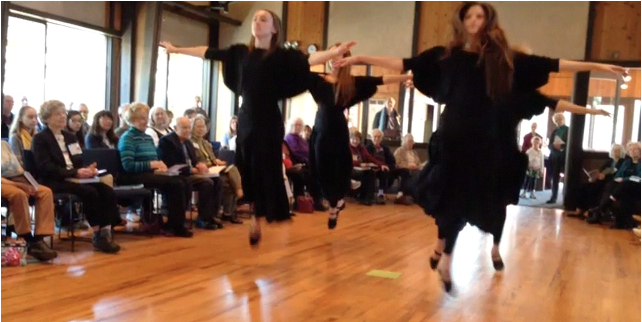
What these sixth graders, and us adult teachers, experience in the worship service and throughout the class can be understood metaphorically as a form of dance; not high-art dance done as a performance by professionals (e.g., ballet, modern dance, etc.), but participatory social dance done as a community. Even though our congregation rarely includes dance in our formal worship services (as is true of most religious groups stemming from the Christian tradition), you can find elements of informal social dance throughout the worship service, and in the liturgical elements interspersed through the class time: a time to stand and to sit, a time to greet each other in worship; a time to run pell-mell, a time to pick up worms; gestures and movements that express who we are and how we are interconnected. If we did not have these elements of dance, if we did not respect the bodies of all those in our congregation, it is likely that the children would be much less willing to be part of our congregation: “If children are screaming, they might just be having a bad day or else they might be doing what many of the adults feel like doing.” (28) Not that we always manage to respect the bodies of those in our congregation, but at our best, children, teens, and adults embody our values through dance-like moves.

Carla Walter, a dancer and scholar in our congregation, describes a womanist spirituality, drawing on African spirituality, which helps me understand what our post-Christian congregation aspires to. A womanist spirituality, says Walter, incorporating elements like dance, music, oral tradition, direct perception of spiritual matters, and relationships with other people, “draws on ancient knowledge of power in our spirits and communities to move us as it remembers the past, and on today’s hegemonically valued groups to work against intra- and intergroup hatred to build social sustainable structures. Spiritual wholeness is what is sought, in interconnectivity….” (29) This is what we are trying to do with our children and teens: make socially sustainable structures, seek spiritual wholeness. Womanist spirituality, a “struggle spirituality” that was never subject to Cartesian dualism and “the Adam and Eve mythos that informs Western religion,” (30) helps us dance through the resistance to Western religion; rather than correct interpretation of sacred texts to solve environmental problems, it nurtures spiritual wholeness and liberation through interconnectivity.

I don’t mean to suggest that scholars should give up re-interpreting sacred texts, like the Adam and Eve mythos in Genesis 2, to help solve environmental problems. And I appreciate the attempts to describe a straightforward connection from sacred texts to “ecological lived practices that continue to reshape an ecologically conscious social imaginary.” (31) But as a religious educator in a post-Christian congregation in the San Francisco Bay Area, I have found this approach is more likely to lead to restless children and resistant teens, and not a few restless and resistant adults.
DanceService6 copy

Above: a dance choreographed by Carla Walter in a UUCPA worship service

Dance — “the earliest art form” which “allows expression that can’t approximate rational thought” (32) — lies closer to the embodied experience of young people than sacred texts. And while dance may not be prominent in sacred texts, it is there in the texts; in addition to re-interpreting Genesis 2, we might pay attention to texts like Exodus 15:20, where Miriam led women in celebratory dance, (33) as well as many other sacred texts that describe the relationship of human beings, other beings, and the divine in terms of processional dance, ecstatic dance, dances of praise and worship, etc. When we move out of the spheres of Western-style religion, and Westernized scholarship, we may find that dance is valued more highly. Professor Hyun Kyung Chung of Ewha Women’s University in Seoul gave an unusual presentation to the Seventh General Assembly of the World Council of Churches in 1991:

“Chung entered from the rear of the hall. She was accompanied by nineteen Korean dancers with bells, candles, drums, gongs, and clap sticks … [and] two Australian Aboriginal dancers dressed only in loincloths and body paint. … When they had all reached the stage, Chung and her companions stepped through a synchronized pattern [of dance] which combined Aboriginal movement with traditional Korean folk dance.” (34)

Some of those present experienced Chung’s presentation “electrifying, powerful, evocative,” while for others it was an “abject surrender of Christianity to a pagan environment.” (35) Many of us in the West have come to believe that hierarchies, orthodoxies, and standardized rituals define religion. Thus the General Assembly of the World Council of Churches gave a mixed response to Hyun Kyung Chung’s incorporation of dance into her presentation. Western Christianity (and Western religion more generally) has been preoccupied with hierarchies, creeds, and standardized rituals. But the majority of Christians now live in the global South, Christianity is no longer no longer shaped exclusively by Western-style religious practices, and Christianity is no longer defined by hierarchies, creeds, and standardized rituals. (36) This should cause us Westerners to rethink the definition of religion more broadly. We should remember that before Constantine’s deployment of Christianity in service of empire, Christianity “meant a dynamic lifestyle sustained by fellowships that were guided by both men and women and that reflected hope for the coming Reign of God.” (37)

In a post-Christian congregation such as the one I serve, children, teens, and their parents are rightly wary of religion that serves imperial ambitions; rightly suspicious of Western-style religion imposing its hierarchies and standardization on us. As we move away from standardization, then contemporary poems, like the one Beverly read at the beginning of the worship service I described, may serve as sacred texts. As we move away from standardization of religion, we may listen when an elder in our congregation vigorously asserts that “you don’t get your ethics by reading, you get your ethics by living,” we may notice the persons in our congregation who are preliterate children, and we may conclude that reading sacred texts isn’t as important as it has been in Western-style religion. Our bioregion and cultural context may also influences us: here in the San Francisco Bay watershed, an urban area on the Pacific Rim with a large East Asian population, we may find ourselves understanding religion in Asian terms, in non-Western terms, as “a matter of seasonal rituals, ethical insights, and narratives handed down from generation to generation.” (38)

The fact that we no longer have a centralized, standardized definition of what constitutes religion leads to uncertainty in how we conduct religious education here in the United States. Our closest religious cousins in the U.S., the liberal mainline Protestant Christians, also find themselves in the midst of this uncertainty. The disestablishment of Protestantism in the U.S., which occurred half a century ago, challenged mainline congregations—and post-Christian congregations like ours—to embrace “religious, racial, and cultural pluralism”; since then, we have been uncertain what religious education is supposed to accomplish, and who should do the educating. (39) And the uncertainty within religious education, the uncertainty with Western-style religion, is only magnified by the existential uncertainty of the global environmental crisis.
EcoJusticeImage

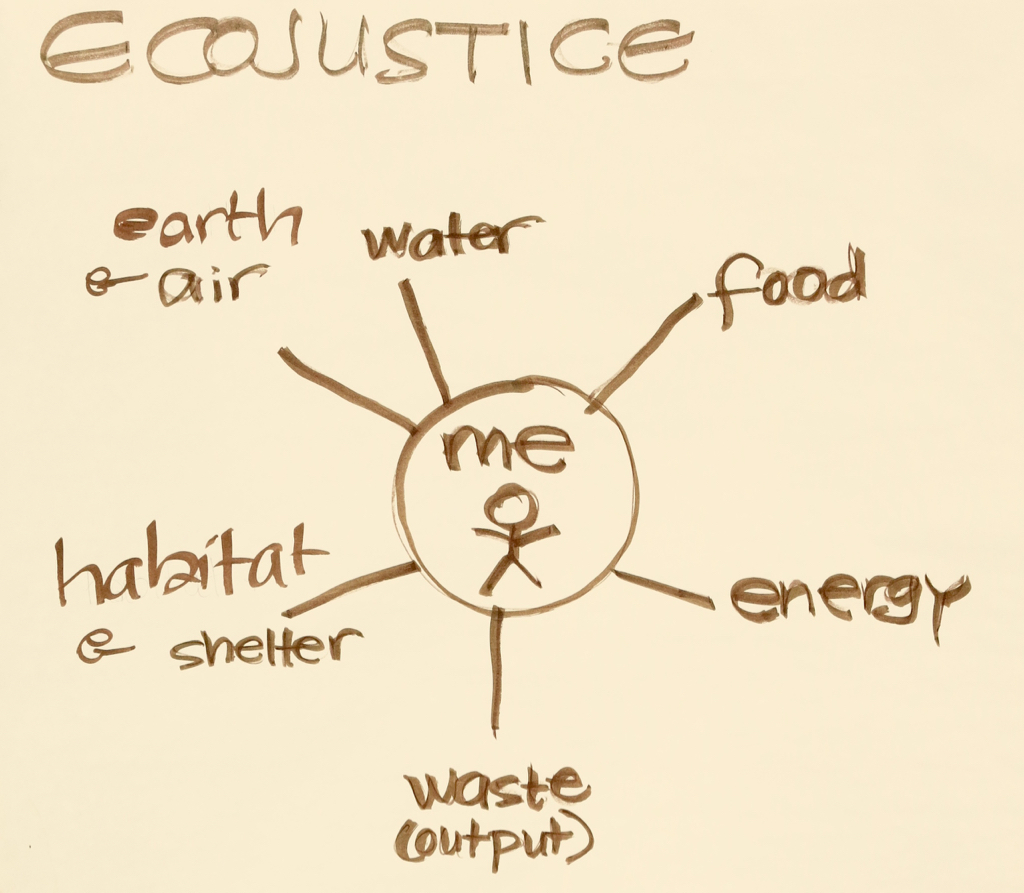
As we re-imagine religious education within our congregation, I find the image of the Web of Life helps to make sense out of the many and varied dance moves we engage in. Bernard Loomer, a theologian affiliated with both mainline Protestant and post-Christian congregations, described the Web of Life as “an indefinitely extended complex of interrelated, inter-dependent events or units of reality,” a complex which includes “the human and non-human, the organic and inorganic levels of life and existence”; what Jesus called the Kingdom of God was also the Web of Life, although this insight of Jesus’s was “covered over because we have surrounded Jesus with religiosity.” (40) In the Web of Life, humans and non-humans and the inorganic are all bound together in a web of relationships; reworking more traditional Christian terms, Loomer says that sin is when we act against this web of relationships, while forgiveness “is a restoration to those relationships.” (41) Loomer adds that as human civilization advances—as we achieve greater freedoms for minority groups, better understand the dignity of the other, etc.—we create the need “for adopting disciplines that are more complex and requiring virtues beyond anything the human spirit has known.” When Loomer said this in 1985, he remained uncertain whether we humans would be able to respond adequately to this challenge: “If the response is inadequate the human organism may turn out to be a dead end.” (42)

Facing this uncertainty, I am sometimes tempted to fall back on old educational models which impose certainty. I could make children and teens find spiritual certainty in a standardized body of sacred texts from which we extract truth. Or — something my congregation would feel more comfortable with — I could have children and teens find scientific certainty in technological fixes to the global environmental crisis. However, the best efforts of both science and Western religion have not decreased the probability of global environmental disaster, nor the probability that we humans will turn out to be a “dead end.” While I wouldn’t advocate abandoning either science or Western religion, they seem to me to be insufficient for making new “virtues beyond anything the human spirit has known.”

Imagine religion as a dance which restores us to the Web of Life, rather than acting against the relationships of the Web of Life. In this dance, we are interconnected with other persons as embodied beings bound in a web of relationships. Those relationships begin in the immediate human community where we are dancing; the relationships extend further into the immediate bioregion of the local watershed; and then still further into the relationships of the whole of the Web of Life. The relationships in the Web of Life are not neat and tidy; rather the Web of Life is a thicket and bramble wilderness filled with the messiness of becoming. In this dance, we communicate the reality of the Web of Life through gestures rather than through words or texts, through the interaction of the whole selves of embodied human beings.

As a religious educator, I hope to restore persons to their relationships of the Web of Life. To that end, the spiritual practices associated with womanist spirituality, including dance, music, narratives and oral tradition, direct perception of spiritual matters, relationships with other beings—spiritual practices that treat human beings as fully embodied beings—help connect children and teens (and adults too) to a spiritual wholeness within the Web of Life.

Our embodied approach to religious education might offer at least three helpful insights to more scholarly or theoretical approaches to mobilize religion to address the global environmental crisis. First, the children and teens in our post-Christian congregation are resistant to Western-style religion, associating it with intolerance and bigotry—associations that seem related to the imperial history of Western Christianity. Second, we see that the children and teens in our Pacific Rim congregation willingly and joyfully participate in dance-like embodied religious education—an educational approach that appears related to changes in global Christianity, and that can be conceptualized through womanist spirituality. Third, an accurate description of what I see in this post-Christian congregation does not lead to neat and tidy conclusions; instead I find myself in a thicket-and-bramble wilderness, where nothing about the messiness of becoming is clear and obvious.

A scholar of religion who walked into one of our classes and saw a bunch of sixth graders building birdhouses might be forgiven for thinking this class didn’t involve religion. Where are the texts, the beliefs, the prayers that define U.S. religiosity? Yet our post-Christian faith community might also be forgiven for thinking that organized religion has, so far, not been very effective in dealing with environmental crisis. It may not look like it on the surface, but our children and teens are dancing their way towards socially sustainable structures of spiritual wholeness. As the poet Marge Piercy says:

Connections are made slowly, sometimes they grow underground.
You cannot tell always by looking what is happening. (43)


Notes:

(23) This description of progressive educational philosophy is from Robert Pazmino, Foundational Issues in Christian Education 3rd ed. (Grand Rapids, Mich.: Baker Academic, 2008), p. 120.

(24) Anna L. Peterson, “Talking the Walk: A Practice-based Environmental Ethic as Grounds for Hope,” in Ecospirit: Religions and Philosophies for the Earth, ed. Laurel Kearns and Catherine Kellar (New York: Fordham University Press, 2007), 46.

(25) Ibid., 58.

(26) Cecil Bridges, personal communication, February 23, 2016. Cecil gave me permission to quote his words.

(27) Gabriel Moran, Fashioning Me a People Today: The Educational Insights of Maria Harris (New London, Conn..: Twenty-Third Publications, 2007), 51.

(28) Ibid., 81.

(29) Carla S. Walter, Dance, Consumerism, and Spirituality (New York: Palgrave Macmillan, 2014), 49.

(30) Ibid., 48.

(31) Anne Marie Dalton and Henry C. Simmons, Ecotheology and the Practice of Hope (Albany, N.Y.: State University of New York Press, 2010), 105.

(32) Walter, 86.

(33) Ibid., 88.

(34) Harvey Cox, Fire from Heaven: The Rise of Pentecostal Spirituality and the Reshaping of Religion in the Twenty-First Century (Cambridge, Mass.: Da Capo Press, 1995/2001), 213.

(35) Ibid., 217.

(36) Harvey Cox, The Future of Faith (New York: HarperOne, 2009), 174.

(37) Ibid., 174, 179.

(38) Ibid., 221.

(39) Charles R. Foster, “Educating American Protestant Religious Educators,” Religious Education, 110 (2015), 548-550.

(40) Bernard C. Loomer, Unfoldings: Conversations from the Sunday Morning Seminars of Bernie Loomer (Berkeley, Calif.: First Unitarian Church, 1985), 1-2.

(41) Ibid., 3.

(42) Ibid., 19.

(43) Piercy, 128.

Short practical guide to grief

You can find tones of books about grief, but (speaking as a minister) I haven’t seen a short practical guide to grief — the practical things I find myself saying to lots of people right after someone close to them (spouse, parent, child, sibling, etc.) has died.

Everyone is different and experiences grief differently, but many peole experience the following:

— The first seven to ten days after the death, the grief is pretty raw. You may find yourself bursting into tears at the slightest provocation; and if you find yourself laughing at some memory the next instant, that’s normal too. It often helps to be with family, or if you don’t get along with family, then to be with good friends. You know how Jews sit shiva for a week after someone dies? That makes total sense. If you only get two or three bereavement days off from work, still you can cancel all your other commitments.

— After the initial shock and raw grief, numbness sets in for most of us (thankfully) for about three months. The grief is still there, but you can pick up with your ordinary life — although from the outside you may look a little out of it at times.

— When that initial numbness wears off, often about three months after the death, that can be the toughest time. Co-workers, friends, and family often expect you to have moved on with your life, and no one is bringing you dinners at home, or treating you extra gently. But here’s the grief, coming in waves, back again as strong as ever. Because grief tends to come in waves, so you might be fine one minute, than overtaken by a wave of grief the next. Be careful when driving!

— For most people, grief lasts about 18 to 24 months. The first year is often the hardest, and the first anniversary of the death can be very tough indeed. In fact, do yourself a favor, and don’t plan anything big on the first anniversary of the death — or do something like plan to have the gravestone installed, or some other commemorative thing like that.

OK, that’s the basic timeline. Remember, grief comes in waves, so you can be fine one minute, and not very functional the next — one minute you might have energy to start working on a project, or start cleaning the house, or whatever, and the next minute about all you can do is sit and cry.

Remember to eat regular meals, you need the energy. Exercise is a good idea, too. Don’t forget to sleep. Breathing is also a good idea; nice slow relaxing breaths can help a lot.

And of course, the reason I’m finally writing this post is that my dad is about to die. So this is a good way of reminding myself of what I need to pay attention to.

My pick for president

I’m tired of the whining presidential candidates calling each other names. Calling each other names is so 2008. We need a REAL presidential candidate who goes beyond name-calling.

That’s why I’m supporting Cthulhu of the Elder God Party.

Cthulhu2016

Of course the Mainstream Media are not taking the Elder God Party seriously. But if they did, imagine a debate with Clinton, Cruz, Sanders, Trump — and Cthulhu.

The other candidates quake in fear as Cthulhu comes on stage, its face a mass of feelers, the scaly rubbery-looking body looming over the other candidates, the prodigious claws on hind and fore feet, the long narrow wings behind. Cthulhu’s supporters begin to chant, “Ph’nglui mglw’nafh Cthulhu R’lyeh wgah’nagl fhtagn!”

Donald Trump points to the Elder God and says, “I’d like to punch him in the face.” Cthulhu eats him.

Bernie Sanders shakes his finger and says, “We are living in a world where greed has become for the wealthiest people their own religion, and…” Cthulhu interrupts him by eating him.

Now only Cruz and Clinton are left standing. By this point, both are quaking in fear. But Cruz is packing a handgun, and he pulls it out, points it at Cthulhu. “If you are one of the gun grabbers and come after our guns, then what I say is ‘Come and Take it.’” One of the tentacles around Cthulhu’s mouth reaches out, takes the gun from Cruz, then pulls the screaming human into its vast mouth.

Clinton looks at the audience, all of whom are now wailing and moaning in mindless terror, then she looks up at the Elder God and says, “Everyday Americans need a champion, and I want to be that champion.” Cthulhu grasps her in one great foreclaw and eats her. It grabs Megyn Kelly and Anderson Cooper, both screaming uncontrollably, and eats them.

The next day, the polls show Cthlhu with an approval rating of over 87% from both Democrats and Republicans, and the Elder God is leading all the other candidates — though that’s a moot point, since the other major candidates are dead, and Kasich hastily concedes (glad that his poll numbers were so low he wasn’t allowed to participate in the debate). Vladimir Putin and Kim Jong-un try to claim that they can take on Cthulhu, but the Elder God flies over and eats them both. Eventually Cthulhu eats all human beings — thus ending global climate change, and the threat of nuclear armageddon — and sinks back beneath the seas to wait in silence until the stars are right once again.

That’s the kinds of candidate we need to lead America. Vote Elder God Party in 2016.