Irrelevant

I admit it, I’m feeling irrelevant.

As I watch a social media debate about accusations of “white supremacy” engulf my denomination, I’m all too aware that I’m on the far periphery of that debate.

Part of my problem, as I learned in a May 27 article on the UU World Web site, is that I’m a religious educator. According Peter Morales, who just resigned as president of the Unitarian Universalist Association (UUA), this means I am not competent for leadership:

“Some have noted that a preference for ministers for certain staff positions also means the candidates will skew white, since there aren’t many UU clergy of color. Morales said the Association would be open to a religious educator in leadership positions but said they seldom have as much management experience as ministers. ‘So the question is, are you willing to overlook that and train them?’ he asked, adding, ‘you don’t want to set people up for failure’ by putting them in positions they aren’t ready for.”

Because I’m on the far periphery of my denomination, because I’m not privy to all the inside information that people on Facebook seem to have, I’m trying hard not to judge anyone who is centrally involved in this debate. But I’ve finally decided that I’m really angry about this comment by Peter Morales. In my first position as a part time Director of Religious Education, I had to hire, supervise, and in one case fire an employee; supervise a couple dozen volunteer staff; coordinate with committees and other staff; and manage events and projects. Yes, I made a lot of mistakes and did a lot of stupid things, but I gained a hell of a lot of management skills, and I was mentored by more experienced DREs who were very adept managers. I got more on-the-job leadership and management training in three years of part-time work than many parish ministers get in five years of full-time work.

But Peter Morales’ attitude is what I’ve come to expect from the cosy little in-group at the head of the UUA: — Religious educators must make poor leaders because, you know, it’s women’s work, and we all know that women don’t make good leaders. As for the male religious educators, if they had real skills they’d have become real ministers (I’m looking at you, Dan Harper).

Yes, I’m generalizing here. There are plenty of people at the UUA who value religious educators. But I have felt dismissed by UUA leaders; the only word for it is “patronized.” And it’s not just the UUA that is pervaded by that patronizing attitude of dismissal towards religious educators; many members and leaders of the Unitarian Universalist Ministers Association (UUMA) do a marvelous job of being politely condescending towards religious education and religious educators; and the UUMA never seems to offer continuing education to its members about religious education, I guess because real ministers shouldn’t lower themselves to that level. I may be generalizing here, what I’m saying may not be true of specific individuals, but what I’m saying is generally true.

Not surprisingly, this kind of thing makes me angry. And I’m a middle-aged white guy. Imagine how I’d feel if I were not white, or if I were a woman.

Maybe part of the UUA’s problem is that we have too many ministers in senior leadership positions. More precisely, we have too many of a certain kind of UU minister with an inflated sense of self-importance, with blind spots about their own prejudices, and with strong connections to a loose network of powerful people within the denomination. Many of these are good people. But this loose network of powerful people in the upper echelons of the UUA (and of the UUMA) takes care of its members in ways that are not good. I have watched this network close ranks around their friends who committed sexual misconduct (I still remember the time I wound up yelling at a senior UUA staffer over the phone regarding a minister who had committed egregious sexual misconductor). I have watched this network provide soft landings for its members when they needed a new job. I also believe this network shunts competent women and competent people of color into the less prestigious jobs at the UUA (“she’ll be a good fit for the Religious Education Department”; “he’ll fit right in to the Diversity Office”; etc.).

At this point, I can see that I’ve let my anger get the better of me, and I’ve gone on too long. “Bring it home, preacher” is what they’d say in some congregations. So I’ll ask: How do we get out of this?

Well, I hold out little hope that any of the three candidates running for UUA president will show increased respect for religious educators (and no, being condescending and not listening are not signs of respect). If you can’t show respect for the people who are training up the next generation of Unitarian Universalists, that’s not a hopeful sign. And if you can’t show respect for religious educators, why would I believe that you could show respect for people of color?

Nor do I see any imminent signs of culture change at the UUA. I know there are good people on the UUA Board of Trustees, and good people working at the UUA in Boston, and as field staff. But UUA policy is set by General Assembly, and General Assembly is dominated by well-to-do white people who can afford a vacation in late June, and well-to-do ministers who have a big enough professional expenses budget to attend. In other words, it’s the same old people who can afford to meet face-to-face who are going to continue to set policy.

Maybe something will come out of the Black Lives of Unitarian Universalism movement. I hope so, but I’m not counting on it.

If we’re going to make real change happen, I strongly believe it has to start from the grassroots: from our local congregations. That’s where I believe we can do the real work: face-to-face in local congregations, where we can respond creatively and specifically to immediate problems. Don’t wait for the UUA to lead the change: make your congregation lead the UUA. Make religious education central to your congregation. Make racial justice central to your congregation. Make your congregation fight against the resurgence of sexism.

As I write this, I realize that it might not be me who is irrelevant. Nor are we religious educators irrelevant, despite Peter Morales’ dismissal of us as incompetent. It might be that the UUA, the senior leaders at the UUA, their cronies in the UUMA and elsewhere: all of that is increasingly irrelevant.

Preferred pronouns

Non-binary gender meets arts-and-crafts…. I was trained up by old-school DREs (Directors of Religious Education) who addressed many congregational issues with arts and crafts projects and filing systems. Sure, arts and crafts and filing systems can’t address every social challenge, but you’d be surprised at what you can accomplish through simple means.

In our congregational, we’ve been thinking about non-binary gender. How do you educate people about non-binary gender? How do you make non-binary gender seem fun and interesting? If you were trained up by old-school DREs, the answer would be obvious: stickers! Stickers and a filing system for them!

You can see my prototype above. We’re going to try it out this Sunday, though I expect a number of problems. First off, an index card file box is not the ideal storage system, and and it may not work well during real-world coffee hour. The stickers may prove to be a bit small, though I had to size them to fit on our name tags (recognizing that people who would use these might have one or more other stickers on their name tags already, e.g., rainbow sticker, UUSC sticker, etc.). And I’m sure someone will criticize my choice of personal pronoun sets (’cause we’re Unitarian Universalists, and we love to criticize each other).

Aside from the inevitable problems, I think three things will work well from the start: 1. the stickers will affirm those who don’t fit into binary gender (even if they don’t use the stickers because they don’t want to be out about it on Sunday morning); 2. the stickers will serve an educational function; and 3. everyone likes stickers!

Specifics of how I formatted the stickers are below: Continue reading “Preferred pronouns”

Sayyambhava finds the truth

This story of a Jain elder might wind up as one of a series of stories for liberal religious kids. Source and notes at the end.

Prabhava was one of the great teachers of the Jain religion. He wandered all over the earth teaching people to live a simple life, and to not be distracted by the pleasures of the senses, and to harm no living beings. Prbhava taught that if you could live like that, you could get rid of all your karma and achieve omniscience, so that you could see and know everything.

After Prabhava had been teaching for some time, he began to wonder who could take his place once he died. He thought about all his students and followers, but none of them (so he thought) would be able to take over for him. Then he used his upayoga power, that is, his mental sight, a power which allowed him to see everything in the whole world. He looked and looked until at last he saw someone who could take his place, a man named Sayyambhava.

This Sayyambhava was a priest of the Vedic religion, and when Prabhava saw him, Sayyambhava was in the city of Rajagriha, about to kill a goat as a sacrifice. Even though Sayyambhava was a priest in a religion that killed other living beings, because of his power of omniscience, Prabhava knew that he would make a good successor. “The beautiful lotus flower grows in the mud,” Prabhava said to himself, “so if you want a lotus flower you have to look in the mud.”

Prabhava went to Rajagriha to meet Sayyambhava. He sent two Jain monks ahead of him, and told them to go to the place where Sayyambhava was about to sacrifice the goat. “When you get there,” Prabhava told the two monks, “beg for food.” (Jain monks made their living by begging food from others.) “If the Vedic priests give you nothing, turn and walk away, and as you walk away, say in a loud voice, ‘Ah, it is too bad you do not know the Truth.'”

The monks got to the place where the sacrifice was about to take place, asked for alms, and when the Vedic priests refused to give them anything, they turned and walked away, saying in loud voices, “Ah, it is too bad you do not know the Truth.”

When Sayyambhava heard this strange remark, his mind became unsettled. Did these two monks know something that he didn’t know? Was his religion not the Truth? Instead of sacrificing the goat, he turned to his spiritual master, his guru, and asked, “Are the Vedas true — or not? Is our religion the path to the Truth — or not?”

His guru shrugged his shoulders.

Growing angry, Sayyambhava continued in a loud voice, “Those were holy monks, who obviously tell no lies. You’re not a true teacher, you’ve been lying to me all this time!” He took the dagger which he had been going to use to kill the goat. “Tell me the truth! If you don’t, I’ll cut off your head.”

Seeing that his life was in danger, the guru said, “I have not been telling you the truth. It is pointless to memorize the Vedas.” (The Vedas were the holy scriptures of the Vedic religion.) “Not only that,” the guru said, “but a statue of one of the Jain deities — a Jina, one of the highest Jain deities — is buried at the foot of the post where we tie to goats we are about to sacrifice.”

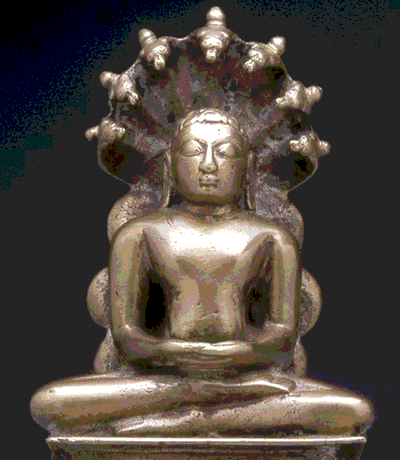
Jina (modified Wikimedia Commons public domain image)The guru pulled the sacrificial post out of the ground, and Sayyambhava looked down into the hole, where he saw a statue of a Jain deity. The guru went on, “There, that is a statue of the true religion. The only reason we do sacrifices is because we get to keep the meat afterwards. It’s an easy way to make a living. But what good is a religion that kills innocent animals? It is no good at all.

“Yes, I have been lying to you all these years,” said the guru to Sayyambhava. “Lying just so I could fill my stomach with easy food. But you are too good for that. Leave me, so that you can follow the true religion. If you do, I know that you will become all-seeing, and all-knowing.”

But Sayyambhava said, “You are still my teacher because in the end you told me the real truth.” Then Sayyambhava bid his guru a fond farewell, and went in search of the two Jain monks….

To be continued….


This story is from Canto 5:1-37 of The Lives of the Jain Elders, by Hemachandra (1098-1172). I used the following sources:

Sthaviravali Charita, or Parisishtaparvan, Being an Appendix of the Trishashtisalaka Purisha Charita by Hemachandra. Ed. by Herman Jacobi (Calcutta: Baptist Mission Press, 1891), pp. 39-41.

Hemacandra, The Lives of the Jain Elders, trans. R. C. C. Fynes (Oxford University Press, 1998), pp. 117-119.

The image of the Jina is a modified Wikimedia Commons public domain image.

How the rabbi missed Yom Kippur services

Another in a series of stories for liberal religious kids. Source and notes at the end.

This is a story about Rabbi Israel Salanter, who lived in Lithuania in the 1800s:

It was Yom Kippur, the holiest day of the year for Jews. All the people had gathered in the synagogue to wait for Rabbi Israel to lead them in reciting the Kol Nidre, the prayer that begins Yom Kippur. But Rabbi Israel didn’t come. After waiting a long time, the people in the synagogue recited the Kol Nidre without the rabbi, hoping he would appear. Still he didn’t come. The people continued to wait for Rabbi israel, though by now he was so late they began to worry that he would not arrive until after the service was over.

Finally the rabbi came into the synagogue. The people looked at him in amazement: they saw down stuck in his hair and his beard, and his clothing was wrinkled and messy. But Rabbi Israel walked in as if nothing were wrong, as if he were not horribly late. He put on a prayer shawl, and began to recite his prayers. When he had finished praying, he at last explained to the congregation why he was so late:

He had been walking to the synagogue [he said], with plenty of time to spare, when he heard crying inside a house he was walking past. He went into the house, and there was a baby lying in its cradle, with a six year old girl fast asleep nearby. A bottle of milk stood above the cradle, just beyond where the baby could reach it. The rabbi could see what had happened: the mother had gone off to the Yom Kippur service, telling her six year old daughter (who was too young to go to the service) to give the baby its bottle if it started crying. But the girl had fallen asleep, and she did not hear the baby crying. So Rabbi Israel fed the baby. When the baby finished the milk, the rabbi tucked it in the cradle and watched it fall asleep.

It was just then [said the rabbi] that the little girl awakened. She was afraid to be home alone, and begged him to stay with her. The rabbi looked around, and saw that the candles the mother had left were burning low; here was a good reason not to leave the child alone. So he stayed until the children’s mother got back from the synagogue. He concluded his story by saying he was very glad that he had a chance to do such a good deed on the most holy day of the year.

The people in his congregation stared at him. One of them asked: You mean you didn’t say the Kol Nidre, you were absent for the Yom Kippur services, you missed the most important moment of the whole year, all this just because a baby was crying? You, the greatest intellect, the smartest person of our time, you missed being here because of a baby? Rabbi, what were you thinking?

The rabbi scolded them all, saying: Don’t you know that there are reasons why we Jews are allowed to skip prayers, reasons why we are even allowed to break the laws of the Sabbath? If there is the slightest chance of saving a life, we are allowed to — no, we must skip prayers and break the Sabbath. Then too, don’t you know that our families, our children, are central to Jewish life?

This silenced the people. They realized that it didn’t matter that Rabbi Israel had humbled himself by taking care of a mere baby. As he said, there could nothing more important.

Source: This story is from Lucy S. Dawidowicz, ed., The Golden Tradition (Syracuse University Press, 1996), pp. 173-174; the story is quoted and interpreted in Leora Batnitzky, How Judaism Became a Religion: An Introduction to Modern Jewish Thought (Princeton University Press, 2001), pp. 124-125; I am indebted to Batnitzky’s interpretation of the story.

Process art: veggie printmaking

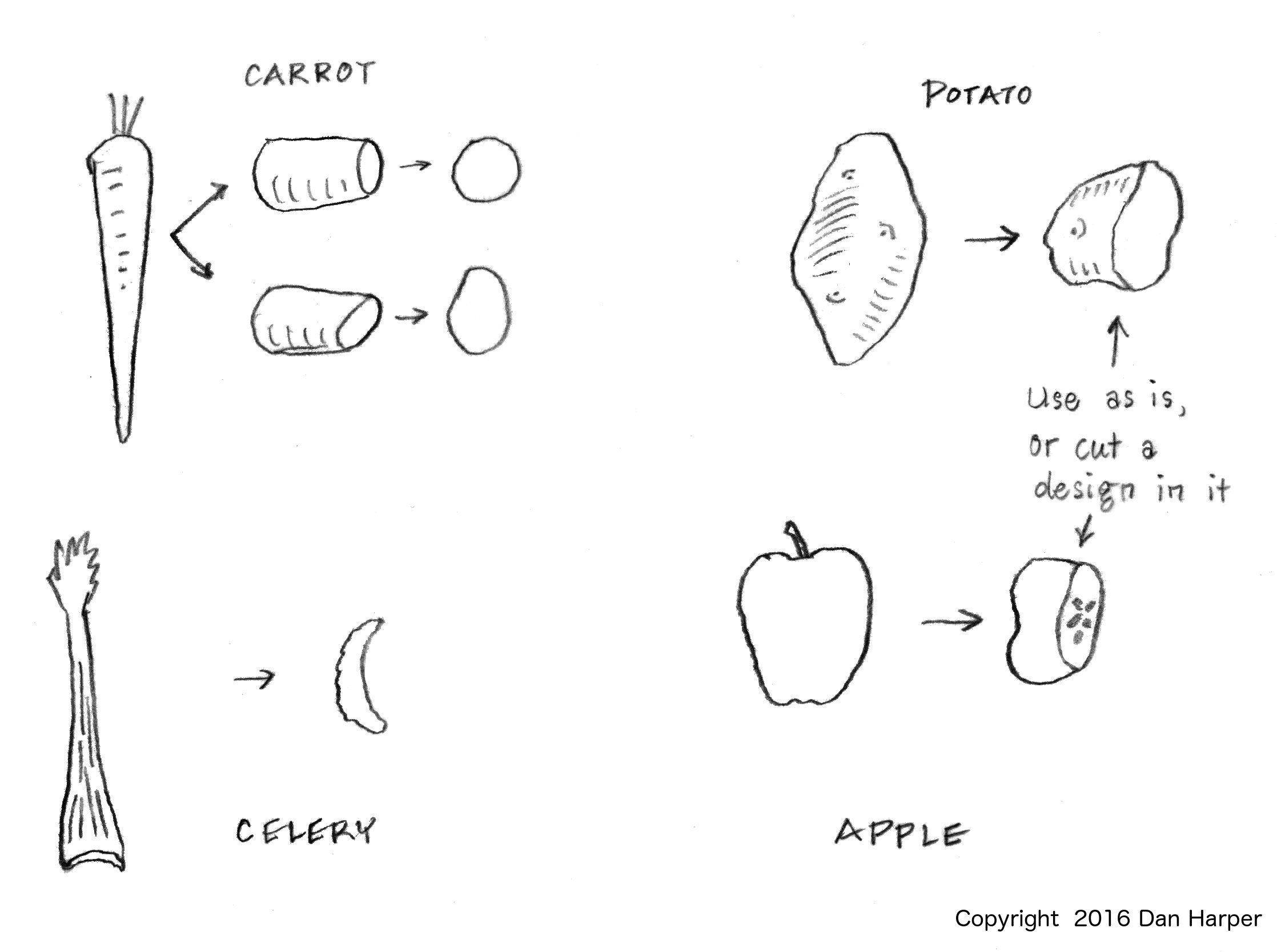
For summer Sunday school today, I wanted to do some process art. (In process art, you have fun with the process and don’t worry about the final product.) I decided to do veggie printmaking, using cut vegetables dipped in thick paint to make prints. One of the children today said it’s like stamping, except you use veggies instead of rubber stamps.

veggieart007

In the end, 14 children showed up, ranging in age from 3 to 13. It was a little challenging to keep the three preschoolers supplied with paint and veggies, although ultimately some of them stuck with it longer than the big kids. For paint, I bought a ten-pack of Crayola Washable Kid’s Paint. It’s thick enough to use for this project. The children liked some of the colors better than others. The dark blue and the light blue were especially vivid and fun to print with, and today we used up most of each of those 2 oz. bottles.

For veggies, I had a 5 lb. bag of potatoes, 3 apples, 4 carrots, 2 stalks of celery, and an eggplant. We used almost all the veggies today. I also had blunt-tipped serrated steak knives that the big kids could use to cut designs into the apples and potatoes. Some of the big kids tried elaborate designs like hearts and stars, but a third grader made the design I liked best: simple stripes:

veggieart006

The apples proved to be a lot of fun to print with. They were pretty juicy, so they diluted the paint. Some of the children loaded them up with paint, and then rubbed them around on the paper. Here’s a print where a child did just that:

veggieart004

Another fun thing to do was to use the serrated knife to cut a potato in half. This leaves a textured surface, which makes really interesting images:

veggieart005

Printmaking lasted about thirty minutes, and then we transitioned into a game of tag. Most of the prints were pretty forgettable, and most of the children did not bother to take their prints home. Of course, that was the point: the fun was in the process.

Chart of Christian churches

Another handout I developed for our “Neighboring Faith Communities” course for middle schoolers, a timeline of Christian churches and their derivatives:

Christian Church timeline thumbnail

Christian church timeline (PDF)

This is a revision of an earlier version of this timeline, which I originally posted here.

One purpose of this chart is to introduce middle schoolers to the incredible diversity of Christian churches, especially churches that are not well know in the West (i.e., Oriental Orthodox Churches, African Independent Churches), and groups that are often passed over or ignored by religious liberals (i.e., Restorationist groups including Mormons, Pentecostals).

Another purpose of the chart is to show how Unitarian Universalists do in fact derive from Christian churches — and further to show how very few in number we Unitarian Universalists are compared to the various Christian churches.

Chart edited. See comments.

Chart of world religions

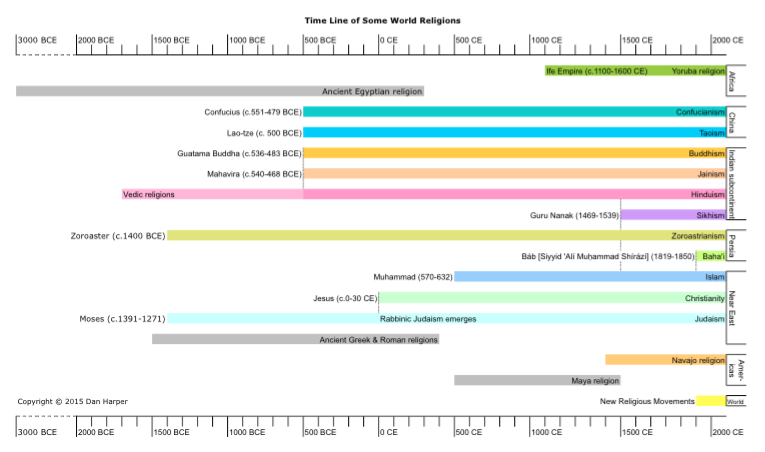
Here’s a handout I developed for our “Neighboring Faith Communities” course for middle schoolers, a timeline of some world religions:

World religions chart thumbnail

Timeline of some world religions (PDF)

This timeline shows the eight major world religions, as listed in Stephen Prothero’s book God Is Not One: Islam, Christianity, Confucianism, Hinduism, Buddhism, Yoruba religion, Judaism, Daoism.

In addition, the timeline shows some other religions of interest. Two religions from the Americas are shown, Mayan religion and Navajo religion. Two ancient religions that influenced the Western tradition are shown, viz., ancient Greek and Roman religions and ancient Egyptian religion. Several smaller religions that may be of interest to Unitarian Universalists are also shown: Jainism, Sikhism, Zoroastrianism, and Baha’i.

I’m still revising this timeline, and I invite your comments!

Journal on childhood and religion

Noted recently on the Religious Education Association blog: an online journal devoted to childhood and religion.

The Journal of Childhood and Religion is a peer-reviewed journal providing “an interdisciplinary forum for scholars representing a wide range of research fields, interests, and perspectives that relate to children and religion.” The journal was started in 2010, and there are about four articles per year.

I’m glad to find a journal focused on children and religion; so many religious education scholars and researchers these days focus either on older persons, or on abstract issues.

Test your religious knowledge

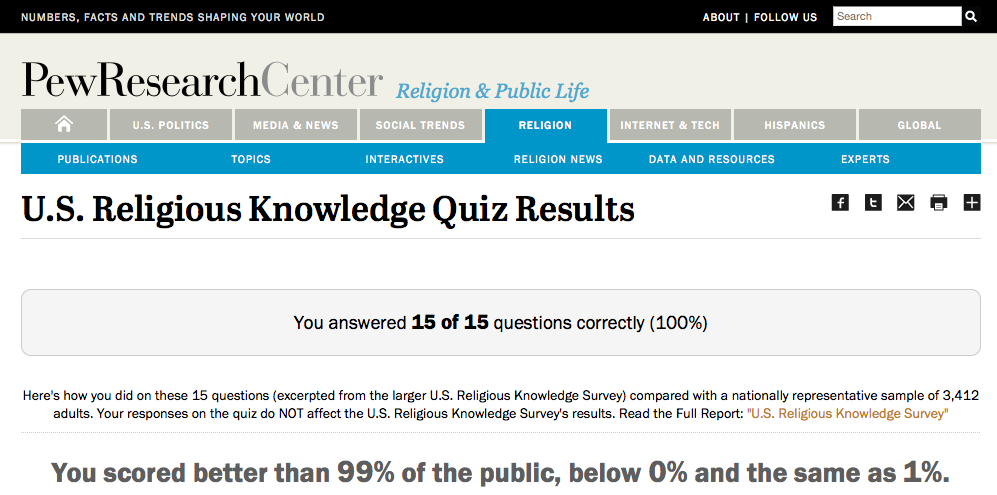
Think you know a lot about religion? Well, the Pew Research Center has developed a “U.S. Religious Knowledge Quiz” where you can find out. The fifteen questions on the quiz test your knowledge of the Bible and of world religions. The online quiz is here.

After you take the online quiz (and find out how much you really do know), you’ll want to go on to read about the survey from which this quiz was extracted, the “U.S. Religious Knowledge Survey.” Pew Research Center did a telephone survey in which they asked 32 religious knowledge questions of a random sample of U.S. residents. The average number of correct responses was 16 out of 32. Jews, atheists/agnostics, and Mormons scored best on this longer quiz. Scoring below average were white mainline Protestants, black Protestants, Hispanic Catholics, and “nothing in particular.”

There were so few Unitarian Universalists included in the sample that they are not included in the statistical analysis. How well would we perform? Sometime I’d like to administer either the shorter quiz, or the longer set of survey questions, to young people who have gone through a UU religious education program. How well have we done at teaching our children basic religious literacy? Since religious literacy is not the goal of most UU religious education programs, my guess is that our kids would only do well if their day school taught them this information. And how about us professional religious educators, how would we do on this quiz? I scored 100% on the quiz, but I’ve been working in UU congregations for two decades, during which time I earned my M.Div. degree — back in 1994, when I started working as a religious educator, my guess is that I would have scored between 50-75%. Finally, how about our ministers?

Do we care? — that is, should religious literacy be a goal of Unitarian Universalist religious education (and should it be a goal for our ministers and religious educators)? I’d argue that in order to be good U.S. and world citizens, we do need a basic level of religious literacy, and that Unitarian Universalists have always aimed to produce good citizens; yet there are very good reasons to disagree with making religious literacy an educational goal.

What do you think?

Rethinking a classic story

“The Picture on the Kitchen Wall,” a story from the classic Sophia Fahs book From Long Ago and Many Lands, has some serious problems: it’s arguably not very Chinese, it contains a number of hidden biases, etc. This story is, in fact, a good example of why we should question everything that Sophia Fahs wrote — even though she remains the most brilliant Unitarian Universalist religious educator we’ve ever seen, she was not by any means perfect.

“The Picture on the Kitchen Wall” purports to tell the back story of the Kitchen God, the minor deity in Chinese popular religion whose image is mounted somewhere near the kitchen stove. Each year, according to most accounts, the Kitchen God leaves the kitchen and reports to a higher deity (sometimes identified in English-language accounts as the Jade Emperor) about the good and bad deeds of the family in whose house he lives. In Fahs’s retelling of the Kitchen God’s story, he was originally a historical figure, a person named Chang Kung.

In tracing Chang Kung, I find him mentioned in a book of maxims attributed to Emperor K’ang-hsi [Kangxi], who ruled China from 1661-1722, an early emperor of the Ch’ing [Qing] dynasty. These maxims appeared in English translation in 1817 as The Sacred Edict, Containing Sixteen Maxims of Emperor Kang-He, Amplified by his Son, the Emperor Yoong-Ching, trans. Rev. William Milne (London: Black, Kingsbury, Parbury, and Allen, 1817), pp. 51-52:

“Formerly, nine generations of Chang-kung-e inhabited the same house; and a Mr. Chin of Keang Chow had seventy persons who all ate together. Those who belong to one family, and are of one surname, should think of their ancestors; rather exceed, than be deficient in respect; rather surpass, than be wanting in kindness. When there is prosperity, rejoice mutually, by an interchange of social affections; when adversity, sympathize mutually, by affording reciprocal aids. In building a family temple to sacrifice to ancestors; in erecting a domestic academy for instructing youth; in purchasing a charity field for the supply of indigent brethren; and in correcting the family calendar, to interweave the names of the more distant relatives — let the same mutual aid be afforded.”

Chang Kung continued to be mentioned by later English-speaking writers as the nineteenth century progressed. A typical example, with an unpleasantly racist conclusion, may be found in Arthur H. Smith D.D., Village Life in China: A Study in Sociology (New York: Fleming H. Revell Co., Publishers of Evangelical Literature, 1899), p. 27:

Continue reading “Rethinking a classic story”