I just updated my story-based curriculum “Beginnings,” aimed at middle and upper elementary ages. This is a “light revision,” mostly cosmetic but with a few major changes.
This eight-session curriculum features explorations of truth — what is true, how do we know what truth is? This topic seems quite relevant in this presidential election year.
“Effect of the Edge on Eastern Cottontail Density: Urban Edges are Harder than Agricultural” studies Eastern Cottontail density in urban preserves in Mexico City, and concludes that this species of rabbit avoids the edges of urban preserves (perhaps due to noise, light, etc.). This effectively reduces the amount of land habitable by these rabbits in an urban preserve.
“The Bee (Hymenoptera: Apoidea) Fauna of a Transmission Right-of-Way in a Highly Developed and Fragmented Landscape of Central New Jersey” sampled bee populations in a power line right-of-way. The authors conclude that power line rights-of-way probably offer habitat for bees that would otherwise be lacking in a highly developed landscape. Unfortunately, 13% of the species found by the researchers were introduced or invasive bees. I was also struck by the observation that highways result in high bee mortality: “Roads can be substantial barriers to the movement of bees, and can cause high mortality that increases as roadway speed and traffic volume rises….”
As urban areas increasingly dominate our landscapes, obviously this kind of research is increasingly important. Since most of you reading this live in an urban or suburban area, it’s worth dipping into this journal to learn about some of the unforeseen effects our urbanized lifestyle has on other organisms…if we’re gonna feel guilty about eating meat, maybe we should also feel guilty about contributing to worldwide bee decline every time we drive on a highway.
I wrote this post while I was experimenting with cyanotype as a way to get people to look more closely at plants. I updated it several times, with the final revision on 21 August 2025.
(Updates: 30 May; 12 July 2025; 17 July; 20 July 2025. Final revision, 21 August 2025.)
Cyanotype books
Many of the books on cyanotype available online are self-published. The following two books come from reputable publishers.
Cyanotype: The Blueprint in Contemporary Practice by Christina Anderson (Focal Press, 2019), covers everything you need to know about cyanotypes — setting up a “dim room”; how to coat your own cyanotype paper; recipes for classic cyanotype, new cyanotype, and other formulas; how to tone prints; and more. Anderson tested over 100 different papers to see which worked best for cyanotype, and there’s a whole chapter on paper. The last chapter of the book showcases artwork by contemporary cyanotype artists. This is a must-have book.
Finding paper that’s good for cyanotype can be a challenge, since not only must the paper stand up well to repeated wetting, but the pH of the paper is also important. See Christina Andersons’ book for comprehensive information on papers.
One of the inexpensive papers Anderson recommends is Canson XL Watercolor paper. This is currently my go-to paper, and I can recommend it. Widely available at places like Michael’s and Dick Blick.
At a week-long summer art workshop, three of us loved Fabriano Medievalis paper. It’s slightly cream-colored, which sets off the Prussian blue of the cyanotype nicely. However, it does not stand up well to toning, or long wash baths.
I’ve also used Yasutomo “Sketch,” which produces similar results to Hahnemuhle Sumi-e, but is much less expensive. However, it’s very fragile in water and tears easily during the developing process — you can forget about bleaching and toning this paper. If you’re on a budget and very patient, maybe give it a try.
Cyanotype in the classroom
Lawrence Hall of Science sells “Sunprint Kits” with 12 pieces of 4 inch square cyanotype paper and a clear acrylic overlay sheet. Cost buying direct from them is US$5.99 per kit (do not buy from Amazon where the price is higher). This cyanotype paper develops quickly and requires little water to develop — perfect for classroom use. They also sell refill packs of 12 sheets of cyanotype paper for US$3.99, as well as 8-1/2 by 11 inch cyanotype paper. The kits and refills are ideal for class use — inexpensive enough to allow people to experiment.
My younger sister the children’s librarian uses 5×7 inch “Nature Print” cyanotype paper from Dick Blick. It’s just as good, but I’ll stick with the Lawrence Hall of Science paper, because my purchase helps support their science education mission.
Cyanotype websites
Many of the cyanotype websites appear to be “AI”-generated slime. Others are too basic (“Expose the cyanotype paper, put it water, look at the result!”). But I found the following websites to be worth a look.
Cyanotypes with plants
Cyanotype by Angela Chalmers, a PDF, gives instructions on making cyanotype photograms using plants. Great ideas, and the author’s photograms are gorgeous.
The “Koraks Tinkers” blog has a post pointing out the difference between collimated vs. diffuse light when exposing cyanotypes. Direct sunlight provides collimated light, while an overcast day provides diffuse light. This difference is less important when making contact prints from a negative, but will produce quite different results with 3-D objects. Cloudy skies = diffuse light, and blurred edges. Clear skies = collimated light, and sharp edges.
UV light boxes
A UV light box allows you to expose cyanotypes indoors, or at night. I finally decided not to build a UV light box (no room for one in our tiny apartment), but here’s some info I collected while researching them.
Cyanotype of two mullein leaves. The leaves were dampened before placing on the paper, so this is a partially wet cyanotype process — this yields the greenish hues seen above — and a longer exposure would have revealed more details of the veins in the leaf.
Because Yvonne asked me to, I put together a timeline of UU history. Instead of focusing on White male ministers from wealthy urban areas, my timeline includes people and events from outside the mainstream of UU history.
13 October 2025: Updated in an attempt to give at least one entry for every decade
Timeline of Unitarians and Universalists (mostly North American)
Because race is so important in the U.S., racial identities of U.S. individuals are generally given. I note with sadness that there are very few working class people mentioned on this timeline.
18th century
1736 Naomi Isaac, an “Indian” (possibly Massachusett) joins the liberal church in Cohasset, Mass., which later became Unitarian
1773 Caleb Rich (White) becomes minister of a new church in Warwick, Mass., that has a universalist theology
1775 John Murray (White), Universalist minister, serves as a chaplain in the Revolutionary army
1779 The Independent Christian Church (Universalist) organized in Gloucester, Mass., one of the earliest Universalist congregations in the U.S.
1785 King’s Chapel is the first Unitarian congregation in the U.S.
c. 1795 The scientist Joseph Priestley (White) holds Unitarian services in Northumberland, Penna.
c. 1795 Prince (no last name), a Black man, joins the church in New Bedford, Mass., as a full member
19th century
1823 Mary Rotch, a White Quaker in New Bedford, Mass., is expelled from Quakerism for being too liberal; she joins the Unitarian church, where she later influences Ralph Waldo Emerson
1838 Nathan Johnson, a Black Universalist in New Bedford, Mass., shelters Frederick Douglass on the latter’s first night of freedom
1843 Adin Ballou, a White Universalist, founds the Hopedale community, a utopian pacifist community in Mass.
1859 Elizabeth Palmer Peabody, a White Unitarian, opens the first kindergarten in the U.S.
1860 Samuel Jackson, a Black Baptist minister, asks to bring his entire congregation into the American Unitarian Association, but because he and his congregation are Black, he is ignored
1863 Olympia Brown, a White woman, ordained by the Universalist General Conference, the first woman to be ordained by a denomination (rather than just a congregation) in the U.S.
1871 Magnús Eiríksson, an Icelandic theologian living in Copenhagen, openly espouses Unitarian theology; this eventually led to the Icelandic Unitarian movement
1876-1878 The U.S. government invites Protestant denominations to manage American Indian reservations; the Unitarians receive the charge of Ute tribes in Colorado
1883 Poet William Carlos Williams, a Hispanic Unitarian, is born
1887 First Unitarian service is held in the Khasi Hills of India, led by Kissor Singh (South Asian)
1894 Watari Kitashima (Japanese) ordained by the Unitarian church of Vineland, NJ
1895 Eliza Tupper Wilkes, a White Universalist minister, is the first woman to preach in Stanford University’s nondenominational chapel
20th century
1902 The American Unitarian Assoc. publishes an essay promoting eugenics, written by David Starr Jordan, the White president of Stanford Univ. (Jordan was a member of the Palo Alto Unitarian church)
c. 1915 Sylvie Thygeson, a White Unitarian, helps open a birth control clinic in St. Paul, Minn.
1917 Adeniran Adedeji Isola (Black) founds the Unitarian Brotherhood Church (Ijo Isokan Gbogbo Eda) in Lagos, Nigeria
1918 Unitarian minister William Short Jr. is arrested for draft evasion, because he’s doing peace activism; when he appeals to the American Unitarian Association to confirm that he’s a minister, they throw him under the bus
1922 Abigail Eliot (White), an LGBTQ Unitarian educator, brings the nursery school concept to the U.S.
1923 The first Flower Celebration is led by Norbert and Maja Capek, ministers at the Unitarian church in Prague, Czechoslovakia. This ritual is later wrongly called a “flower communion.”
1930s Probably a third of all Unitarian and Universalist churches close due to the Great Depression
1932 Poet Sylvia Plath, a White Unitarian, is born
1935 Utah Phillips is born; a member of the Industrial Workers of the World labor union and a musician, he became Unitarian Universalist as an adult
1937 Unitarians and Universalists cooperate to create a new hymnal
1937 Concerned that Leila Thompson, an ordained Unitarian minister, is running for city council in Berkeley, Calif., as a Socialist, American Unitarian Assoc. officials do their best to disavow her
1942 Unitarian minister Norbert Capek dies in the Auschwitz concentration camp
1947 Stephen Fritchman, a White minister, is forced out of his job editing the denominational magazine due to accusations that he is Communist
1948 Imaoka Shin’ichiro (Unitarian) and Shigetaro Akashi (Universalist) found the Japan Free Religious Assoc. in Tokyo
1950s (date uncertain) UU ministers officiated at some of the earliest UU same sex weddings
1956 Christopher Moore, a White minister at First Unitarian in Chicago, founds the Chicago Children’s Chorus, an interracial chorus which rapidly became one of the best children’s choruses in the U.S.
1950s Religious liberals in the Philippines affiliate with the Universalist Church of America
1961 Unitarians and Universalists consolidate into one denomination; the new UUA bylaws have six principles
1964-1976 Rev. Andrew Yoshinobu Kuroda leads Japanese language services at All Souls Unitarian church in Washington, DC
1965 Year with highest Unitarian Universalist membership in the U.S.
1965 Victor Carpenter, minister in the Cape Town Unitarian church of South Africa, delivers sermon opposing apartheid
1965-1970 Unitarian Universalism loses half its Black members during the Black empowerment controversy
1977 Ysaye Maria Barnwell founds the Jubilee Singers, a gospel choir, at All Souls UU church in Washington, D.C., the first Black-led UU gospel choir
1977 First Unitarian of Los Angeles publishes the first Unitarian hymnal with Black and working class music in it
1980 The first Water Ritual takes place at a feminist gathering of women; later, it was wrongly called a “Water Communion”
1985 The UUA adopts new non-sexist bylaws with seven principles
1991 Cheng Imm Tan, an Asian immigrant, ordained as a UU community minister
1993 The UUA publishes a hymnal containing Black spirituals, the first official denominational hymnal (Universalist, Unitarian, or Unitarian Universalist) with non-White music
21st century
2004 Unitarian Universalist Association of Uganda is formed
2005 Last year of growth in U.S. Unitarian Universalism
2008 Carleton Pearson, a Black Pentecostal minister who became a Universalist, brings his congregation to the Unitarian Universalist church in Tulsa, Oklahoma
From about 2010 on, enrollment in UU children and youth programs declines steeply
2017 Peter Morales, the Hispanic president of the UUA, is forced out over allegations of racism
Last year, Dr. Vivek Murthy, the U.S. Surgeon General, issued an advisory report on social media and the mental health of kids:
“The current body of evidence indicates that while social media may have benefits for some children and adolescents, there are ample indicators that social media can also have a profound risk of harm to the mental health and well-being of children and adolescents….” — Social Media and Youth Mental Health (U.S. Surgeon General’s Office, 2023)
This is not just a public health concern. It’s also a religious concern, or should be. In a recent opinion piece, Rabbi Jeffrey Salkin writes:
“A religious temperament might mean questioning our utter reliance on such technology: creating islands of time, like the Sabbath or Sunday, when we would liberate ourselves from technology and being more self-aware of how we use our tools, which have become our toys…. That [old] rabbinic statement that has become a cliche: ‘Whoever saves one life, it is as if they have saved the entire world.’ If regulating access to social media will save the life of one kid, it will be worth it.”
We now know that social media has serious adverse effects on adolescent and pre-adolescent health. So let’s do something about it.
A team at the University of California in Davis, headed by Tom Maiorana, has developed a game that models evacuations in the face of wildfires. (Apparently there was a story about this game on National Public Radio (NPR), but I don’t listen to NPR and read about this online somewhere.) They’ve set up “Prototyping Resilience,” a website for the game.
As someone who has been doing ecojustice education on the side for nearly two decades now, as soon as I heard about this game my gut response was: Wow, what a great teaching resource. Then I has to stop and think about why this would be such a great teaching resource. First, the game raises awareness of a new phenomenon, massive wildfires, which result from climate change and to a certain extent from land use change. Second, the game empowers people to know what to do in case of a wildfire (i.e., it’s akin to the tabletop exercises long used in emergency prep circles). Third, the game educates people about community cooperation. Raising awareness, empowering, building community — all key precepts for ecojustice education.
Detail of the visual instructions for the game.
The current iterations of the game are specific to actual communities in California. But the game developers plan to have a generic “Evacuation Boardgame” ready by October, 2024. I signed up for the generic game using the “Game Request Form” link at the bottom of this webpage.
I ran into Mary P at the Sunday service here in Cohasset. She’s the other delegate from our congregation to General Assembly. She asked me if I’d been following General Assembly. I said that I had, but added that it was painful to watch at times. She agreed.
We both were repelled by speakers (on both sides of various issues) who were mean-spirited, unkind, willing to mistake opinion for facts, and so on. We both agreed that we were not seeing these kind of behaviors in our local Unitarian Universalist congregation.
I suspect the online format tended to encourage bad behavior. But whatever the cause, I felt frankly embarrassed by some of my co-religionists. Mind you, it was people on both sides of the issues being debated. For example, in the discussion of the bylaws revision, after legal counsel for the Unitarian Universalist Association gave her professional opinion that the bylaws revision would not reduce the freedom of individual congregations, at least one speaker said the bylaws revision would reduce congregational freedom. In another example, one speaker who supported the revision of the bylaws relied on what I considered to be ad hominem attacks; I wound up muting the audio.
This online General Assembly was one of the few times I felt embarrassed to be a Unitarian Universalist. To me, it felt like hyper-individualism had run amok. Sadly, the whole thing was livestreamed on Youtube, so anyone could watch it.
Oh well. Who am I trying to kid? We live in a horribly polarized society. Why should Unitarian Universalists be immune from polarization? And a huge driver of polarization is people doing way too much social interaction online, instead of in person. If we hold General Assembly online, I guess we have to expect the same bad behavior that has driven me from Facebook, Twitter, Mastodon, and other social media platforms.
And the problem may well be my problem. These days, the only thing I use social media for is finding out about Sacred Harp singings; I’m no longer accustomed to a daily dose of mean-spiritedness, unkindness, and misinformation. Maybe if you use social media a lot, General Assembly seemed tame and well-behaved. But it’s not for me — and I’m not enthusiastic about ever attending another online General Assembly.
I was finally able to retrieve my delegate credential for the online General Assembly (GA). Which prompted me to log in to the Whova event management portal for GA.
As I poked around, two things caught my eye.
(1) There’s a friendly prompt to answer an icebreaker question. Great idea for an online space, so I clicked through. The first icebreaker question that appeared was “What’s your favorite place of all the places you’ve travelled?” and you are given a list of countries around the world to choose from. This is a classic question used to establish your your socio-economic class: choosing, for example, Papua New Guinea places you in a higher socio-economic class than choosing, say, Canada or the United Kingdom. There are other icebreaker questions you can choose from, of course, but choosing this question is a good way to establish yourself as being part of the upper middle class.
Anyway, I decided to skip the icebreaker question.
(2) I noticed that there were quite a few online sessions aimed at teens. Given that increased screen time correlates with decreased mental health in teens, I’m not sure how I feel about this. It’s great that GA organizers are trying to serve Generation Z. But it’s more screen time….
Actually, screen time has been associated with depression among adults, too. Depression is actually one of the biggest health risks for clergy (substance abuse is another). I check in periodically with a psychotherapist, so I don’t believe I am currently suffering from depression. However, I do find that the thought of spending much time with online GA leaves me feeling — well, depressed.
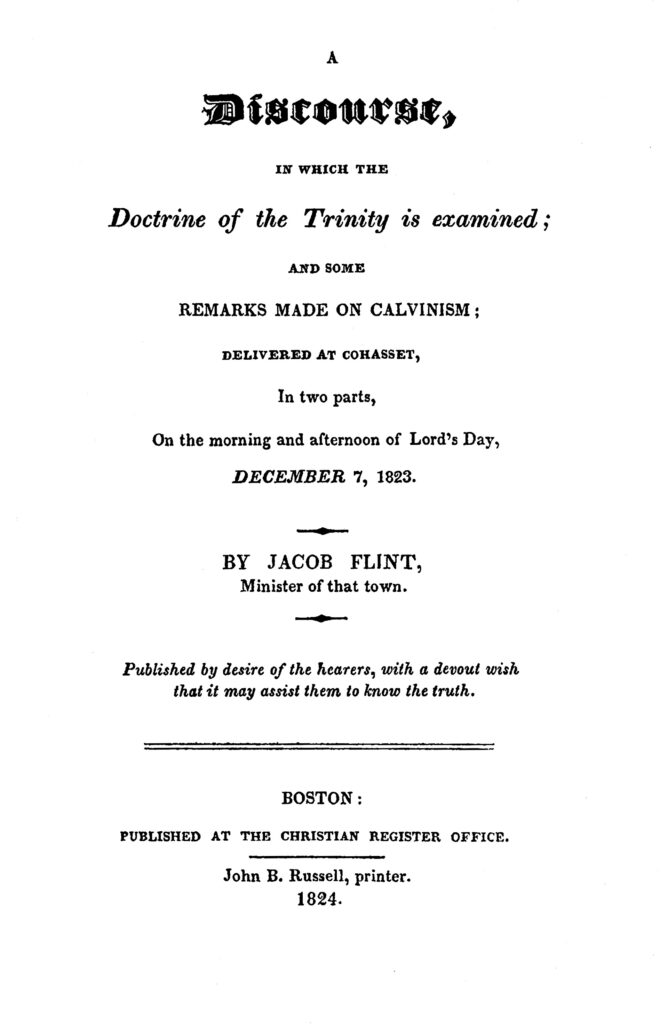
Back in 1823, Rev. Jacob Flint was the minister of the one church that then existed in Cohasset, Mass. He had been ordained in Cohasset in 1798. He was fairly liberal to begin with, but over the quarter of a century he served the congregation he had become an outright Unitarian. So on December 7, Flint decided to preach a sermon on Unitarianism.
I can imagine the scene. He preached this sermon in the Meetinghouse that we still use today, but the old box pews were still in use in 1823. Wood stoves had been put in the Meetinghouse for the first time the previous year, in 1822, so at least people would have been relatively warm for the two lengthy sermons that were delivered each week. Flint would have climbed up into the high pulpit, suspended halfway between the main floor and the gallery. Sadly, he was not a good speaker — John Adams wrote that “his elocution is so languid and drawling that it does great injustice to his composition” (John Adams, Diary, 19 Sept. 1830).
Despite his poor elocution, at least some people in the congregation must have been paying close attention to this day-long Unitarian sermon. Within months the Trinitarians had left in a body to start building their own church just a hundred feet away across the town common. I can just imagine how angry the Trinitarians were after the morning service on December 7, 1823, and how little they looked forward to the second sermon in the afternoon when they would hear even more about how wrong the doctrine of the Trinity was. How they must have steamed and stewed as Flint preached, especially since his preaching seems specially designed to infuriate anyone with Trinitarian leanings.
But this was probably to be expected of Flint, who was an uncompromising man. Years later, Capt. Charles Tyng remembered a time from his boyhood when he had to live in Flint’s house:
“…I was then put under the charge of the Rev. Dr. Jacob Flint, the minister at Cohasset. I soon found that the change was from the frying pan to the fire. Doctor Flint was a large man with a forbidding countenance. He was morose & cross in his family, which consisted of his wife, three sons, and an infant daughter…. I dreaded Sunday, the Dr. was so very strict, made us boys sit in the house, reading our Bibles, or learning hymns…. Dr. Flint was a tyrannical man, and very severe, particularly with his own children. Hardly a day passed without his whipping them. Us Boston boys did not get it so often, although I often felt the effects of the rod. He probably was deterred from whipping those who boarded with him, as his disposition would have induced him, had he not thought our parents would take us away.” (Charles Tyng, Before the Wind: The Memoir of an American Sea Captain, 1808-1833, chapter 1.)
With that preface, here’s the first part of Flint’s divisive Unitarian sermon of December 7, 1823:
Brief excerpt from the opening paragraph of a sermon given by Rev. Jacob Flint here in Cohasset, Mass., on 19 October 1823:
“Nature has formed an infinite number of systems, which are parts only of the great whole, connected by a chain which can never be broken without injury to the parts and disorder to the whole…. Being connected, the parts are so constructed that … they are mutually dependent on each other for their support, general utility, beauty, and order. This is true of what is called the natural world, as well as of the moral.”
The text he chose for this sermon was Romans 12:5, “So we being many are one body in Christ, & every one members one of another.” Two months later, Flint precipitated a split in the Cohasset congregation by preaching a sermon in which he attacked the doctrine of the Trinity. I can’t help but wonder if he wrote the October sermon having already observed the beginnings of a split in the congregation, and hoping to persuade people that they were still part of a unity; then by December, he gave up preaching unity and went on attack.
Regardless of the historical background, I find the above passage to be still relevant. It is reminiscent of what 20th century theologian Bernard Loomer called the interdependent Web of Life.