Progressive Confucianism

Progressive Confucianism is a new Web site, primarily in Chinese, though with a small amount of English-language content as well. I wish I read Chinese, because the material on Progressive Confucianism in English makes the concept sound pretty interesting, such as this passage:

“The idea that ethical insight leads to progressive political change, which in turn leads to greater realization of our potential for virtue, lies at the heart of Progressive Confucianism.”

(Thanks to.)

Global vs. local atheisms

In a post on the Indian Philosophy Blog, Elisa Freschi distinguishes between global and local atheisms:

“The Mimamsa school of Indian philosophy started as an atheist school since its first extant text, Jaimini’s Mimamsa Sutra. At a certain point in its history, however, it reinterpreted its atheist arguments as aiming only at a certain conception of god(s). In other words, it reinterpreted its atheism as being not a global atheism, but a form of local atheism, denying a certain specific form of god(s) and not any form whatsoever.”

I find this an extremely useful distinction, which in my experience is mostly absent in Western thought. In the West, our religious thinking has been dominated by monotheistic religion — Christianity and to a lesser extent Judaism — which have tended to force our thought into either/or, binary thinking: either I believe in the the monotheistic Christian (or Jewish) deity, or I believe in nothing. It is difficult for us to conceive of any other option.

In the Indian religious landscape, however, there is a multiplicity of deities. I suspect that kind of landscape allows a more nuanced approach to thinking about deities. In one example, Freschi quotes one Indian philosopher as saying: “I have refuted the inference to the existence of the Lord said by other scholars, but I have not refuted the Lord Himself” (Nayaviveka, tarkap?da, end of sambandh?k?epaparih?ra).

But I can see other possibilities that could also be interesting, such as refuting the existence of certain classes of deities. This brings to mind Xenophanes, a thinker from the pre-Christian West, who made some well-known criticisms of the class of anthropomorphic deities:

“Yes, and if oxen and horses or lions had hands, and could paint with their hands, and produce works of art as men do, horses would paint the forms of the gods like horses, and oxen like oxen, and make their bodies in the image of their several kinds” (fragment 15, John Burnet translation); and

“The Ethiopians make their gods black and snub-nosed; the Thracians say theirs have blue eyes and red hair” (fragment 16, John Burnet translation).

Xenophanes also criticized the class of deities that not only looks like but behaves like humans:

“Homer and Hesiod have ascribed to the gods all things that are a shame and a disgrace among mortals, stealings and adulteries and deceivings of one another. (fragment 11, John Burnet translation)

All this raises an interesting line of thought: arguments supporting atheism in the Western tradition tend to argue against the monotheistic traditions of Christianity and Judaism. And indeed, Western atheists have developed some powerful arguments against these monotheistic deities. But because their arguments focus so narrowly on the specifics of Western monothesitic deities, I find their arguments less convincing when considering, for example, panentheism. (And no, that’s not a typographical error; see the Stanford Encyclopedia of Philosophy article on panentheism.)

The most interesting point here for me is that in an increasingly multicultural world — that is, in a globalized world where cultures previously separated by comfortable distances now find themselves living literally next door to one another — arguments against the Western concept of “God” might suddenly be revealed to be a local atheism. Similarly, arguments for the Christian or Jewish deity might well be a local theism.

Exodus: The Card Game

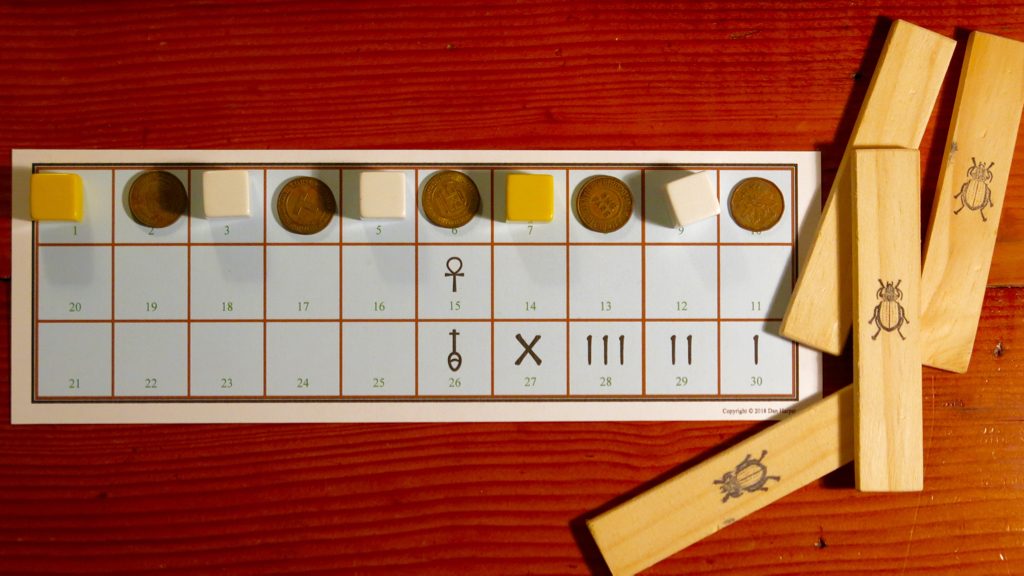
A few months ago, I wrote about prototyping “Exodus: The Card Game,” a game based on the wanderings of the Israelites. After lots of play with both kids and adults (and lots of changes to the rules), prototyping is finally done. I made 6 decks using the online printer Board Games Maker; the printing quality is excellent, and here’s what a deck looks like:

One of our curriculum goals in our Sunday school is to play more games. “Exodus: The Card Game” is designed to supplement an upper elementary or middle school unit on the Hebrew Bible. Once you learn the rules, play takes about 15-20 minutes, so it fits nicely into a typical Sunday school class time. And the rules are fairly simple and straightforward; I’m including them below the fold so you can get an idea of the game.

The only problem with this game is the price. I bought 6 decks, and the price including shipping and handling came out to just under $25 per deck — pricey for a card game. (If I printed 1000 decks the price would drop to about $6 per deck, but what would I do with 1,000 copies of this game?)

If you’d like to buy a copy of the game, email me and I can get you a single copy for about $27. (There’s a price break at 6 copies, which knocks approximately $2 off the price; next price break is at 30 copies.) If you’re going to the Pot of Gold religious education conference in Sacramento on Sept. 29, I’ll have a few extra copies of the game to sell.

Continue reading “Exodus: The Card Game”

New book: Unitarians in Palo Alto

For the past five years, I’ve been researching Unitarians who lived in Palo Alto from 1895 to 1934, and writing short biographies of these ordinary Unitarians. I’ve finally collected these biographies and printed them in a perfect-bound paperback book, Available on Lulu.com either as a print copy for $10.84 (plus whatever Lulu charges for shipping and handling), or as a PDF download. The Introduction to the book appears below the fold.

Unitarians in Palo Alto, 1895-1934: A Biographical Dictionary
by Dan Harper
ISBN: 978-0-9889413-5-9

A biographical dictionary of Unitarians living in Palo Alto, Calif., from 1895 to 1934, most of whom were associated with either the Unity Society of Palo Alto (1895-1897) or the Unitarian Church of Palo Alto (1905-1934).

Continue reading “New book: Unitarians in Palo Alto”

Obscure Unitarians: Eliza Corbett Thompson Stebbins

Eliza (Elsie) Corbett Thompson Stebbins was born in England on April 6, 1879, and emigrated to the United States in 1884. She attended the University of California at Berkeley c. 1898-1901, but she does not appear to have graduated. In 1900, she gave her occupation as “Teacher of Music,” and lived in a boarding house in Oakland.

She married Horatio Ward Stebbins in Santa Barbara on February 14, 1906; Horatio was the son of Rev. Horatio Ward Stebbins, long-time minister of the Unitarian church in San Francisco. The younger Horatio, a graduate of the Massachusetts Institute of Technology, taught mechanical engineering at Stanford University. Presumably the younger Horatio was also affiliated with the Unitarian church, though the extant documents do not mention him. Elsie and Horatio had one child, Amelia “Amy” Adams Stebbins (b. June 11, 1912).

Elsie served on the Board of Trustees of the Unitarian Church in Palo Alto beginning in 1916.

She died May 25, 1968, in San Mateo.

Notes: 1900, 1910, 1920, 1930 U.S. Census; University of California Reg-ister, 1898, 1901; “Marriages,” Christian Register, March 1, 1906, p. 249; Eliza “Elsie” Corbett Thompson, “The New England Mathers,” https://wc.rootsweb.com/cgi-bin/igm.cgi?op=GET&db=mikemather63&id =I147333 accessed 11 September 2018); Bulletin of the Massachusetts In-stitute of Technology, Boston: Register of Former Students (Boston, Mass.: May, 1915), p. 470; California Death Index, 1940-1997, Department of Public Health Services, Sacramento.

Obscure Unitarians: “Mr. Wolff”

A “Mr. Wolff” served on the Committee of Ushers of the old Unitarian Church in Palo Alto in 1908. Who was this man, mentioned only once in the extant records of that long-defunct church?

A likely candidate is Franklin Fowler Wolff. The son of a Methodist minister, he was born in Pasadena in 1887, and rejected orthodox Christianity while he was in his teens. He studied mathematics, psychology, and philosophy at Stanford University, and received his A.B. in mathematics in 1911. He then did graduate study in philosophy at both Stanford and Harvard, returning to Stanford in 1914 to teach mathematics. But after only a year, he left academia to pursue his own studies, and changed his name to Franklin Merrell-Wolff. He eventually became known as a spiritual teacher, a mystic, and a writer.

This identification of “Mr. Wolff” should be considered tentative. Another possible “Mr. Wolff” is Marcus Wolff, who received his A.B. in economics from Stanford in 1906; however, he appears to have been living in San Francisco in 1908.

But if Franklin Merrell-Wolff did indeed attend a Unitarian Church while an undergraduate at Stanford, barely out of his teens, it would not surprise me — the Emersonian philosophy that underlies much of Unitarian theology could have had a distinct appeal to a developing mystic.

Notes: Ron Leonard, The Transcendental Philosophy of Franklin Merrell-Wolff (Albany, N.Y.: SUNY Press, 1999).

Guide to visiting other faith communities

Here’s a five-minute video I made about what to pay attention to when you visit services at a faith community that’s not your own. Drawing on Ninian Smart‘s seven dimensions of religion, the video suggests that when visiting another faith community it’s most interesting to focus on three of Smart’s seven dimensions: the emotional/experiential, social, and material dimensions.

Confucian autumnal rites

Anyone who has read Confucius knows that Confucius said you had to do the rites right. But what do Confucian rites look like?

You can find out what one of today’s Confucian rites looks like by visiting Autumnal Sacrifice to Confucius Web site. This fabulous site includes video footage of the Autumnal Sacrifice from a Confucian temple in Taiwan, along with succinct text to provide background.

I’m part way through this Web site, and it’s fascinating. For example, when you sacrifice to the ancestors, it turns out they don’t like strongly-flavored food, so you give them things like celery that have a mild flavor.

Above: offering of celery at the Autumnal sacrifices

(Thanks to Warp, Weft, and Way for pointing me to this Web site!)

Boomers and privilege

I’m critical of using the language of privilege in public discourse; what can be a useful tool for analysis among like-minded persons does not always translate well to a wider context. For example, when white people of the professional and upper middle classes gain awareness of how they have personally benefited from structural racism, they may find it helpful when speaking with others who are challenging structural racism to use the phrase “white privilege”; in that context, “white privilege” becomes a useful shorthand way of referring to the specific benefits professional and upper middle class white people get from structural racism. However, when professional and upper middle class white people use the term “white privilege” in public discourse, working class whites can rightfully challenge them on at least two counts: first, the experience of white working class people in accessing the fruits of structural racism is different from that of white people of the professional and upper middle classes; second, white working class people have themselves been the targets of discrimination by white professional and upper middle class people (for one example, see Nancy Isenberg’s analysis of why upper middles class whites embraced eugenics, in her book White Trash: The 400-Year Untold History of Class in America).

A big part of the problem here, I think, is that the nuances of intersectional analysis get lost in public discourse — “white privilege” is a short-hand phrase that sums up a good deal of thoughtful analysis, and short-hand phrases often do not translate well to the public arena. Obviously, the same applies to the phrase “male privilege,” another phrase that is sometimes used in public discourse. Nevertheless, just because I’m critical of using the language of privilege in public discourse, I do find that talking about privilege is helpful when I’m trying to analyze structural inequalities; with the caveat that when you’re dealing with individual people, one individual can experience more than one kind of structural inequality. So it’s important not to reify specific kinds of privilege, e.g., “white privilege” is an abstraction, not an actual thing.

With all that in mind, I’d like to explore the notion that here in the U.S. Baby Boomers have some kind of privilege. “Boomer privilege,” if it exists, arose for a couple of demographic reasons. First, there are large numbers of Boomers, and so it is easy for them to find many others who share a set of life-shaping experiences; because of this, it’s easy for Boomers to assume that their experiences are normative, and then to extend what they perceive as normative to other generations who may have a quite different set of experiences. This perception of what is normative is similar to one of the generating causes of white privilege, dating from when whites comprised the vast majority of the U.S. population: “whiteness” came to be seen by many white people as normative. Continue reading “Boomers and privilege”

Look. Listen. Feel. Visiting other faith communities.

I’m in the process of updating our congregation’s “Neighboring Faith Communities” course for middle schoolers (available online here).

The introductory video for this curriculum might be of interest to readers of this blog, so here it is:

I’ll put the script for the video below the fold, as some group leaders might want access to it. Continue reading “Look. Listen. Feel. Visiting other faith communities.”