Family tree for Unitarian Universalism

Drew asked about a “family tree” for the Unitarian Universalism, and as it happens I had drawn one back in 2003, so I revised it and sent it to him. It might be of interest to others:

Simplified family tree of the Unitarian Universalism

This family tree is based on a revisionist interpretation of Unitarian Universalist history, and therefore some explanation is in order.

First, this family tree shows Transylvanian Unitarianism as quite separate from North American Unitarianism. This is based on my reading of Earl Morse Wilbur’s history of European Unitarianism; Wilbur dearly wanted to connect Transylvanian and North American Unitarians, but the few connections he documents may be summed up as: maybe a few English-speaking Unitarians read a few books about Transylvanian Unitarianism. When you look at the two Unitarian groups today, some of the differences are more pronounced than the vague theological similarities: the Transylvanians have bishops, their religion seems more narrowly ethnic, etc. Thus, I depict the two groups as quite separate.

I understand North American Unitarianism and Universalism as being reactions against aspects of Calvinism. Thus I show both groups as having roots in Calvinism.

North American Unitarians came in large part from the New England Standing Order churches; there wasn’t enough room to show the small but important influence of Joseph Priestley and a few other early Unitarians who brought their Unitarianism from England, rather than getting it from Boston. Thus I show the major event in the beginning of North American Unitarianism to be the split between the conservatives — people like Jonathan Edwards — and the liberals — people like Charles Chauncy, a split which took place after the Great Awakening. However, the first openly Unitarian congregation in North America was King’s Chapel; originally affiliated with the Church of England, it became Unitarian in 1785, long before any of the Standing Order churches openly declared themselves to be Unitarian.

The beginnings of North American Universalism are a little more tangled. John Murray and George DeBenneville brought their Universalist beliefs from England when they came to live in the coastal cities of the New World; that history is well known. But there’s another history, well documented by scholar Stephen Marini and others, of how Universalism also arose in central New England, often in formerly Baptist churches. Thus I show Universalism as having some roots in Baptist traditions; this is perhaps most evident in the institutional structures (or lack thereof) of early Universalism. Then too, it is important to mention John Murray’s marriage to Judith Sargent; she came from a prominent and wealthy New England family, and both her family connections and her own intelligence contributed a great deal to John’s eventual success as a Universalist standard-bearer.

By about 1825, both Unitarians and Universalists were well established in North America. But the boundaries of both denominations remained somewhat porous. In the early nineteenth century, Unitarians sometimes cooperated with the Christian Connexion denomination (not show in the family tree). In the late nineteenth century, a small group of ministers split from the Unitarians to form the Free Religious Association, and in a few cases they brought their congregations with them; some of those congregations reportedly never rejoined the Unitarian denomination (though I’ve never been able to document that myself). Then around 1900, some Icelandic Lutheran churches in the prairie provinces of Canada switched to the Unitarian denomination; at least one other formerly Lutheran church, Nora Church in Hanska, Minnesota, also joined the Unitarians.

However, Unitarian boundaries were not completely porous. When William Jackson, an African American Baptist minister, tried to join the American Unitarian Association in 1860, bringing his congregation with him, he was carefully kept out.

In Universalism, the porous boundaries become most evident in the late nineteenth century, a time when many Universalists became enamored with spiritualism. Then spiritualism became an organized religion, and some Universalists, such as minister John Murray Spear, left Universalism to become Spiritualists. But again, the boundaries of Universalism were not completely porous. A splinter group of Primitive Baptists (Baptists who, among other things, refuse to have musical instruments in church, relying instead on a capella singing) adopted Universalist beliefs, probably after having read books by Hosea Ballou, the great Universalist theologian. But there has been very little interest in exploring the commonalities between Primitive Baptist Universalists (PBU) and Universalists, or for that matter Unitarian Universalists (the PBU-UU connection between may seem more robust theologically than the connection between Transylvanian and North American Unitarians; but the class difference is far greater).

As for the racial boundaries of Universalism, they were slightly more porous than those of the Unitarians. The Universalists accepted Joseph Jordan, an African American and former Baptist minister, into fellowship and ordained him in 1889. However, the racial boundaries were not all that porous: there remained little denominational support for African American Universalists outside of a couple of congregations in Virginia, and individual Universalist congregations in the South remained explicitly segregationist up into the mid-1960s.

The late nineteenth century saw a growing number of connections between Unitarians and Universalists ; this is symbolized on the family tree by Eliza Tupper Wilkes; she was ordained a Universalist minister, but worked for both groups at different times, and founded both Universalist and Unitarian congregations. There were also strong connections between both the Unitarians and the Universalists with the Congregationalists. During the early twentieth century, there were Universalist congregations that merged into Congregationalist congregations, and both Universalist and Unitarian congregations that federated with Congregationalist congregations. Some of the federated congregations still exist; they are one congregation in real life, but on paper they also exist as two separate congregations, and when you join a federated congregation you decide if you’re joining as, e.g., a Congregationalist or a Unitarian.

In 1961, the Unitarians and the Universalists consolidated (the legal term is “consolidated,” not “merged”). This now seems inevitable to us here in North America, but groups like the Khasi Hills Unitarians in India, or the Universalist churches in the Philippines, had no corresponding group to merge with.

Finally, it is worth remembering that several features of contemporary North American Unitarian Universalism which today seem diagnostic in helping to identify who’s a Unitarian Universalist are actually recent innovations. The “seven principles,” the widespread use of the flaming chalice in worship services, the water communion service — all these grew out of the feminist revolution of the 1980s, a revolution led by people like Natalie Gulbrandsen. Feminist theology has helped drive us further away from groups like the Primitive Baptist Universalists, while driving us closer to the United Church of Christ (UCC), a very liberal Christian group that is the inheritor of the old conservative New England churches from which the Unitarians split in the early nineteenth century. The UCC and the UUA today are close religious relatives, sociologically, politically, and demographically. The UCC and the UUA cooperated to produce the innovative “Our Whole Lives” comprehensive sexuality education program; politically, UCC churches are often to the left of UU churches; demographically both groups a dominated by white college-educated professionals. The only big difference today is that more UCC members believe in God than do Unitarian Universalists; though that too may be changing, as a friend of mine who’s a UCC minister says that most of the children and teens in her church are professed atheists.

PDF of the family tree.

The Pool of Enchantment, or the Riddle Contest

Another in a series of stories for liberal religious kids, this one from the Mahabharata. Adapted from The Indian Story Book: Containing Tales from the Ramayana, the Mahabharata, and Other Early Sources, by Richard Wilson (London: Macmillan & Co., 1914).

One day, near the end of their long exile in the forest, King Yudhisthira and his four brothers were searching for a mysterious deer which had stolen the wooden blocks which a Brahmin needed so he could light the sacred fire. The king and his brothers wandered deeper and deeper into the forest trying to find the deer. They grew more and more thirsty, but they were unable to find water. At last they all sat down, exhausted, beneath a tall tree.

“If we do not find water soon, we shall surely die,” said Yudhisthira He turned to his brother Nakula. “Brother,” he said, “climb the tree for us and see if you can spot water nearby.”

Nakula quickly climbed the tree, and in a few moments called down, “I see trees which only grow near running water, and there I hear the sound of cranes, birds which love the water.”

“Take your quiver,” said Yudhisthira. “Go fill it with water, and bring it back to quench our thirst.”

Nakula set out, and quickly found a small stream which widened into a pool of clear water with a crane standing on the far side.

A Sarus Crane (Antigone antigone). Public domain image.

Nakula knelt down at the edge of the pool to drink. Suddenly a stern Voice spoke: “Do not drink, O Prince, until you have answered my questions.”

Nakula was so thirsty he ignored the Voice, and drank eagerly from the cool water. In a few moments he lay dead at the edge of the pool.

The other four brothers waited patiently Nakula’s return. At last Yudhisthira said, “Where can our brother be? Go, Sahadeva, find your brother, and return with a quiver full of water.”

Sahadeva walked off through the forest. Soon he found Nakula lying dead at the edge of the pool. But he was so thirsty that he did not stop, but knelt down at the pool to drink.

The stern Voice spoke: “Do not drink, O Prince, until you have answered my questions.”

But Sahadeva had already drunk from the water, and lay dead at the edge of the pool.


Once again the remaining brothers waited patiently. At last Yudhisthira spoke to his brother Arjuna, the mighty archer. “Go, Arjuna,” he said, “find our brothers, and return to us with a quiver full of water.”

Arjuna slung his bow over his shoulder, and with his sword at his side walked to the pool. When he saw his brothers lying dead among the reeds, he fitted an arrow to his bow while his keen eyes pierced the darkness of the forest searching for the enemy who had killed them. Seeing neither human nor wild beast, at last he knelt down at the edge of the pool to drink.

The stern Voice spoke: “Do not drink, O Prince, until you have answered my questions.”

Prince Arjuna looked about him. “Come out,” he cried, “and fight with me.” He shot arrows in all directions, but the Voice only laughed at him, and repeated its command.

But Arjuna ignored the Voice, knelt and drank, and soon lay dead at the edge of the pool.


Yudhisthira waited patiently, but when Arjuna did not return, the king turned to Bhima. “Go,” he said, “find our brothers, and return with them and a quiver full of water.”

Bhima silently rose, walked to the pool, and found his brothers lying dead. “What evil demon has killed my brothers,” he thought to himself, looking around. But he was so thirsty he knelt to drink.

Again the stern Voice spoke: “Do not drink, O Prince, until you have answered my questions.”

Bhima had not heard the Voice, and so he lay dead next to his brothers.


Yudhisthira waited for a time, then went himself to find water.

When he came to the pool, he stood for a moment looking at it. He saw clear water shining in the sunlight, lotus flowers floating in the water, and a crane stalking along the edge of the pool. And there were his four brothers lying dead at the edge of the pool.

Even though he was terribly weak and thirsty, he stopped and spoke aloud the name of each of his brothers, and told of the great deeds each had done. He spoke out loud his sorrow for the death of each one.

“This must be the work of some evil spirit,” he thought to himself. “Their bodies show no wounds, nor is there any sign of human footprints. The water is clear and fresh, and I can see no signs that they have been poisoned. But I am so thirsty, I will kneel down to drink.”

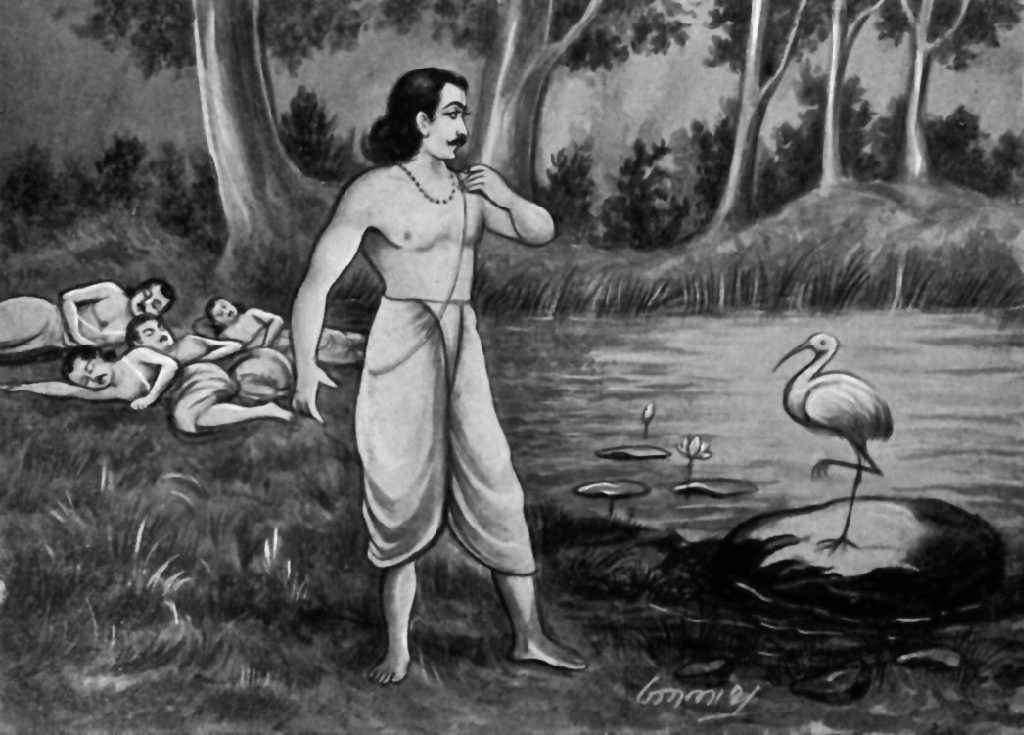
Yudhisthira and the crane (public domain image)

As King Yudhisthira knelt down, the Voice took the shape of a Baka, or crane, a gray bird with long legs and a red head. The Baka spoke to him in a stern voice, saying:

“Do not drink, O King, until you have answered my questions.”

“Who are you?” said Yudhisthira boldly. “Tell me what you want.”

“I am not a bird,” said the Baka, “but a Yaksha!” And Yudhisthira saw the vague outlines of a huge being above crane, towering above the lofty trees, glowing like an evening cloud.

“It seems I must obey, and not drink before I answer your questions,” said the king. “Ask me what you will, and I will use what wisdom I have to answer you.”

So the questioning began:


The Yaksha said: “Who makes the Sun rise? Who moves the Sun around the sky? Who makes the Sun set? What is the true nature of the Sun?”

The King replied: “The god Brahma makes the sun rise. The gods and goddesses move the Sun around the sky. The Dharma sets the Sun. Truth is the true nature of the Sun.”

The Yaksha asked: “What is heavier than the earth? What is higher than the heavens? What is faster than the wind? What is there more of than there are blades of grass?”

The King replied: “The love of parents is both heavier than earth and higher than the heavens. A person’s thoughts are faster than the wind. There are more sorrows than there are blades of grass.”

The Yaksha asked: “What is it, that when you cast is aside, makes you lovable? What is it, that when you cast it aside, makes you happy? What is it, that when you cast it aside, makes you wealthy?”

The King replied: “When you cast aside pride, you become lovable. When you cast aside greed, you become happy. When you cast aside desire, you become wealthy.”

The Yaksha asked: “What is the most difficult enemy to conquer? What disease lasts as long as life itself? What sort of person is most noble? What sort of person is most wicked?”

The King replied: “Anger is the most difficult enemy to conquer. Greed is the disease that can last as long as life. The person who desires the well-being of all creatures is most noble. The person who has no mercy is most wicked.”


The questions went on and on, but Yudhisthira was able to answer them all, wisely and well.

At last the Yaksah stopped asking questions, and revealed its true nature: the Yaksha was none other than Yama-Dharma, the god of death, and the father of Yudhisthira.

Yama-Dharma said, “It was I who took on the shape of a deer and stole the wooden blocks so the Brahmin could not light the sacred fire.

“Now you may drink of this fair water, Yudhisthira! And you may choose which of your four brothers shall be returned to life.”

“Let Nakula live,” said Yudhisthira.

“Why not Bhima or Arjuna or Sahadeva?” said Yama-Dharma.

“My brother Nakula is the son of Madri,” said the King, “while Arjuna, Bhima, Sahadeva and I are the sons of Kunthi. If Nakula returns to life, then both my mothers, both Madri and Kunthi, will have a living child. Therefore, let Nakula live.”

Then Yama-Dharma spoke kindly as he faded away. “Truly you are called ‘The Just,” he said. “Noblest of kings and wisest of all persons, for your wisdom and your love and your sense of justice, I shall return all of your brothers to life.”


More riddles — Here are two dozen more of the riddles that Yama-Dharma asked of Yudhisthira:

1. How may a person become secure? — A person becomes secure through courage.
2. How may a person become wise? — A person gains wisdom by living with people who are wise
3. What is best for the Brahmans (those who pursue learning as their life’s work)? — Studying the Vedas, the holy books, is best for the Brahmans.
4. What is best for the Kshathriyas (those who are the warriors and defenders)? Weapons are best for the Kshathriyas.
5. What is best for farmers? — Rain is best for farmers.
6. Who does not close their eyes when sleeping? — Fish do not close their eyes when sleeping.
7. What does not move even after birth? — Eggs do not move even after birth.
8. What does not have a heart? — A stone does not have a heart.
9. What grow as it goes? — A river grows as it goes to the sea.
10. Who is the guest who is welcome to all? — Fire is the guest who is welcome to all.
11. Who travels alone? — The Sun travels alone.
12. Who is born again and again? — The Moon is born again and again.
13. What container can contain everything? — The Earth can contain everything.
14. Out of all things, what is best? — Out of all things, knowledge gained from wise people is best.
15. Out of all blessings, what is best? — Out of all blessings, good health is best.
16. Out of all pleasures, what is best? — Out of all pleasures, being contented is best.
17. Out of all just actions, which is best? — Out of all just actions, non-violence is best.
18. What must a person control in order to never be sad? — A person must control their mind in order to never be sad.
19. What will a person never be sad to leave behind? — A person will never be sad to leave behind anger.
20. What should a person leave behind to become rich? — A person should leave behind desire in order to become rich.
21. What should a person leave behind to be have a happy life? — A person should leave behind selfishness to have a happy life.
22. By what is the world covered? — The world is covered by ignorance.
23. Why doesn’t the world shine brightly? — Bad behavior keeps the world from shining brightly.
24. What is surprising? — It is surprising that we think of ourselves as stable and permanent, when every day we see beings dying.

Illustrations are from the following public domain sources (accessed through the Internet Archive):
Sarus Crane, H. E. Dresser, “A History of the Birds of Europe,” London: 1871-1881.
Yudhistira and the crane, Mahabharata, Gorakhpur, India: Geeta Press, n.d.

“The World Is Full of Smelly Feet”

Veronika sent a photo of hymn number 736 in Anglican Hymns Old and New, Revised and Enlarged (Great Britain: Kevin Mayhew, 2008). The hymn is titled “The Wolrd Is Full of Smelly Feet.” Of course I thought it was a faked photo, but a little bit of Web searching reveals that it is, in fact, a real hymn with text by by Michael Forster, and music by Christopher Tambling.

I suppose if one is in a Christian church with a liturgical heritage, and one is looking for a contemporary praise-song-type hymn to sing during footwashing, one might consider having the congregation sing this; although it’s hard to imagine.

But then my Web searching revealed that this hymn is included in a collection for junior choirs, and that boggled my mind. If the junior choir I was in sang this song — which we wouldn’t have, since it was a Unitarian Universalist church — but if we had been told to sing that song, my buddy Barry and I would have been laughing so hard we probably would have been unable to sing. Maybe some of the serious older girls would have sung it, but I can’t even imagine them getting through the lyrics with a straight face.

I am sometimes annoyed by some of the hymns in the Unitarian Universalist hymnals. It is good to know that we, at least, do no have a hymn to smelly feet.

For educational purposes, and in the spirit of Maundy Thursday, I’ll include the chorus and two of the verses here. I think you’ll especially enjoy the unexpected rhyme between “toes” and “nose.”

Chorus: The world is full of smelly feet,
Weary from the dusty street.
The world is full of smelly feet,
We’ll wash them for each other.

Jesus said to his disciples,
‘Wash those weary toes!
‘Do it in a cheerful fashion,
‘Never hold your nose!

We’re his [Jesus’] friends, we recognise him
In the folk we meet;
Smart or scruffy, we’ll still love him,
Wash his smelly feet!


Deity?

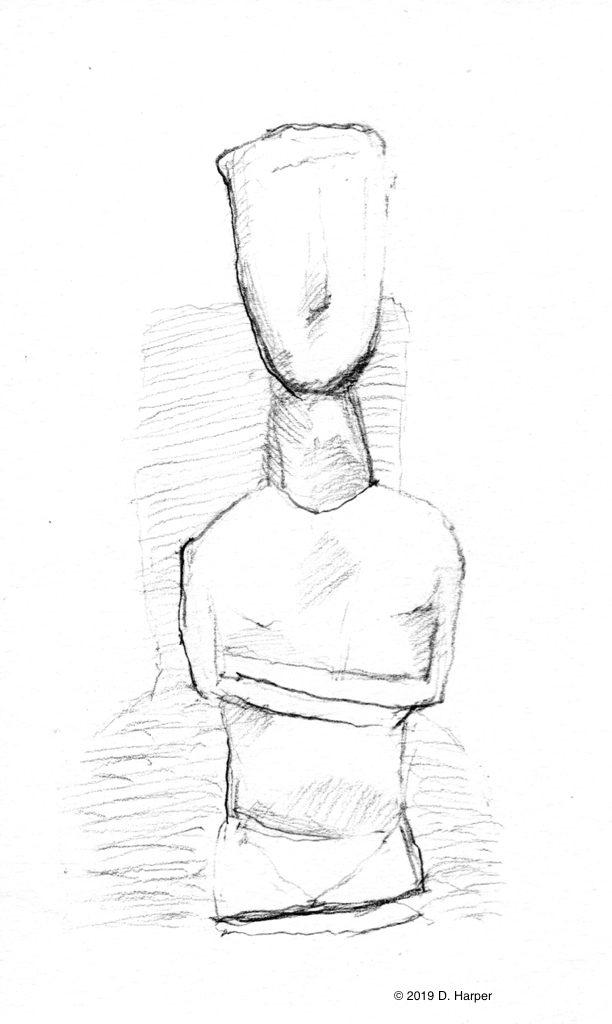
The DeYoung Museum in San Francisco has a number of Cycladic figures made thousands of years ago in what is now Greece. I was attracted to one of these figures, labeled as “Cycladic Figure, Early Cycladic II, Spedos variety,” dating to perhaps 2500 BCE, so I made a quick sketch of it:

This is a typical Cycladic figure of a woman with her arms crossed; it is made of white marble, though originally it would have been “painted with mineral-based pigments—azurite for blue and iron ores, or cinnabar for red.” There are those who assert that this type of figure represents a deity, perhaps the Great Goddess who may have been the chief deity of the ancient Greek world.

But of course there’s really no way to know what this figure represents. Is it a deity, or just a human figure? Or maybe something in between? Perhaps we would tend to call it a deity because the shape is so satisfying to look at; when we like looking at a piece of art it is tempting to think of that art as representing something beyond the mundane.

Risk Reduction Resource Kit

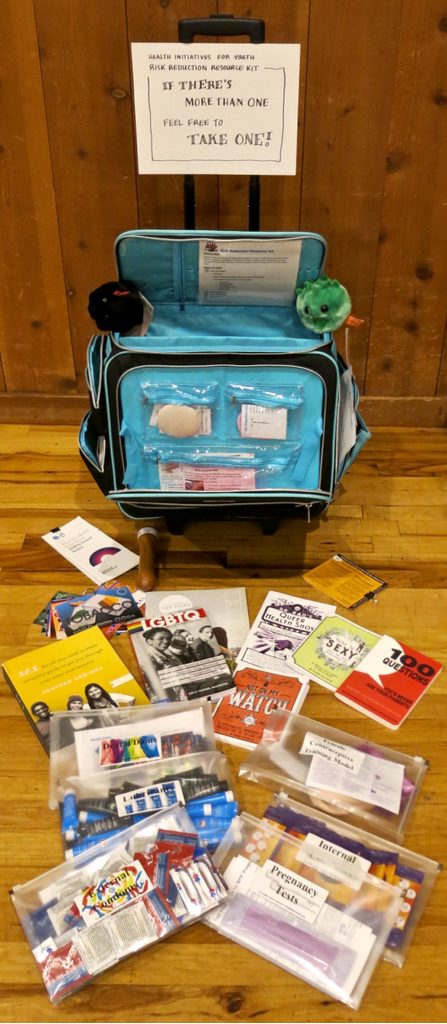
Alex, a friend who works at Health Initiatives for Youth (HI4Y) in San Francisco, told me about their Risk Reduction Resource Kits. These kits contain resources to help teens teens learn about sexuality and safer sex. Alex knows about the OWL comprehensive sexuality education program, and has heard me describe our youth programs, and based on that he encouraged me to put in an application for the last remaining Risk Resource Reduction Kit, and Carol and I went in to JI4Y’s offices to pick up the kit on Monday.

The whole point of the kit is that it’s supposed to be placed where teens can access it without adult supervision, to encourage them to explore the materials on their own. The kit was designed to accompany a sexuality education curriculum developed by HI4Y, but be accessible both to teens taking the curriculum and other teens. So for our congregation, it’s a prefect accompaniment to the OWL unit for gr. 10-12; for those taking OWL the kit will reinforce the curriculum; and it can also serve as an educational resource for those not taking OWL.

The Curriculum Subcommittee of our congregation met the day after I picked up the kit, and we devoted the meeting to talking about the kit. The Curriculum Subcommittee has been exploring ways to be more intentional about our congregation’s implicit curriculum, asking ourselves: How can we structure intentional learning opportunities that are not part of the explicit curriculum, the formal educational programs? We agreed that the kit is a solid addition to our implicit curriculum: Not only does it educate teens about specific sexuality topics, it provides a larger lesson that information about sexuality should be easily accessible and shared without shame or guilt.

Beyond educational theory, we also talked about how best to implement this aspect of our implicit curriculum. Alex had warned us that sometimes the kits get forgotten, and stowed in some obscure corner. So we’re going to provide orientation to the kit for key adults (youth advisors, OWL leaders, ministers, and others) to increase the chance that adults will remember to make the kit accessible. In addition, we’re also going to provide a brief orientation to the kit to teens — both to youth group members, and participants in OWL gr. 10-12 — showing them what’s in the kit, and telling them where it will be located. (When we offer OWL for gr. 7-9 next year, we’ll do another orientation.)

But the real strength of the kit is what it contains. HI4Y came up with some excellent youth-friendly resources, including comics, zines, books, and samples — I’m putting a complete list of what’s in the kit below. The materials are housed in a wheeled nylon case, like airline luggage (actually, it’s a scrapbooking case HI4Y bought from Michael’s art supply). A highlight of the kit is contraceptives samples that youth can examine: condoms of course, but also dental dams, female condoms, and lubricant; HI4Y even has some grant money left to replenish samples when they get depleted. There’s both a penis model (made of wood, not plastic!) for trying condoms, and a vulva/vagina model for trying female condoms. We were able to add one very important thing to this kit: our congregation has a ten thousand dollar bequest that we can use to put books in the hands of children and teens, so we are able to provide copies of the book “S.E.X.” by Heather Corinna that youth can take for their own.

We would not have been able to afford to put this kit together ourselves, and we are grateful to HI4Y for writing the grant and assembling the kit, and to the federal government for providing the grant money. Just in case your UU congregation can find the funding, I’m going to provide a complete list of all the resources in the kit below; at the very least, this list of resources might spark ideas for you.

The Risk Reduction Resource Kit (we added the sign at top).

Here’s what’s in the kit:

Birth control samples and examples:
Dental dam samples
Female condom samples
Female Contraceptive Model (to practice inserting female condoms)
Lubricants samples
Male condom samples
Penis model (to practice with male condoms)
IUD model
The Ring model
The Pill model
The Implant info card
Plan B info card
Birth Control Patch info card
“How Well Does Birth Control Work” info card

Home test kits:
Pregnancy test kits
HIV Home Test Kit information (actual kit is stored separately, per instructions from Health Initiatives for Youth)

Handouts and Miscellaneous:
“Pre-Exposure Prophylaxis” handout
Individual Drug Fact Cards (handouts)
Drug Fact Cards set
Chlamydia Plush Toy
HIV Plush Toy
Youth Clinic Youth Guide to San Francisco and Silicon Valley (list of local clinics that serve youth; includes 1-page summary of California law on youth’s right to treatment)
(We also added handouts from the nearest Planned Parenthood Health Center)

Publications:
“Dr. Rad’s Queer Health Show: Self Exams & Check-Ups” zine by Rad Remedy and Isabella Rotman
“You’re So Sexy When You Aren’t Transmitting STIs” comic zine by Isabella Rotman
“Not on My Watch: Bystander’s Handbook for Prevention of Sexual Violence” comic zine by Isabella Rotman
“100 Questions You’d Never Ask Your Parents” book by Elisabeth Henderson and Nancy Armstrong
“S.E.X.” book by Heather Corinna
“LGBTQ: The Survival Guide” book by Kelly Huegel Madrone
“Birth Control Top Picks” magazine by Bedsider.org

Buffy Saint-Marie on colonialism

An authorized biography of singer-songwriter Buffy Saint-Marie came out last year; “authorized” means that it was written with Saint-Marie’s cooperation, and it contains lots of quotes by her. Saint-Marie is a Cree Indian from Saskatchewan, who was adopted into a white New England family, and who later reconnected with her birth parents (probably; the records aren’t entirely clear). She quickly became aware of the ways in which the world was exploitative; this exploitation she identifies this as colonialism. Indeigenous people like herself get exploited, but it goes far beyond that:

“Colonialism doesn’t just bleed Indigenous people; eventually, it bleeds everybody except the jerks who are running the racket.”

I would only add that colonialism is related to capitalism; they co-evolved.

More coloring pages

In response to my recent post about creating coloring pages, Carol sent me a link to “Color Our Collections,” an initiative hosted by the New York Academy of Medicine (NYAM). For the past three years, libraries, archives, and museums in North America and Europe have created coloring pages based on items in their collections, and NYAM shares them at library.nyam.org/colorourcollections . Most of these collections of coloring pages are really aimed at adults, but there are dozens of collections to look through. I’m going to be able to use at least some coloring pages from the collections created by the Shangri La Museum of Islamic Art, Culture, and Design; the Biodiversity Heritage Library; the San Francisco Maritime National Historical Park; Berkeley Library at the University of California; and maybe one or two others.

And Matt pointed me to the 2019 coloring and activity book created by Black Lives Matter at School. This is a big book, with 32 pages, and mostly aimed at kids older than my target audience. We won’t be able to use the activity pages that require knowing how to read and write, but I know we’ll be using the coloring pages titled “Diversity,” “Black Families,” “Black Women,” “Queer Affirming,” and “Transgender Affirming.” Both the art and the messages are fabulous.

If any of you have any more tips for great free coloring pages, let me know — I’m especially looking for coloring pages that feature East Asian, South Asian, and Hispanic culture. And some time in March, I’ll set up a coloring pages Web page on my curriculum web site, with links to the best coloring pages.

Coloring pages

Coloring pages are an essential part of how we make space for children in our Palo Alto congregation. When they enter of Main Hall, children and their parents can pick up packets of coloring pages and crayons, to give the children something to keep them engaged while they’re in the worship service.

Now, for years I’ve made special activity books for two of our intergenerational worship services, Easter and Flower Communion; the Easter activity books in particular are designed to have some educational value. But I haven’t put much thought into our regular weekly coloring pages; the Religious Education Assistant just found free coloring pages on the Web, and that’s what we used. The coloring pages may have nothing to do with our faith community, but at least the kids are happy.

But it occurred to me that we were missing an educational opportunity: why not come up with coloring pages that are both fun, and have some educational value? I did a Web search to see if other Unitarian Universalist congregations had produced coloring pages, and found the Alice the Chalice coloring pages by talented religious educator Rev. Amy Friedman — great stuff! But Amy has only provided a half a dozen different coloring pages. We give out packets with 8 or so coloring pages, and ideally I wanted to have a different packet for every month. It looked like I was going to have to make my own.

I began to collect images that I thought would be fun to color in. More importantly, I began to think about what I wanted to teach. Our religious education program does a lot with nature and ecojustice. So it made sense to produce coloring pages of living things; this would show young children and our families that we value non-human organisms, and if the images were of organisms native to California this would show our awareness of the immediate web of life surrounding us. (OK, maybe this is a little above the head of a four year old, but parents and older siblings will be looking at these, too.)

A search for public domain line drawings turned up a good selection of Pacific Coast wildflowers, as well as Lepidoptera (butterflies and moths), and I was quickly able to assemble 8 coloring pages with California native plants, and 8 coloring pages with butterflies and moths. California mammals would be another obvious category, but I couldn’t find line drawings that would make good coloring pages; I was going to have to draw my own. I’ve started working on mammal coloring pages, and if you click on the image below you’ll get a PDF with two of those pages.

Above: Townsend’s Chipmunk, a sample page from the California Mammals coloring pages.

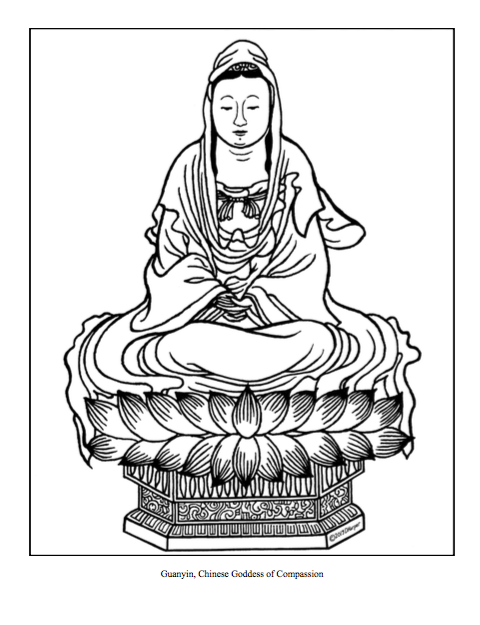
What about coloring pages with more explicitly religious content? We Unitarian Universalists are known for being feminists, so why not Goddesses Coloring Pages? I was able to find some public domain line drawings of goddesses, including goddesses from South Asia and the Mediterranean, and East Asia. I’m still looking for public domain images of goddesses from Indigenous America, Africa, and Oceania — and the images of the East Asian goddesses needed to be completely redrawn. Eventually, I’m planning on two packets of Goddesses Coloring Pages, and if you click on the image below you’ll get a PDF with two of those pages.

Above: Guanyin, a sample page from the Goddesses coloring pages.

You’ll notice that I’ve put copyright notices on the coloring pages; I did so because it’s a big, bad Internet out there, and I don’t want other people to steal my work. But I hereby grant permission for Unitarian Universalist congregations, and other educational nonprofits, to print hard copies of these coloring pages for free distribution in their educational programs.

Eventually, I may put all my coloring pages on my curriculum web site, and if I do so I’ll mention it here on my blog. In the mean time, now you have 4 more coloring pages to add to the Alice the Chalice coloring pages.

Deities of non-binary gender

As I develop some new middle-elementary curriculum materials, I’ve been looking at myths and religious narratives for deities who do not have a binary, male-or-female, gender.

The most familiar example of a non-binary gender deity — but an example we mostly ignore — is in one of the two stories of the creation of humankind in the book of Genesis. The more familiar Genesis story of the creation of humankind comes from the second chapter of Genesis, where God creates a male human, then puts the male human to sleep, takes a rib, and makes a woman. However, as feminists began pointing out back in the 1970s, there’s another story about how humans were created in the first chapter of Genesis:

“So God created humankind in his image, in the image of God he created them; male and female he created them.” (Genesis 1:27, NRSV)

Commenting on this passage, Susan Niditch, professor of religion at Amherst College, says:

“For feminist readers of scriptures, no more interesting and telegraphic comment exists on the nature of God. The male aspect and the female aspect implicitly are part of the first human and a reflection of the creator.” (Women’s Bible Commentary, ed. Carol A. Newsom and Sharon H. Ringe, Westminster/John Know Press, 1992, p. 13)

While agreeing with Niditch, I would add that this passage implies to me that the God of Genesis 1 cannot be reduced to a single binary gender.

The Navajo deity Turquoise Boy represents a different approach to gender. In the Dine Bahane, the Navajo creation myth, when the humans get to the Third World, the men decide to live apart from the women, and cross a river in order to separate themselves. But the men take Turquoise Boy with them, because he is able to do the women’s work of grinding corn, etc., which the men ordinarily wouldn’t be able to do. (See: Aileen O’Bryan, The Dîné: Origin Myths of the Navaho Indians, Bulletin 163, the Bureau of American Ethnology, Smithsonian Institution, 1956.) Note that this is an ambiguous gender role, not non-binary or transgender. White Shell Girl is possibly a non-binary gender deity; the narrative refers to her as being intersex, or in the O”Bryan translation, a hermaphrodite.

Turning to Chinese myths and religious narratives, Lan Caihe (Lan Ts’ai-ho), one of the Eight Immortals of Taoism, is ambiguously gendered. According to folklorist E. T. C. Werner:

“Lan Ts’ai-ho is variously stated to have been a woman and an hermaphrodite…. According to the Hsiu hsiang Pa Hsien tung yu chi, … though he was a man, he could not understand how to be a man (which is perhaps the reason why he has been supposed to be a woman).”(Myths and Legends of China, E. T. C. Werner, London: George Harrap & Co., 1922, p. 293)

There are many other deities with ambiguous or non-binary gender, including perhaps most famously the ancient Greek deity Hermaphroditus. What I find particularly interesting is that non-binary gender plays out in many different ways in these various myths and religious narratives. I want to say that there is a spectrum of gender choices, but I think saying that imposes my early twenty-first century Western cultural framework on other cultures. Better to say that gender has been interpreted in many ways in different religious traditions.

5/28/26: Updated to clarify Turquoise Boy.

Clergy hit a new low in perceptions of ethics and honesty

Gallup has been polling people in the U.S. since 1977 about perceptions of the honesty and ethics of various professions. These Gallup polls rate the perceived honesty of professions as “very high/high,” “average,” or “very low/low” (with the obvious addition of a choice for “no opinion”).

In Gallup’s most recent poll about perceptions of the ethics and honesty of various professions, the nursing profession again tops the list, with 84% of people giving them a “very high/high” rating, 15% giving them an “average rating,” and 1% giving them a “very low/low” rating.

By contrast, only 37% of people give clergy as a profession a “very high/high” rating for honesty and ethics; 43% give an “average rating,” 15% give a “very low/low” rating, with the remainder offering “no opinion.” In their report, Gallup made a special note of the decline in the perception of clergy honesty and ethics:

“Gallup has measured Americans’ views of the clergy’s honesty and ethics 34 times beginning in 1977, and this year’s 37% very high/high rating is the lowest to date. Although the overall average positive rating is 54%, it has consistently fallen below that level since 2009. The historical high of 67% occurred in 1985. Positive views of the honesty and ethics of the clergy dropped in 2002 amid a sexual abuse scandal in the Roman Catholic Church, and although positive ratings rebounded somewhat in the next few years, they fell to 50% in 2009 and have been steadily declining since 2012.”

However, although the Catholic sexual abuse scandal is foremost in many people’s minds, evangelical Christian blogger Warren Throckmorton notes that there are other clergy scandals affecting some people’s perceptions of clergy. Throckmorton specifically mentions the recent accusations of clergy financial misconduct at Harvest Bible Church, an evangelical Christian megachurch near Chicago: when some whistle-blower bloggers made those accusations public, rather than addressing the accusations, Harvest Bible Church sued the bloggers for defamation. Throckmorton contrasts Harvest Bible Church with Willow Creek Church, another big evangelical Christian megachurch which recently ousted its founding pastor after credible allegations of misconduct; subsequently the entire leadership team resigned, realizing their leadership had been compromised by their poor handling of the allegations, and realizing that the church needed to get a fresh start. (Throckmorton’s most recent blog post about Harvest Bible Church, which links to the Gallup poll, is here.) We could add more examples from outside evangelical Christianity of how organized religious groups respond poorly to accusations of ethical lapses and dishonesty: the many accusations against the Church of Scientology and their opaque responses come immediately to mind.

One thing that I get from Throckmorton’s post is that poor governance goes hand in hand with decline in trust in clergy. And we should distinguish governance from polity. The hierarchical polity of the Roman Catholic Church should in theory be more effective at removing unethical clergy than our Unitarian Universalist congregational polity; more than one unethical Unitarian Universalist minister was able to continue their unethical ways because the Unitarian Universalist Association cannot prevent a local congregation from hiring whomever they want as minister. However, all too often the Roman Catholic Church hierarchy covered up clergy misconduct. The Unitarian Universalist Association, by contrast, has recommended that search committees carry out careful background checks of potential new clergy hires; in Unitarian Universalism, the failures in governance too often take place at the local level, representing the biggest weakness of congregational polity is dealing with ethics; but on the whole, despite the weakness of its polity, Unitarian Universalists have a somewhat better record of dealing with clergy misconduct than the Roman Catholic Church. Again, my point here is that no type of polity is immune from ethical lapses; the real issue is good governance practices within whatever polity a religion might have.

I suspect, therefore, that the decline in the perception of clergy honesty is linked to a wider decline in trust of organized religion — a decline that in many cases is deserved. Lay leaders and clergy, regardless of our polity, need to be scrupulously careful about maintaining good governance practices that are transparent and that strengthen accountability; and when ethical violations arise, we need to address them quickly and transparently.