Ordinary Unitarians: Martha Ziegler

As the years go by, I find I’m less interested in how famous or “important” Unitarian Universalists live their lives, and increasingly interested in the lives of ordinary Unitarians and Universalists. Maybe this is because I don’t know any important or famous Unitarian Universalists, but I’ve known lots of ordinary Unitarian Universalists. With that in mind, here’s a brief biography of Martha Clara Elizabeth Ziegler Greenlaw [a.k.a. Reynolds, Seymour, and Fancher], a member of the old Unitarian Church of Palo Alto:

A housewife and mother who experienced more than her share of domestic challenges and tragedies, Martha Clara Elizabeth Ziegler was born Feb. 27, 1894, in Chicago. In 1900, she was living in Hyde Park Township (which became part of Chicago). She lived with her father Gustav, a machinist’s helper, who had been born in Denmark; her mother Ida, who had been born in Germany; and her younger brother Charles.

When she was 17 years old, on Aug. 1, 1911, she married Charles Greenlaw in Chicago, Ill. Charles worked for American Telephone and Telegraph (AT&T) installing new phone systems in communities across the country, and his job required him to relocate every few months. His wife and a growing number of children had to move with him, and some of their moves can be traced from the birthplaces of their four children: Arnold Ziegler was born July 12, 1912, in Chicago; Colin Torrey was born March 27, 1914, in Baltimore, Md.; Morrison Bronk was born Aug. 3, 1918, in San Francisco; and Margery Ellen was born Nov. 3, 1920, in Chicago. All these moves put strain on the family.

To try to reduce some of the strain on the family, from about 1918 to 1920 they spent significant amounts of time in a cabin Charles owned in Willits, Calif. But soon they had to move again, and in January, 1920, they were living in Detroit, Mich. And by 1923, the family had moved to 523 Webster St. in Palo Alto.

Martha joined the Unitarian Church of Palo Alto in 1923. The names of her two oldest children, Arnold and Colin, were noted as having excellent attendance records in 1924. After her second marriage, she was listed in the 1926 “List of Resident Members” of the church as “Mrs. James E. Reynolds.”

Charles and Martha’s marriage came apart around 1923, and they probably divorced in 1924. By late 1924, Martha was living without Charles at 523 Webster St., and she was working as a stenographer. She was a single mother and caring for a four year old daughter; Charles had custody of the three older boys.

Soon after her divorce, on Dec. 22, 1924, Martha married James Edward Reynolds, and Rev. Elmo Arnold Robinson of the Unitarian Church officiated at the wedding. She and James had one child together, James E., Jr. (b. c. 1927, Calif.), and she of course also had custody of Margery. However, James and Martha’s marriage only lasted about five years because James developed tuberculosis and died around 1929. Once again, Martha was single, this time with two children under the age of ten.

Once again, Martha quickly remarried, this time to Fred Wesley Seymour (b. c. 1887, Ill.), who was known at various times as both Fred and Wesley. By 1930, they were living in Redwood City with Margery Greenlaw and James E. Reynolds Jr., now known as Edward. At some point between 1930 and 1934, Fred Wesley adopted James, Jr., who then became known as Peter Owen Seymour.

Martha’s third marriage also ended quickly, and again because her husband died. Fred Wesley worked for as a yardman in a railroad yard, and around 1934 he died in an accident on the Southern Pacific Railroad. By 1935, Martha had moved back to Palo Alto to live with Marjorie and Peter, who were now in their early teens.

Around 1940, Martha married for the fourth time, this time to Earl Fancher (b. c. 1883, N.Y.). In 1940, she was living with Earl in Fremont Township, Santa Clara County, along with her daughter Margery and her son Peter. However, this marriage, too, only lasted a few years, though this time the marriage ended with her death.

She died March 19, 1946, in Glendale, Calif. In her short 52 year life, she had had five children and lived through a stressful first marriage which ended in divorce, and she had buried two other husbands. I’d like to imagine that the Unitarian Church of Palo Alto provided some support to her during her divorce and remarriage, and it seems unfortunate that the church had mostly ceased existence during her second husband’s final illness and death, a time when a church could have been a real support.

Notes: 1900, 1920, 1930, 1940 U.S. Census; Illinois, Cook County Marriages, 1871-1920; Illinois, Cook County Marriages, 1871-1920; Illinois, Cook County, Birth Certificates for Arnold Ziegler Greenlaw, Marjorie Ellen Greenlaw; Calif. Birth Index, Calif. Death Index, and U.S. Social Security Death Index for Morrison Bronk Greenlaw; Russ Greenlaw, “Martha Clara Elizabeth Fancher formerly Ziegler aka Greenlaw, Reynolds, Seymour,” from “Family records and recollections of Alberta Seymour,” Wikitree Web site www.wikitree.com/wiki/Ziegler-463 accessed Aug. 1, 2020; Directory of Palo Alto, Mayfield, Stanford University, Ravenswood, and East Palo Alto, Palo Alto: Willis Hall, 1924, 1925 [Martha is listed as living alone at 523 Webster St. in the 1925 Directory, which was after she had married James Reynolds; but the information for the directory was probably collected in 1924]. Genealogical information from familysearch.org except where noted.

Adding links to video series

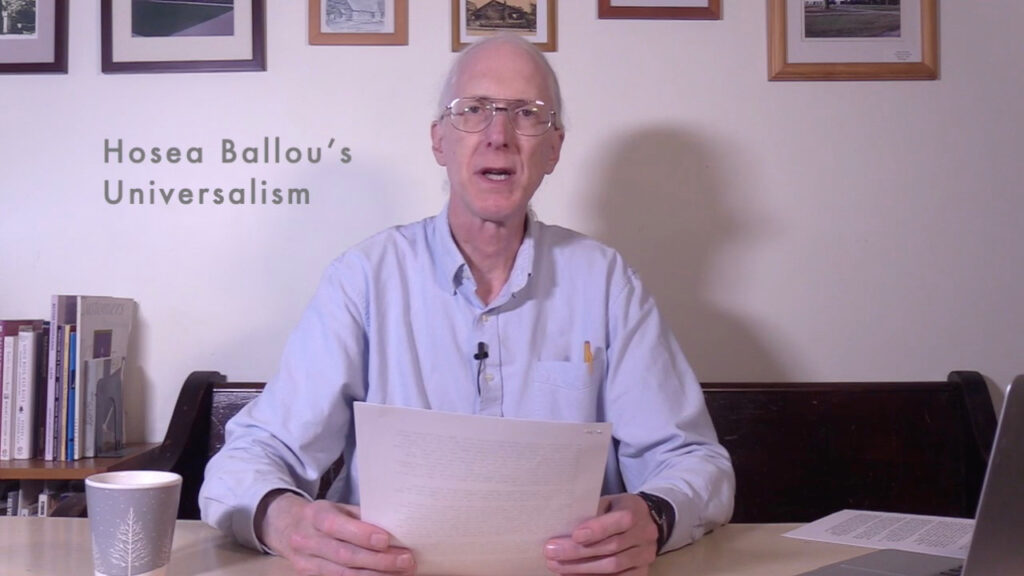
Over the past few months, I’ve been writing and producing videos nearly every week for the online worship services at the UU Church of Palo Alto. For my own reference, I just created blog posts for each of the videos I’ve done so far, including a still from the video, a link to the video on Youtube, and a full script. The posts are backdated to the Sunday on which the video appeared in the worship service.

You can see all these blog posts here.

Clicking on the image above will take you to my Youtube channel where the videos are posted

Obscure Unitarians: Bertha Louise Chapman Cady

This is a major revision of an earlier short biography of Bertha Cady Chapman.

A writer, biologist, and sexuality educator, Bertha Louise Chapman was born July 5, 1873, in Santa Barbara, Calif., the daughter of Truman (sometimes given as “Freeman”) Fletcher Chapman and Mary Elizabeth Furlong Chapman; Bertha’s older sister Elizabeth Corinne Chapman had been born in the same place in 1870. By August, 1873, the family was living in San Buenaventura (now known as Ventura), Calif., where Truman worked as a druggist.

After Bertha was born in 1873, Truman became involved in mining, and he moved the family to New Mexico to operate mines there. In 1880, Bertha, her parents, and both siblings were living in Las Vegas. Truman was the postmaster of Las Vegas, New Mexico, from Jan., 1878, to Sept., 1880. In 1880, he owned the St. Nicholas Hotel on the Plaza. Las Vegas had grown into a bustling town with the coming of the railroad in 1878, but the Plaza retained a distinctly Southwestern flavor:

“The Plaza is in the center of the town.…About the center of the Plaza is the relic of the old well, the windmill having been torn down, and the well long out of use. It was the scene of [a] horrible sight this Spring, as on the night of February 9th the vigilantes hung one cowboy to the windmill, and laid his two companions out beneath him, riddled with bullets, because of their murder of Joe Carson, a few weeks previous. The Plaza is the principal market for the produce of the farmers.… Almost daily one will see large droves of burros standing about, loaded with wools, hides, or pelts.…Little, narrow, crooked streets lead out from the Plaza, and on all side of the town are scattered those queer little adobes, which give the place its ancient and foreign appearance to strangers.” (H. T. Wilson, Historical Sketch of Las Vegas, New Mexico [Chicago: Hotel World Pub., 1880?], p. 18)

This is the town where Bertha lived when she was perhaps 5 to 8 years old.

Continue reading “Obscure Unitarians: Bertha Louise Chapman Cady”

Westerners misappropriating non-Western religious imagery

A broad-based interfaith coalition, including Buddhists, Christians, Hindus, Jains, and Jews, has targeted a nightclub chain that uses Buddhist, Hindu, and Jain statues for interior decoration. As reported by Religion News Service, the “Foundation Room” night clubs operated by Live Nation Entertainment in U.S. cities including Boston, Chicago, Dallas, Las Vegas, and New Orleans uses the following religious imagery as decor: statues of Buddha (Buddhism); statues of Ganesha, Hanuman, Shiva, and Rama (Hinduism); statues of Mahavira and Parshvanatha (Jainism).

Live Nation said in a statement that the Foundation Room clubs are (according to them) all about “promoting unity, peace, and harmony.” Before you cynically respond “Bullshit!” — it may be that Live Nation’s management really did see the misappropriation of these religious images as promoting unity. Since they’re based in the U.S., we can assume that they — consciously or unconsciously — see the “Judeo-Christian tradition” as normative; and while “Judeo” is merely a modifier of “Christian” in this formulation, Judaism is still seen as somehow normative. Since Christianity and Judaism are part of mainstream U.S. culture, Live Nation’s management would never think of putting up a cross or star of David in one of their nightclubs.

Why then is it OK to use religious images from Buddhism, Hinduism, and Jainism? Well, part of the answer might well be that “religion” as a concept is a Western concept that only dates back to the Enlightenment. Prior to the Enlightenment, the West did not have a concept that corresponds to our current notion of “religion.” And “religion” as a concept was developed in part as a way to bolster Western colonialist ambitions: “religion” was defined in such a way that only Christianity (and perhaps Judaism, in a debased way) fit the definition; this allowed Western powers to justify domination of non-Western cultures on the grounds Christianizing them. (For more on the link between “religion” and colonialism, see e.g. Timothy Fitzgerald, The Ideology of Religious Studies [Oxford Univ. Press, 2000]; William T. Cavanaugh, The Myth of Religious Violence: Secular Ideology and the Roots of Modern Conflict [Oxford Univ. Press, 2009]).

Not surprisingly, colonized peoples are accorded less respect than the colonizers. This might make more sense if I put this in racial terms, since so many of us are thinking about race these days: in the Western worldview, Christianity is seen as the property of the West, which means it’s a white religion; while Buddhism, Hinduism, and Jainism are generally seen as having adherents who are people of color; while you wouldn’t use white people’s religious symbol in a night club, it would be OK to use the religious symbol belonging to people of color.

However, while colonialism and racism are strongly linked, I find it more helpful to view this dispute over religious imagery in nightclubs as a legacy of colonialism. After all, Buddhism, Hinduism, and Jainism do have white adherents, and there are strong traditions of black and Latinx Christianity. But non-Christian religions are still seen as somehow “primitive” or less advanced than Christianity, and thus may be accorded less respect; and just as in the past, this viewpoint still allows Western nations to see non-Western nations as suitable for colonial domination through both economics and military action.

Maybe I’m making too much out of this. But I do want to explain why Live Nation Entertainment didn’t put crosses or statues of Jesus Christ in their nightclubs; why does Jesus Christ get their respect, but not the Buddha?

General Assembly 2020

I did register for the online General Assembly (GA), but I have to admit I attended very few sessions. I discovered that I have a limit on how much screen time my body will tolerate in any given week, and I had pretty much reached that limit by Thursday. I watched perhaps an hour of the business sessions — long enough to realize that I’m going to miss our current co-moderators. I find them inspiring and visionary in their leadership. And while I’m sure the incoming co-moderators are highly competent people, it was awfully nice to have co-moderators who were younger than I am.

The one session from GA that really stands out in my mind is a session that I missed, but was brought to my attention by Linda H., a member of the curriculum subcommittee in my congregation. This was session 203, “Collaborative Planning of Highly Interactive Family Worship,” with Louise Marcoux of the UU church of Sharon, Mass. I started listening to the recording, and remembered that I heard Louise talking about this concept a couple of years ago. At that time, I had filed the idea away in my memory as very interesting but impossible to do in our physical space at the UU Church of Palo Alto, because we don’t have a room we could use for family worship on Sunday morning. But we’re going to be doing everything online for some time to come, and it looks like Louise’s concept could translate really well to an online setting.