
UU congregation in Texas firebombed

The Community Unitarian Universalist Church of Plano, Texas, posted the following statement on its Facebook page on July 23 (a similar statement appears on its website):


“Firebomb Attack on July 23, 2023 at Community Unitarian Universalist Church of Plano

“On Sunday, July 23, 2023, between 12:00 am and 12:30 am, a firebomb attack took place at Community Unitarian Universalist Church of Plano. An incendiary device with a chemical accelerant was thrown or placed at the front doors of the main church building. The fire and smoke caused the monitored fire alarm system for the building to go off, which notified church personnel. The City of Plano 911 system received a call from a passerby who saw the fire at the same time. City of Plano Firefighters arrived on the scene and were able to extinguish the fire. Because of the quick action of Plano’s First Responders, the damage to the church property was limited to the front doors, the materials directly outside the front doors, and the entrance foyer. There were no injuries. Plano Police and Fire Department personnel did a thorough collection of evidence of the crime scene. They also interviewed multiple church personnel who arrived on-site to assess the incident. 

“Church officials have been reviewing building security and working with the Plano Police Department since the intrusion of a hate group in the church building during and after Worship Service on Sunday, June 25. That group has posted video of their activities inside the church on various social media sites.

“The church community asks for your support and prayers at this time as we deal with the impact of this incident. Thank you and blessings.”


The “hate group” mentioned in the press release consisted of Bo Alford and Cassady Campbell, both right-wing YouTubers, and and unidentified person. On July 27, NBC News reported that the men were engaged in making a video for Alford’s YouTube channel:

“Alford’s video, titled ‘We acted LGBT at LGBT Church,’ [was] uploaded to YouTube on July 12. In the video, Alford, fellow YouTuber Cassady Campbell and another man film themselves visiting the Plano church. They ask the congregation about their beliefs while in their words, ‘pretending to be LGBTQ’ with the goal of ‘testing’ the church’s theology and exposing ‘false teachers.’ At the end of the video, which has been viewed more than 200,000 times, the men stand by the church sign and ask viewers to ‘pray for these people,’ calling the church ‘pagan and satanic.'”

On July 28, USA Today reported that Alford had removed the video from YouTube. The original NBC story had a statement from Alford saying in part, “First and foremost, my prayers go out to anyone effected [sic] by the fire. As to the accusations, My [sic] channel spreads the message of Jesus and his love for us. If you watch the video you will see the members of the church having nothing but nice things to say about us. She enjoyed our conversation and even ended it with a hug. The fact we are being labeled as a hate group and being tied to this fire in any way is appalling.” Well, actually what’s appalling is that this silly young man somehow justifies his lies about his sexual orientation, and his lies about why he visited the church, just because a kind woman gave him a hug. And now his foolish thoughtlessness will be perceived by many people as being representative of all Christians; his actions are part of the reason why so many people are leaving Christianity these days. (Please do us all a favor and don’t go search for his YouTube account; if he gets lots of views from this little escapade, it’ll make him want to do it again.)

Back to the Community UU Church of Plano. It looks like their building did not experience much in the way of physical damage, fortunately. And according to their Facebook page, they continue to hold worship services. All best wishes to them, and may they thrive and continue to provide an oasis of love in Plano.

Job alternatives for ministers

Usually I ignore whatever employment advice LinkedIn sends me in their periodic emails. They usually notify me of religion jobs for which I’m wholly unqualified: pastor at an evangelical Christian church, priest at a Roman Catholic church, etc. I guess their job-matching algorithm can’t figure out what a Unitarian Universalist is. But today, I saw that one of their emails offering me some good job advice….

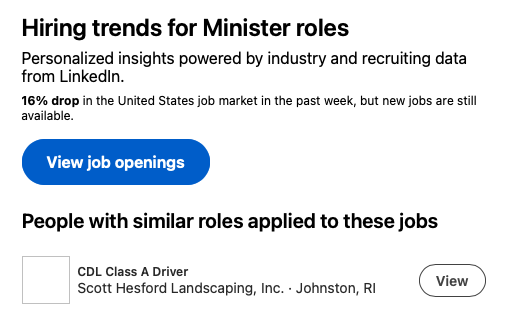
Screen shot from a LinkeIn email; text of the email given below.
Screenshot: detail of LinkedIn email

“Hiring trends for Minister roles,” the email begins. “Personalized insights powered by industry and recruiting data from LinkedIn. 16% drop in the United States job market in the past week, but new jobs are still available. People with similar roles applied to these jobs: CDL Class A Driver, Scott Hesford Landscaping, Inc….”

Hmm. I know that the job market for ministers is declining. Given the ageism that exists in ministerial search committees, if I lost my current job I’d likely be hard-pressed to find another position. So yeah. Getting a Commercial Drivers License as a back-up plan might be a good idea.

“How sport became the new religion”

“The Conversation” website has an excellent piece titled “How Sport Became the New Religion,” by Hugh McLeod, professor emeritus at the Univ. of Birmingham (U.K.). McLeod traces the history of the rise of sport, and the concurrent decline of religion, over the past two centuries. From his perspective as a U.K. historian, he identifies several key moments:

1850s: sport was of central importance in the U.K.’s elite private high schools; these elite high schools were training grounds for Anglican clergy, and one third of the top cricketers and footballers from Oxford and Cambridge Universities went on to become clergy

1880s: “Muscular Christianity” movement begins to develop, with clergy advocates emphasizing spirt, mind, and body

1920s and 30s: a large percentage of club teams in hockey and rounders (women), and cricket and football (men) were church-based clubs

1960: the Football Association (soccer to us Yanks) lifted its ban on Sunday games

1960s: emergence of a trend of scattering a deceased person’s ashes on the field of their favorite sports team

1990s: “sports chaplaincy” movement becomes a standard position in many U.K. sports teams, esp. football (soccer) and rugby

2000s: “Game Plan,” a U.K. government initiative to “reduce crime and enhance social inclusion,” claims that participation in sports can reduce social ills — i.e., society is now looking to sport rather than to organized religion to reduce social ills

2017: in spite of sports scandals, 71% of Britons believe “sport is a force for the good”

Today: McLeod writes that “religion has been crowded out by sport in general society, it remains a conspicuous part of elite sport – with a number of studies around the world finding that athletes tend to be more religious than non-athletes.”


Obviously, the U.S. would have a somewhat different timeline. But the end result is much the same: participation in organized religion continues to decline, while participation in sports — both as a player and/or a fan — remains robust.

So don’t believe people who claim that religion is dying out in the U.S. Maybe Christianity is in decline, and probably other organized religions as well. But participation in sports is not in decline, and in fact it has taken over the role that religion used to play in the U.S.

Deconstruction and reconstruction

“…The term ‘postmodern’ had been used sporadically by process [theology] thinkers since the 1960s. The later French movement that gave ‘postmodernism’ wide currency reinforced many Whiteheadean criticisms of modernity, but it concluded on a ‘deconstructive’ note. Whiteheadians [and other process thinkers] joined with other constructive critics of modernity in emphasizing reconstruction.” — John B. Cobb, Jr., “Process Theology,” in The Routledge Companion to Philosophy of Religion (Routledge, 2007), p. 561.

Unitarian Universalists are in the direct lineage of process thought, through the contributions of thinkers like Charles Hartshorne and Bernard Loomer, both of whom were members of Unitarian Universalist congregations. And for many years, our thinking emphasized the reconstructive aspects of postmodernity. More recently, though, I’ve been feeling that we Unitarian Universalists (and I include myself in this critique) have been following the French postmodernists by emphasizing the deconstructive aspects of postmodernity. This is due, I think, to our adoption of liberal political discourse, which currently emphasizes deconstruction over reconstruction — liberal politics tends to default towards breaking down stereotypes and attacking the sacred cows of the existing social order, as opposed to trying to construct a better social order. We who ally ourselves with liberal politics know what we are against, but we sometimes find it difficult to articulate what we are for.

Speaking for myself, to get out of reactive deconstruction, it’s been helpful to think about process thought. But the process thought of Hartshorne, Loomer, et al., seems a little dated these days. Maybe for us Unitarian Universalists, the work that Dan McKanan is doing around ecospirituality is one way to be reconstructive rather than deconstructive. Although, finding myself still in a deconstructive mode, I can’t help but keep looking for someone who isn’t a Western white male….

LGBTQ+ and religion

Here are a few things I’ve come across recently on the topic of religion and LGBTQ+ issues:


1. A statement signed by some 300 prominent Muslim scholars and clerics titled “Navigating Differences: Clarifying Sexual and Gender Ethics in Islam” interprets the Quran as asserting that “God explicitly condemns sexual relations with the same sex”; and further, that “as a general rule, Islam strictly prohibits medical procedures intended to change the sex of healthy individuals, regardless of whether such procedures are termed gender ‘affirming’ or ‘confirming.'” While acknowledging that there are Muslims who interpret the Quran as fully supportive of LGBTQ+ rights, these Muslim scholars and clerics say that public schools should not force their Muslim children to hear any messages that support what they call “LGBTQ ideology.” These Muslim scholars and clerics join many conservative/evangelical Christians, many Orthodox Jews, and many other religious subgroups in saying that their religion does not affirm LGBTQ+ rights.


2. Three social science scholars realized that U.S. research on LGBTQ+ and religion tends to focus on the attitudes of non-LGBTQ+ people towards LGBTQ+ persons. But there isn’t much social science research on how LGBTQ+ persons themselves relate to religion. So last month, they did a survey of LGBTQ+ persons to ask them about their relation to religion. While they admit that their survey is not representative, the results are still of interest:

“Our findings suggest that the relationships LGBTQ+ people have with religion are more complicated than most media headlines portray. Many LGBTQ+ people are religious… 36% of participants report a religious affiliation; about the same percentage say they attend religious services at least once a year…. A full 80% of survey respondents were raised religious. Of those who no longer identify religiously, nearly 1 in 3 say they nonetheless continue to feel a connection to their religious heritage.”

Let’s hope this preliminary survey eventually leads to published research on this topic.


3. Sarah Imhoff, professor of religious studies at Indiana University, has written an essay for The Conversation titled “Nonbinary genders beyond ‘male’ and ‘female’ would have been no surprise to ancient rabbis.” She says in part:

“As a scholar of Judaism and gender, I find that people across the political spectrum often assume religion must be inherently conservative and unchanging when it comes to sex and gender. They imagine that religions have always embraced a world in which there are only men and women. But for Judaism – and for many other religious traditions, too – history shows that’s just not true.”

My favorite part of this essay is when Imhoff points to interpretations by ancient rabbis, found in the Jewish Midrash, where Genesis 1:27 is interpreted to mean that the first human created by God was both male and female — not exactly what we today would call transgender, but definitely a human who did not have binary gender.

Religion isn’t separate from human society

Yet another news article about a religious group taking a public stand that homosexuality is sinful: the Christian Reformed Church in North America did so in its national meeting last month. Because of this stance, several open and affirming Christian Reformed Churches have to decide what to do. Do they disaffiliate, or kick out their openly LGTQ+ members and staff? The news article offers this insight:

“‘I think it’s because of the culture wars in the United States that the [Christian Reformed Church] synod has decided that they’re going to push this issue,’ said Henry DeMoor, a professor emeritus of church polity at Calvin Seminary who has watched the unfolding clash and belongs to another Christian Reformed Church in Grand Rapids. ‘It seems like we have divided the church, the way the Republicans and the Democrats divide politically.'”

Politics has long influenced US religious history. Back in the mid-nineteenth century, Protestant denominations split over the issue of slavery. Baptists, Methodists, Presbyterians, and other Protestant groups split because of differing views on slavery and anti-Black racism.

Today, we’re still seeing denominations splinter over approaches to anti-racism. The Southern Baptists have lost congregations over critical race theory (CRT). A US Catholic writer has written a book about how CRT cannot be reconciled with Catholic teaching (although other authors disagree). The Presbyterian Church of America has been accused by some of its adherents of “kneeling before the golden statue” of CRT. And the newly-formed North American Unitarian Association (NAUA) seems to have formed at least in part due to disagreements with the Unitarian Universalist Association (UUA) on the best approach to dealing with racism.

But — these days, denominations are also splintering over human sexuality. The United Methodist Church is losing something like one fifth of all its congregations over LGBTQ+ issues. The Southern Baptists just kicked out one of their largest congregations, Saddleback Church, because that congregation ordained women as pastors.

This leads us to an obvious conclusion:

Religion does not belong to some Platonic Realm of Truth which is somehow separate from daily life. Religion is thoroughly enmeshed in the ordinary concerns of day-to-day living. And right now, US society is deeply divided over how to address ongoing racism, and how to understand human sexuality. These deep divisions are going permeate every aspect of human society, including religious organizations.

Religion is of this world. For someone like me, this is a good thing because it means that religion is actually of use in dealing with day-to-day problems. But that also means religion is not going to be some idyllic oasis where you can escape from reality — religion may help you deal with reality, but it is not going to separate you from reality.

Endangered

Earlier this week, Carol and I walked on a beach in Maine where we saw two endangered bird species, Piping Plovers (Charadrius melodus) and Least Terns (Sternula antillarum).

Small sand-colored bird, standing in the sand, covering a chick with its wing.
Piping Plover with a nestling
Small gray and white bird nestled in the sand, perhaps sitting on a nest.
Least Tern — this bird remained stationary while we watched it, and may have been on a nest

Both these species nest on the beach above the high water mark. Nesting in the sand was a useful evolutionary adaptation for most of these birds’ existence. However, in the last hundred years as humans have used beaches more and more heavily. Many former nesting sites have either been eradicated. Other nesting sites see such heavy human use that nesting success has dropped precipitously.

Take the Piping Plover. The main strategy they use to evade predators is their cryptic coloration — when threatened, they squat down in the sand and are almost invisible. But this adaptation is counterproductive when the birds encounter over-sand vehicles (the birds and their nests get smushed), or off-leash dogs (the birds are found by smell, not sight) or oblivious humans playing on the beach (again, the birds get smushed). Then when some humans try to enact regulations to protect the birds — like restricting dog-walkers’ access to nesting areas, or prohibiting over-sand vehicles near nesting areas — many humans don’t comply with the regulations. So at another location in Maine this week, I saw a human with an unleashed dog standing right next to a marked nesting area where a few hours I had earlier seen a Piping Plover.

This is an example of how land use change and human overpopulation have caused rapid species decline over the past several decades. Now we can add another threat to these two species. Global climate change is already causing rising sea levels. If sea level rise continues, the preferred nesting locations for these birds is going to disappear.

It’s easy to sink into despair and imagine that these two species will be extinct in the next couple of decades. But while I’m not optimistic, there is still hope. Because even though humans are pushing these species to extinction, it’s also possible that they can be saved from extinction by careful human management. For that reason, I’ve decided that “management” is my new synonym for “hope.”

Reading list: Search

Bev loaned me the book Search: A Novel (Penguin, 2022), by Michelle Huneven. Search is the story of a ministerial search committee in a Unitarian Universalist congregation in southern California during their year-long process to find someone to replace their retiring minister. Michelle Huneven actually served on a ministerial search committee, and the book is a fictionalized account of her experiences. Bev, who loaned me the book, is a long-time lay leader who has lived through six different ministerial searches in the past quarter century. She told me that I really need to read this book. So I did.

(Spoiler alert: I’m going to reveal key elements of the book’s plot. Continue at your own risk.)

Photo of the book lying on a wood tabletop.
Continue reading “Reading list: Search”

What the Southern Baptist vote means

A few days ago, the Southern Baptist Convention voted to expel some local churches that had women as pastors. They kicked Rick Warren’s huge Saddleback Church, and they also kicked out a small church where as woman has been serving as pastor for three decades. If they’re suddenly kicking out a church where there’s been a woman as pastor for three decades, that makes it clear that this is not a situation where suddenly women are becoming Southern Baptist pastors. It’s the denomination that has changed its opinion.

Rabbi Jeffery Salkin, who writes an opinion column for Religion News Service, makes this observation:

“This is a war the right wing is waging: roll back women’s rights…. If you are looking for the symptoms of incipient fascism in this country, pay attention to the signs: the growth of antisemitism, a parallel growth of misogyny and a powerful growth of anti-LGBTQ hatred.” Salkin adds that this new rise of fascism doesn’t look like 1920s Germany so much as it looks like 1950s United States of America.. That was the decade, according to Salkin, of “women who did not work outside the home … queer folks in the closet … an America where Blacks were still in the back of the bus and where Jews and other ethnic and religious outsiders faced serious restrictions.”

I’m inclined to agree with him. The fascism of Trump, DeSantis, and others should not be compared to Nazi Germany. They are not trying to impose a new type of fascism on the U.S. Instead, they want to go back to a time when conservative White men were firmly in control of U.S. society. We don’t like to think of the 1950s as a time of fascism, but it was — not Nazi Germany fascism, but a distinctly American kind of fascism. Nor was it only Blacks, LGBTQ+ people, and women who were targets of this uniquely American fascism — Joe McCarthy’s House UnAmerican Affairs Committee also targeted White men whose politics happened to be anywhere to the left of the John Birch Society, destroying their careers and sometimes sending them to jail.

And this week’s Southern Baptist vote shows just one of the ways conservative White men (and the women who submit to love them) are trying to make 1950s U.S. fascism return. Get those doggone women out of the pulpit before they mention that Phoebe, a woman, was one of the leaders of the early Christian church — i.e., get rid of the women before they reveal that 1950s U.S. fascism was not rooted in Christianity at all, but instead springs entirely from the fevered imaginations of conservative White men who want to retain their ill-gotten power.

I’ve been researching the race riot that happened at the high school in my hometown in 1978 (I hope to have a blog post about it on the 45th anniversary of the actual event). Part of my research led me to a 2002 oral history interview with Phil Benicasa, for many years an elementary school principal in Concord. I never knew him, but my younger sister worked as a reading tutor in his school for a few years, and always had good things to say about him as an educator.

So here’s what Phil Benicasa said about parents and education back in 2002, not long before he retired:

“[S]omething is going on with the youngster who comes to our door in kindergarten [in 2002] as opposed to the youngster that came to our door 20 or 25 years ago. They are nowhere near as well prepared for the conventions of learning as kids were some time ago. I think parents are confused about parenting. I think kids therefore are confused about their role as children. In 1975 if you took the chunk of time out of my week that I spent doing discipline, 80% or 90% of that would have been at the fourth and fifth grade level, and more often than not it was mischievous sort of stuff. It was the kind of stuff that you could chew out a kid for and send him out of the office and chuckle about what it was that the kid had done. Today 80 to 90% of my time in discipline is spent in kindergarten, first, and second grade. That’s astonishing. And it’s not mischief. There are really a tragic number of kids with social and emotional baggage that they are having great difficulty casting off….

“I think parents have bought into the business about, the sooner my kid learns to read, the better they’re going to be. If my kid learns to read by age 3, that’s a direct line to Harvard. That’s absolutely nonsense. There are so many more important things that need to be learned before they get to us [in elementary school]. You know that business, ‘everything I needed to know, I learned in kindergarten’? — to clean up after myself, to share, to listen to others, to wait my turn, not cut ahead — all that’s true. Generally speaking kids had much of that in place before they arrived in the door.… [K]ids are not coming to school in kindergarten as well prepared to take advantage of what it is we are offering than they have been in the past. That means we have to modify what we are offering.”

Three obvious caveats — (1) This statement represents the observations and opinion of just one educator. (2) Phil Benicasa’s observations were limited to Concord, a predominantly White town in New England. (3) The demographics of Concord’s schools changed from 1975 to 2002, from an economically diverse cohort of children, to a nearly homogenous upper-upper middle class cohort.

Yet even with these caveats, what Phil Benicasa said back in 2002 resonates with what I saw in a different educational setting, religious education in Unitarian Universalists, back in the late 1990s. But I was working with the same upper middle class predominantly White children that Benicasa worked with. To use a current catchphrase, I felt children in the late 1990s were often deficient in social-emotional learning. I don’t know why that was true, but it was.

Things have changed since 2002. I’m no longer in religious education, but I still see the same upper middle class predominantly White children that I’ve been working with since 1994. Up until the COVID pandemic, I felt that children became more able to fit in to structured social situations. Some of that change came from a bit more social-emotional learning, and some of it came from children simply becoming more compliant with authority.

I also felt that some of that change came at the cost of children’s mental and spiritual well-being. In the years leading up to 2020, I felt that I saw increasing amounts of depression and anxiety in children; at least, in the populations I worked with. Children had internalized the message that they need to do everything they can to gain (as Phil Benicasa put it) “a direct line to Harvard.” And, to quote him again: “That’s absolutely nonsense.” What you do in elementary school or middle school is not going to get you into Harvard.

Then the pandemic hit. The pandemic accelerated some of these trends. To succeed at online school, kids had to become even more compliant. And the rates of depression and anxiety went up even faster, as near as I could tell. But the pandemic also meant that children lost a lot of ground in social-emotional learning. We’re barely out of the pandemic, so it’s too early to know if children will regain that lost ground or not. The pandemic also meant that children stopped participating in extra-curricular activities that promoted social-emotional learning, programs like Sunday school. Participation in sports keeps rising, but while sports does tend to make children more compliant, in my observation it doesn’t do much to improve social-emotional learning.

The pandemic also accelerated a trend I’ve been watching when it comes to the spiritual development of upper middle class children. The upper middle class consists of the “cultured despisers of religion,” so spiritual development tends to be low on their list of priorities (spiritual development won’t get you into Harvard). The upper classes limit spiritual development to meditation, mindfulness, and yoga — which are considered worth doing because they allegedly help children tolerate stress better. Unfortunately, what I’ve seen is that meditation, mindfulness, and yoga mostly seem to work to make children more compliant. Nor do they address the root causes of children’s anxiety and depression; instead, they simply cover them over.

I’d like to say that Unitarian Universalist (UU) religious education would help advance children’s social-emotional learning, improve their mental health, and (instead of making them more compliant) help them discover who they are and what their purpose is. But I’m less than impressed with the way most UU congregations implement their religious education programs. Most of these programs today seem to be run for the convenience of the staff and the child-free lay leaders. As an example, think of the many UU congregations that set monthly themes for worship services, then force children’s religious education curriculum to follow those themes regardless of the developmental and educational needs of the children. The adults come first; the children are supposed to be quiet and comply with the needs of the adults. No wonder UU religious education enrollment has been plummeting in recent years.

I don’t have a happy little conclusion for this blog post, except to say I’m worried. I’m worried that the selfishness of Unitarian Universalist adults is driving children away. I’m worried about children’s mental health, and limited social-emotional learning. I’m especially worried about the way children are being make more and more compliant — this in a time when fascism is on the rise.

(See also this post on why Sunday schools are declining.}