
Last week I created a webpage of Readings for Memorial Services. As a companion project, I’ve created a webpage of Readings for Weddings. At the moemnt there are more than 25 readings (or links to readings) there, including several readings by UU authors. And I have plans to add more wedding readings to it Real Soon Now.
Category: Religion
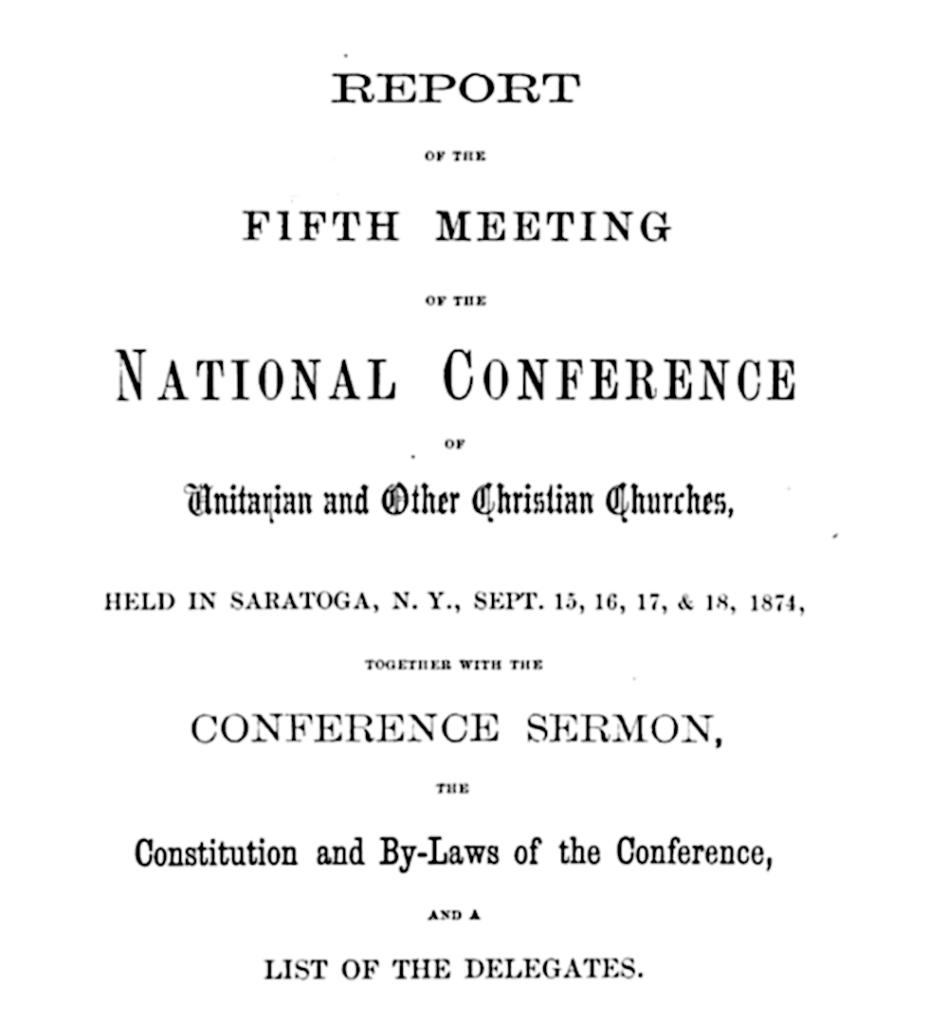
Documents relating to the Ute Indians and the Unitarians
Recently, people in the United States have been taking the month of September to reflect on the wrongs perpetrated against the indigenous peoples by the U.S. government and citizens.
(And yes, the perpetrators of wrongs against Native Americans were nearly all White, which means that Ron DeSantis doesn’t want this material taught in the Florida public schools because it might make some White kids feel ashamed of their race. More than 20 other U.S. states have laws similar to Ron DeSantis’s law in Florida, which means that this blog post is officially and legally banned in schools in more than one third of the U.S. But I digress….)
After the Civil War, various religious groups were assigned to Native American groups. The Christian religion, especially Protestant Christianity, was considered a “civilizing force,” a means by which White settlers could maintain control over Native peoples by forcibly integrating them into White culture. The Unitarians were still considered Christians in the 1870s (we got kicked out of the Christian club after 1900), and as a small denomination we were assigned “the Utes of Colorado,” a group of Native nations then living in Colorado, later forcibly removed to Utah. The Unitarians considered this “mission work,” a way of spreading the Unitarian religion through good works among non-White (and therefore less “civilized”) persons; and they classed it with the Unitarian mission in Kolkata, India, and the mission work done among African Americans in the Deep South.
Apparently, the Unitarians were fairly ineffective at this mission work. Given the history of Unitarianism, I suspect our ineffectiveness was due to our usual lack of organization and unwillingness to provide adequate funding. We established a school for Ute children, which is not listed in the first volume of the Federal Indian Boarding School Initiative Investigative Report, so perhaps it was not a boarding school. Nevertheless, given what we know now about how White-run boarding schools did so much damage to Native children, it seems important that we learn more about how this school operated.
(All this makes me think: The Universalists can be thankful that we were so small and disorganized and heretical during the 1870s and 1880s that the U.S. government never assigned them a group of Native peoples.)
In any case, I’ve collected some documents from the 1870s and 1880s pertaining to the Unitarian mission among the Ute peoples. They make for some pretty uncomfortable reading. Even though the Unitarian Universalist Association formally apologized to the Utes back in 2009, we still have a lot to do to reflect on how the Unitarian religion was used as a tool of colonization.
Scroll down for the documents….
Readings for memorial services
Families who are planning Unitarian Universalist (UU) memorial services often want suggestions for readings. Yes, there are many websites with tons of readings for memorial services. But many of those websites are going to have material that is too religious for us Unitarian Universalists. And some of the readings you’ll find online don’t exactly fit with UU values.
Of course, there’s the printed book with a collection of memorial service readings published by the Unitarian Universalist Association, Beyond Absence compiled by Edmund Searl. I used to lend that book to families planning memorial services, supplemented that with a small printed collection of readings that I had put together. But these days, almost all the meetings I have to plan memorial servicesare online. You can’t lend out printed material over a Zoom meeting.
So I finally put together my own online collection of readings for a memorial service. Public domain material appears in full in my online collection, using the most accurate texts I could find. I also include fair use material (excerpt under 500 words and less than half of a poem). For other copyrighted material, I provide links to an accurate text, with a very brief excerpt to give an idea what the reading is like. I’ve made an effort to include both older classics, and links to contemporary authors. I’ve provided readings by authors of different races and ethnicities, and different religious backgrounds ranging from “Nones” to UUs to Buddhists to lots more.
Click here to see my online collection “Readings for memorial services.”
“Social Movements and Congregational Responses”
The Congregational Consulting Group blog has a new post by David Brubaker titled “Social Movements and Congregational Responses”:
“Congregations [in the U.S.] often experience conflict in response to social movements in the world around them. Since World War II, movements regarding civil rights, the war in Vietnam, the ordination of women, and human sexuality—each vitally important in its own right—also have raised challenges inside congregations, forcing leaders to address internal questions of power and culture.”
Brubaker gives a brief overview of four external social movements that had a big effect on U.S. congregations: the Civil Rights Movement; the movement against the Vietnam War; the movement to ordain women; and the LGBTQ+ rights movement. I’d like to take a look at Unitarian Universalist (UU) response to each of these movements.
We Unitarian Universalists like to think that we were on the “right side” (i.e., the progressive side) of each of these movements, but that’s not true. We don’t often tell this part of our history, but if you talk with older Unitarian Universalist (UUs) — or if you’re old enough to remember these movements yourself — you know that we had a very mixed record for all these movements.
Civil Rights Movement
We like to tell ourselves the story that we were early and unified and vigorous supporters of the Civil Rights Movement. There is little evidence that was true.
Continue reading ““Social Movements and Congregational Responses””The ongoing effects
Last night I was trying to explain to Carol about the lingering effects of COVID burnout on the helping professions. She pointed out that many trends that were supposedly caused by COVID were simply existing trends that accelerated during lockdown. But I’m pretty sure that it actually was COVID that contributed to increased burnout in the helping professions.
The healthcare professions are an obvious example. During the first year of the COVID pandemic, doctors, nurses, and others who worked directly with COVID patients saw an increased workload, and an increased risk of infection. There were also healthcare professionals who had a very different experience of COVID — I knew a dermatologist who saw a substantial decrease in their workload during lockdown, although that decrease brought separate concerns of declining income, etc. On the whole, though, a significant number of health professionals left their profession, and reports are that there’s still a labor shortage in much of the healthcare system.
Mental health professionals saw their workload peak a bit later in the pandemic, as many people began to have mental health problems isolation caused by lockdown. We’re still seeing a high rate of depression, anxiety disorder, and other mental health problems, and mental health professionals may still be feeling overwhelmed by the lingering aftereffects of the pandemic. The end result is that someone seeking mental health care can wait weeks for an appointment.
I know less about other helping professions, but I suspect that other professions also saw increased burnout. For example, it seems likely that many social workers — depending on their specialty — also experienced burnout during COVID due to increased workload and increased job pressures.
This brings us to clergy. From what I’m seeing and hearing, clergy are also subject to COVID burnout, just like the other helping professions. In 2021, 42% of clergy reported considering leaving ministry. I suspect there were several reasons for this. Sociologist Scott Thuma has outlined some of the stresses on clergy during the pandemic: increased conflict in the congregation, increased demand for food and other assistance, increased mental health problems, and learning new ways to do ministry. I’ve watched as more Unitarian Universalist (UU) ministers than usual have left the profession over the past couple of years. I wouldn’t be surprised to learn other UU ministers are just quiet quitting.
Beyond all this, all people in the helping professions can experience the trauma or secondary trauma that everyone in society is experiencing. The epidemic of mental illness that began during lockdown continues today — we’re all feeling the effects.
I know I’m still feeling the effects. I had to put in some extra hours this week. This is normal for ministers; some weeks we have to work long hours, other weeks there’s less for us to do. Pre-COVID, I had no problem working a few extra hours. But this week, those extra hours really tired me out; I don’t have the reserves of energy I used to have pre-COVID.
I don’t have a call to action for you. Nor do I have an easy solution for clergy burnout. Nor do I mean to imply that clergy somehow have it worse than anyone else in society. I think my only point is that we all need to be understanding of each other’s ongoing stress, as the effects of the pandemic continue.
Filling the church-shaped hole
In an opinion piece on the Washington Post website, Percy Bacon, Jr., talks about why he stopped going to a Christian church: “I couldn’t ignore how the word ‘Christian’ was becoming a synonym for rabidly pro-Trump White people who argued that his and their meanness and intolerance were somehow justified and in some ways required to defend our [Christian] faith.”
That’s not the only reason Bacon stopped attending church during the Trump years. He also discovered that his church wouldn’t allow LGBTQ+ people to lead small groups. And he started reading leftist Black intellectuals who were openly skeptical about religion. Bacon contacted Daniel Cox, director of the Survey Center on American Life, who told him: “Your experience is very typical. Most people who disaffiliate do not cite a single precipitating factor. It’s more of a fading away from religion rather than a dramatic break.”
Bacon goes on to say: “People have told me to become a Unitarian Universalist. Unitarian churches I have attended had overwhelmingly White and elderly congregations and lacked the wide range of activities for adults and kids found at the Christian congregations that I was a part of. But they have a set of core beliefs that are aligned with more left-leaning people (‘justice, equity and compassion in human relations,’ for example) without a firm theology. I’ve also thought about starting some kind of weekly Sunday-morning gathering of Nones… or trying to persuade my friends to collectively attend one of the Unitarian churches in town and make it younger and more racially diverse. But I’ve not followed through on any of these options….”
In short, Bacon hasn’t found a good way to fill what he calls the “church-shaped hole” in his life. He adds, “It’s strange to me that America, particularly its left-leaning cohort, is abandoning this institution, as opposed to reinventing to align with our 2023 values.”
I appreciate his response to Unitarian Universalism, which can be summed up as: “Mm, yeah no….good set of core values, but too White and too old.”
As an old White guy, sometimes that’s my feeling about Unitarian Universalism. It’s too bad that we can’t realign Unitarian Universalism to our 2023 values of supporting children and young adults, and not being entirely White.
UU author wins award
The Before Columbus Foundation (BCF) was founded in 1976 “dedicated to the promotion and dissemination of contemporary American multicultural literature.” Their annual award, the American Book Award, is given by writers to other writers. Though not as well known as the National Book Award, winning this award puts you in august company. Previous recipients of the American Book Award include Edward Said, Joy Harjo, and Toni Morrison. Current members of BCF’s board of directors include Ishmael Reed, Joy Harjo, and other respected writers.
This year’s awards were recently announced. Poet Everett Hoagland won an award for his recent collection of poetry, The Ways: Poems of Affirmation, Reflection and Wonder (North Star Nova Press, 2022); other award winners included Maxine Hong Kingston and bell hooks.
Some of the poems in Everett’s collection appeared in UU World magazine; Everett’s a member of First Unitarian in New Bedford, Mass. I got to see the book in manuscript, and loved it (Everett even invited me to write the foreword). Also, there are plenty of poems here that would work well in a Unitarian Universalist worship service, so if you’re a minister or religious educator you might want to pick up a copy.
Unfortunately, about the only place you can buy the book is through Amazon. My spouse the writer does Not Like Amazon, so I won’t provide a link here. But you can easily find it. Go buy a copy. You’ll be glad you did.
Ecojustice Camp comes to Cohasset
I teamed up with Ngoc Dupont and Matt Mulder, two professional educators, to bring the Ecojustice Camp concept to the South Shore of Boston last week. We didn’t have the best of weather for the camp, with rain showers almost every day, and a tornado alert for early Friday morning. The tornado alert meant that we didn’t camp at Wompatuck State Park, but instead camped at the Parish House of First Parish (where there was a full basement we could retreat to if necessary). Yet in spite of the weather, we had a blast.
We’ve posted photos from the past week on the camp website. Since we only have permission to post photos from camp on that website, you’ll have to click here to see them. The photos will give you an idea of the range of camp activities — from cooking outdoors, to whittling, to ecology simulation games, and more.
Another take on White Christian nationalism
Andrew Whitehead, who grew up an evangelical Christian, is now associate professor of sociology at Indiana University and Purdue University Indianapolis. In an opinion piece on Religion News Service, he writes:
“After years of examining Christian nationalism as a social scientist, I’m convinced the greatest threat to Christianity in the United States is not outside forces [i.e., feminism, divorce, homosexuality, Secularism or non-Christian faiths]. Instead, it is white Christian nationalism. Over and over, I find evidence that the practical fruit of Christian nationalism is not love; it is power, control, domination, fear and violence.”
Whitehead then identifies the three chief “idols” that White Christian nationalists worship: “Power, Fear, and Violence.” He concludes with a call to “confront” Christian nationalism.
This is one of the best brief summaries of Christian nationalism I’ve seen. Definitely worth reading.
What is religion, anyway?
I’ve been doing a deep dive into the question: What is religion, anyway? It’s pretty clear that “religion,” as we use it today, is a concept that really arises fairly recently in human history, during the European Enlightenment. From what I can see, the concept of “religion” arose from more than one source.
On the one hand, as nation states emerged in the early modern era, there was a general cultural move to make a strong distinction between “religious” and “secular.” “Secular” meant the emerging nation states, which had control over armies, warfare, coining money, imperialism and colonialism, etc. “Religion” was a new category, or perhaps a radical redefinition of medieval Western Christianity. “Religion,” especially in Protestant nation states, was conceived as inhabiting voluntary associations (local congregations and larger groupings of congregations called “churches”), and as being a matter of personal experience. “Secular” meant public spaces; “religious” increasingly meant personal spaces, or spaces inhabited by small bounded communities.
On the other hand, at the same time that Europeans were beginning to distinguish between “religious” and “secular,” they were also sailing all over the world and colonizing other lands and other peoples. As Europeans encountered other peoples, they experienced a bit of culture shock: people in the Americas, in Africa, and in southern and eastern Asia didn’t have anything that looked at all like Christianity — nor like Islam or Judaism, the other two traditions that Christian Europeans knew best. For example, at first Europeans had a hard time knowing what to do with peoples in the Indian subcontinent; then the Europeans decided to subsume a diversity of traditions under the heading of “Hinduism,” arguing that all “Hindus” actually worshiped the same transcendent god, named Brahma, who was sort of like the Christian god; and Hindus all traced there lineages back to sacred texts like the Rig Veda. Before the Europeans colonized the Indian subcontinent, “Hindu” was mostly an ethnic descriptor, people who lived around the Indus River; after colonization, “Hindu” became an adherent of “Hinduism.” So Hinduism is, in a sense, a creation of the colonization process.
The European Enlightenment also challenged traditional European concepts of the Christian God. As the Enlightenment progressed, various people began doubting the truth of the Christian God. By the late nineteenth century, a robust tradition of atheism emerged in Europe and in (European-colonized) North America. From what I can tell, this European tradition of atheism knew little about, e.g., much older traditions of atheism in the Indian subcontinent. That still holds true today, so that what we call “atheism” is really mostly the narrow tradition of Euro-American atheism. I call it narrow, because it was heavily influenced by Protestantism. This is not to say that Euro-American atheism is somehow a kind of super-Protestantism (although it can seem that way at times), but both traditions are clearly the product of the same broader Euro-American culture. As a result, Euro-American atheism can look a lot like Euro-American Christianity, with an emphasis on: personal belief or non-belief; conversion stories; proselytizing or the seemingly similar activity of actively encouraging people to leave religions; etc. Again, it’s not that Christianity and atheism/secularity are two sides of one coin; but rather that they’re both products of the same culture, and seem to take up much the same sort of cultural space.
That’s a brief summary of what an increasing number of scholars agree upon. My deep dive into the topic? I’ve been reading a whole bunch of books.
One book I’ve found helpful on this topic: The Secular Paradox: On the Religiosity of the Not Religious, by Joseph Blankholm (NYU Press, 2022). The book is a sociological study of people who are not religious, and who are part of organized secular groups. One of the fascinating things Blankholm finds is that organized secular groups in the U.S. seem to be dominated by older white men from vaguely Christian backgrounds. Blankholm interviews Black atheists, Hispanic atheists, formerly Jewish atheists, “Muslimish” atheists, etc. — people who often don’t fit neatly into the organized secular groups. So how come the old white guys get to dominate U.S. atheism? Blankholm has some good things to say about this.
Another book I’ve found super helpful is: Before Religion: A History of a Modern Concept by Brett Nongbri (Yale Univ. Press, 2015). Nongbri is a scholar who specializes in the Ancient Near East. He also argues that “religion” is a concept that didn’t exist before the European Enlightenment. Thus, when we talk about “ancient Egyptian religion” or “ancient Greek religions,” we are using anachronistic terminology. Even when we talk about early Christianity or early Islam as “religions,” we are using anachronistic terminology. Nongbri goes into some textual analysis showing how modern translators use the word “religion” to translate ancient terms that do not carry our contemporary meaning. In other words, to say that Jesus of Nazareth (or Paul of Tarsus, depending on your theology) founded a “religion” is an anachronistic way of framing that history. Jesus may have founded something, but it was not what we mean today when we say “religion.”
If we take Nongbri and Blankholm (and many other scholars of religion) seriously, we find something rather disconcerting. The word “religion” works best to describe Western European Christianity from the early Modern period onward. That implies that “religion” does not work so well to describe the so-called “world religions.” And indeed, if we look closely, we see that the concept “religion” has been imposed on many phenomena that weren’t religions before colonialism, e.g., “Hinduism” wasn’t even a thing until after the British colonized India. Nor does “religion” work so well when applied to anything before the Enlightenment.
Which in turn implies that “religion” is not a universal concept that applies to all human cultures in all times and all places. This is something that scholars have been saying for some years now, e.g., Jonathan Z. Smith in “Religion, Religions, Religious” (1998). And if “religion” is not a timeless and universal concept, then neither is “secular.”
The practical effect of all this? Well, for us Unitarian Universalists, we are definitely part of a religion, since both Unitarianism and Universalism started out as Christian heresies. But at an institutional level, we got kicked out of the Christian club a century ago. You can be a Christian Unitarian Universalist, but Unitarian Universalism can’t really be considered Christianity. Which means the term” religion” when it is applied to us is not going to be a perfect fit. In fact, it might be argued that these days we look more like organized secularism than organized religion. And given the apparent complicity of organized religion in colonialism, maybe that’s not a bad thing.