Grants to Amarillo

Before we got back on the interstate, we drove to El Malpais National Monument, parked at the visitor center, and hiked for about an hour on the Continental Divide National Scenic Trail. We didn’t see much of the badlands for which El Malpais is best known, but we did see a meadow and a dike that was all that was left of a failed 1930s Civilian Conservation Corps project to attempt to dam up a seasonal stream to create a reliable water source, and we did see some beautiful pinyon pine woodlands.

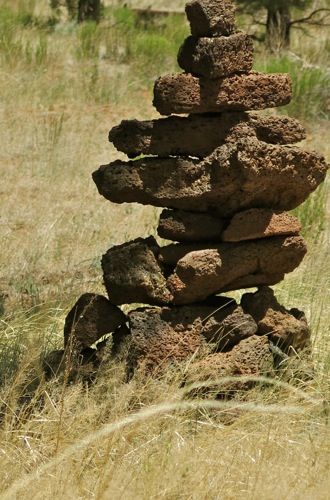
The badlands are actually old lava flows that crept out across the red dirt and sandstone so characteristic of this part of New Mexico. The trail was marked by cairns made up of a mixture of volcanic rock and red sandstone.

BlogJun2414a

Above: Continental Divide Trail, El Malpais National Monument

In ancient Greece, cairns were inhabited by Hermes, god of travelers, and of thieves and tricksters. Hermes, it was said, got into trouble with Hera for killing her servant Argus. A trial was held, with the other gods and goddesses acting as jurors. Each god or goddess had a stone which represented their vote, and Hermes argued so skilfully in his own defense that all the gods and goddesses cast their stones at his feet, until there was a pile of stones with Hermes inside. Ever since then, Hermes resides, as it were, inside the piles of stones that are cairns, helping travelers find their way.

In New England, I always thought that there was a remote whiff of Hermes inside the cairns that I saw on mountain trails; New England is close enough to Europe that perhaps the old gods and goddesses immigrated with the white Europeans who came to North America; so every New England house I ever lived in had its household gods, our version of the Roman Laertes. But these Western cairns had nothing of the Old World gods and goddesses about them. They did, however, have a presence; I felt there was something partly alive about them; but it was more of a sense of animism than of Olympian divinities.

When we left El Malpais National Monument, I went into the small visitor center to use the bathroom. I tried to avoid the books, but a children’s book titled Eco Trackers caught my eye. Ah, that would be perfect for the ecojustice camp were going to do! That was the third book I bought on this trip; I had gotten an Agatha Christie mystery and another book yesterday in Starrlights Books in Flagstaff.

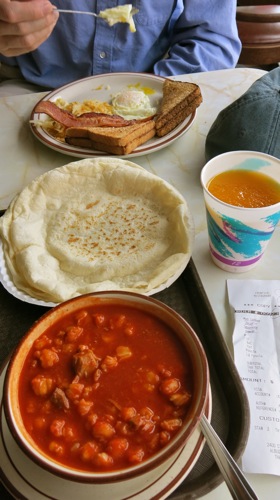
As we drove towards Albuquerque, I called my dad. “What was that restaurant that you liked so much in downtown Albuquerque?” I asked him. He couldn’t remember the name, but reminded me that is was on the main drag right across from one of the main entrances to the University of New Mexico. We drove down old Route 66, and there it was: Frontier Restaurant, Tony Hillerman’s favorite restaurant. Carol had pozole, flour tortillas, and a peach smoothie; I had breakfast.

BlogJun2414b

Above: Albuquerque, N.M. (Photo courtesy Carol Steinfeld)

The food was excellent, and the restaurant was a good place for Carol to hang out and watch people while I ran across the street to the University of New Mexico bookstore — where I bought three more books.

We drove on. The red rock country of New Mexico began to flatten out, and turn into the southern end of the Great Plains. We could see dark thunderclouds all around us, and rain coming down in the distance. I was reading the Agatha Christie novel aloud to Carol, when I stopped and said, “Look! there’s standing water on that field!” Coming from drought-stricken California, where it doesn’t rain all summer anyway, that was an amazing sight.

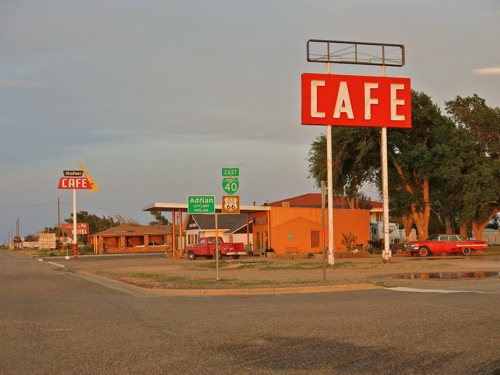
We stopped in Adrian, Texas, at nine o’clock to see if we could get me some dinner. The cafe was closed.

BlogJun2414c

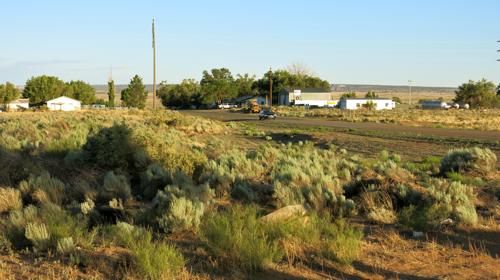
Above: Adrian, Tex.

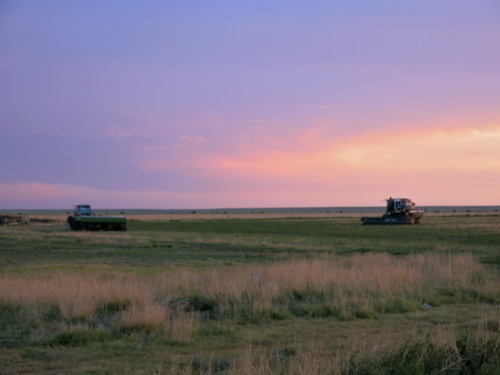
But right across the interstate, there was a gas station with a mini-mart. The kind woman at the counter — I’d guess she owned the place — sold me her last two hot dogs. “And I’m glad to sell them both to you,” she said. “So you don’t have any left over to go to waste,” I said. She chuckled and said that was it. They were pretty good hot dogs. I ate them standing by the car looking out at the darkening sky over the wide open, and very green fields, of Adrian.

BlogJun2414d

Above: Adrian, Tex.

Needles to Grants

Vivid dreams occupied me all night, though I didn’t remember any of them when I awakened in the morning. Perhaps they were anxiety dreams, or dreams of overwork; with Peace Camp and the youth service trip and my ordinary tasks, I worked pretty much seven days a week in the three weeks leading up to vacation.

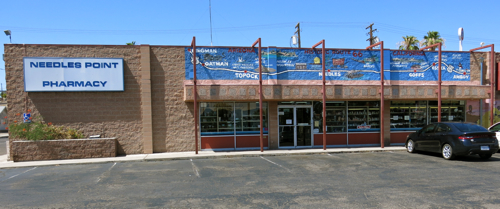
We got up late, and after I ate breakfast we walked over to the Needles Point Pharmacy. I needed razors, and Carol needed a needle to sew up a shirt.

BlogJun2314a

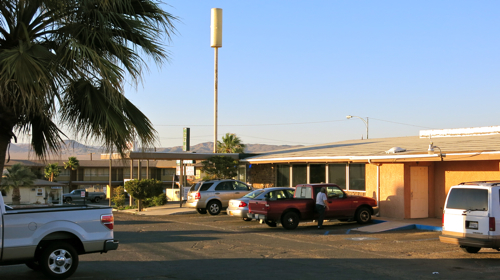
Above: Needles, Calif.

The store was pretty big on the inside. I found the razor blades I wanted, and then Carol and I wandered around looking at everything they had. They seemed to have everything. In addition to the usual drugstore merchandise, they had in stock: jigsaw puzzles, Hummel figurines, 3.5 inch diskettes for your computer, writing tablets with air mail paper, a bright red Mickey Mouse travel alarm clock in yellowed plastic packaging, and brand new Clairol blow dryers dating from the 1980s. On a whim, I bought some air mail paper from the very pleasant woman behind the counter.

When we finally started driving, the thermometer outside the motel office read 110 degrees.

Carol drove for most of the day, while I dozed, and read aloud to her from Agatha Christie’s Murder at Hazelmoor. It seemed odd to be reading about a murder in country house in England in the middle of a dark snowy winter, when we were driving through the wide open, sun-filled southwest.

We stopped for some caffeine at a gas station in Navajo, Arizona. While I was in the gas station, Carol wandered over to where a man was selling jewelry that he had made. When i got there, Carol was trying to decide if she liked one of his necklaces. I got to talking with him. He had been born in the area, half Navajo and half Hopi, and he spoke both languages as birth tongues. Then he had been relocated to a Mormon couple in Utah; enlisted in the Army and served in Vietnam; went to college in Provo on the G.I. Bill; and then had lived in Greece, the Bay area, and several other places I have now forgotten.

He was a big supporter of Barack Obama. “He’s the only president who has done anything for Native Americans,” he said. We agreed that, regardless of his merits, that some of the criticism of Obama was due solely to the fact that he wasn’t white. “White people really like to be right,” he said, and I gave a snort of laughter at the truth of that statement. That got us into a discussion of race and racism, during which I insisted that the Boston area, where I grew up, was the most racist place I have ever lived. “Even the white people hate each other in Boston,” I said, thinking of the Yankees, Irish, Italians, and French Canadians. He agreed with me, though I wasn’t convinced he knew anything about Boston.

BlogJun2314b

Above: Navajo, Ariz.

San Mateo to Needles

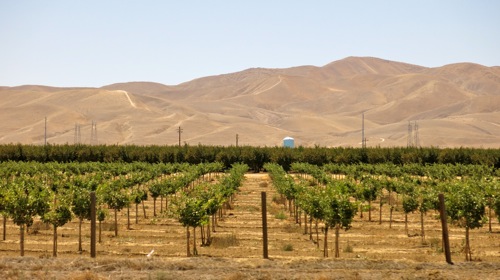
We left San Mateo in the middle of the morning, drove down through San Jose and Gilroy, and up over Pacheco Pass into the Central Valley. There’s a grayish-brown cast to the landscape of the Central Valley, and everything looks dry and dead — except where the land has been irrigated for crops.

BlogJun2214a

Above: Interstate 5, near Lost Hills, Calif.

We’re now in the third year of a severe drought across California. In a few places, acres of trees had been uprooted and left to die, perhaps because they use too much water. On the fences surrounding many agricultural fields were signs protesting any possible reduction in water allotments to agribusiness and farming interests: “No Water = No Jobs,” “Stop the Congress-created Dust Bowl,” etc.

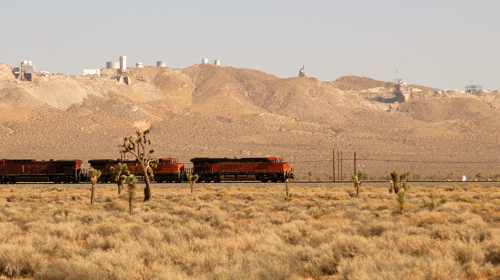
We turned east onto Route 58 through Bakersfield, climbed over the mountains at Tehachapi, heading towards the Mojave Desert. “There’s a Joshua Tree!” I said to Carol, pointing out the car window. The sometimes contorted shapes of Joshua Trees, their arm-like branches, make them seem like beings that are about to move, to turn and point at you.

On a map, it looks like there isn’t much in the desert, but it is far from empty. There’s the highway; there are mysterious industrial plants in the middle of the desert; there are power transmission lines everywhere; there is Edwards Air Force, with its planes, and strange structures on the tops of high mountains; there’s the historic Southern Pacific rail line, now owned by BNSF, with several mile-long freight trains per hour; and there are the Joshua Trees.

BlogJun2214b

Above: Near Boron, California

In Barstow, we stopped at the Canton Diner for dinner. Carol asked our white waitress if she could get just plain vegetables. The waitress went and got a middle-aged Chinese man from the front desk. Carol explained that she wanted just some plain stir-fried vegetables. He disappeared, and came back in a moment with some uncooked Chinese broccoli, and something that looked like amaranth, to show to her. She choose the Chinese broccoli. “Any meat?” he asked. “No, thank you,” she said apologetically, “I just want some vegetables.” “A little garlic?” he asked. “Sure,” she said. When the plate of stir-fired Chinese broccoli came, it was as good as anything you might get in San Francisco’s Chinatown.

When the man brought us the check, I asked him if he were from Hong Kong. “Yes,” he said, looking a little surprised, “why do you ask?” “You have just a little bit of an English accent,” I said; and he was old enough to have completed his education while Hong Kong was still a British possession. He smiled, and when we walked out, he bid us a pleasant good-bye.

BlogJun2214c

Above: Canton Diner, Barstow, Calif.

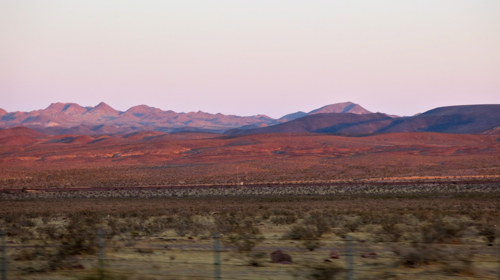
East of Barstow, the landscape grew emptier, though the rail road was still nearby, transmission lines crisscrossed the landscape, and there were still mysterious-looking plants here and there in the distance. The setting sun turned the landscape a warm glowing red.

BlogJun2214d

Above: Along Interstate 40 east of Newberry Springs, Calif.

We pulled in to Needles at 9:20; it had gotten up to 108 in the middle of the day, and the temperature was still in the mid-90s. The first time I came to Needles, I had just read a biography of Charles Schulz, the cartoonist. He had spent three years of his childhood in Needles, and hated it. It was cold during the winter, so cold he could hear rocks cracking; and during the long summer it was brutally hot, sometimes not getting below 90 at night. But I liked Needles: I liked the small-town feel, I liked the newspaper that’s been continuously published since 1888, I liked the stark desert landscape surrounding the town. I liked it enough that I keep coming back.

The only reason Needles existed when Charles Schulz lived here as a boy was because of the railroad. It’s still a railroad town, and it’s still a small town, with fewer than 5,000 residents. Carol and I took a walk down to the Amtrak depot. A man was standing on his front porch, and we said hi. “Nice and warm,” I said to him. “It’s a lot cooler now than it was,” he said, and we both chuckled. If it weren’t for the climate, it might be a nice place to live.

Southern California

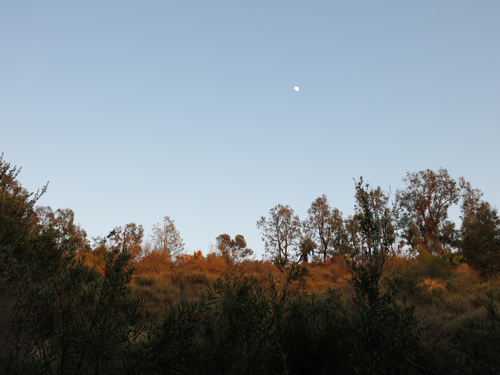
I’m in the Los Angeles area with my congregation’s youth group, headed towards Big Oak Canyon where we’ll be working at an ecology school. Tonight we’re staying at a motel in Irvine, and I went out for a walk to stretch our legs after the long drive. In amongst the malls and corporate office parks and suburban subdivisions, I found the Whiting Ranch Wilderness Area. I walked up Borrengo Canyon Trail, leaving behind the well-irrigated world of suburbia. I looked up, and there was the moon above the canyon:

BlogJun0814

Just about then, I saw Sam, who had gone out running before I left. He was headed back down the trail. It was time to head back to the motel.

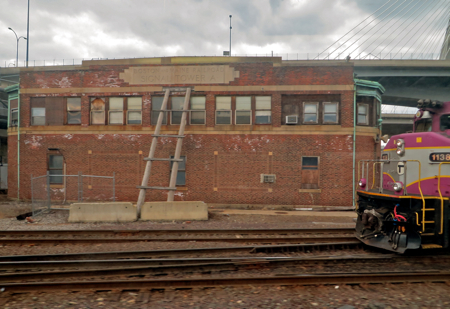
Signal Tower A, near North Station, Boston

Signal Tower A, Boston

I’m in the Boston area for my dad’s 90th birthday. While taking the train out to South Acton from Boston, I took this photo of the old Boston and Maine Railroad Signal Tower A near North Station. At right, you can see the nose of MBTA locomotive 1138 — one of the T’s many EMD GP40s — pulling a commuter train out from North Station, probably headed to Rockport (the Rockport train departed at the same time as the South Acton train).

“Multimedia” curriculum

I’m on study leave, in the archives of Meadville/Lombard Theological School, looking at curriculum kits published by the Unitarian Universalist Association under the editorship of Hugo “Holly” Holleroth, during the so-called “Multimedia Era” (c. 1968-1987).

Multimedia Era curriculum kits were packaged in attractive cardboard boxes, which contained the expected leader’s guides, but also included other materials such as audio recordings (long-playing records in the earlier units, cassette tapes in the later units), visual resources (including film strips and photographic slides in earlier kits, videos tapes in one 1989 kit, posters, etc.), written or text resources (including story books, resource books, etc.), and other materials (games, pamphlets, etc.). The earliest Multimedia Era curriculum kit dates from about 1968, and kits were still being published in the late 1980s.

I’m interested in curriculum kits from the the Multimedia Era for three main reasons:
(1) They incorporated audio, visual, textual, and interactive components — not unlike today’s Web-based curriculum
(2) They were developed in a time of rapid social change, and time that questioned organized religion — not unlike the rapid social changes we face today
(3) Many of the kits were founded on an educational philosophy quite different from the usual essentialist or progressive educational philosophies of so much UU curriculum development Continue reading ““Multimedia” curriculum”

The green flash

We all knew my mother’s illness had gotten to the point where she had only a couple more years to live. So I decided to go on a ten day hiking trip.

I really wanted to take an entire month and hike the Long Trail in Vermont. I had left one job in June and was about to start another job in August, which meant I had a month to spare. But what if my mother should get suddenly worse while I was on the trail? This was before cell phones, and you couldn’t count on a pager receiving a message in the Green Mountains of Vermont. Finally Carol told me what I already knew: I could not take a whole month to go hiking. I settled on ten days hiking the Long Trail in the Green Mountains of Vermont.

Carol drove me up U.S. 4 to where it intersected the Long Trail, and I started hiking south. It had taken a good three hours for Carol to drive me from our group house to the trailhead, so I only got a half day’s hiking in. I stopped about an hour before sunset to spend the night at Pico Camp, a bunkhouse near Pico Peak. One more hiker showed up to spend the night, a fellow a few years younger than I; he was headed north, through-hiking the Appalachian Trail.

The other hiker suggested we climb up the lookout tower on Pico Peak to watch the sunset. We hiked the steep little half mile trail to the summit of the mountain, and climbed up the old fire tower.

Aviators talk about unlimited visibility. That’s what we had. We could see the Taconic Range in New York straight ahead, the White Mountains in New Hampshire fading into dusk behind us, and the broad ridge of the Green Mountains heading south towards Massachusetts on one side of us, and north towards Quebec on the other side. We didn’t say much, but just looked and looked, amazed at the view.

The sun began to set behind the distant mountains of New York. We watched it touch the horizon and slowly disappear. Just as it disappeared, there was a flash of green light.

“Did you see that?” we said to each other. We had just seen the legendary green flash. It’s a rare sight at sea, and rarer still on land. Just by chance, the two of us had happened to wind up at Pico Camp on a day with unlimited visibility; we just happened to have time to climb the old fire tower right at sunset. We looked at each other, and back at the waning light from the sun.

“I’ve been hiking since February, and this is the best view I’ve gotten, and you get it on your first night out,” said the other fellow, without rancor.

We stayed up in the fire tower another fifteen minutes. But it was getting cold and dark and late, and we both had a long day of hiking ahead of us the next day. We climbed down the rickety steps of the tower, hiked down the spur trail to Pico Camp, and went to bed. The other hiker headed north to Mt. Katahdin in Maine, and I headed south to Mt. Greylock in Massachusetts. Of course I never saw that other hiker again; I’m told that the rickety old fire tower is gone from Pico Peak; and I’ve never seen the green flash again.

Oil change

The young guy at the oil change shop said with surprise, “How’d you go four thousand miles in less than a month?”

“We drove across the country,” I said.

He looked interested. “How long did it take?”

“Seven days to get across,” I said. “You should do it. It’s an amazing drive.”

He asked me whether I wanted synthetic or conventional oil, and then asked me a few more questions. He wanted to know if we had to bring our passports, and I said no, all you need is your driver’s license. He was fascinated, but seemed a little overwhelmed at the idea of driving all the way across the country. I told him, “You’d love it. Do it before you get old.” He laughed.

Then he and the rest of the crew got to work. Ten minutes later, he came over and handed me the keys. “Remember,” I said, “seven days across and seven days back. That’s your two week vacation. You gotta do it some day.”

He smiled as he turned away. Maybe I’d gotten him thinking about it.

From Elko, Nevada, back home

The air in Elko this morning was clean and dry and cool, and it made me feel like a million dollars. We walked a couple of blocks to McAddoo’s in downtown Elko for breakfast, and then headed over to the Western Folklife Center, the home of the Cowboy Poetry Gathering in late January, and currently housing an exhibit on Basque sheepherders that we thought sounded like it was worth seeing. But the Center is closed on Sundays, so we read the cowboy poem that was displayed on six banners hung in six large windows near the entrance. The section of the poem on the first banner read:

BlogJul2113a
PUTTING THE RODEO TRY INTO COWBOY POETRY
Paul Zarzyski

Let’s begin
with the wildest
landscape, space
inhabited
by far more of them
than of our own kind
and, yes, we are
talking other hearts,
other stars…


It was a pretty good poem, and I took photos of each window so I could remember it.

We drove across north Nevada, a land of forbidding desert and mountains interspersed with small green valleys that look so inviting that you want to settle down and live there. We could have lived in Elko, if there were jobs for us; my cousin Susan and her husband ran a computer business in Winnemucca for many years, and I can understand why they wanted to live in a small city in northern Nevada: open and friendly people, bracing desert air, incredible natural beauty that overwhelms even the tawdriest casino. We stopped in Battle Mountain for lunch. It is not as attractive a city as Elko, but it was still a pleasant place to spend an hour or two.

As we made our way down into Reno, the traffic got heavier, and the fact that I would have to return to ordinary life tomorrow at last began to emerge in my consciousness. Then we climbed up out into the Sierra Nevadas, and stopped at the Donner Summit rest area. We needed to stretch our legs, so we walked along some of the trails that connect to the rest area.

BlogJul2113g

One of the trails that connects to the rest area is the Pacific Crest Trail. We met three or four people through-hiking the trail from Mexico to Canada; Carol offered to take photos of Sheepdog, and later of Trivia — these are their trail names, for through-hikers on long distance trails in the United States tend to use trail names rather than their regular names — and then email the photos to them. We chatted a bit with both these hikers, and Sheepdog said that there had been very little water for the last fifteen miles of the trail, and that it had been a very hot day, and that she would have loved a cold can of soda. Unfortunately, we had none to offer her.

We ate dinner at the rest area, enjoying the delightful air that you get in an alpine environment at an altitude of about six thousand feet above sea level. At last it was time to begin the drive back down out of the mountains, down to sea level and the Bay Area. Down, down, down we drove, and when we got to Loomis (population 6,430, elevation 399), I realized that this was probably the lowest altitude we had been at since we left Massachusetts. Down we drove, dodging the crazed drivers going at maniacal speeds — I imagined they were stressed-out people trying to get home after a relaxing weekend in the mountains — and I thought about when we drove under the Appalachian Trail where it crossed Interstate 90 in the Berkshires just a few days ago, and I thought about my friends who hiked the Appalachian Trail, and I wondered where Sheepdog and Trivia would spend the night tonight; and now I sit here at home wondering why we take long trips, pilgrimages, that have no real destination, trips that are taken only for the sake of leaving home and then returning once again.