In the clouds

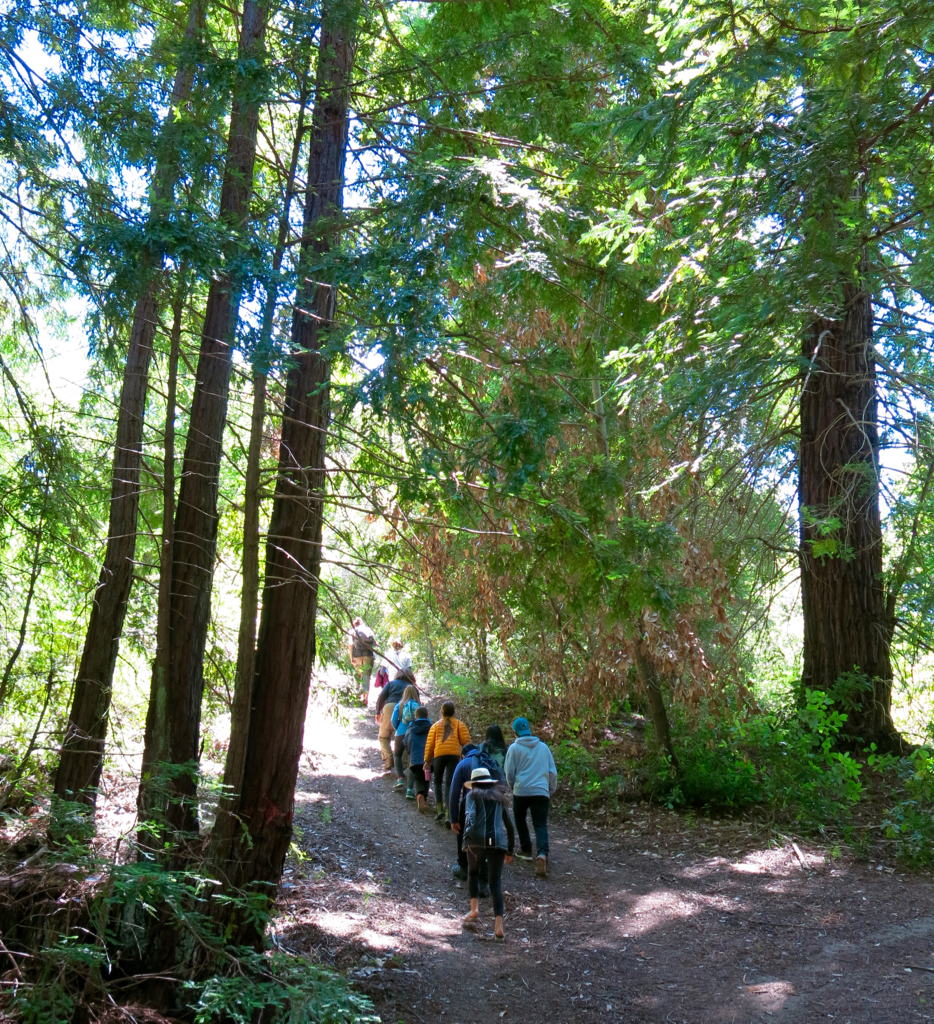
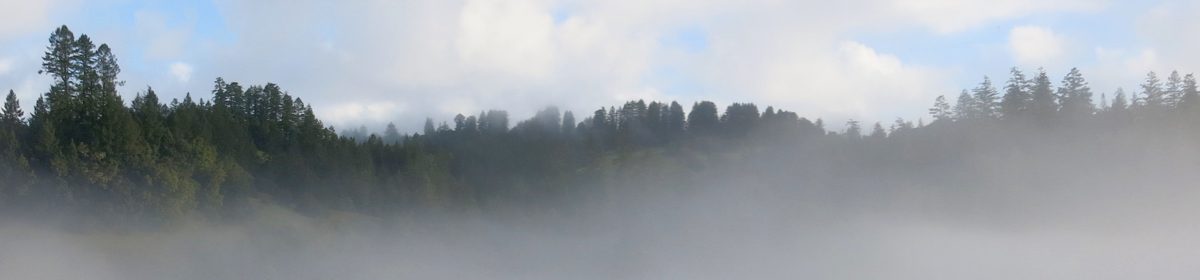
We decided to go for a hike up in the redwoods late this afternoon. As we drove up into the hills, we got closer and closer to the clouds, until finally we were in them. The trail started close to two thousand feet above sea level, then wound down the coast side of the hills. The clouds were blowing in from the ocean against the hills, so we were in the clouds all the way down to where we turned around, at about twelve hundred feet elevation. In fact, the clouds (or was if fog?) got thicker the lower we got.

IMG_5124

It continues to amaze me that we can start driving from downtown San Mateo, in the city a mile from the bay at maybe twenty feet about sea level, and in twenty minutes we can be hiking in the mountains among Douglass fir and redwoods two thousand feet above sea level. This is one of the benefits of living in a seismically active region: mountains right next to the ocean.

Experiment in hugelkultur

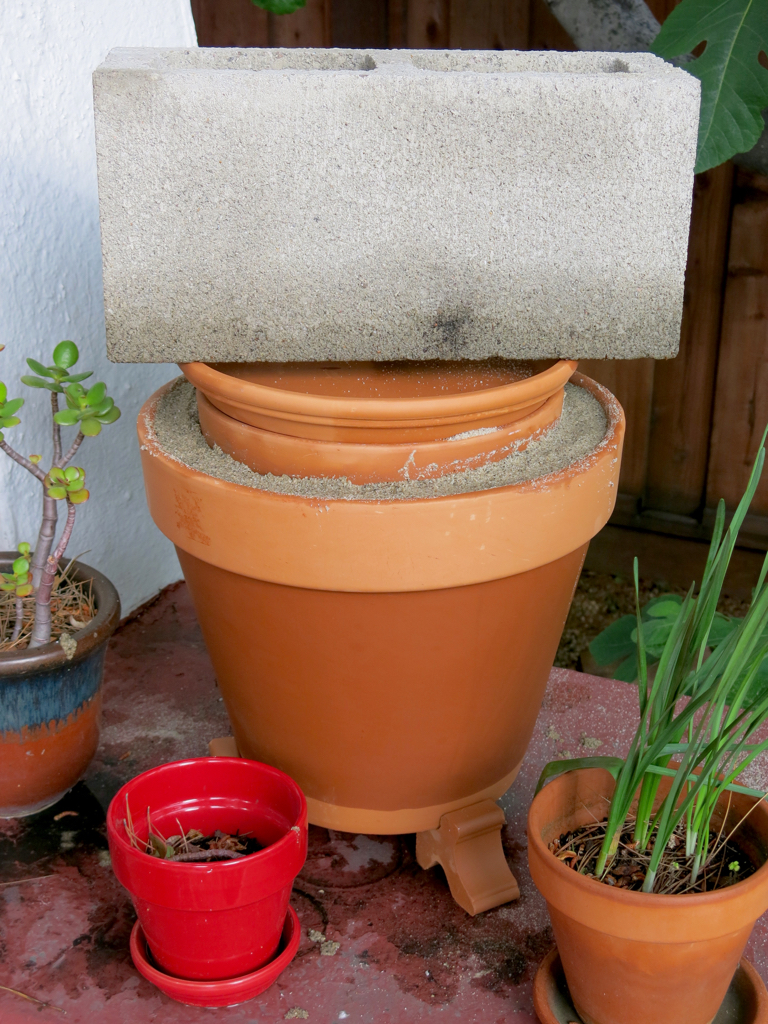
Carol has decided to experiment with hugelkultur in the garden this year. A hugelkultur garden bed consists of decaying wood and other compostable material from plants. This technique is supposed to create more fertility in the soil, and improve water retention. Given the ongoing drought here in northern California, improved water retention alone makes this technique worth trying.

Rather than build up a mound of decaying material, as is typical with hugelkultur, Carol got me to make a raised garden bed; with the tiny amount of space we have for our garden, this seemed to make the most sense. We got some cheap boards from a lumberyard, I scrounged some scrap wood for the corners, and in about an hour we put together a bed 96 inches long and 25 inches wide. Then we put in some partially finished compost, along with twigs and small branches.

hugelkultur raised garden bed

In the photo above, we’ve put down a layer of partially finished compost; the two buckets behind the raised garden bed are more compost waiting to go in. Carol has started laying some twigs and branches on the compost. After this, she put down another layer of compost, and then added a layer of potting soil we purchased from the hardware store across the street.

Carol is also planning to set up a greywater system (she is something of an expert on the topic). We already collect greywater — we have to run about two and a half gallons of water before the water in the shower gets hot, so we collect this and use it for watering the garden. Given how bad the drought is, that wasn’t enough water, so she is looking at other easily accessible sources of greywater that we can use without annoying our very nice landlord.

If you look closely at the photo, you’ll see potatoes growing in the raised bed behind the new bed. Today they started wilting a little. The National Weather Service predicts “dry weather and above average temperatures are likely to persist into the first half of next week”; we’re going to have to start watering the garden now, right in the middle of the winter-wet season. This is global climate weirdness happening in front of our eyes; maybe hugelkultur is one small way to help restore some balance to an out-of-balance world.

another view of hugelkultur bed

Above: The bed with more twigs and branches, and more bins of partially finished compost ready to go on top (photo credit: Carol Steinfeld).

Bee nests

In the fall of 2014, the ecojustice class (gr. 6-8) at our congregation made “bee houses” to provide potential nesting sites for Mason Bees. We kept watch on the bee houses through spring of 2015, but neither I nor the teens observed any nesting activity. (Mason Bees are solitary, and do not nest in hives like the more familiar Western Honeybee.)

But when this year’s ecojustice class checked on the bee houses last Sunday, it looked like some of the holes are now or had recently been occupied by insects:

BlogFeb2316a

BlogFeb2316b

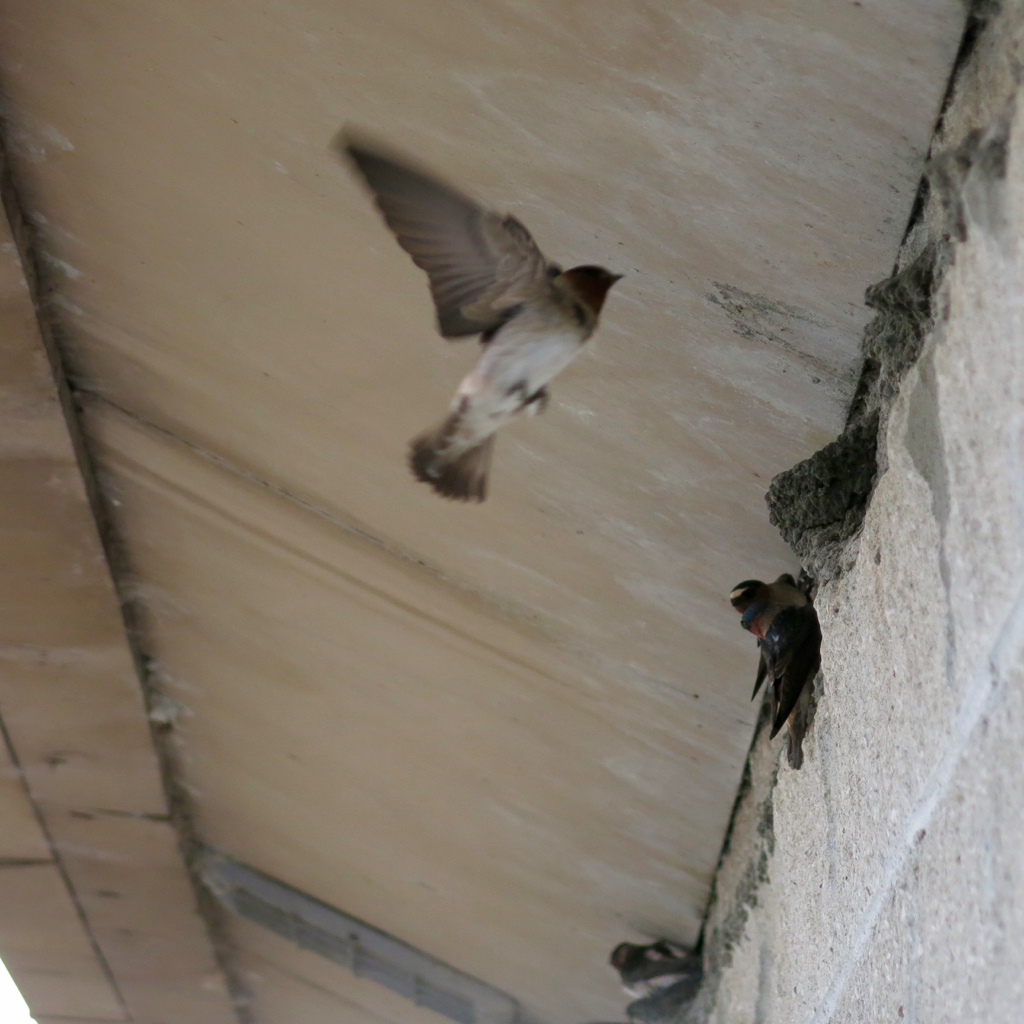
Since Mason Bees use mud and soils to plug up their nesting holes, and these holes do not look like they have mud in them — the color of the plugs is not the color of any of the nearby soils — I’m not convinced that Mason Bees are nesting here. Nevertheless, some organism has definitely moved in to these holes; perhaps further observation will reveal what that organism might be.

Macomber turnip

One of the things I miss about living in southeastern Massachusetts is the Macomber turnip. Macomber turnips produce large roots that look like light-colored rutabagas on the outside; when you cut the roots open, the flesh is crisp, relatively easy to cut, a creamy white with a light grain to it. You can cook them like any turnip or rutabaga; I like them boiled or steamed and mashed, though they can be a little watery. But I think the best way to eat them is to slice them into sticks and eat them raw. I’m eating one as I write this: it’s mild and sweet with a slight tang of turnip or radish, crisp and moist, like no other vegetable I’ve eaten.

I haven’t seen Macomber turnips anywhere outside of southeastern Massachusetts. But in that area, it’s such a famous vegetable that the town of Westport gave it its own historic marker, on Main Road, near Swartz’s Way. According to the inscription, the origin of the Macomber turnip was rutabaga seed which Aiden and Elihu Macomber brought back from the Philadelphia Exposition of 1876. When we lived in the area, we were told that the rutabagas (Brassica napus), or perhaps they were turnips (Brassica rapa), then crosspollinated with radishes (Raphanus sativus) to form this new variety. Based on the taste, I find it more plausible to believe that Macomber turnips are a cross between B. napus and B. rapa. I’d be interested to know what a qualified taxonomist had to say about the matter.

In any case, it is such a pleasure to taste the Macomber turnip again. Sometimes, I wish they would become a fad food, so I could buy them here in California. More often, I’m glad they remain a local specialty, because it is possible to grow them so they become sharp and bitter; better that American Agribusiness leaves them alone.

Macomber turnip

Kelp

Bull Kelp, Nereocystis luetkeana, Half Moon Bay State Beach

This is apparently an air bladder of Bull Kelp (Nereocystis luetkeana), but with a much shorter stipe (or stalk) than that usually associated with this species of macroalgae. Carol found this beautiful organism when we were on a walk at Half Moon Bay State Beach late this afternoon (I walked right by it because I was too busy looking at Sanderlings and Mew Gulls).

References:
Peter Alden and Fred Heath, National Audubon Society Field Guide to California, p. 87.
A. L. Baker, An Image-Based Key: Algae (PS Protista), Cyanobacteria, and Other Aquatic Objects, Nereocystis.
Washington State University, Intertidal organisms EZ-ID Guide, Nereocystis luetkeana (Bull Kelp).

Old Time Religion

Recently, I heard some new verses for the parody version of “Old Time Religion.” Here they are:

Yoruba religion, a.k.a. Orisha devotion:

Let us pray to the Orishas,
Not the ones who are too vicious,
Just the ones who grant our wishes;
And that’s good enough for me!

Ancient Egyptian religion:

O we sing the praise of Horus
Like the Dynasties before us —
A three thousand year old chorus;
And that’s good enough for me!

Worshiping at the altar of Wall Street:

The mighty Dollar is my Savior,
She controls my ev’ry behavior
Whether I spend her or I save her;
And that’s good enough for me!

BlogDec0915I was particularly interested in these verses because they happened to be about three religions I am currently studying. And lest you think I’m kidding about Wall Street being a religion, you might want to check out Scott Gustafson’s new book At the Altar of Wall Street: The Rituals, Myths, Theologies, Sacraments, and Mission of the Religion Known as the Modern Global Economy (Eerdmans Publishing, Sept., 2015), in which the author “argues that economics functions in our current global culture as religions have functioned in other cultures.”

Monarchs

Ed, whom we met through Sacred Harp singing, is a docent at Natural Bridges State Park, where migrating Monarch butterflies spend several months in the winter. Months ago he had offered to show us the Monarchs, and today we took him up on his offer.

Many of the Monarchs roost near the visitor center, down in a hollow where Blue Gum Eucalyptus trees grow. We walked into the grove at 11:40; the sun was well down into the hollow, and the temperature was rising into the mid-50s F. I looked up, and saw dozens of Monarchs soaring about twenty feet above me. Many more were roosting in the trees, and in the ivy growing up the trees.

Monarch Butterflies roosting in ivy

Ed pointed out three large clusters of Monarchs, on three nearby Eucalyptus branches. He had a scope, which he focused on one of the clusters of Monarchs. The scope took in about half the cluster, and it was a spectacular sight: I counted well over a hundred butterflies roosting, all closely packed together. They were mostly showing the dull orange of the undersides of their wings, but every once in a while one would spread its wings, making a momentary spot of vivid bright orange.

Male and female Monarch

The park has a collection of dead Monarchs, and using two dead insects Ed showed us the difference in the wing patterns of the male and female Monarchs: males have a distinct black spot on each hindwing; females have heavier black veining on their wings.

Monarch caterpillar

Near the visitor’s center, there’s a small butterfly garden, with two different species of milkweed growing. The caterpillars of Monarch butterflies will eat only milkweed. Sure enough, there were two caterpillars feeding on one of the milkweed plants.

It was a pretty fabulous way to spend a morning.

Info about visiting Natural Bridges State Park and the Monarchs here.

Dahwoodi Bohra mosque

Recently, a new mosque opened in Palo Alto, which is affiliated with a specific group of Shia Muslims known as Dahwoodi Bohra. I’ve been looking into Dahwoodi Bohra, and have found that it challenges some of my notions of Islam.

Dahwoodi Bohra is a branch of Isma’ili Islam, along with the better-known Druze; and Isma’ili is a branch of Shi’a Islam. Isma’ilism has Seven Pillars, instead of the more familiar Five Pillars of Islam. The Isma’ili consider the Shahadah — “There is no God but Allah and Muhammad is his prophet” — to be the grounding statement of all Seven Pillars, and therefore not a pillar in itself. The Seven Pillars of the Isma’ili include the familiar Salat (prayer), Zakat (charity), Sawm (fasting), and Hajj (pilgrimage). The three additional pillars are Jihad (struggle), Walayah (guardianship of the faith), and Taharah (purity). Although I usually think of Muslims performing Salat, prayer, five times a day, the Dahwoodi Bohra pray three times a day, since they perform some of the prayers at the same time.

The Dahwoodi Bohra have characteristic clothing which they may wear at religious ceremonies. The men wear a white tunic and coat, with a hat known as a topi (on Youtube, I found instructions on how to properly starch a topi here). Women typically wear head scarves, but rather than the subdued fabric I usually see Muslim women wearing, Dahwoodi Bohra headscarves tend towards the bright and spangly.

In common with other Shi’a Muslims, a major ritual is the Mourning of Muharram, which is observed in the first Islamic month; this observance is generally not performed by Sunnis. And there is much more to learn about the Dahwoodi Bohra: they have their own language; the largest number live in Gujarat, India, and Karachi, Pakistan; the women sometimes perform genital mutilation of girls, yet the men may be unaware of this; etc.

Yet learning even this little bit about the Dahwoodi Bohra has shown me the extent to which I have assumed that Sunni Muslims are normative. I should know better: every religious tradition I have started investigating has proved to be far more diverse than my original assumptions allowed for.


And here are some links to news stories on the local Dahwoodi Bohra mosque: here, here, and here. There’s not much about the congregation on Salatomatic, but for reference, their listing is here. Finally, the “official” Dahwoodi Bohra Youtube channel, which appears to be mostly audio files, is here.

List of faith communities near Palo Alto

I’ve been compiling a list of religious organizations mostly in Silicon Valley, from San Jose to San Francisco. The middle school class of our congregation visits other faith communities, and this list is designed to be used as a resource to help the class find places to visit.

Even though I was familiar with the work of Harvard’s Pluralism Project, even though I expected a wide diversity of religious traditions, I was still astonished at the religious diversity I found: there are hundreds of faith communities, ranging from Anabaptists to Zoroastrians, within an hour’s drive of our congregation.

Most of the research I did was online. It proved difficult to research some faith communities online, as quite a few do not have Web sites, or they have Web sites that are so outdated you don’t trust them. Yelp proved to an excellent source of information about many faith communities, especially when there were recent reviews (search for “Religious organizations” in a given locale). Youtube also proved a good source of information in a few cases; sometimes faith communities have inadequate Web sites but their members may post videos that provide useful information. One or two congregations had Facebook pages that provided the most recent information.

This list also relies on some real-world research. Our middle school class has visited some of these congregations, as noted on the list below. I also relied a lot on word-of-mouth information — people telling me about some faith community that they knew about, or had friends in, or belonged to.

Perhaps the most difficult part of making this list was figuring out a reasonable way to organize it. I started with the eight major world religions identified in Stephen Prothero’s book God Is Not One; added Zoroastrian, Sikh, Baha’i, and Jain to the list; then finished off with a list of New Religious Movements organized according to the categories in the book New Religious Movements, ed. Christopher Partridge. That takes care of the major divisions. It was more difficult to know how to categorize sub-groups within Christianity and Islam. Christianity is arguably the most diverse of the major world religions, and I did the best I could based on various scholarly reference works. Islam was also challenging to categorize, and I finally decided to use the categories from the Salatomatic Web site.

If you live in Silicon Valley, I’d love it if you looked over the list — then let me know if you see any errors or obvious omissions.

And now: the list! Continue reading “List of faith communities near Palo Alto”