Bay Area Sacred Harp

Some Stanford University undergraduates made a brief documentary on the Bay Area Sacred Harp singing community. The students were in an ethnomusicology class, and their goal was to document a local musical community. Given their time constraints, I think they give a pretty good sense of how music and community are woven together in Sacred Harp.

Notes: No one is identified in the video, but this is who you’ll hear from, in order of appearance: Pat Coghlan, Gridley, Calif.; Lena Strayhorn, San Francisco; Jeannette Ralston, Half Moon Bay; Terry Moore, Palo Alto. (Jeannette is the senior singer who was interviewed; she has been singing Sacred Harp in the Bay Area since the 1970s.) The local singings shown are Berkeley (in the church with pews); Palo Alto (in the children’s art room); and San Francisco (in the living room). You’ll hear the Palo Alto singers on Nehemiah Shumway’s Ballstown (begins 0:05; cont. 0:27 and William Billings’s Easter Anthem (begins 1:58).

Adventures in grilling

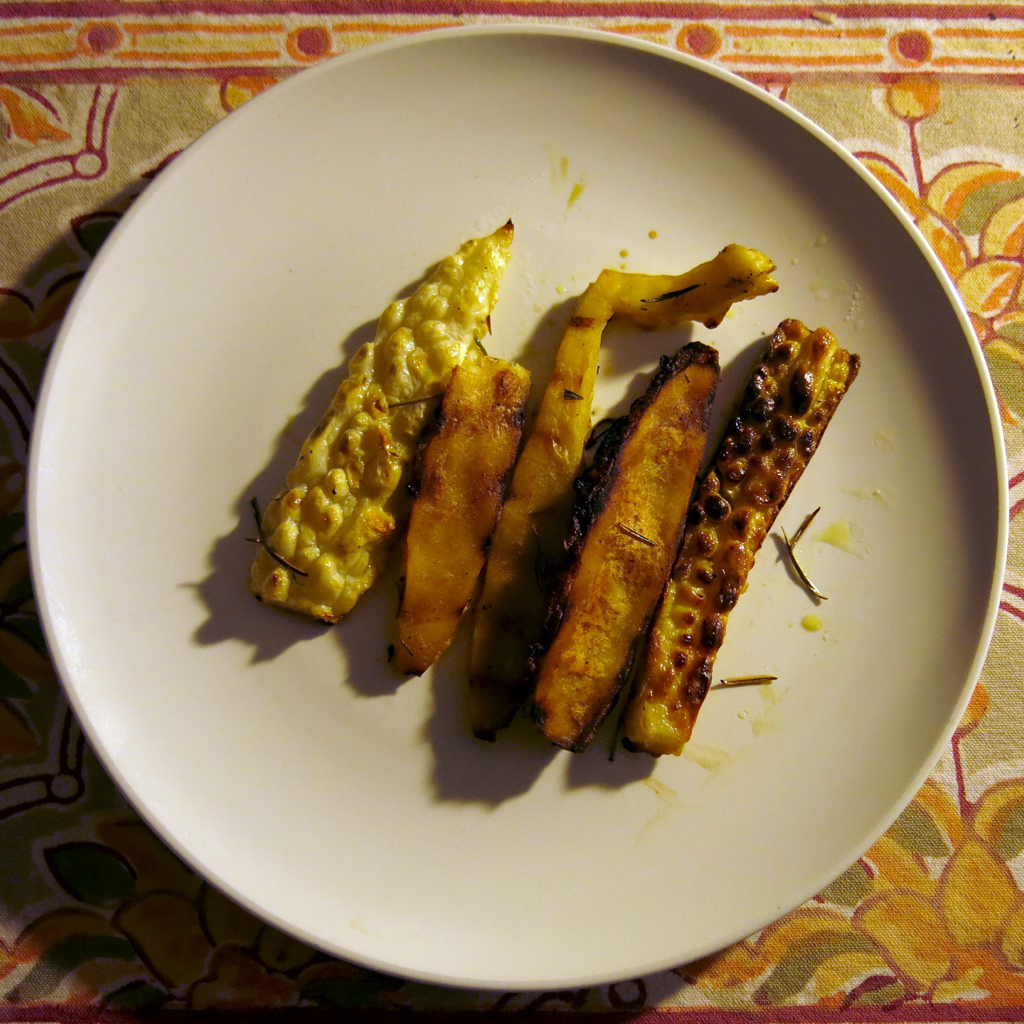
It was hot today, so we decided to grill our dinner. I hardly ever eat beef any more (can’t afford it, it’s bad for me), but Carol had gotten some local grass-fed beef from a nearby farm, so we grilled hamburgers and potatoes. That wasn’t quite enough for a dinner. Carol saw that we had a small mild white bitter melon in the refrigerator — what about grilling that? She basted it in olive oil and rosemary before she grilled it. It turned out well — slightly crispy, nicely bitter, very yummy.

Bioregional quiz

In the Winter, 1981, issue, the editors of the magazine Coevolution Quarterly published “Where You At? A Bioregional Quiz,” developed by Leonard Charles, Jim Dodge, Lynn Milliman, and Vitoria Stockley (you can find this quiz online here). The quiz was later republished in the book Home: A Bioregional Reader (New Society, 1990). Since then, others have modified the quiz; most notably, in 2006 Kevin Kelly posted a revised version of this quiz titled “The Big Here” on his blog.

As much as I like the original version of the quiz, some of the questions are specific only to certain bioregions, such as “What spring wildflower is consistently among the first to bloom where you live?” — if you live in a region where flowers bloom year-round, there is no good answer to that question. And some of the questions are maybe too difficult, such as “Name five grasses in your area” — I’ve been trying to learn how to identify grasses down to the species level, and it’s very challenging. A couple more things bother me about the quiz. First, the quiz focuses too much on book knowledge; you are merely asked to “Name five resident and five migratory birds,” you are not asked to identify them in the field. Second, the quiz ignores whole clades of organisms that would have been familiar to indigenous peoples, such as invertebrates and non-vascular plants.

So I’ve been thinking about how to revise the quiz. I wanted to create a quiz that would prompt me to learn more about my watershed, and to encourage me to get outdoors and explore that watershed. The first draft of my quiz appears below. How many answers did you get? What did I leave off that I should have included?

Continue reading “Bioregional quiz”

Lichens

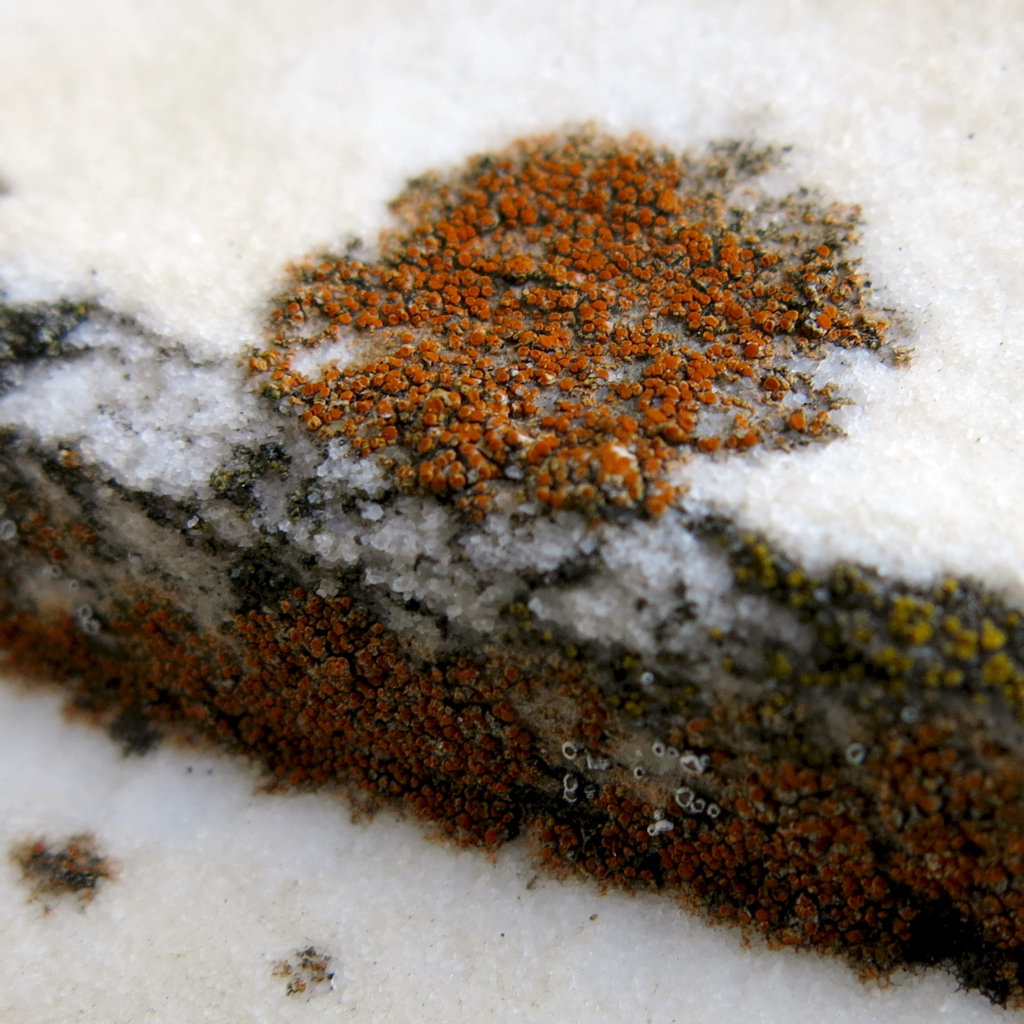
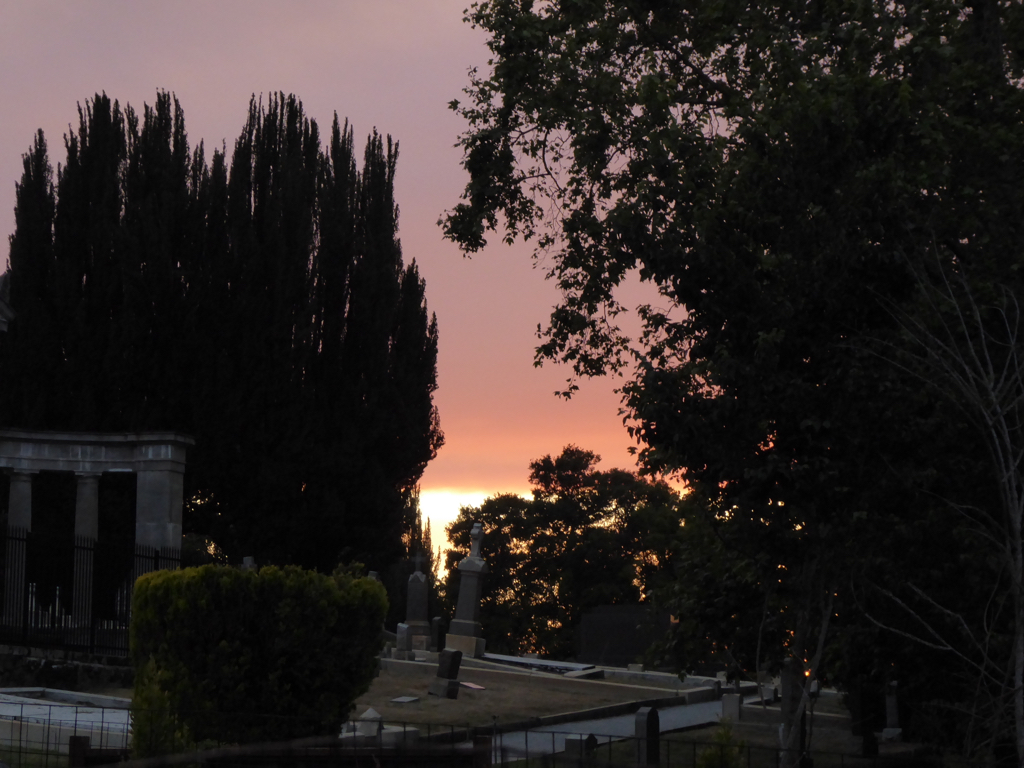
Living in a cemetery gives me the opportunity to observe a nice diversity of lichens. I went out this evening to see some of this diversity; my camera served in stead of a hand lens.

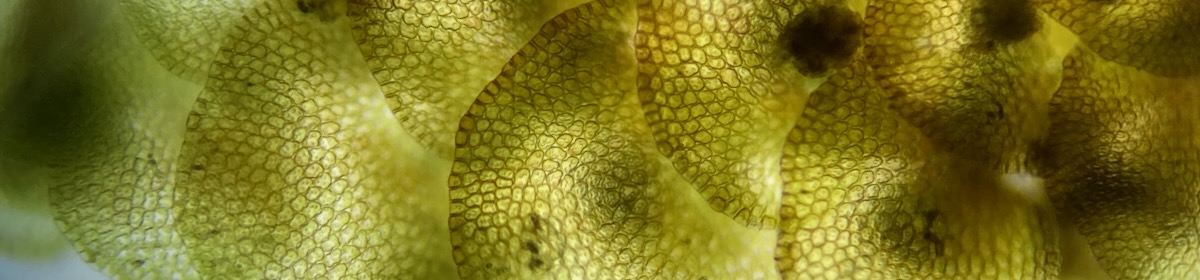
This crustose lichen, covering an area about the size of a quarter, was growing on a marble gravestone. The magnification of the photo shows how the lichen has etched an indentation into the stone. To make an accurate identification of crustose lichens, I’d need both a microscope and far more knowledge than I currently have. But this may be in the genus Caloplaca: “The 25 to 30 species [of Caloplaca] reported from California … occur very widely on trees and mostly calcareous rocks. Caloplaca saxicola is common and one of the first crustose lichens collected by beginners” (Mason E. Hale Jr. and Mariette Cole, Lichens of California [Berkeley: Univ. of Calif. Press, 1988], p. 190).

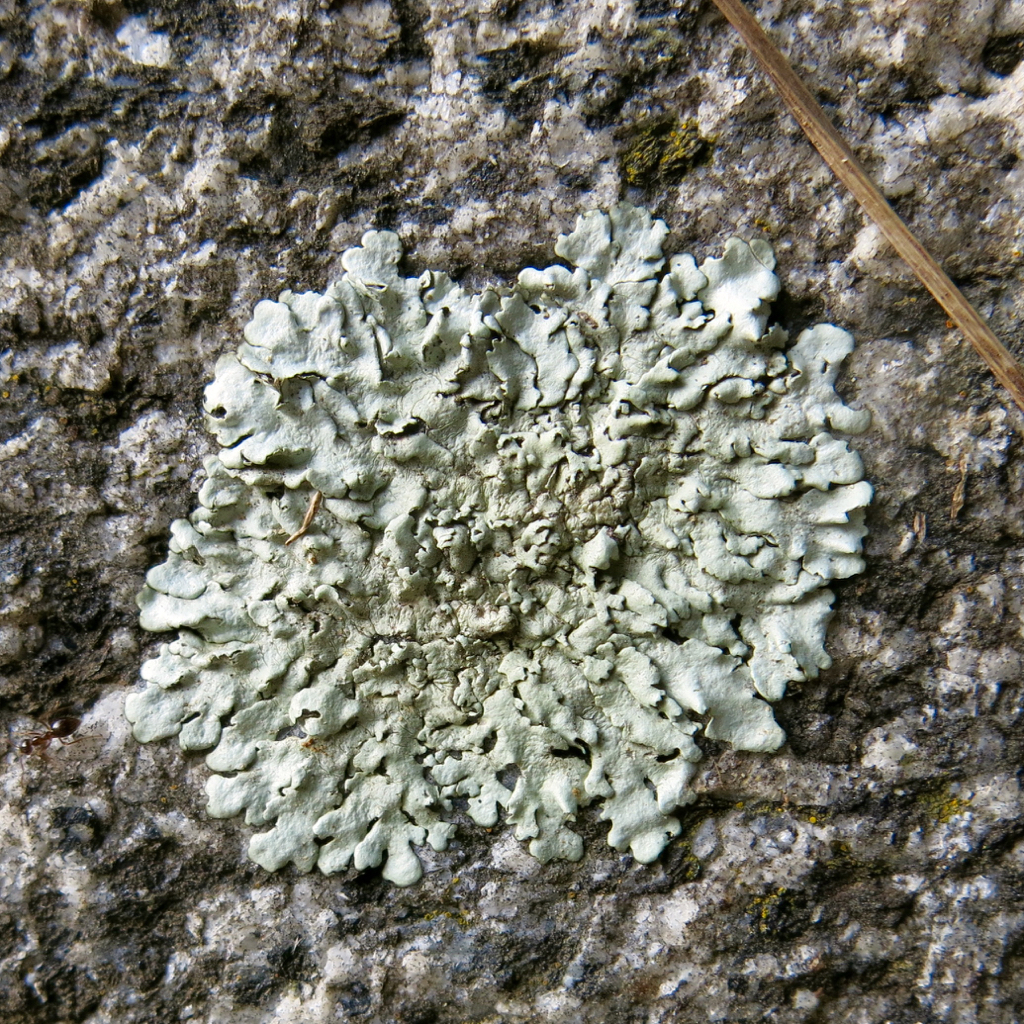
The foliose lichen above, about an inch across, and found on a piece of granite, may be in the genus Xanthoparmelia. According to Hale and Cole, “Xanthoparmelia is by far the dominant foliose lichen on granites, schists, shale, and other non-calcareous rocks throughout California…. Two species, X. cumberlandia and X. mexicana, are common and collected almost everywhere in the state.”

If I were to get serious about identifying lichens, I’d need to go out and get the K, C, and P reagents, an inexpensive USB microscope, and a few other things. Then I’d have to get serious about studying them: dissecting them, looking at them under the microscope, etc. Is it enough to just look at lichens without identifying them? or do I want to engage in more serious study of them? Heraclitus advised that “those who are lovers of wisdom must be inquirers into many things indeed” (DK35); but how deeply should one inquire into each of those many things? One only has so much time in this world; a serious in-depth study of one topic means less time to inquire into the many other things.

New potatoes

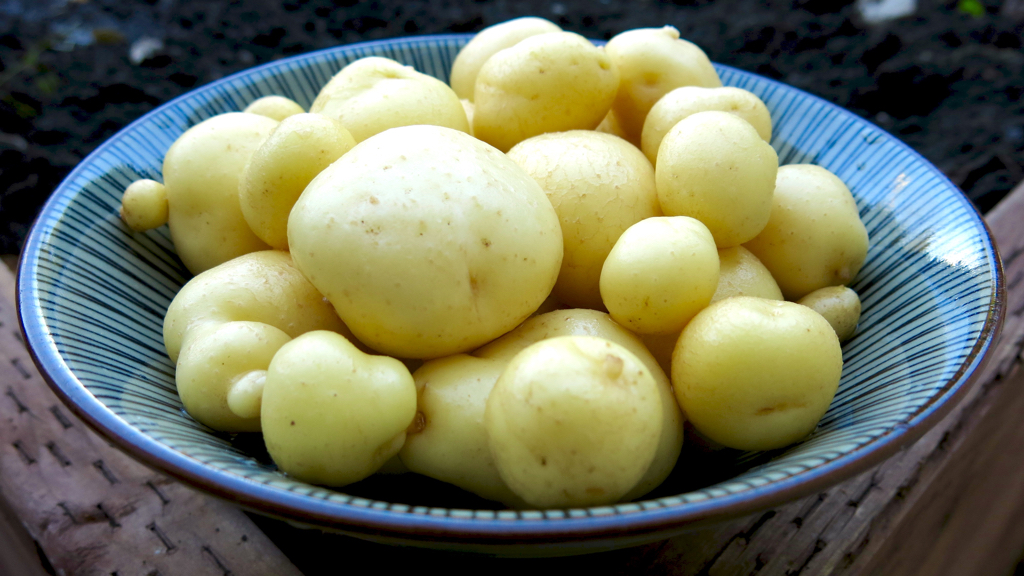
We planted a four foot row of potatoes right after we moved in to our new place, back in November. Something ate most of the leaves from the plants, and they slowly withered and died. This evening, Carol said we should look to see if there were any potatoes. I turned the heavy black soil over with a spading fork, and she sifted through looking for potatoes. We wound up with about a pound and a half of new potatoes. I took them in to the kitchen and carefully scrubbed them, trying to keep as much of the tender skin as I could.

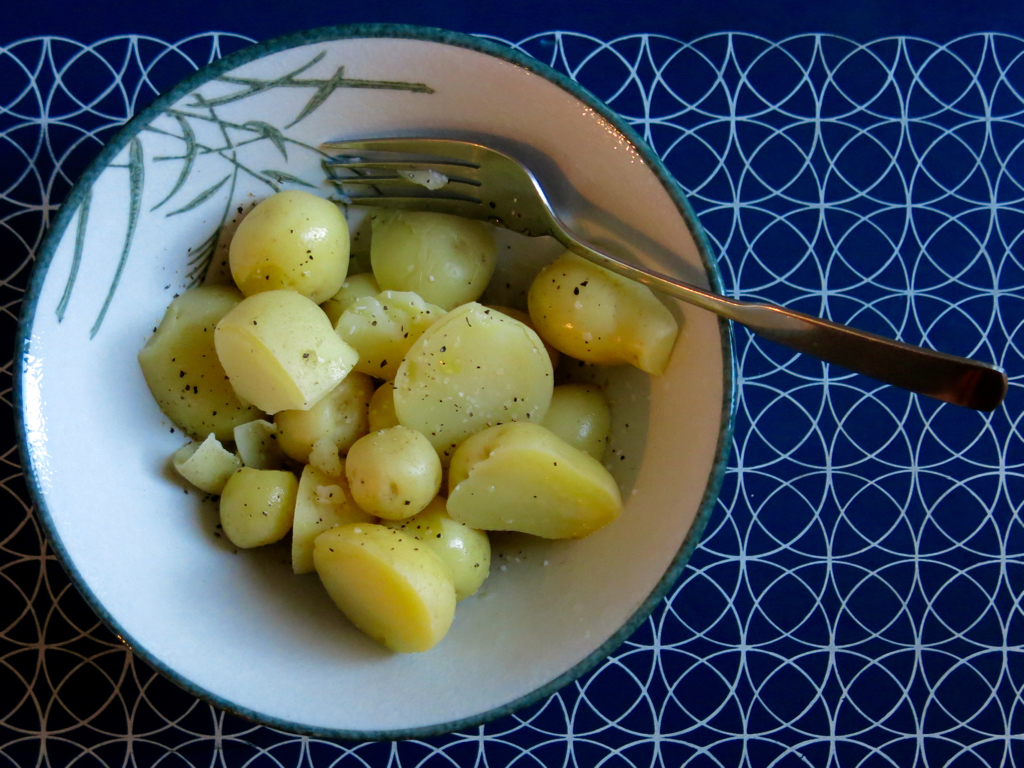
When they were washed, I cut up the larger ones. I put them in a pot of simmering water for a few minutes. We served them with nothing more than some olive oil, a little kosher salt, and a sprinkling of black pepper.

Less than an hour after we pulled them out out of the soil, we were eating them. They tasted wonderful: faintly earthy, with a delicate texture.

It’s that time of year

Five minutes ago, Carol was sitting in the living room staring at her laptop, and I was in the kitchen reading a murder mystery. Suddenly my ears caught the sound of something outside the window. I stopped to listen, and it came again.

“Hear the owl?” I said to Carol.

“No,” she said. “Where?”

I opened one of the kitchen windows a crack, and we stood there and listened.

“Hu-hu, hu, hu,” said the owl in a nearby tree.

Carol and I grinned at each other. This is one of those times when we really like living in a cemetery. “Great Horned Owl,” I said.

“Hu-hu, hu-hu.” It’s mating season.

Redding to San Mateo

We left Redding, in the narrow upper end of the great Central Valley, and headed south towards home. In the late morning, we stopped just south of Willows at the Sacramento River National Wildlife Refuge to walk the two-mile marsh loop.

There is something about being near wetlands that I find soothing: perhaps the big vista of sky you get from being in an essentially flat landscape; perhaps the nearness of an astonishing number of nonhuman organisms. Carol felt like walking fast and charged on ahead. I walked as fast as she, but stopped now and then to look at or listen to something: a mixed flock of White-fronted Geese, American Coots, Northern Pintails and other ducks swimming cautiously away from me; Marsh Wrens calling in last year’s dead and grey tule reeds; swarms of Red-winged Blackbirds flying across the marsh and up into the trees and back down into the marsh.

I stopped to look west towards the Coast Range in the distance, and the nearer ridge of the Great Valley Sequence, which, according to Roadside Geology of Northern and Central California, 2nd ed., “defines the boundary between the flat valley floor and the gaunt ruggedness of the Coast Range.” For someone raised among the smooth glaciated hills and mountains of New England, the mountains and ridges of California always look strangely ragged. This is a landscape defined by ongoing tectonic movement, not by the glaciers of fifteen thousand years ago.
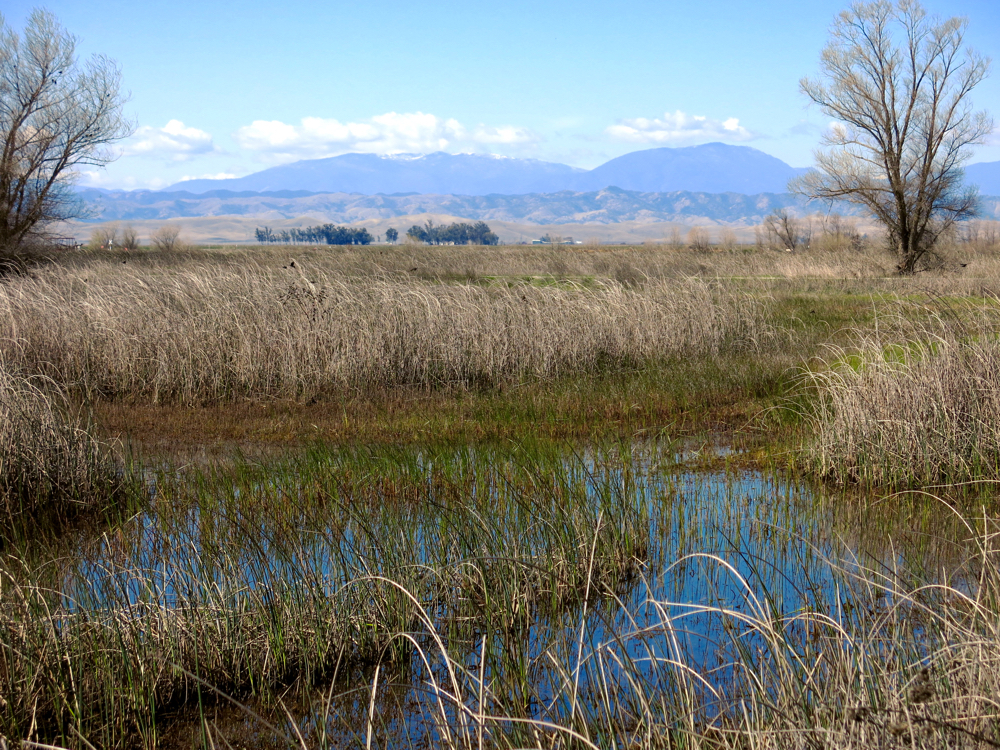
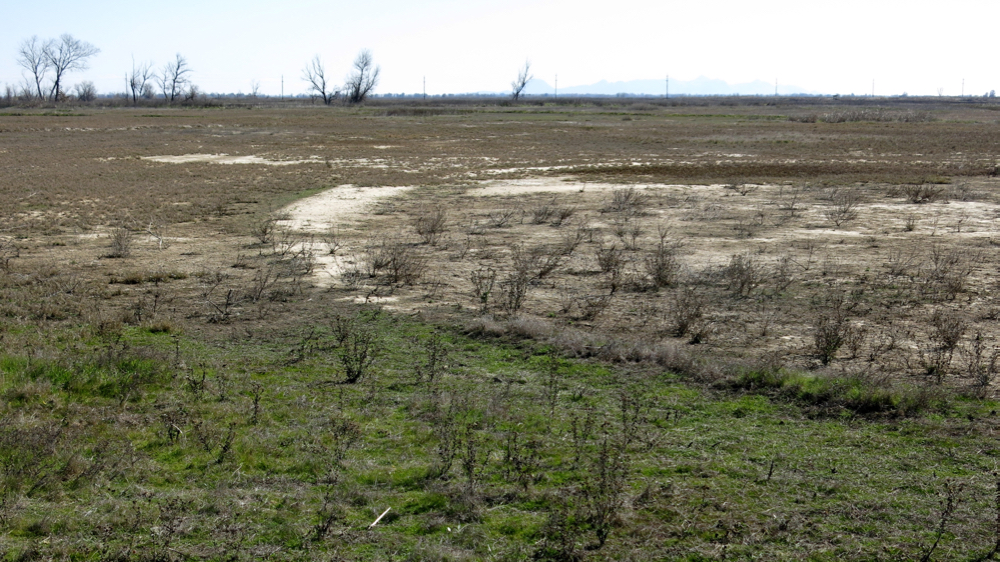
A little later on, I stopped to spend ten minutes looking at an alkali meadow. The soil was almost white in places, the vegetation low and scraggy. It was not a very attractive place. Yet there were a number of game trails criss-crossing the meadow, and earlier I had seen a jackrabbit lopping off towards this meadow. In the distance, through the moist and hazy air, I could just see Sutter Buttes, the old defunct volcano that sits in the middle of the Central Valley.
I finelly caught up with Carol near the parking lot where we had started walking. It was time for lunch. We sat and ate at a picnic table near half a dozen bird feeders. The birds were cautious of us at first, but when they saw we probably wern’t a threat, they swarmed out of the tule reeds and nearby trees: White-crowned Sparrows, Yellow-crowned Sparrows, House Sparrows, Song Sparrows, Lesser Goldfinches, House Finches.

The rest of the ride home was unremarkable and dull. I read aloud from a bad murder mystery while Carol drove. The traffic got bad as we approached San Mateo. At last we arrived at home.
Seattle to Redding

We dropped off Saba at the Montessori school where she works, and started driving south. It was a gray and dreary day, and before long it started snowing. Pretty soon it was snowing hard enough that the ground was white on either side of the highway, and in a few places slush accumulated between the lanes. We saw some accidents: a couple cars spun out and off the highway, something on the northbound side of the freeway with several tow trucks and emergency vehicles and traffic backed up for a mile or more. South of Eugene, the snow stopped, but the forecast for the Siskiyou Mountains was for snow tonight and snow tomorrow morning. We decided to drive as far south as we could before we got tired. Wes topped briefly in Ashland so Carol could collect mineral water from the public fountain in Ashland Plaza. Then we started driving again, winding up over the mountains and back down again until we reached Redding, where we stopped to spend the night.

As for the lithium water, it smells sulphurous, like slightly rotten eggs. The water also has quite a bit of barium in it, so you’re not supposed to drink more than a few sips at a time. If we decide to drink it, we should do with it what they do with “Crazy Water” from Texas: dilute it; “Crazy Water” tastes pretty yucky, too, but once diluted it’s at least drinkable.