Gravestone, Salem, Mass.

In Salem, Massachusetts, yesterday, we spent a half an hour wandering around the old burying ground. There are some seventeenth and eighteenth century stones there, and I could have spent a couple of hours looking at them. While I’m most interested in the carving, the inscription on one of the stones caught my attention:

In Memory of
Miss SALLY GRANT,
daughter of Cap. SAMUEL
& Mrs. ELIZABETH GRANT,
who died Sept. 16th 1789:
in the 26th year of her age.

I long[,] she faintly cries[,] to lose my breath
And gently sink into th’embrace of death
Adiue [sic] vain World[,] a long adiue[,] I go
Where joys that have no bound forever flow.

I have been unable to find a source for the short verse on this gravestone. It sounds like it might be a verse from a late eighteenth century spiritual song or hymn, perhaps remembered not quite accurately.

Memorial

We went up to Swampscott today to see the memorial at the train station for the 1956 Swampscott train wreck. The memorial reads:

IN MEMORY OF THOSE WHO DIED IN THE
SWAMPSCOTT TRAIN WRECK
FEBRUARY 28, 1956
WALTER D. ALLEN     WALTER B. LEE
RUTH F. BEAN      PAULINE PAVLO
FRANCIS E. BOETTNER    GEORGE S. SILLARS
ALBERTA L. HALEY     DONALD K. TAYLOR, JR.
RAYMOND F. JONES     ERNEST A. TOURTELOTTE
PENELOPE KOTSOVILLIS    GARDNER S. TRASK, SR.
GEORGE V. WARREN, JR.
DEDICATED NOVEMBER, 2005

The memorial is relatively small, and sits at the bottom of the wheelchair access ramp that leads from the parking lot up to the train platform. The actual wreck took place about a half mile farther up toward Salem, along an inaccessible stretch of track.

Our grandfather’s name is the first one on the list: Walter D. Allen. He died before my mother had children, so neither my sisters nor I knew him. Even so, I found it affecting to see his name there.

Tide pool

Tide pool at East Point Sanctuary near Biddeford Pool, Maine. Tentative identifications of organisms in this tide pool: Common Periwinkle (Littorina littorea), a snail that is an invasive exotic species introduced in North America in the nineteenth century; limpets (mollusc spp. in family Lottiidae); Blue Mussel (Mytilus edulis); barnacles (crustacean spp. in subclass Cirripedia); Knotted Wrack, a seaweed (Ascophyllum nodosum).

Beams, Concord, Mass.

Carol and I went to the Robbins House, an early nineteenth century historic house at the Minuteman National Historic Park in Concord, Mass. The house was originally occupied by Susan and Peter Robbins, two grown children of Caesar Robbins, and perhaps by Caesar Robbins himself; I say perhaps, because the history and chronology of the house, as set forth on the Robbins House Web site, is not entirely clear to me. This is not surprising, given how poorly documented African American lives of the early nineteenth century were. What’s important to know is that Caesar was an African American man who won his freedom from slavery by serving in the American Revolution, and the house was occupied by his descendants and extended family until about 1870.

We got an excellent tour from one of the interpreters, who told us a great deal about the people who lived there, and about the social history surrounding the house. But I have to admit what interested me was the construction of the house. I was particularly interested in the exposed roof beams in one room, which included both hand-hewn beams and sawn joists. The sawn lumber was manufactured using a vertical saw, not a rotary saw. Why the mix of hand-hewn and sawn lumber? The hand-hewn beams could have been salvaged from an older structure, something that was often done in the early nineteenth century, or they could have been made for that house; the sawn lumber could have replaced older joists, or they could have been original, though sawn lumber would have been more expensive than hewing one’s own beams. When the house was being restored, there were archaeology, dendrochronology, and other architectural studies were carried out; I hope the non-profit organization that operates the house publishes the tests and tells us why there are two kinds of beams.

Dusk

The past couple of evenings, the wildfires north of here have given us sunsets that are more colorful than usual. Tonight I went out and walked around the cemetery at dusk; the light was rosy with a yellowish tinge. I went up to where you can look out at San Francisco Airport, and watched a couple of jetliners land. A bank of fog was stretched from the Golden Gate across the Bay towards Oakland; an avalanche of fog curled over the top of San Bruno Mountain; here in San Mateo, the fog was several hundred feet above me, pushed upwards as it moved up the Crystal Springs Gap. Then I happened to look up, and there was a pair of White-tailed Kites hovering overhead, silhouetted against the bright low clouds; they worked their way down the hill, and for a few minutes I watched them come to a hover every minute or so, until they disappeared farther down the hill behind some trees. The rosy glow from the sunset really was lovely, even with the realization that a good bit of that lovely redness came from wildfire smoke.

Bay Area Sacred Harp

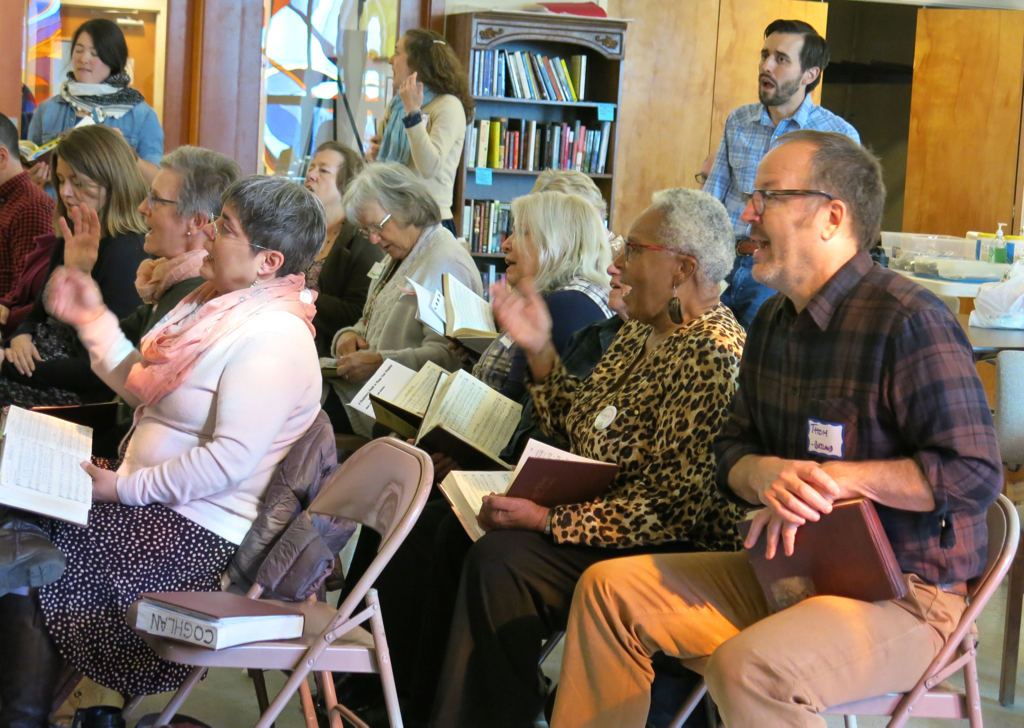
Some Stanford University undergraduates made a brief documentary on the Bay Area Sacred Harp singing community. The students were in an ethnomusicology class, and their goal was to document a local musical community. Given their time constraints, I think they give a pretty good sense of how music and community are woven together in Sacred Harp.

Notes: No one is identified in the video, but this is who you’ll hear from, in order of appearance: Pat Coghlan, Gridley, Calif.; Lena Strayhorn, San Francisco; Jeannette Ralston, Half Moon Bay; Terry Moore, Palo Alto. (Jeannette is the senior singer who was interviewed; she has been singing Sacred Harp in the Bay Area since the 1970s.) The local singings shown are Berkeley (in the church with pews); Palo Alto (in the children’s art room); and San Francisco (in the living room). You’ll hear the Palo Alto singers on Nehemiah Shumway’s Ballstown (begins 0:05; cont. 0:27 and William Billings’s Easter Anthem (begins 1:58).

Adventures in grilling

It was hot today, so we decided to grill our dinner. I hardly ever eat beef any more (can’t afford it, it’s bad for me), but Carol had gotten some local grass-fed beef from a nearby farm, so we grilled hamburgers and potatoes. That wasn’t quite enough for a dinner. Carol saw that we had a small mild white bitter melon in the refrigerator — what about grilling that? She basted it in olive oil and rosemary before she grilled it. It turned out well — slightly crispy, nicely bitter, very yummy.