Oh, that explains it

I’ve been reading about the meltdown of the Mt. Gox bitcoin exchange in the mainstream media. It all sounds so Serious and Mysterious — Was it outside thieves or insider embezzlement? — What will this do to online finances? — And, whither the future of bitcoin and similar currencies?

It’s not serious or mysterious, it’s actually stupidity. Charlie Stross, science fiction author and former computer programmer, points out that “MtGox” stands for “Magic: the Gathering Online Exchange.” Then he goes on to add:

“C’mon, folks. Mt. Gox was a trading card swap mart set up by an amateur coder and implemented in PHP! And you expected NSA-levels of trusted computing security, so you trusted your money to it?”

Now that I know all this, the whole story just seems Sad and Sordid. A few Magic card freaks move into amateur banking. A bunch of credulous people trust way too much money to the Magic card freaks. As happens all too often in human affairs, stupidity bred disaster.

I think there’s theology in here somewhere: Something about the essential fallibility of humans. And (more importantly) something about the way humans need to pretend that stupid human mistakes are actually Serious and Mysterious.

Drums in springtime

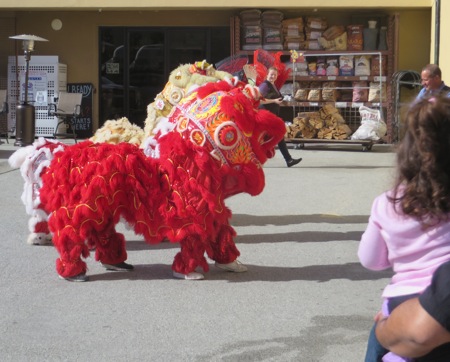
When you hear the sound of drums and cymbals outside your apartment coming from somewhere down the street, of course you go out and find out where they’re coming from. It was the West Coast Lion Dance Troupe performing in the small parking lot of the hardware store near us. It was fun to watch the brightly-colored lions dancing in the warm February sunshine:

West Coast Lion Dance Troupe

This hardware store, formerly independent, was bought out by a small locally-owned chain of hardware stores. Since they were bought out, they’ve been doing things to attract the attention of passers-by. In addition to the lion dancers, the local animal shelter had a tent set up and was promoting adoptions of small pets. Not a lot of people came, but we were all smiling.

After I watched the dancers, and glanced at the terrarium with a lizard or something in it, I started walking home — and as I walked I wondered why our UU congregation doesn’t do things like this to attract the attention of passers-by. I know what you’re going to say: “Most UU congregations try to hide from passers-by.” Well, I’m not feeling that cynical today, when it’s so warm and sunny and the faint smell of perfumed flowers permeates the air and makes my eyes itch. I think we’ve just never thought about inviting a lion dance troupe, or (honk!) an activist street band, or or some other community arts organization, to perform in front of our building. Maybe if we had sales goals to meet, as retail establishments do, we’d be thinking more along those lines. Not that I think we should have sales goals per se, but you know what I mean.

What I did with my weekend

Sacred Harp singing convention

The view from the bass section as a singer from Bremen, Germany, (alas, I didn’t catch her name) named Eva led well over a hundred singers at a Sacred Harp singing convention this past weekend.

What was it like singing with all those people, you ask? I’ll limit myself to the physiological response. With something over thirty singers in the bass section, I could feel my whole body vibrating to the lower notes. And since this is highly rhythmic music, we could also spend time talking about entrainment from an ethnomusicological perspective.

This, by the way, is why you might want to improve congregational singing so that it’s good, rhythmic, and loud — because when you do that, it feels really good.

What I did on vacation

Some people take trips when they go on vacation. Some people catch up on their sleep. I’m taking a week of vacation, and I decided to finish up the collection of Christmas carols that I’ve been working on for several years, and finally turn it into a book. Here it is:

YuletideSongAndCarolBook“The Yuletide Song and Carol Book” — This is a collection of four dozen Yuletide songs, in easy arrangements for SATB voices. Songs include familiar classics such as “Joy to the World,” lesser-known favorites like “Sussex Mummers Carol” and “Los Posadas,” familiar songs such as “Go Tell It on the Mountains” that are hard to find in SATB arrangements, and a few little-known gems such as William Billings’ “Shiloh.” The texts mostly come from older Unitarian, Universalist, American Ethical Union, and Quaker hymnals and songbooks, and will appeal to most religious liberals. Suitable for carolers, choirs, and informal groups that enjoy singing four-part harmony. 8-1/2×11, 100 pp., $9.99.

Now available through Lulu.com

(Soon to be available for distribution through Ingram, Amazon, and Barnes and Noble.)

Pete Seeger: a brief appreciation

When my older sister and I were young, our parents used to play this one record that I liked to try to sing along to: “Pete Seeger at Carnegie Hall.” I loved all the songs on that album: “Little Boxes,” and “We Shall Overcome,” and “Guantanamera,” and “Keep Your Eyes on the Prize.” I can still remember Pete Seeger’s spoken introduction to “If You Miss Me at the Back of the Bus,” when he talks about the violent measures taken against civil rights protesters. I can remember trying to memorize the words to “Little Boxes,” and in the process learning how to be critical of the assumptions undergirding middle class suburban culture, which probably helped lay the intellectual groundwork for my studies of critical theory and Marxism about ten years later, when I was in college. I had already learned from my parents how to be critical of what I was taught in school, but listening to “What Did You Learn in School Today?” made that seem fun and mischievous and delightful, and a few years later when I started working with children the memory of that song gave me a standard by to judge my own efforts as an educator.

Pete Seeger’s greatest strength was his ability to sing for children and young people. He was a teacher as much as, or more than, a musician. When he sang, he taught about big concepts like justice and human rights and racism and social inequality — he taught all these big concepts in a way that a six year old could understand them. His infectious songs and style of singing ensured that the children and young people who heard him sing would remember the lessons he taught for a long, long time. Continue reading “Pete Seeger: a brief appreciation”

Update

I managed to get bronchitis and laryngitis at the same time (I always think it’s amusing when preachers, who make their living by talking, get laryngitis). This slowed me down: I haven’t had much energy for a week, and my brains feel like Swiss cheese.

But I did have enough energy to finally update The Folk Choir Song Book, which was first published in 2009 (when I was coming off two years of directing a folk choir at a UU church). I’ve corrected many typographical errors, removed one song that turned out to be covered by copyright, and added some fun stuff that didn’t make it into the first edition.

Update, 2023: this book is no longer available.

Amiri Baraka: a brief appreciation

When I was in college, I wanted to take a course that was being offered on the history of jazz; but I was still a physics major, and didn’t have the time. So I bought the main book for the course, Blues People by LeRoi Jones, and read it on my own. I was listening to a lot of jazz at the time, and Jones — who had changed his name to Amiri Baraka by the time I read the book — showed me how jazz grew out of the historical and social experiences of people of African descent in the United States. It was one of those books that changed the way I understood the world, and started me off on an intellectual journey that led to Harry T. Burleigh and James Weldon Johnson and Sun Ra, and (by a circuitous route) to James Cone and William R. Jones.

Blues People has, I think now, a deep theological strain to it. When I read James Cone’s The Spirituals and the Blues, I couldn’t help comparing Cone’s understanding of African American music to Baraka’s understanding, not entirely favorably. Cone focuses too much on Christian doctrine, and I think that tends to exclude some of the irreducible African-ness of the spirituals and the blues, and later jazz. Baraka, on the other hand, showed how African Americans remained a part of the African diaspora, keeping their spirituals in some sense separate from the white man’s religion, and he showed (I thought so, anyway) the way so-called secular music could made sense out of lived experience, could bring meaning to life. I later learned — heard, really — how jazz could incorporate the lived experiences and meaning-making of other cultures, particularly Latin American cultures, but also various white North American cultures. Baraka opened my eyes to how jazz can express cross-cultural thoughts and longings and meaning-making, and so I came to understand it as the religious music par excellence. And so it was that Baraka opened my heart to William R. Jones’s Is God a White Racist? (the answer to the title is a nuanced and qualified yes). I don’t think you can understand God in the same way after you’ve read Blues People.

Baraka’s poetry had less of an impact on me. I love some of his individual poems: “Numbers, Letters,” for example, had some exquisite lines that have stayed with me for years, that match or surpass anything written by Allen Ginsberg or the more famous white Beats:

If you’re not home, where
are you? Where’d you go? What
were you doing when gone? When
you come back, better make it good….

…I am Everett LeRoi Jones, 30 yrs. old.
A black nigger in the universe. A long breath singer,
wouldbe dancer, strong from years of fantasy
and study….

That’s what I wanted to be: a long breath singer who is strong from years of fantasy and study; but I never made it, though the poem stayed with me. Some of Baraka’s poems have been living inside me for years: “Numbers, Letters” of course; and “For Hettie” and “Legacy” and “Poem for Speculative Hipsters” and others. But I could never sit down and read a whole book of his poems, the way I could with Langston Hughes or Elizabeth Bishop (I must have read “Geography III” a few dozen times) or Denise Levertov or Lucille Clifton. The fault is mine, I know. I can recognize Baraka’s brilliance, I can appreciate the bracing clarity of his moral insight, I need the white heat of his anger — but I feel that he demands something of his readers (and of himself) that is beyond human ability; or at least beyond my ability. It’s hard to read a whole book of poetry when you know that you’re going to fall short of what the poet demands of you; when you know that you or any error-prone, love-befuddled, smelly, awkward, confused and all-too-human being can not live up to what the poet demands. Adrienne Rich is a little that way, too: when I read poets like Baraka and Rich, I know I’ll never be good enough, never be able to transcend my humanness, never be able to get to that land towards which they point. It’s tough to read a whole book that makes you feel that way.

And it’s hard to know what we’ll do without Amiri Baraka. We need people who will hold us to impossible standards. I miss him already.

What we do at committee meetings

One of the things we do in committee meetings in our congregation is we wind up talking about other subcultures of which we are a part. Beth, for example, is part of the autoharp subculture. And, said Beth, one of the things they sometimes do at autoharp conventions is they have an autoharp toss. What’s that? we asked. That’s when you take an old autoharp that’s beyond repair, and see how far you can toss it. So we interrupted committee business to watch a Youtube video of autoharp tossing….

Autoharp Toss

When I showed this video to Carol, my partner, she thought it was silly. She’s obviously not a sports fan.

Twelfth day

It’s the twelfth day of Christmas. What to do on the twelfth day of Christmas? You could read Shakespeare’s “Twelfth Night.” Or some family traditions hold that this is the day to take down your Christmas tree.

Or, if you have a certain kind of obsessive personality, you could sing every verse of “The Twelve Days of Christmas.” And, in case you want to engage in this last effort, I’m posting a PDF of sheet music with guitar chords and a SATB/piano accompaniment.

twelvedays

N.B.: The first five verses are written out completely. Then the last page shows all twelve verses, and you’ll have to figure out on your own where to start each new verse.

16 SATB Xmas carols and songs

I’ve added a new Web page with 16 Christmas carols and songs, in basic SATB arrangements (one is STB) — including carols not in the current Unitarian Universalist (UU) hymnals (like “Jingle Bells”), carols with words from older UU hymnals (like “Joy to the World”), etc. You can find the page here.

(Yes, I know Christmas is over for the year. I’ve been meaning to put these online for a couple of years, I never seem to have time to do it before Christmas, so I’m going to put them up now.)