A 1907 Unitarian sermon from Palo Alto

This is the only sermon I’ve been able to find that was preached at the Unitarian Church of Palo Alto, which existed from 1905 to 1934. It’s a sermon preached at the dedication of the new building of the Unitarian Church of Palo Alto, March 24, 1907. It was doubtless revised for publication, and then was printed in the Christian Register (later called the Unitarian Register) on April 25, 1907, pp. 465-466.

George Stone, who preached this sermon, was the first minister the Unitarian Church of Palo Alto ever had. He was actually the American Unitarian Association’s Field Secretary for the West coast, and part of his duties were planting new Unitarian churches; since Palo Alto was a college town, it was seen as a likely spot for a Unitarian congregation, and that’s doubtless why Stone went ot Palo Alto in 1905. He worked with the new Palo Alto congregation for about a year, until 1906, when they called their first settled minister, Sydney B. Snow. Evidence in the extant documents of the Unitarian Church of Palo Alto show that they considered him their minister, even though he wasn’t a called minister. And in 1907, he returned to Palo Alto to preach the dedicatory sermon when their new building was complete.

But this sermon is of more than historical interest. True, we might not agree with some of the theology, and certainly the gender-specific language (e.g., “man” for “humankind,” male pronouns for the deity, etc.) now sounds dated. But Stone argues for the continual progress of organized religion; looking back at old forms of American religion, Stone says that our spiritual forebears “were passing through a stage of evolution which to us seems a sad one.” And he acknowledges that some day, he, too, will seem outdated: “Who knows but our descendants will look back upon the record of our lives with equal pity and tenderness?” Yet Stone has some powerful things to say about the purpose of public worship. A Unitarian congregation, says Stone, “stands for the solidarity of the race rather than for the single individual” — and yet, all these years later, we Unitarian Universalists are still overly individualistic, and reading Stone’s sermon might help us realize how far we have yet to go in our religious development.

“Public Worship” by Rev. George W. Stone

The mission of Unitarianism is to help mankind to a higher and more spiritual faith than it has had before; for Unitarianism is not a theology and a philosophy only, it is a life. It is, least of all, a negation or a denial of some other religion. It is a comprehensive religion, including the good in the older religions. No man is ready to become a Unitarian until he is able to do his own thinking. In order to be a Unitarian he may outgrow the old theologies, but he must not outgrow religion. Until he learns to use his freedom wisely, and not make it simply a license to reject everything he cannot understand, until then, he may not be orthodox, but he is not necessarily a Unitarian, for Unitarianism is a positive faith. It believes that love is the only divine power in the universe, and that at last all mankind will grow into it, that the process of man’s development from the animal, through the human, into the spiritual, is now going on, that it will one day be completed.

Continue reading “A 1907 Unitarian sermon from Palo Alto”

Possum feels stressed, part two

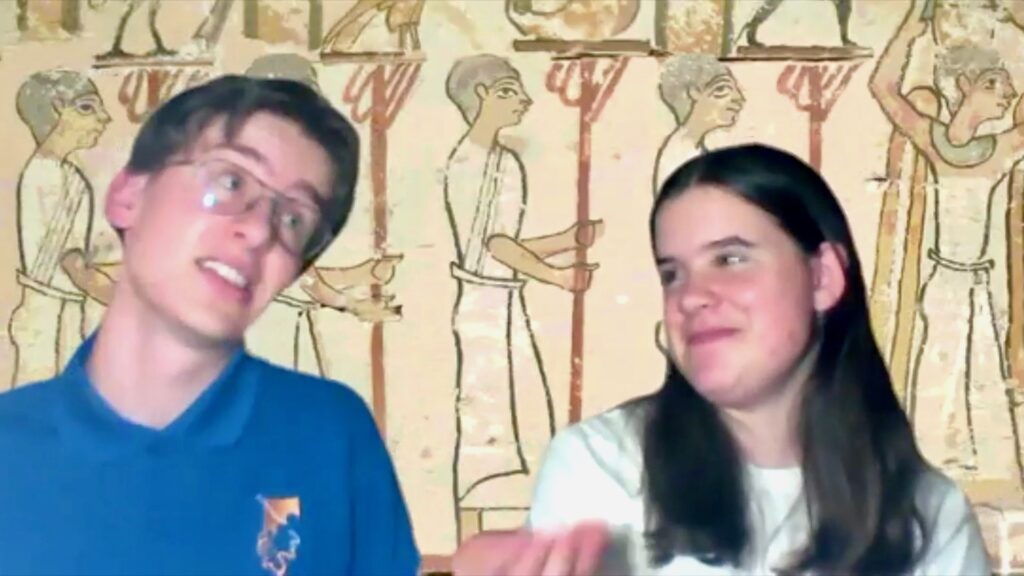
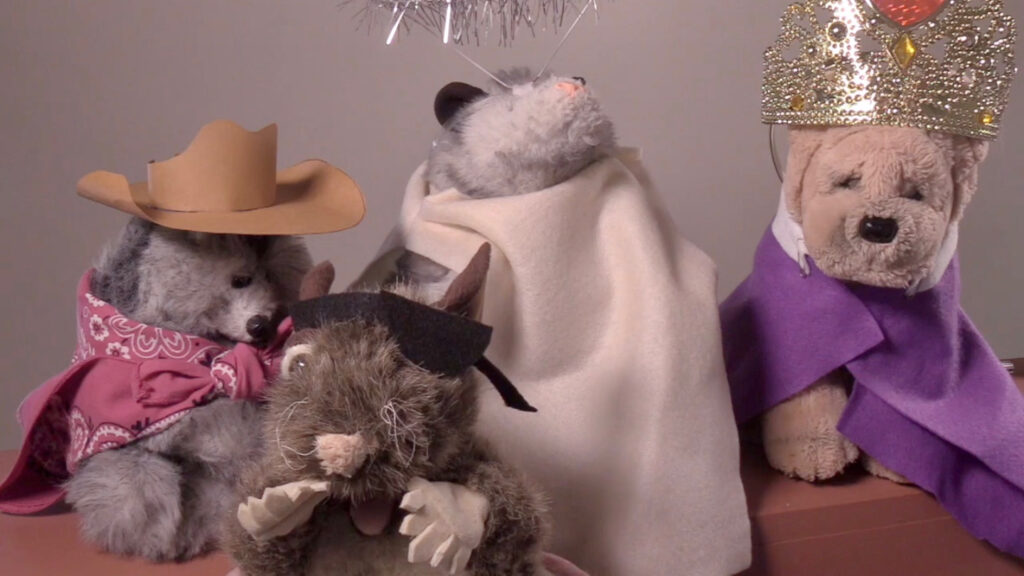
The second video in the Possum Feels Stressed series. Mindfulness meditation didn’t work out as a stress-reliever for Possum, and in this episode he and his friend Nanas the monkey try yoga…

Possum falls over while trying to do yoga.
Clicking on the photo above will take you to the video on Youtube.

The script is below, for those who like that sort of thing. Be warned, it got changed a bit in performance and editing.

Continue reading “Possum feels stressed, part two”

“My religion is humanity…”

Alice Locke Park, pacifist and early feminist, was a member of the Unitarian Church of Palo Alto from 1907 to 1920. Alice resigned from the church in 1920 in protest of the way some people in the church supported the the First World War; she was probably referring to people like Rev. Bradley Gilman and George Fullerton Evans, both of them saber-rattlers who spouted pro-war “propaganda” (in the words of another pacifist in that congregation). She later joined the Quakers. But she was a Unitarian for 13 years, and some of her writings seem to me to encapsulate a very contemporary Unitarian Universalist worldview—like this statement:

My religion is humanity—humanitarianism—confident that the present time is all that we are sure of, and [that] our duty, our progress and our usefulness are all here and now—If we think earnestly of the present and try to do all we can right here and now—we are at least sure of immediate results. My religion is boundless—Nothing human is alien to me. [quoted in Eunice Eichelberger, “‘Hearts Brimming with Patriotism,’” ed. Robert W. Cherny, California Women and Politics: From the Gold Rush to the Great Depression, Univ. Neb. Press, 2011, pp. 321-332.]

I think this would make a good responsive reading, if you arranged it something like this:

My religion is humanity—humanitarianism—

Confident that the present time is all that we are sure of, and that our duty, our progress, and our usefulness are all here and now—

If we think earnestly of the present and try to do all we can right here and now, we are at least sure of immediate results.

My religion is boundless—Nothing human is alien to me.

Not that this is some final definition of religion, some kind of dogma. By the end of his life, my father had become such a strong environmentalist that he refused to call himself a humanist any more, and I can imagine his criticisms of this reading. Nevertheless, the call to action and the appeal to a wide humanitarianism should be pleasing (if not definitive) to most.

Ordinary Unitarians: Martha Ziegler

As the years go by, I find I’m less interested in how famous or “important” Unitarian Universalists live their lives, and increasingly interested in the lives of ordinary Unitarians and Universalists. Maybe this is because I don’t know any important or famous Unitarian Universalists, but I’ve known lots of ordinary Unitarian Universalists. With that in mind, here’s a brief biography of Martha Clara Elizabeth Ziegler Greenlaw [a.k.a. Reynolds, Seymour, and Fancher], a member of the old Unitarian Church of Palo Alto:

A housewife and mother who experienced more than her share of domestic challenges and tragedies, Martha Clara Elizabeth Ziegler was born Feb. 27, 1894, in Chicago. In 1900, she was living in Hyde Park Township (which became part of Chicago). She lived with her father Gustav, a machinist’s helper, who had been born in Denmark; her mother Ida, who had been born in Germany; and her younger brother Charles.

When she was 17 years old, on Aug. 1, 1911, she married Charles Greenlaw in Chicago, Ill. Charles worked for American Telephone and Telegraph (AT&T) installing new phone systems in communities across the country, and his job required him to relocate every few months. His wife and a growing number of children had to move with him, and some of their moves can be traced from the birthplaces of their four children: Arnold Ziegler was born July 12, 1912, in Chicago; Colin Torrey was born March 27, 1914, in Baltimore, Md.; Morrison Bronk was born Aug. 3, 1918, in San Francisco; and Margery Ellen was born Nov. 3, 1920, in Chicago. All these moves put strain on the family.

To try to reduce some of the strain on the family, from about 1918 to 1920 they spent significant amounts of time in a cabin Charles owned in Willits, Calif. But soon they had to move again, and in January, 1920, they were living in Detroit, Mich. And by 1923, the family had moved to 523 Webster St. in Palo Alto.

Martha joined the Unitarian Church of Palo Alto in 1923. The names of her two oldest children, Arnold and Colin, were noted as having excellent attendance records in 1924. After her second marriage, she was listed in the 1926 “List of Resident Members” of the church as “Mrs. James E. Reynolds.”

Charles and Martha’s marriage came apart around 1923, and they probably divorced in 1924. By late 1924, Martha was living without Charles at 523 Webster St., and she was working as a stenographer. She was a single mother and caring for a four year old daughter; Charles had custody of the three older boys.

Soon after her divorce, on Dec. 22, 1924, Martha married James Edward Reynolds, and Rev. Elmo Arnold Robinson of the Unitarian Church officiated at the wedding. She and James had one child together, James E., Jr. (b. c. 1927, Calif.), and she of course also had custody of Margery. However, James and Martha’s marriage only lasted about five years because James developed tuberculosis and died around 1929. Once again, Martha was single, this time with two children under the age of ten.

Once again, Martha quickly remarried, this time to Fred Wesley Seymour (b. c. 1887, Ill.), who was known at various times as both Fred and Wesley. By 1930, they were living in Redwood City with Margery Greenlaw and James E. Reynolds Jr., now known as Edward. At some point between 1930 and 1934, Fred Wesley adopted James, Jr., who then became known as Peter Owen Seymour.

Martha’s third marriage also ended quickly, and again because her husband died. Fred Wesley worked for as a yardman in a railroad yard, and around 1934 he died in an accident on the Southern Pacific Railroad. By 1935, Martha had moved back to Palo Alto to live with Marjorie and Peter, who were now in their early teens.

Around 1940, Martha married for the fourth time, this time to Earl Fancher (b. c. 1883, N.Y.). In 1940, she was living with Earl in Fremont Township, Santa Clara County, along with her daughter Margery and her son Peter. However, this marriage, too, only lasted a few years, though this time the marriage ended with her death.

She died March 19, 1946, in Glendale, Calif. In her short 52 year life, she had had five children and lived through a stressful first marriage which ended in divorce, and she had buried two other husbands. I’d like to imagine that the Unitarian Church of Palo Alto provided some support to her during her divorce and remarriage, and it seems unfortunate that the church had mostly ceased existence during her second husband’s final illness and death, a time when a church could have been a real support.

Notes: 1900, 1920, 1930, 1940 U.S. Census; Illinois, Cook County Marriages, 1871-1920; Illinois, Cook County Marriages, 1871-1920; Illinois, Cook County, Birth Certificates for Arnold Ziegler Greenlaw, Marjorie Ellen Greenlaw; Calif. Birth Index, Calif. Death Index, and U.S. Social Security Death Index for Morrison Bronk Greenlaw; Russ Greenlaw, “Martha Clara Elizabeth Fancher formerly Ziegler aka Greenlaw, Reynolds, Seymour,” from “Family records and recollections of Alberta Seymour,” Wikitree Web site www.wikitree.com/wiki/Ziegler-463 accessed Aug. 1, 2020; Directory of Palo Alto, Mayfield, Stanford University, Ravenswood, and East Palo Alto, Palo Alto: Willis Hall, 1924, 1925 [Martha is listed as living alone at 523 Webster St. in the 1925 Directory, which was after she had married James Reynolds; but the information for the directory was probably collected in 1924]. Genealogical information from familysearch.org except where noted.

Adding links to video series

Over the past few months, I’ve been writing and producing videos nearly every week for the online worship services at the UU Church of Palo Alto. For my own reference, I just created blog posts for each of the videos I’ve done so far, including a still from the video, a link to the video on Youtube, and a full script. The posts are backdated to the Sunday on which the video appeared in the worship service.

You can see all these blog posts here.

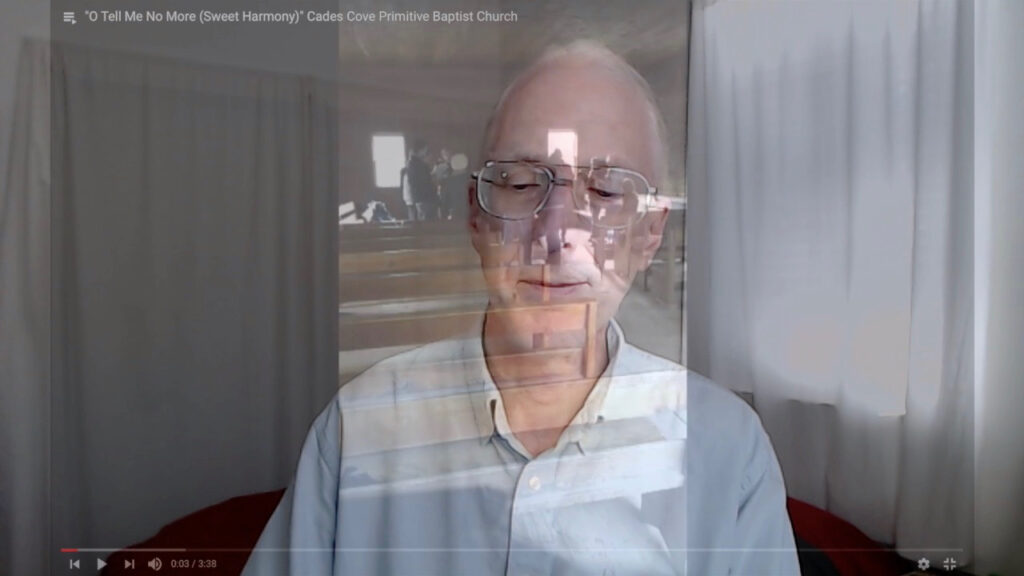
Clicking on the image above will take you to my Youtube channel where the videos are posted

Obscure Unitarians: Bertha Louise Chapman Cady

This is a major revision of an earlier short biography of Bertha Cady Chapman.

A writer, biologist, and sexuality educator, Bertha Louise Chapman was born July 5, 1873, in Santa Barbara, Calif., the daughter of Truman (sometimes given as “Freeman”) Fletcher Chapman and Mary Elizabeth Furlong Chapman; Bertha’s older sister Elizabeth Corinne Chapman had been born in the same place in 1870. By August, 1873, the family was living in San Buenaventura (now known as Ventura), Calif., where Truman worked as a druggist.

After Bertha was born in 1873, Truman became involved in mining, and he moved the family to New Mexico to operate mines there. In 1880, Bertha, her parents, and both siblings were living in Las Vegas. Truman was the postmaster of Las Vegas, New Mexico, from Jan., 1878, to Sept., 1880. In 1880, he owned the St. Nicholas Hotel on the Plaza. Las Vegas had grown into a bustling town with the coming of the railroad in 1878, but the Plaza retained a distinctly Southwestern flavor:

“The Plaza is in the center of the town.…About the center of the Plaza is the relic of the old well, the windmill having been torn down, and the well long out of use. It was the scene of [a] horrible sight this Spring, as on the night of February 9th the vigilantes hung one cowboy to the windmill, and laid his two companions out beneath him, riddled with bullets, because of their murder of Joe Carson, a few weeks previous. The Plaza is the principal market for the produce of the farmers.… Almost daily one will see large droves of burros standing about, loaded with wools, hides, or pelts.…Little, narrow, crooked streets lead out from the Plaza, and on all side of the town are scattered those queer little adobes, which give the place its ancient and foreign appearance to strangers.” (H. T. Wilson, Historical Sketch of Las Vegas, New Mexico [Chicago: Hotel World Pub., 1880?], p. 18)

This is the town where Bertha lived when she was perhaps 5 to 8 years old.

Continue reading “Obscure Unitarians: Bertha Louise Chapman Cady”