Washington, D.C., to West Concord, Mass.

Sometimes, when you’re driving along one of the highways of the Washington-to-Boston megalopolis, you look around and it feels like there’s nothing there but paved highways.

BlogJul0716a

Obviously there’s more to the Great American Megalopolis than highways. On this trip, just a few minutes from the highway, I saw the well-loved green chair and ottoman in a porch where Russell sat next to L.E.W. Smith’s Twelve Poems Reconsidered and looked out at the birds in his garden. Also just a few minutes from the highway, I saw the small garden at E’s house where she picked a squash which she cubed and cooked and mixed with pasta and ricotta cheese.

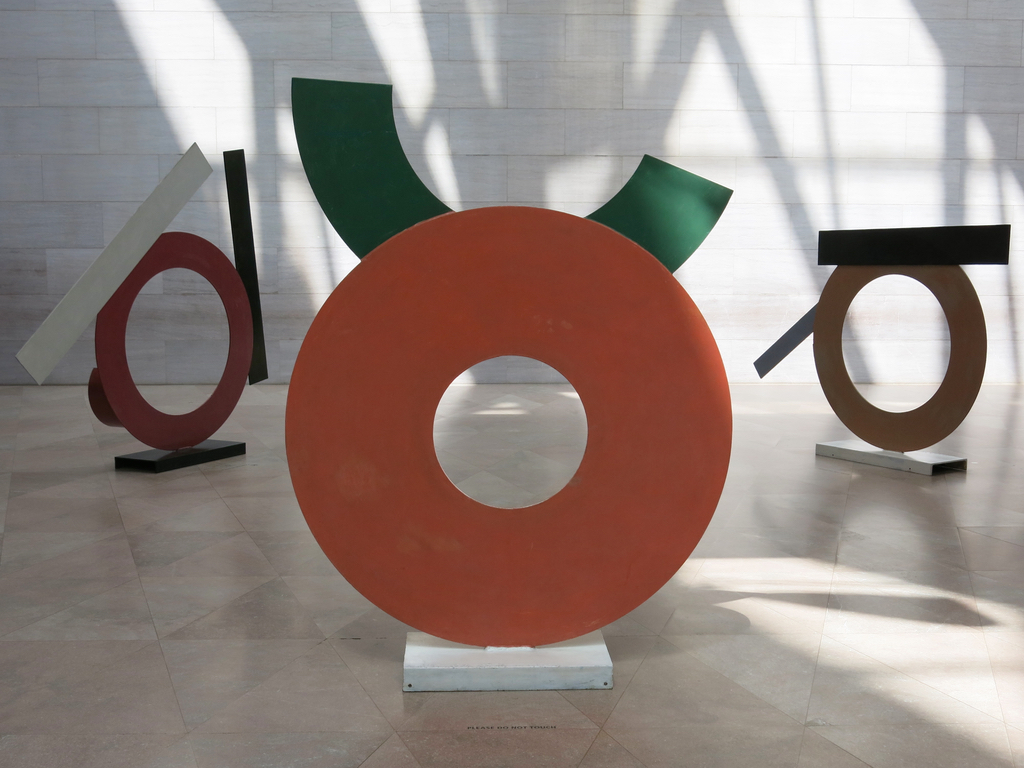
As we drove along, I thought about the welded steel sculptures made by David Smith that I had seen at the National Gallery. Eight foot high circles on bases that look like feet, with appendages welded on that look like arms, these painted sculptures feel like they’re almost animate, as if they’re going to move at any moment, like some kind of large fanciful animals.

David Smith sculptures, East Wing, National Gallery, US

Actually, maybe they’re more like representations of mid-twentieth century North American deities. Maybe highway signs, also made of brightly painted metal, are close cousins to these sculptures, pragmatic deities that are also akin to ancient Greek cairns in which the god Hermes hid to guide passers-by. Maybe this was what Frank Stella was getting at in his book Working Space. This became a confused train of thought, and I know I dozed off because when Carol said, “Should we stop here for lunch?” I snapped awake.

After lunch, Carol wanted me to read aloud. I finished a book that she had been reading aloud the last time we were driving, The Egyptian News by Scott Steedman, a children’s book with ancient Egyptian “news stories” like an investigative report into Tutankahmen’s death (“Boy King Murdered?”) and an interview with an embalmer. At a rest stop, we bought a copy of the New York Times, and I read aloud the front page news, and several other articles including the very entertaining story about Donald Trump explaining to a crowd how the graphic accompanying his social media post against Hillary Clinton was not anti-Semitic, and how he was mad at his staff for removing it from the Web. I read some chapters from the novel we’ve been reading aloud off and on during this whole trip. My voice finally gave out about thirty minutes before we arrived in West Concord, Massachusetts.

Isis

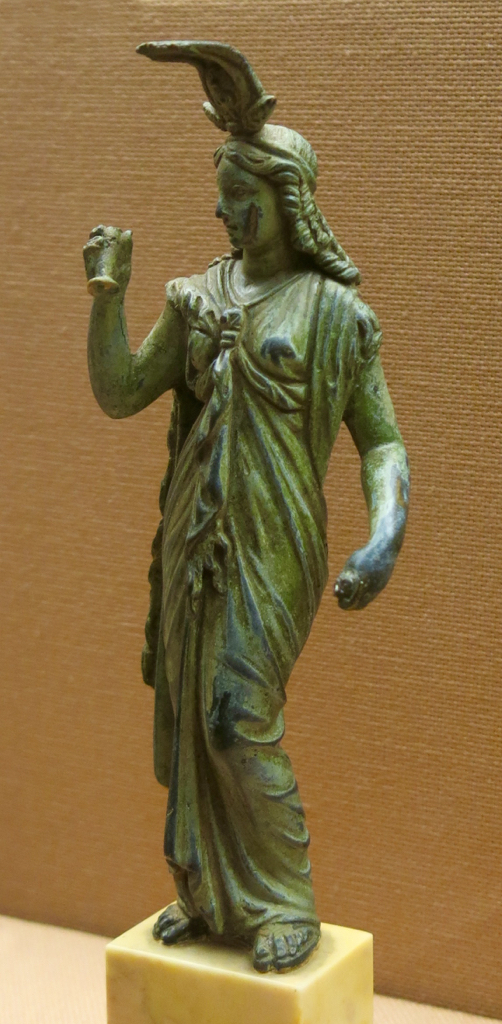
Isis is a well-known Egyptian goddess who needs little introduction. This beautiful little sculpture of Isis dates from a period when the Romans ruled Egypt; so Isis is wearing an Egyptian headdress, but she’s also wearing Roman clothing.

Isis, c. 100-200 BCE

Above: Isis with sistrum, from Roman Imperial period, c. 100 BCE to 200 CE; bronze. Boston Museum of Fine Arts, accession no. 04.1713.

She is shaking a sistrum, an small percussion instrument that was used almost exclusively by women. Kara Cooney, a professor of Egyptian art and architecture, interprets the sistrum in terms of sexuality: “The sistrum was a kind of rattle — a wooden handle supporting bars of metal, each piercing small rings that clanged together when the instrument was vibrated. The sistrum itself represented human sexuality — round objects penetrated by a phallic rod holding them in place” (1). This interpretation could be accurate, but it could be overly influenced by Freud and Co., and therefore anachronistic.

The archaeologist Joyce Tyldesley offers another interpretation; she says the sistrum, which “was played only by women,” was “a rather large loop-shaped rattle with a long handle, often featuring the head of Hathor [another Egyptian goddess], which had initially represented the papyrus reeds of the Nile Delta where, mythology decreed, Hathor had been forced to hide with her young son. Eventually the sistrum lost all trace of its original meaning and instead started to serve as a religious symbol for life itself. It consequently become absorbed by other deities, and was particularly identified with the cult of Isis at the end of the Dynastic period.” (2) And this sculpture in fact does date from the end of the Dynastic period, the time when Isis had taken over the sistrum form Hathor.

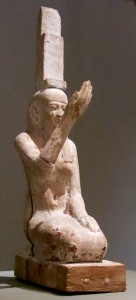
Thus in this sculpture, we see the goddess Isis at the end of some three millennia of change and development. She is wearing the flowing robes of Rome rather than the simple sheath dress of Dynastic Egypt. She wears a headdress that identifies her as Isis, though it is not the older stepped headdress of Isis seen in sculptures from 500 years earlier (see, e.g., the sculpture of Isis below, from c. 685-525 BCE). And she has taken over the sistrum from Hathor and other goddesses.

Although their adherents may say otherwise, art and material culture does not show gods and goddesses as unchanging and fixed; instead, they grow and evolve over time.

Isis, Dynasty 26

Above: Isis mourning Osiris, from Dynasty 26, c. 685-525 BCE; wood. Boston Museum of Fine Arts, accession no. 72.4172.

Notes:

(1) Kara Cooney, The Woman Who Would Be King (New York: Broadway Books, 2014), p. 39.
(2) Joyce Tyldesley, Daughters of Isis: Women of Ancient Egypt (London: Penguin, 1994), p. 139.

Taweret

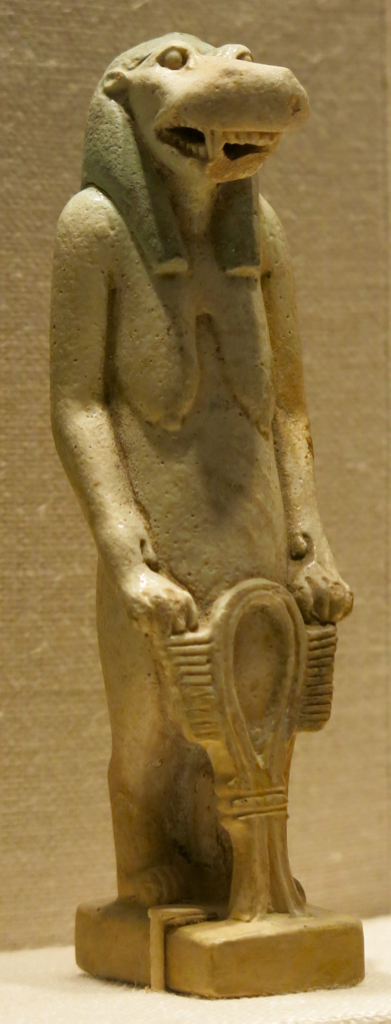
Taweret is one of the deities who was a fairly common presence in ancient Egyptian households. Sculptures of Taweret have the head of a hippopotamus and the body of a female human being, and the arms and legs of a lion (note 1); though of course the physical manifestations of ancient Egyptian deities were not thought to adequately represent the actual deity. Sculptures of her “held the attribute of the sa [an ancient Egyptian symbol of magical protection] in her hands and sometimes also the ankh or a torch, the flame of which was supposed to expel typhonic forces” (note 2).

A statue of Taweret would typically stand in a niche in a house, with perhaps an offering table. A Taweret sculpture might also be placed in bedrooms, to prevent sleeping humans from being assaulted by demons or ghosts. According to some accounts, she was married to the god Seth (note 3).

Below is a fine tiny sculpture of Taweret, made of faience sometime in Dynasties 26-30, now in the Boston Museum of Fine Arts (accession number 64.2252). She is holding the sa, and you can see her hippo head, human body, and lion limbs. She is fearsome enough to give you a measure of assurance that she will indeed protect you, as a household god should; but she also appears friendly enough that I would not mind having her in my household.

Taweret

Notes:

1. Garry J. Shaw, The Egyptian Myths: A Guide to the Ancient Gods and Legends (Thames and Hudson, 2014), p. 155.

2. Manfred Lurker, An Illustrated Dictionary of the Gods and Symbols of Ancient Egypt [Thames and Hudson, 1980/2006], English language edition of Gotter und Symbole der Alten Agypter, rev. and enlarged by Peter A. Clayton, p. 119.

3. Shaw, pp. 152, 158, 55.

Aphrodite

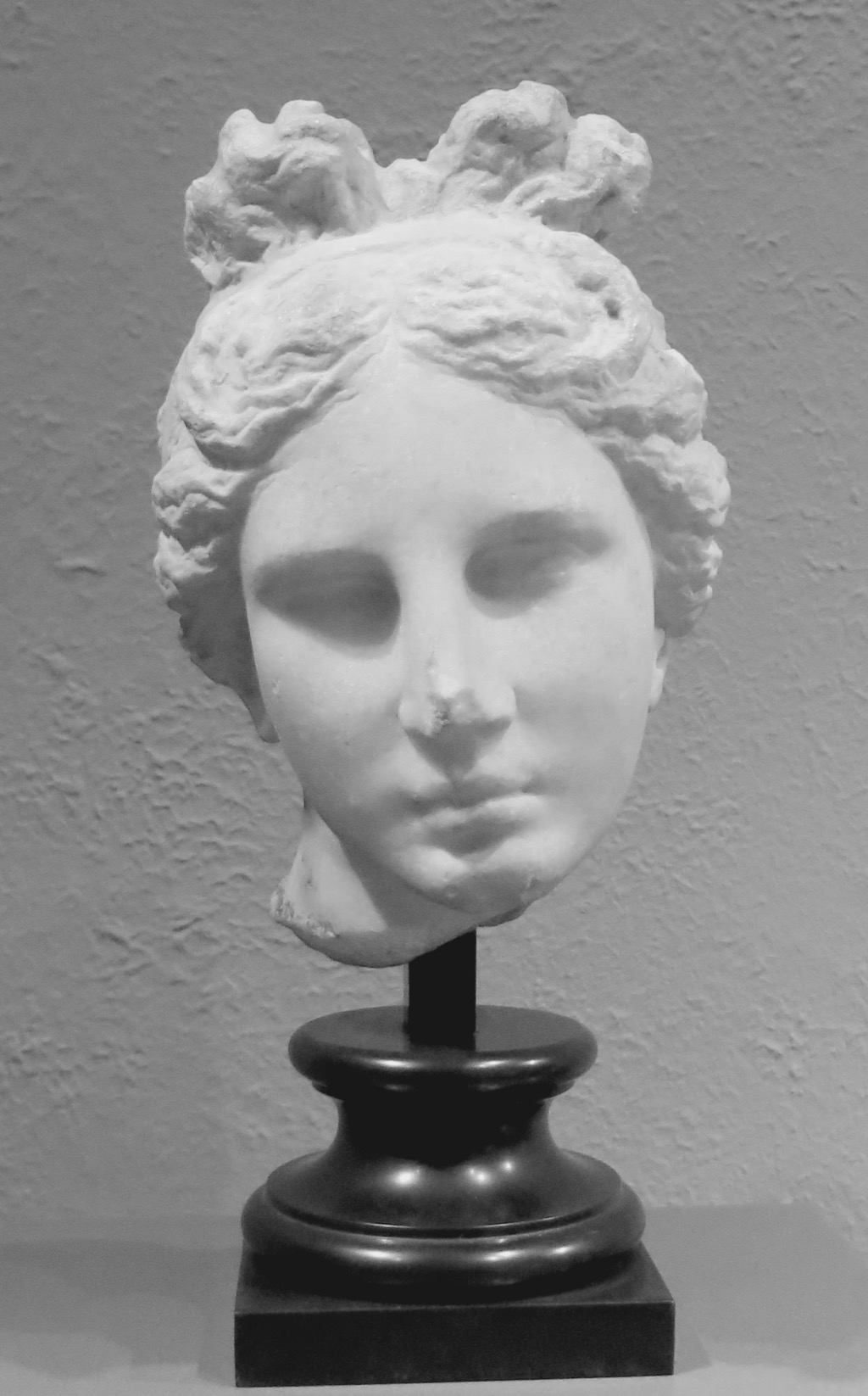
Aprhodite’s nature and deeds are well enough known that they don’t need to be repeated here. This head of Aphrodite, carved between 300 and 300 BCE, is sometimes called the “Bartlett Head.” It was once attached to a complete figure, and likely would have been part of a temple; many Greek sculptures from this era were painted. Now the temple and the rest of the figure are lost, and this isolated head is on display in the Boston Museum of Fine Arts. It is worth remembering that when we see religious art in museums, what we are seeing has been removed from its original religious setting and purpose, and put into a completely secular context where it has no purpose except to be gazed at for its presumed artistic beauty.

Aphrodite

Ma-ku

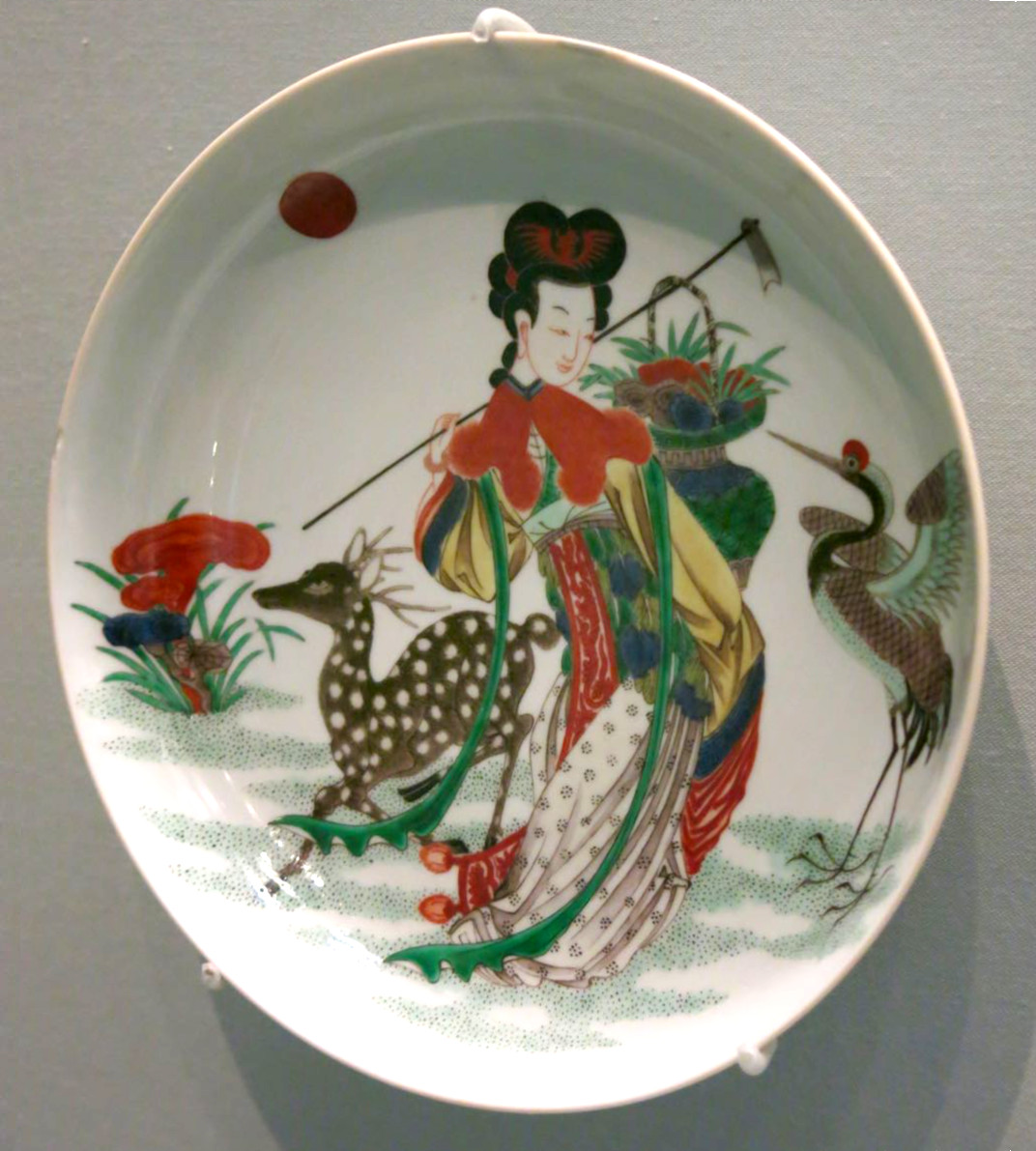
Ma-ku is a Taoist deity of longevity. In the image below, she can be identified by her hoe and a basket of the fungus of immortality. This Ching dynasty porcelain presentation dish was made sometime in the eighteenth century, and is now in the Asian Art Museum in San Francisco (accession no. B60P376):

Ma-ku

Today in the West, Ma-ku’s name is sometimes translated as “Hemp Maiden,” which has led a number of Westerners to misappropriate her as the patron deity of pot smokers; you can find plenty of Web sites that state this as an absolute fact. Note, however, the iconography of Ma-ku often shows her, not with marijuana, but with a basket of the fungus of immortality. And so, not surprisingly, other Western writers have jumped to the conclusion that Ma-ku is not the goddess of marijuana, but rather the goddess of psychoactive mushrooms. Obviously, psychoactive mushrooms do not produce longevity, but we Westerners do love to superimpose our own meanings on the gods and goddesses of other times and other cultures.

Rather than imposing Western values on Ma-ku, I’m more interested in learning her role and place in Chinese culture. I found it difficult to locate good solid information about Ma-ku in English. But Mesny’s Chinese Miscellany (1899), though not a scholarly work and probably biased by a colonial outlook, has a useful entry on Ma-ku under the general heading of Gods and Goddesses:

MA KU

Ma Ku: A Taoist immortalised female saint or Hsien Nu; a portrait of Ma Ku is very popular as an emblem of longevity, and is one of the very best presents a person can make to his superiors on the occasion of a birthday feast.

During my stay in Kuei-chou, I received several such presents, in the form of a portrait of Ma Ku with a pilgrim’s staff and a basket of flowers over her shoulder, the whole embroidered in fancy coloured silk floss, on a scarlet satin tablet some 8 or 10 feet long by about 3 feet wide.

Mayers writing of Ma Ku says that she is “One of the female celebrities of Taoist fable. She is said to have been a sister of the immortalized soothsayer Wang Feng-ping (see Wang Yuan), and like him to have been admitted into the ranks of the genii [i.e., the immortals]. It is related that once when Fang-ping revealed himself in the presence of Ts’ai Ching, whom he chose as his disciple and taught, by corporeal sublimation, to free himself from the bonds of death, the genii was accompanied by his sister Ma Ku, who appeared in the semblance of a damsel of eighteen or twenty, arrayed in gorgeous apparel, and who waited on her brother and his pupil with strange viands served in platters of gold and chrysoprase.

“The wife of Ts’ai Ching was newly delivered of a child, seeing which Ma Ku took some grains of rice and threw them on the ground, where they at once became transformed into cinnabar (the magic of the alchemists). Fang-ping seeing this exclaimed with a smile, ‘Sister, do you still indulge in child’s play?’ to which the damsel replied: ‘Since I have been our handmaid, thrice has the eastern sea become fields where the mulberry grows!’…

“Hence the Tsang Sang Chih Pien, signifying the cyclic revolutions of nature and cataclysms occurring upon the earth’s surface such as beings of immeasurable longevity alone are priveleged to witness more than once.” It is on this account that the image or portrait of Ma Ku is so highly prized by the Chinese as an emblem of extreme long life and happiness.

— William Mesny, ed., Mesny’s Chinese Miscellany: A Text Book of Notes on China and the Chinese, vol. III, (Shanghai: Shanghai Mercury, 1899), p. 286.


Ho Hsien-ku

Ho Hsien-ku [Pinyin: He Xian’gu] is one of the Eight Taoist Immortals (Pa-hsien, Pinyin Baxian), and the only one who is unambiguously female. Six of the other Eight Immortals are definitely male, though at least one source (W. Perceval Yetts, “Eight Immortals,” p. 805) notes that Lan Ts’ai-ho may be depicted by artists as gender-ambiguous.

These Immortals began as humans, and transcended their humanity to become more than human. They could not be classed as either God or saint in the senses of those words used in the dominant Western religious traditions; but given their immortality and their powers, I would class them as deities. “The Eight Immortals are a group of seven men and one woman who are said to have attained immortality inspired by each other, and who continue to serve humanity by appearing in seances and inspirations” (Livia Kohn, Daoism and Chinese Culture, [Cambridge, Mass.: Three Pines Press, 2004], p. 164).

Below the photograph, I’ll append a brief biographical account of Ho Hsien-ku by W. Perceval Yetts, from “The Eight Immortals,” The Journal of the Royal Asiatic Society of Great Britain and Ireland, (London: 1916), pp. 781-783 (endotes are Yetts’ own notes).
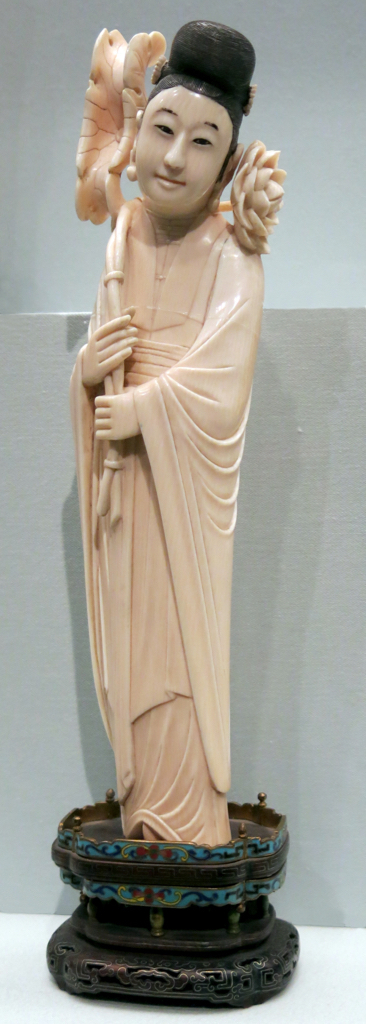
Ho Hsien-ku

Above: Ho Hsien-ku with a lotus, an ivory sculpture made between 1850 and 1911 (Ch’ing Dynasty) at the Asian Art Museum (accession no. R2005.71.47).


“Ho Hsien-ku,” from “The Eight Immortals by Perceval Yetts:

Ho Hsien-ku is shown as a comely girl sometimes dressed in elaborate robes, but more often wearing over a simple garment the leafy cape and skirt affected by the hsien [English: enlightened one, immortal]. A large ladle is her recognized emblem. Its bowl, made of bamboo basketwork, is often filled with several objects associated with Taoist immortality, e.g., the magic fungus (1) and peach; (2) sprigs of bamboo and of pine; (3) and flowers of the narcissus. (4) The place of the ladle may be taken by the more picturesque long-stalked lotus bloom; and sometimes she holds just a fly-whisk or the basket of wild fruit and herbs gathered for her mother.

Biography from Lieh hsien chuan [Collected Biographies of Immortals by Lieh-hsien chuan], ii, 32, 33:

Ho Hsien-ku was the daughter of Ho T‘ai, of the town of Tsêng-ch‘êng, in the prefecture of Canton. At birth she had six long hairs on the crown of her head. When she was about 14 or 15 a divine personage appeared to her in a dream and instructed her to eat powdered mica, (5) in order that her body might become etherealized and immune from death. So she swallowed it, and also vowed to remain a virgin.

Up hill and down dale she used to flit just like a creature with wings. Every day at dawn she sallied forth, to return at dusk, bringing back mountain fruits she had gathered for her mother. Later on by slow degrees she gave up taking ordinary food. (6)

The Empress Wu (7) dispatched a messenger to summon her to attend at the palace, but on the way thither she [Ho Hsien-ku] disappeared. (8)

In the ching lung period (about A.D. 707) she ascended on high in broad daylight, (9) and became a hsien. In the ninth year of the t‘ien pao period (A.D. 750) Ho Hsien-ku reappeared, standing amidst rainbow clouds over a shrine dedicated to Ma Ku. Again, in the to li period (about A.D. 772) she appeared in the flesh on the Hsiao-shih Tower at Canton.

NOTES

[These are W. Perceval Yetts’s own notes.]

(1) This, the most ubiquitous object in Chinese art, has received various botanical names. (See Bretschneider, “Botanicum Sinicum,” Journal of the Chinese British Royal Asiatic Society, vol. xxv, p. 40, and vol. xxix, p. 418.) Its branches expand into flattened umbilicated extremities with scalloped edges. It is probably largely because of the resistance its wood-like substance offers to decay that it has been adopted as the emblem par excellence of immortality. There are records of its supernatural qualities having been recognized as early as the third century B.C. (see Chavannes, Les Mémoires historiques de Se-ma Ts’ien, vol. ii, p. 176 seq.), and to the present day it is sold by native apothecaries as a drug capable of prolonging life.

(2) Any representation of the magic peach is a covert allusion to that enigmatical figure, Hsi Wang Mu, the Queen of Taoist Fairyland. Among the wonders of her mountain domain was the tree that bore but once in 3,000 years peaches the taste of which gave immortality.

(3) Bamboo and pine, being evergreen, are emblems of longevity.

(4) The name the narcissus bears is sufficient reason why it should be included in this category.

(5) For the meaning of [what is here translated as “mica”]: see note by Dr. Laufer in T‘oung Pao, vol. xvi, p. 192. Perhaps a parallel may be found here between the alchemy of China and the West. Talc, a mineral often confused with mica, figures prominently in the writings of mediaeval alchemists, and as late as 1670 it was advocated as a mysterious preservative of youth and beauty by the Apothecary in Ordinary to the English Royal Honsehold, N. le Febure by name, in his Compleat Body of Chymistry, pt. ii, p. 106 seq.

(6) One of the first steps on the road to hsien-ship. Taoists are often said to have given up the ordinary diet of cereals. Some gradually reduce their food till they die of starvation. So emaciated is their condition that their bodies after death become mummified, and thus they do actually attain a kind of corporeal immortality. Particulars of this aspect of Chinese eschatology are to be found in an article by the writer in The Journal of the Royal Asiatic Society for July, 1911.

(7) The notorious woman who, through the possession of an extraordinary personality and a genius for intrigue, rose from obscurity to become the supreme ruler of China during the latter part of the seventh century. See Mayers, Chinese Reader’s Manual, pt. i, No. 862; and Giles, Biographical Dictionary, No. 2331.

(8) I.e., Ho Hsien-ku eluded the envoy. Chinese legend abounds in instances of summonses to Court being sent to hermit sages and others who had cut themselves off from worldly affairs. The recipients have almost invariably shown a consistent contempt for mundane honors by refusing to comply, and imperial curiosity as to their reputed wisdom or powers of magic has remained unsatisfied.

(9) The actual period of the day or night when emancipation from earthly ties takes place and the final stage in becoming a hsien is completed is considered in Taoist lore to have a determining influence upon the subsequent career of the hsien. See, for example, the following passage from the Chi hsien lu: “When (after death) the body remains like that of a living man, the condition is that of release from the flesh, shih chieh; when the legs do not become discolored nor the skin wrinkled — that is shih chieh; when the eyes remain bright and unsunken, in no respect differing from those of a living man — that is shih chieh; when resuscitation follows death — that is shih chieh; when the corpse vanishes before it is encoffined, and when the hair falls off before the mortal body soars (to heaven) — both of these are shih chieh. Most perfect is the release that takes place in broad daylight, but less complete is the release that occurs at midnight. When it takes place at dawn or at dusk, then the persons concerned are relegated to a terrestrial abode” (i.e. they will not reach the celestial paradise, but remain in haunts of the hsien on earth, such as the K’un-lun Mountains, the Isles of the Blest, and the Five Sacred Hills).
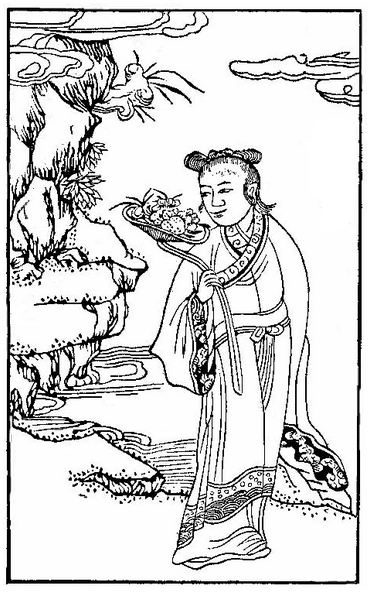
HeXiangu2

Above: Drawing of Ho Hsien-ku in Yetts, p. 781 (public domain image).

Tan’gun

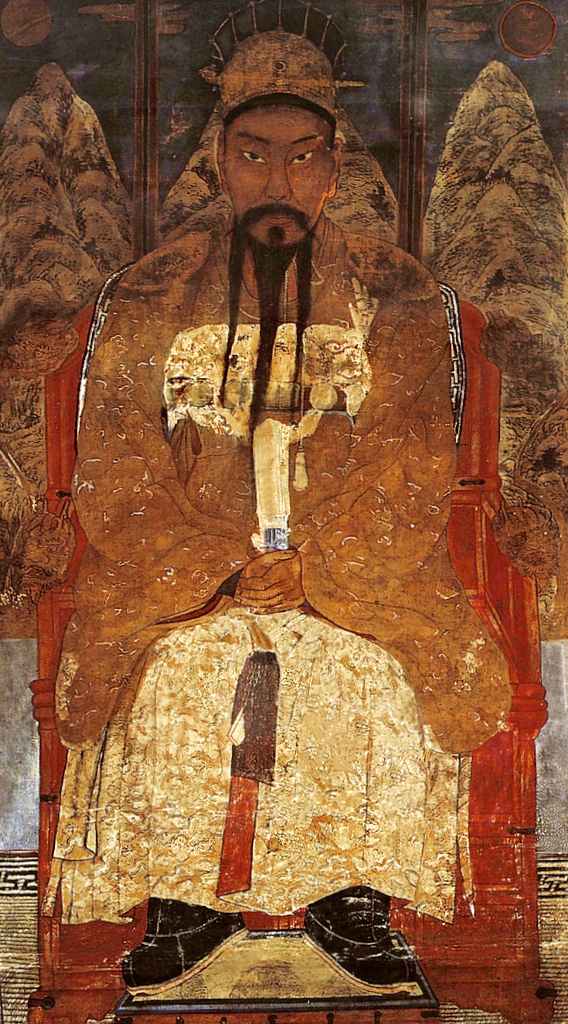
Taejonggyo, a new religious movement in Korea, worships Tan’gun, the legendary founder of the first Korean kingdom. The contemporary expression of Taejonggyo was founded in 1909 by Nach’ol, a Korean nationalist who was resisting the Japanese occupation of Korea. Nach’ol said that Taejonggyo had been the religion of Korea for some three thousand years before the importation from China of the foreign religions of Buddhism, Taoism, and Confucianism during the Mongol invasions of the 13th century (Don Baker, Korean Spirituality [University of Hawai’i: 2007], pp. 118-119).

“Taejonggyo (The Religion of the Great God) … claims that Tan’gun, the legendary founder of Korea, is the original founder of Taejonggyo, which was revived by Nach’ol in 1909. It claims that it embodies the national spirit and philosophy. Tan’gun is believed to be the god-man and the founder of Korea, and he is the object of worship in Taejonggyo. Taejonggyo was at the forefront of the anti-Japan independence movement during Japnese colonialism in Korea. As a result, its followers were persecuted severely by the Japanese authorities.” Oliver Leaman, Encyclopedia of Asian Philosophy (Routledge: 2006), p. 383.

Tan’gun is linked to National Foundation Day, or Gaechenonjeol, in South Korea: “Gaecheonjeol was made an official South Korean national holiday in 1909. The day is typically celebrated with public ceremonies, performances and speeches; government offices and many schools and private businesses are closed. … Ceremonies are held to honor Dangun [Tan’gun] at an altar of rocks he built at Chamseongdan, located at the top of Mount Mani…” (Korea Ye Web site). According to historian Don Baker, National Foundation Day was originally established by the Taejonggyo religion as a day to venerate Tan’gun (Baker, pp. 90-91).

Tan'gun, legendary founder of the first Korean kingdom

The image above is a public domain image of Tan’gun from Wikimedia Commons (I edited this image for legibility). Unfortunately, Wikimedia Commons does not tell us what painting this image comes from. If you search for additional images of Tan’gun on the Web, note that his name is sometimes transliterated as Dangun.

Ahura Mazda

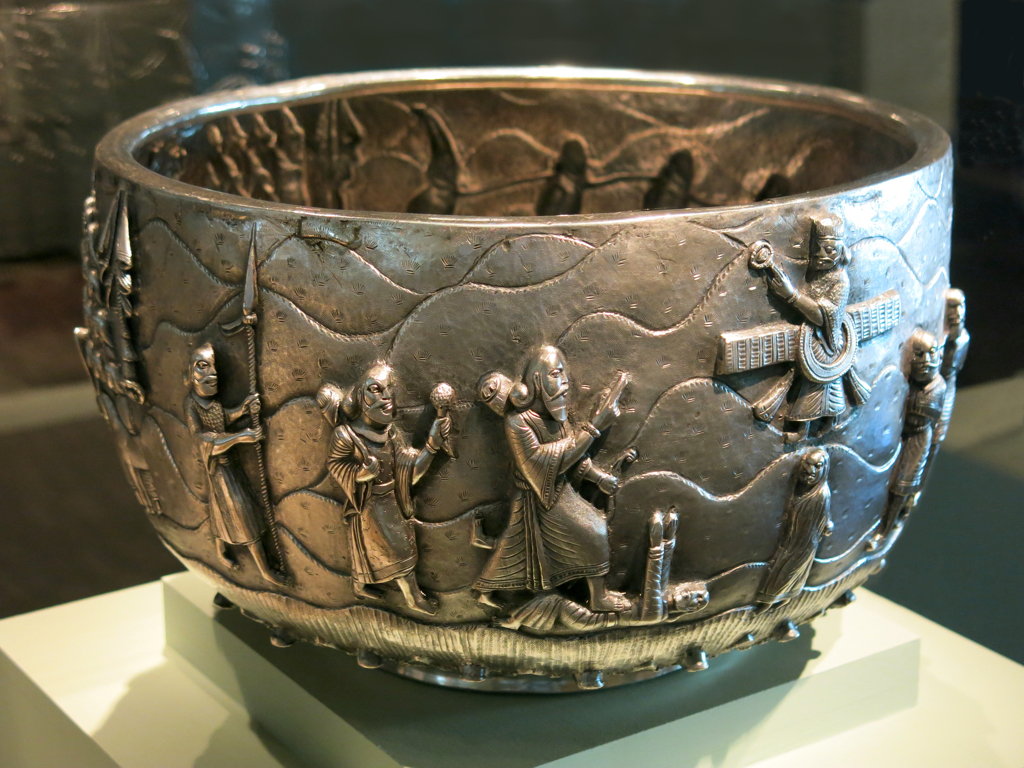
BlogOct3015

The supreme deity of the Zoroastrian faith, known as Ahura Mazda, is represented on this ceremonial bowl as a winged disk, at upper right in the photo. The bowl depicts the victory of the Zoroastrian Emperor Darius (550-486 BCE), with Ahura Mazda appearing as a presence near and above the emperor. The bowl was made in Burma in the last quarter of the nineteenth century, and is now at the Asian Art Museum in San Francisco (accession no. 2009.25).

Zoroastrianism is the oldest extant monotheistic religion. According to the Pluralism Project: “The one supreme and infinite God — Ahura Mazda — cannot be fully understood by humanity, [but] six attributes of Ahura Mazda were revealed to Zarathushtra. Known as the Amesha Spentas, they include Vohu Mana, the Good Mind; Asha, the divine law of righteousness, justice, and truth; Kshathra, the majesty and power of good dominion; Armaity, Ahura Mazda’s love and benevolent devotion; Haurvatat, well-being and perfection; and Ameratat, immortality. Humans must strive, both through reason and action, to emulate these attributes of God to live a good life.”

What’s a deity?

This week I’ve been posting images of deities. But what is a deity, anyway?

Here in the United States, popular culture has been heavily influenced by Protestant Christian culture, and so when we are asked to define a deity, we default to the concept of a monotheistic transcendent deity. If we have to draw a picture of this deity, we might either draw a picture of a man with a white beard sitting on a cloud, or say that this deity is transcendent and can’t be pictured.

However, most of the human race, for most of human history, has had a far more complex and nuanced understanding of deities. In our own Western cultural tradition, which extends back to the civilizations of Rome, Greece, and the ancient Near East more generally, we can find a great diversity of deities. Here’s a list of some of the categories of deity we can identify in the Western religious traditions:

• a single transcendent deity, e.g., the transcendent god of Xenophanes and other early Greek philosophers; God for some Jews; God the Father for some Christian sects
• a most powerful deity among other deities, e.g., Zeus in ancient Greece
• greater deities, e.g., the more powerful ancient Egyptian deities such as Horus, Osiris, and Ra
• lesser deities, e.g., the Titans in ancient Greece
• local deities, e.g., river gods, deities of a grove or forest, etc.
• household deities, e.g., the household gods of ancient Rome, etc.
• deified humans, e.g., the ancient Egyptian Pharaoh, Roman emperors deified after death, etc. (some might argue that the Virgin Mary of some Christian sects fits into this category)
• humans that are more than mortal but slightly less than gods, e.g., Herakles for the ancient Greeks, Jesus for the Christian followers of Arius, etc.
• humans with special powers who are worthy of veneration, e.g., canonized saints, sports figures and celebrities, etc.
• abstract concepts as deities, e.g., god as the unmoved mover in Aristotle, scientific method, financial success, etc.

These are just the first examples from the Western religious traditions that come to my mind. Then we can add in all the deities which are current in our increasingly multicultural world, such as the vast hierarchy of Hindu deities, the several Buddhas (who may appear as humans with special powers, but who may also appear as transcendent deities), ancestors who are venerated (as in some African traditions), deities as part of nature or tied to natural places (as with some Navajo deities), etc., etc.

I don’t believe we should accept without question the U.S. Protestant Christian definition of deity as a single transcendent god in whom one either believes or doesn’t believe. Humans in the U.S. today venerate a variety of deities, many of which look nothing like the U.S. Protestant transcendent God. And that veneration can take a variety of forms, from overt public worship to more covert forms of veneration. Given that, don’t you think that there is a lot more religion in the U.S. today than is captured by polls which ask whether people believe in “God” and attend “church”?

Kuan yin

Kuan yin (in Pinyin, Guanyin) is a deity with multiple identities, including multiple gender identities. According to the Lotus Sutra, the Buddha said, “If living beings in this land must be saved by means of someone in the body of a Buddha, Guanshiyin Bodhisattva will manifest in the body of a Buddha and speak Dharma for them.” And if someone needs to be saved by this boddhisattva, Guanshiyin, who is also known as Guanyin or Avalokiteshvara, will manifest him/herself in whatever form works best:

“If they must be saved by someone in the body of the wife of an Elder, a layman, a minister of state, or a Brahman, he [sic] will manifest in a wife’s body and speak Dharma for them. If they must be saved by someone in the body of a pure youth or pure maiden, he will manifest in the body of a pure youth or pure maiden and speak Dharma for them. If they must be saved by someone in the body of a heavenly dragon, yaksha, gandharva, asura, garuda, kinnara, mahoraga, human or non-human, and so forth, he will manifest in such a body and speak Dharma for them.” [trans. from City of Ten Thousand Buddhas Web site

Guanyin2

Above: “The Boddhisattva Avalokiteshvara (Chinese: Guanyin), 1300-1400 CE,” Asian Art Museum, catalog no. B61S37+

Guanyin also became a Daoist deity, a female immortal; one can chant a spell to the Daoist Guanyin “whereby one will accomplish unimaginable virtues, and give evidence to the penetration of the absolute.” (Guanyin mizhou tu)

Guanyin

Above: A Daoist Guanyin, adapted from Henrik Sorenson’s article “Looting the Pantheon.”

“The increasing Daoist appropriation and transformation of the Avalokiteshvara cult and the associated teachings which took place during the later imperial period, is also reflected in the mid-Qing work, the Guanyin xin jing bijue (‘Secret Explanation on the Heart Scripture of Avalokiteshvara’). This text, which to all appearances and purposes appears to be a Buddhist commentary on the Prajnaparamitahrdaya sutra, one of the most important and popular Buddhist scriptures in China, on closer examination turns out to be a Daoist commentary on the Buddhist sutra. In addition to its full-scale doctrinal modification, it casts Avalokiteshvara in the role as a female immortal (nuxian) from the Zhou dynasty (1122–255 BCE). … the level of appropriation [of Buddhist deities by Daoism] could, and often did, go well beyond superficial borrowing, ending with something akin to full-scale integration.”

— Henrik H. Sørensen, “Looting the Pantheon: On the Daoist Appropriation of Buddhist Divinities and Saints,” The electronic Journal of East and Central Asian Religions, vol. 1 (Edinburgh: Asian Studies at the University of Edinburgh, 2013), p. 62.