Hermes and the Woodman

Another in a series of stories for liberal religious kids. This story is one of Aesop’s Fables, ancient Greek tales dating from about 500 BCE. Aesop’s Fables typically get modernized, with morals that are borrowed either from Poor Richard’s Almanac, or from greeting cards or fortune cookies. Instead of completely modernizing this fable, I’ve tried to retain at least a little of the ancient Greek sensibility — so I left off the obvious moral, “Honesty is the best policy,” and instead used a more literal translation of the original moral. I also like the fact that this myth includes an actual Greek god.

A Woodman was chopping wood alongside a river, when his axe flew out of his hands and and was carried away by the swift current. The Woodman sat down on the riverbank and began to weep; for he earned his living with his axe, and what was he to do without it?

Hermes, the messenger of the gods, and himself the god of trade, merchants, roads, and many other things, saw the Woodman weeping, and took pity on him. The god’s winged sandals carried him to the riverbank, and he appeared before the Woodman. “Why are you crying, Woodman?” he said.

“I have dropped my axe in the river, and the swift current has carried it away,” said the Woodman.

Hermes went into the river, and emerged holding an axe made out of solid gold. “Is this your axe?” he asked. But the Woodman said it was not his. Hermes went into the river again, and this time brought up an axe made of solid silver. But again, the Woodman said it was not his.

Once more, Hermes went into the river, and this time brought up the Woodman’s axe. This time, the Woodman recognized his axe. Hermes rewarded the Woodman’s honesty by giving to him, not just his own axe, but the gold and silver axes, too.

When the Woodman told this story to his friends, one of them grew jealous. He decided to do the same thing as the Woodman. The jealous friend went to the riverbank, began chopping wood, and then let his axe fall into the river, where it was carried away by the swift current. He sat down and began weeping.

The god Hermes appeared and asked what had happened, and the man said that he had lost his axe in the river. Hermes went into the river and brought up an axe made of solid gold. Hermes asked if this was the axe he had lost. The man said happily, “Yes, this is it.” Hermes hated such shameless greed. The god kept both the golden axe, and also the axe the jealous man had dropped into the river.

This fable shows that the divine is in agreement with people who are just, and the divine is opposed to people who are unjust.

Sources: V. S. Vernon Jones, Aesop’s Fables: A New Translation (1912); Laura Gibbs, Aesop’s Fables: A New Translation, Oxford University Press (2002); and a machine translation of the ancient Greek text from the Chambry edition (no. 253).
Updated Greek Myths curriculum

I spent the last two days doing an update of the Greek Myths curriculum on my curriculum website.

Tessa Swartz, then 12 years old, and I developed this curriculum back in 2014. Teachers at the UU Church of Palo Alto did a field test in 2015, and I did a quick revision that year incorporating field test feedback. I was supposed to do a final edit the following year (2016), but that was the year my father died and I wound up dropping the project. Nevertheless, the curriculum continued in use at the Palo Alto church right up through the pandemic.

This final revision retains the same stories originally curated by Tessa and me in 2014. But the following changes were made: revised the lesson plans (some quite heavily); added more illustrations; upgraded existing illustrations; rewrote the introduction; and did an overall edit.

If you have any comments on the curriculum, please leave them here or email me.

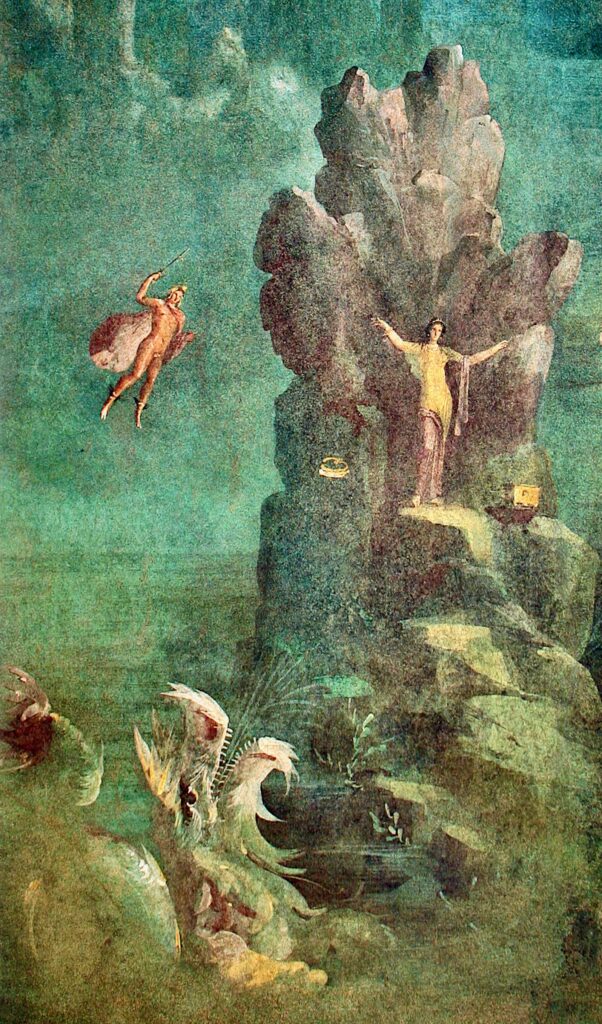
A woman chained to a rack cliff, with a sea monster below her and a man hovering above her.
A new illustration just added to the Greek Myths curriculum: Andromeda chained to the rock. This is a detail from a Roman wall painting of the first century BCE, from the Boscotrecase, Italy (public domain image).

Deity?

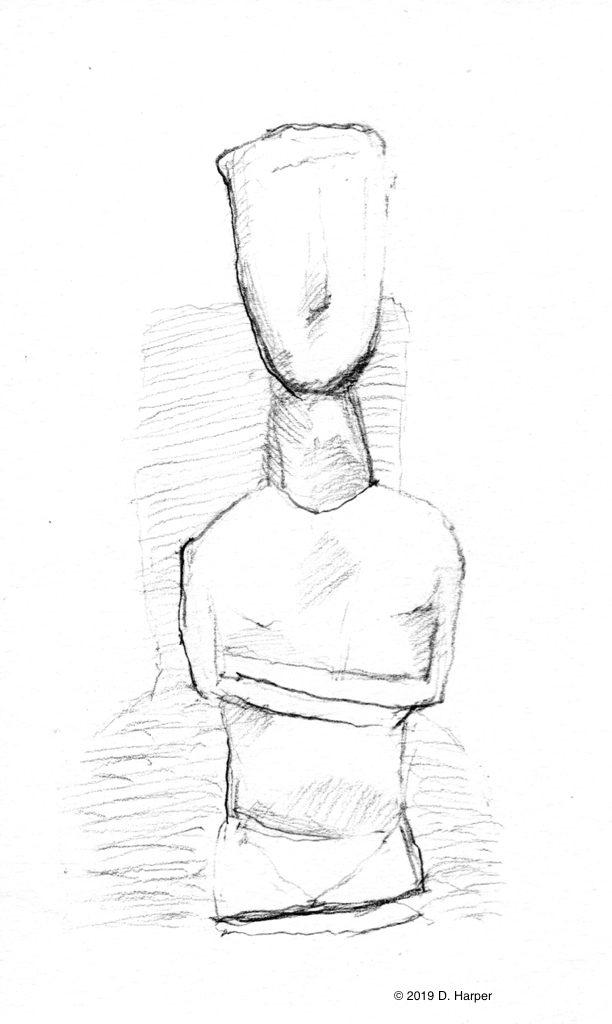
The DeYoung Museum in San Francisco has a number of Cycladic figures made thousands of years ago in what is now Greece. I was attracted to one of these figures, labeled as “Cycladic Figure, Early Cycladic II, Spedos variety,” dating to perhaps 2500 BCE, so I made a quick sketch of it:

This is a typical Cycladic figure of a woman with her arms crossed; it is made of white marble, though originally it would have been “painted with mineral-based pigments—azurite for blue and iron ores, or cinnabar for red.” There are those who assert that this type of figure represents a deity, perhaps the Great Goddess who may have been the chief deity of the ancient Greek world.

But of course there’s really no way to know what this figure represents. Is it a deity, or just a human figure? Or maybe something in between? Perhaps we would tend to call it a deity because the shape is so satisfying to look at; when we like looking at a piece of art it is tempting to think of that art as representing something beyond the mundane.

Aphrodite

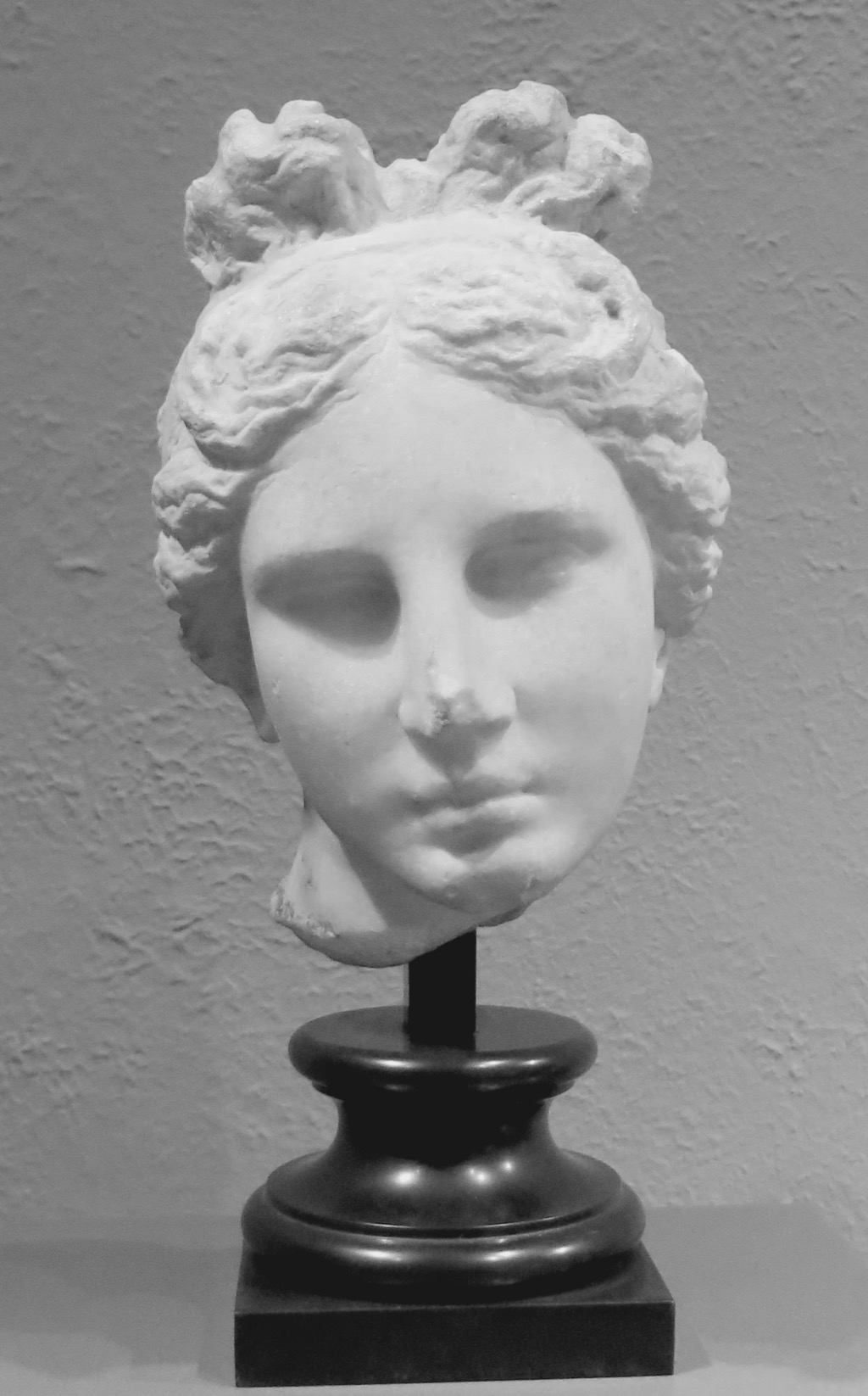
Aprhodite’s nature and deeds are well enough known that they don’t need to be repeated here. This head of Aphrodite, carved between 300 and 300 BCE, is sometimes called the “Bartlett Head.” It was once attached to a complete figure, and likely would have been part of a temple; many Greek sculptures from this era were painted. Now the temple and the rest of the figure are lost, and this isolated head is on display in the Boston Museum of Fine Arts. It is worth remembering that when we see religious art in museums, what we are seeing has been removed from its original religious setting and purpose, and put into a completely secular context where it has no purpose except to be gazed at for its presumed artistic beauty.

Aphrodite

What’s a deity?

This week I’ve been posting images of deities. But what is a deity, anyway?

Here in the United States, popular culture has been heavily influenced by Protestant Christian culture, and so when we are asked to define a deity, we default to the concept of a monotheistic transcendent deity. If we have to draw a picture of this deity, we might either draw a picture of a man with a white beard sitting on a cloud, or say that this deity is transcendent and can’t be pictured.

However, most of the human race, for most of human history, has had a far more complex and nuanced understanding of deities. In our own Western cultural tradition, which extends back to the civilizations of Rome, Greece, and the ancient Near East more generally, we can find a great diversity of deities. Here’s a list of some of the categories of deity we can identify in the Western religious traditions:

• a single transcendent deity, e.g., the transcendent god of Xenophanes and other early Greek philosophers; God for some Jews; God the Father for some Christian sects
• a most powerful deity among other deities, e.g., Zeus in ancient Greece
• greater deities, e.g., the more powerful ancient Egyptian deities such as Horus, Osiris, and Ra
• lesser deities, e.g., the Titans in ancient Greece
• local deities, e.g., river gods, deities of a grove or forest, etc.
• household deities, e.g., the household gods of ancient Rome, etc.
• deified humans, e.g., the ancient Egyptian Pharaoh, Roman emperors deified after death, etc. (some might argue that the Virgin Mary of some Christian sects fits into this category)
• humans that are more than mortal but slightly less than gods, e.g., Herakles for the ancient Greeks, Jesus for the Christian followers of Arius, etc.
• humans with special powers who are worthy of veneration, e.g., canonized saints, sports figures and celebrities, etc.
• abstract concepts as deities, e.g., god as the unmoved mover in Aristotle, scientific method, financial success, etc.

These are just the first examples from the Western religious traditions that come to my mind. Then we can add in all the deities which are current in our increasingly multicultural world, such as the vast hierarchy of Hindu deities, the several Buddhas (who may appear as humans with special powers, but who may also appear as transcendent deities), ancestors who are venerated (as in some African traditions), deities as part of nature or tied to natural places (as with some Navajo deities), etc., etc.

I don’t believe we should accept without question the U.S. Protestant Christian definition of deity as a single transcendent god in whom one either believes or doesn’t believe. Humans in the U.S. today venerate a variety of deities, many of which look nothing like the U.S. Protestant transcendent God. And that veneration can take a variety of forms, from overt public worship to more covert forms of veneration. Given that, don’t you think that there is a lot more religion in the U.S. today than is captured by polls which ask whether people believe in “God” and attend “church”?

Ancient Greek marriage laws and same-sex marriage

During the Supreme Court argument session on Obergefell v. Hodges, according to the transcription, Justice Alito had the following exchange with Mary Bonauto, Esq., representing the petitioners:

JUSTICE ALITO: But there have been cultures that did not frown on homosexuality. That is not a universal opinion throughout history and across all cultures. Ancient Greece is an example. It was ­­– it was well accepted within certain bounds. But did they have same-­sex marriage in ancient Greece?
MS. BONAUTO: Yeah. They don’t ­­– I don’t believe they had anything comparable to what we have, Your Honor. You know, and we’re talking about —
JUSTICE ALITO: Well, they had marriage, didn’t they?
MS. BONAUTO: Yeah, they had ­­– yes. They had some sort of marriage.

[p. 14 of the official transcript]

I have some interest in ancient Greek thought, and so I’d like to stop right there for a moment. What sort of concept of marriage did the ancient Greeks have, and is it something we would look to as analogous to our present-day concept of marriage? Continue reading “Ancient Greek marriage laws and same-sex marriage”

Medusa

I’m writing lesson plans and teacher resources for a curriculum for upper elementary grades on Greek myths. The core material in the curriculum was developed with Tessa Swartz, a middle school student who had taken classes with me where I piloted some of the preliminary material. Tessa proved to be a valuable collaborator, especially given her sensitivity to the essentially alien nature of Greek myths, and her willingness to go beyond the common trite interpretations of many of these myths. As we developed the core material of the curriculum, both of us got interested in the figure of Medusa. Here’s an excerpt from this new curriculum, a teacher resource on Medusa:

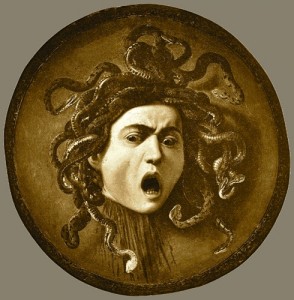
Medusa as imagined by the artist CarvaggioWhen we chose stories for this course, both of us placed the Medusa story at the top of our lists. What makes Medusa such a fascinating figure? The face of Medusa contains great power: the power to freeze others into stone. On the other hand, we considered Medusa’s killer, Perseus, to be little better than a bully, a strong-arm man who coerces others into doing what he wants through violence or the threat of violence. So the story of Medusa can lead to interesting explorations of power, and the use of power.
Let’s look at Medusa first: Continue reading “Medusa”

Epilogue: Demeter and Triptolemus

When Persephone returned to her mother from the underworld, and Demeter grew happy once more, she came back to Eleusis.

First Demeter showed Triptolemus and others how to conduct religious rites in her honor, and she taught them her mysteries. These mysteries filled mortal humans with awe when they were initiated into the cult of Demeter. And any one who was initiated into the Mysteries at Eleusis ever told about them, for deep awe of Demeter and the other gods and goddesses stopped them from speaking. Happy is the mortal among all humans on earth who has seen these mysteries; and those who are initiated into the religion may hope for better things when they finally die and go the underworld with Hades. As for those who were never initiated into the Mysteries of Eleusis — once they die, they could count on having nothing good down in the darkness and gloom of the underworld.2

Then Demeter had Triptolemus bring wheat to all humankind. She went to the stable where she kept her pair of dragons, also known as the Sacred Serpents. She harnessed them to her chariot, and drove from the stable back to Triptolemus. Demeter gave him seed to scatter all over the world, telling him to sow the seed partly in land that had never been farmed before, and partly in farm fields that had been lying fallow since the beginning of the famine.

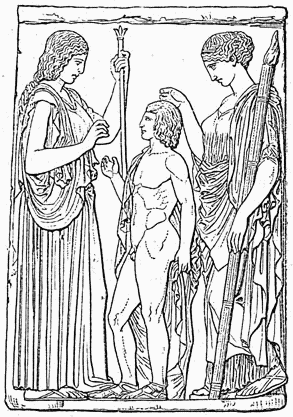
Demeter, Triptolemus, and Persephone

Above: Demeter, Triptolemus, and Persephone (l-r) celebrating the Eleusinian Mysteries. Demeter hands Triptolemus the sheaves of wheat, while Persephone blesses them. A 19th century drawing of a marble relief from 5th C. B.C.E. Continue reading “Epilogue: Demeter and Triptolemus”

Persephone and Demeter Meet Again

The fourth and final installment of the story of Demeter and Persephone.

Rich-haired Demeter still sat apart from all the blessed gods, wasting with yearning for her daughter Persephone. She caused a most dreadful and cruel year for humankind all over the earth.

The farmers and their oxen plowed the fields in vain. Farmers sowed seeds of the white barley, but the ground would not let the seed sprout. It seemed that Demeter would destroy the whole human race with cruel famine. And without humankind, the gods and goddesses who dwell on Mount Olympus would no longer receive the gifts and sacrifices that meant so much to them.

Zeus knew he must do something. First he called for golden-winged Iris, the goddess of the rainbow, to bring Demeter to Mount Olympus. Iris sped with swift feet to Eleusis, and found dark-cloaked Demeter in her temple.

“Demeter,” said Iris, “father Zeus, whose wisdom is everlasting, calls you to come join the tribes of the eternal gods. Come and do not ignore the command of Zeus, who rules over all the gods and goddesses.”

But Demeter’s heart was not moved, and she refused to go with Iris.

Then Zeus sent forth each of the gods and goddesses. They went to Demeter one after the other, offering many beautiful gifts, and godly rights and privileges.

But Demeter was still full of anger, and none of them could persuade her to go to Mount Olympus. Demeter said she would never set foot on fragrant Olympus, nor would she let food grow from the ground, until she saw her daughter again.

When all-seeing Zeus heard this, he called for Hermes, messenger of the gods, god of trickery and travelers and thieves. Zeus sent Hermes to the underworld, to convince Hades with soft words to allow Persephone come up from the misty gloom of the underworld, so that her mother Demeter might see her with her own eyes.

Hermes straightaway flew down to the underworld. He found Hades in his house, seated upon a couch, and his shy wife Persephone with him. Continue reading “Persephone and Demeter Meet Again”

What Doso Did with the Baby

Some years ago, I started working on a version of the story of Demeter and Persephone. For part one, click here. For part two, click here.

Doso immediately began her duties as a nurse, taking care of Demophoon, the infant son of Metaneira and Celeus. With Doso as his nurse, the child grew like some immortal being. This was because during the day, when no one was watching, Doso secretly anointed him with ambrosia, one of the foods of the gods. And as she held him at her breast, she breathed sweetly on him, and that too helped him to grow like an immortal.

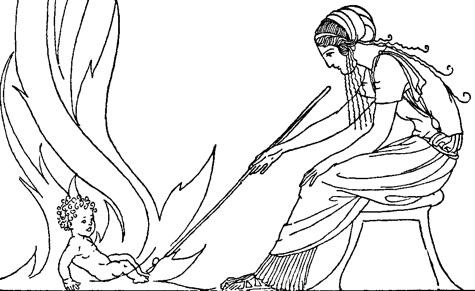
At night, when Metaneria and Celeus were fast asleep, Doso did something that required even more secrecy. She went to the hearth, where the fire burned all night, and placed Demophoon in the fire. Because she was a goddess, the fire did not hurt the baby. Instead, the fire worked a great wonder in the child, and he grew beyond his age, and his face looked like the face of one of the gods.

Not only that, but if a goddess can hold a mortal child in the fire night after night, eventually that child can become immortal, too. Doso loved the little boy, and hoped to hide Demophoon in the fire night after night, until he became deathless and unaging, just like her.

Demeter and Demophoon, by Willy Pogany

Demeter holding Demophoon in the fire, as imagined by artist Willy Pogany (public domain) Continue reading “What Doso Did with the Baby”