I am increasingly convinced that the pandemic is accelerating a number of trends that are going to change the way we do religious education in our local congregations fairly quickly. However, I don’t these trends should lead us to proclaim either the “post Sunday school era” or “the death os Sunday school.”
And before you get too excited (“Yay, the death of Sunday school!”) or too sad (“Nooo, I miss Sunday school!”), let’s look at a couple of the trends that affect religious education, trends that are being accelerated by the pandemic…..
First and foremost among current trends, most American congregations face looming financial difficulties. Staff costs continue to outpace inflation, driven in part by health insurance costs. Staff costs in Unitarian Universalist congregations are also under pressure because we expect our professional staff — both ordained ministers and lay religious educators — to have at least a four year college degree, and often three or more years of graduate study; staffers have to pay off their college debts, and that means they need relatively high salaries. Finally, there’s always Baumol’s Cost Disease: American congregations represent an “technologically stagnant sector” which means congregations experience “above average cost and price increases.” The amount each person gives to a congregation has to increase faster than inflation, just so the congregation can provide the same amount of services.
In the bustle of the pandemic, I almost forgot that the 250th anniversary of Universalism is celebrated today. This is the anniversary of the first sermon preached by John Murray.
Alas, too busy to say much about this now, but more on this soon!
Elizabeth Fisher, a stalwart of the UU Women and Religion movement, and author of the influential Rise Up and Call Her Name curriculum, has died. I learned about her death from David Pollard, who saw it announced on the UU Women and Religion Web site.
Rise Up and Call Her Name expanded the exploration of the feminine divine that had been begun in an earlier curriculum, Cakes for the Queen of Heaven. Rise Up expanded on Cakes by going well beyond the geographical regions that Cakes focused on, Europe and the Middle East; Rise Up included images of feminine divinity from a broad range of cultures, including many non-white cultures. Fisher also published The Circle Model of Shared Leadership, a book which offers group facilitation tools for shared leadership.
I mostly know about Fisher because of Rise Up and Call Her Name, which has had a significant impact on Unitarian Univeralism. I hope someone, somewhere, posts a broader appreciation of her life and work.
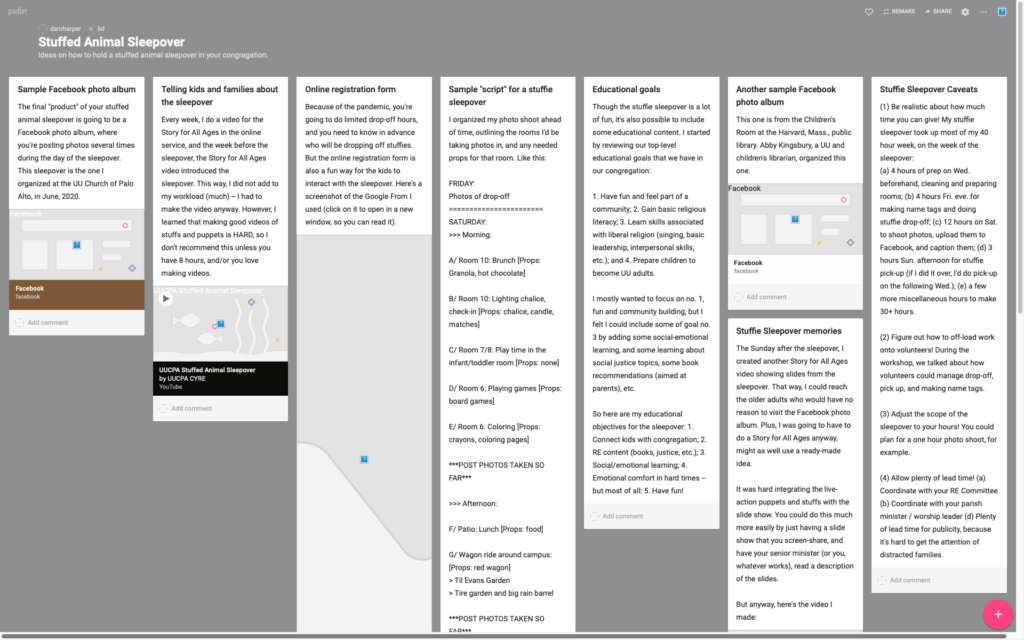
I’ve been looking for a way to extend our congregation’s asynchronous learning, and one of the online tools I’ve looked at is Padlet.com.
Padlet.com is basically an online interactive bulletin board. Some elementary school teachers use padlets to allow students to interact with a teacher presentation — kids can comment on teacher posts, and teachers can also allow kids to make their own posts. (An individual bulletin board is typically referred to as a “padlet.”) Some teachers also use padlets as parent communication tools.
I wasn’t excited or inspired by the gallery of examples on Padlet.com, but since it’s a free service, I thought I’d give it a try. It’s better than I thought.
While it’s hard to imagine that children or teens in a religious education program will voluntarily interact with a padlet — unlike elementary school teachers, those of us in religious education cannot complete students to use something with the threat of a bad grade — I feel that padlets could be useful parent communication tools, to help parents know know what’s going on in a class. I think padlets could work quite well to organize resources to share with adult education classes. And Padlet.com is fairly easy to use for volunteer teachers — there’s not much of a learning curve. Finally, Padlet.com is obviously better for a volunteer-run program like Sunday school than a learning management system like Google Classroom, which has a steep learning curve and requires domain email addresses for all users (who wants another email address?).
However, I don’t think Padlet.com offers much advantage over using existing tools — such as Google Drive — to organize resource materials and allow student interaction. I’m also annoyed because when I just logged on to a padlet I created for other religious educators, Padlet.com refused to display embedded content — see the screenshot below. This does not make me want to pay for a premium account, and if this is what end users are going to see, I’m definitely better off using a Google Drive folder. It also occurs to me that all my volunteers already know how to use Google Drive, and why should I make them learn how to use Padlet.com?
Maybe I’ll return to Padlet.com in the future, but at this point I’m not overly enthusiastic.
William R. Jones, UU theologian and one-time religious educator, pointed out may years ago that the myth of Prometheus serves as a useful counter to the myth of Adam and Eve. For Adam and Eve, rebellion is sinful; for Prometheus, “a response of rebellion is soteriologically authentic.” Although Jones considers the Prometheus myth to be important for humanists, I think Prometheus is important for anyone who is an existentialist — which means almost every Unitarian Universalist today, whether they are humanist existentialists, Christian existentialists, pagan existentialists, Buddhist existentialists,….
That means the myth of Prometheus should be an integral part of Unitarian Universalist religious education for kids. Here’s one attempt to make that happen, as several ordinary people go back in time to relive the myth o Prometheus:
Clicking on the image above will take you to the video on Youtube.
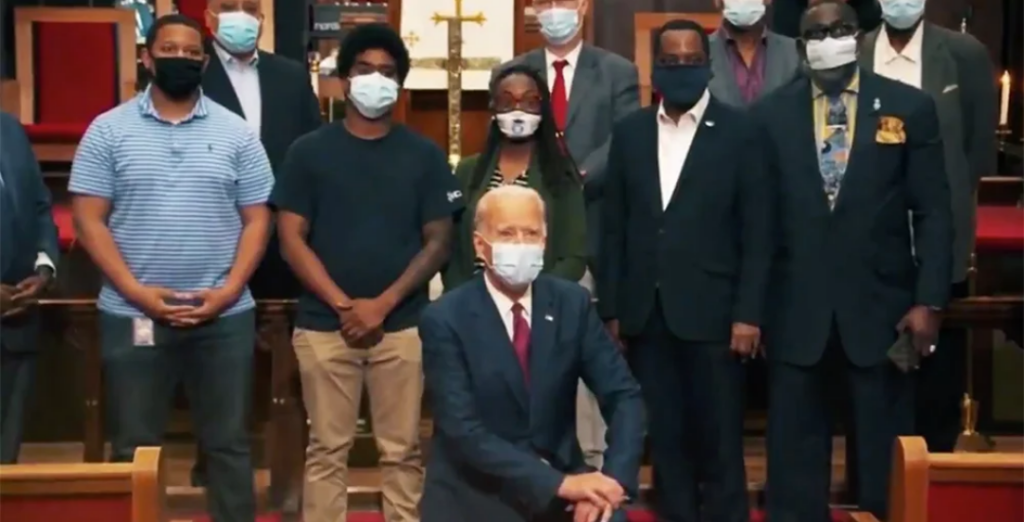
At the literal level, here’s what I see: a White presidential candidate kneeling in front of half a dozen Black men, at least one Black woman, and another White man. I see pews and a crucifix, so I assume that this is in a church, probably a Black church. It looks like a standard presidential campaign photo opportunity. I do wish they had practiced adequate social distancing, to set a good example.
As it turns out, according to Religion News Service (RNS), this is a video still from a video taken when Joe Biden visited Bethel African Methodist Episcopal Church in Wilmington, Del., not long after the death of George Floyd. According to RNS, Biden was at the church to talk about “racial injustice and police brutality before praying with those assembled.” So my literal reading of the photo wasn’t far wrong.
Campaign staffers for the Donald Trump presidential campaign would like to have you see this image in a different light. RNS reports that this video clip has been used to conclude a Trump campaign video which equates Joe Biden with civil unrest. I didn’t have the stomach to watch the video myself, so I will trust RNS when they tell me that immediately following the video clip showing Biden in a Black church, “words appear on the screen reading ‘stop Joe Biden and his rioters’ as Mike Pence declares ‘you won’t be safe in Joe Biden’s America’.”
Thus it appears that what the Trump campaign staffers who created this ad would have you see is something rather different from what I saw. It appears that what they want you to see is that Joe Biden and Black church leaders are dangerous. However, when the RNS asked this question of Donald Trump’s press secretary, this interpretation was categorically denied:
“Asked whether the ad meant to suggest there was something unsafe about Black churches or meeting with Black leaders in a church, Trump campaign deputy national press secretary Samantha Zager replied, ‘That’s absurd and it’s shameful to even make the allegation.’ When Religion News Service followed up to ask what, exactly, footage of the church visit was meant to imply, Zager did not respond.”
In spite of Zager’s denial, it’s clear to me that the intent of this advertisement is to allow people to complete an equation in their mind: dangerous rioters equals the Black church equals Joe Biden. There is also a clear effort to equate Joe Biden with rioters, and with those athletes who kneel during the national anthem. It also seems likely that this advertisement wants to imply that this White man, Joe Biden, will kneel down before Black men and women.
I had quite a few years of training in the visual arts, and I’m always impressed at the multi-layered messages that visuals in political campaign ads can evoke. And I’m cynical enough that it doesn’t surprise me that the Tump campaign is using racial fears to motivate voters; American politicians have been doing that for centuries now, often with great effect; why would a politician who’s hungry to be re-elected give up a tried-and-true campaign strategy?
But I am troubled that a good portion of the American electorate is still so susceptible to political manipulation through their racial fears that it makes it worth the while of unscrupulous politicians to manipulate the emotions of susceptible voters in this way. Someone thinks this may be a winning strategy for the Trump campaign, and they may well be right. All the elegant theories of White privilege and White fragility and White supremacy — these theories haven’t change the emotional make-up of a great many White Americans. Anyone with training in the visual arts knows that a few well-crafted images can easily bypass the most elegant of theories….
I suspect there’s a role here for artists, illustrators, film makers, video game designers, and other visually skilled people. The visual impact of a movie like “Black Panther” may make more of a difference than your average street protest. There may be a role for amateur artists, too, in flooding the interwebs with imagery that equates Black Americans with patriotism, honor, intelligence, serving the public good, and other politically positive messages.