Needles to Gallup

We checked out of the motel and went to get gas The service stations were all displaying prices of $4.70 a gallon, but we really needed gas so I filled the tank. A man in a blue uniform shirt and dark blue uniform shorts, like mechanics wear, walked by and looked at my tires. He bent down to look more closely. “Did you notice this tire is all split?” he said to me. I decided he wasn’t one of those mechanics who lie to you to promote their business: he was looking at the tire, not me; and his body language said that he was actually more interested in the car than in the person driving the car.

I drove the car into one of the bays in his neat and well-organized garage. He put the car up on his lift, and we looked at the tires. They were all pretty worn. “Jeez, and before I left, the dealer I go to said the tires were just fine,” I said. “Course I should’ve checked them myself.” He gave me a reasonable price on four new tires, and as long as it was up on the lift, I asked him to change the oil. He pointed that the the oil cap was cracked and though he didn’t have one on hand, I could probably get one in Kingman. And he added, “Are you going to drive that car for a while. Because if you are, when you get back those struts are looking pretty bad.” I asked if he could recharge the air conditioner, but he didn’t have the right fitting for such an old car. As we drove away, Carol and I agreed that he gave us a fair price, when he could have tried to rob us blind, and he seemed to be one of those guys who just like automobiles.

In Kingman, we found an auto parts store and got a new oil cap. They told us we could get the air conditioner recharged at Cobb’s, next to the freeway. “Ask for Adam, and say that Kevin sent you.” We pulled up. There were half a dozen old cars in various states of repair, a man working on the engine of a tow truck, a thirty year old old mobile home, and four guys sitting in the shade talking. They told me to bring the car around, and three of them sprang into action. The first man didn’t say much, just started working on our car; the second man, a young guy, helped the first man as best he could; the third guy started cleaning up. The place was pretty messy, the three guys were not what you’d call neatly dressed, but the man who was working on our car worked with no wasted motion, and radiated calm competence.

The fourth man, neatly dressed and maybe 75, told us about his trips up the Alaska Highway to go mining. “We used to get enough money to live on,” he said, “and that was when gold was 325, 350 an ounce. Now it’s up about fifteen hundred an ounce. I’d love to go back up there.” From the tone of his voice, you knew he didn’t think he’d be going back up. He told us stories about grizzly bears in Alaska until the car was done. The work was done before we knew it, I paid a very reasonable price, and we got ready to go. “See you in Alaska,” I said to the former miner. He grinned and said he guessed so.

From there we drove straight across Arizona, stopping at Seligman for lunch, at Flagstaff for an afternoon break, and then once at some place out in the middle of nowhere to change drivers. Carol pointed out a bag at the side of the exit ramp: some long distance driver had spent the night there, shit in a white plastic bag, and dropped the bag out of the truck. This is the sort of thing you know when you’re an expert in composting toilets and alternative wastewater management, because you know where the conventional wastewater disposal method doesn’t work.

The moral of the story: don’t pick up bags you might see lying on the ground at exit ramps.

Photo: Carol Steinfeld
At the Bagdad Cafe

It was getting late. We pulled in to Newberry Springs hoping to find a place to eat. We drove for a couple of miles and didn’t see anything, until there was a little place called the Bagdad Cafe. “Just like in the movie,” said Carol, and wondered if they had copied the name from the movie.

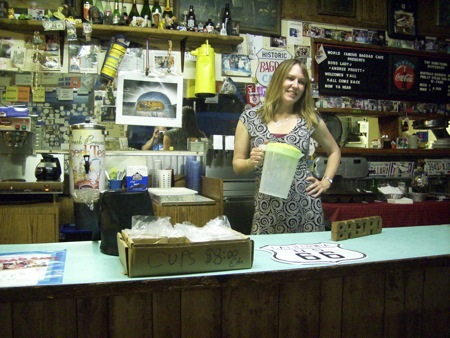
At first we thought it was closed, because the sign said “Open 7 – 7” and it was after seven, but the door was open, and the man said they were still cooking food. He showed us in to the back room where we met the owner of the Cafe; she was holding a sleeping toddler in her arms. Carol asked if they actually shot the movie here, and the owner said that yes they did, and there were the photos on the wall from when they did. We met Halo, the owner’s 16 month old great-granddaughter, ate dinner, and then the man who waited on us told us that everyone had to stand behind the counter to get their picture taken:

Tehachapi Loop

We stopped to buy some fruit along state route 58 over Tehachapi Pass. I found a postcard showing the Tehachapi Loop, a point where the old Southern Pacific (now Union Pacific) railroad line passes over itself as it ascends the grade through the Tehachapi Pass. And our map showed an overlook just off the highway where we could see the Tehachapi Loop.

We got off the highway, drove down a couple of miles of winding mountain road, and saw a couple of pull-offs, one on each side of the road. Two cars were parked there. A man and a boy in one of the cars looked at us as we drove up. Carol wondered aloud if they were having troubles and were hoping we could help them, but I wondered inside if maybe they were rail fans.

I walked over to the side of the road where I could see the Loop. The boy was clutching some radio or something to him, and I realized it was a scanner tuned to the railroad’s frequency. “Is there a train coming soon?” I asked him. “I see you’ve got a scanner.” He said there was, that it had just passed the nearest detector, and was getting close.

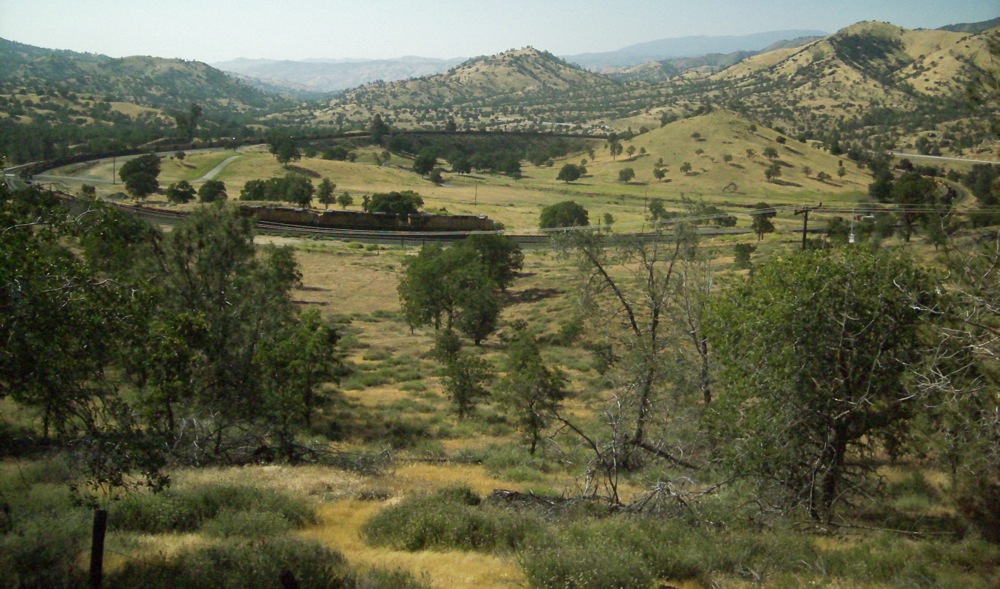
Pretty soon I could hear the locomotives; then I could see them; they looked to be three GE Dash 9s pulling a train of empty double-stack cars. The locomotives moved around the loop until they passed over the tail end of the train following on the track behind and beneath them. In the photo below, you can see the locomotives at the near point on the track, and to the far right you can see the nondescript-looking empty double stack cars on the loop behind and beneath them:

The boy was standing a little way down the road with his father, and an older man whom I assumed to be his grandfather. The father had a big videocamera. When the train had gone, I said, “Did you get a good video?” “Oh yeah,” he said, “not as good as some of my others because the cars were bare. When they have double-stacked containers, you can see it much better.” I told him we thought ourselves lucky because we just happened to show up at the right time as we were driving to North Carolina. We chatted for a minute. “Have a good trip,” said the grandfather as we all drove away.

Preparing for a road trip

We’re about to head off on a road trip across the country. Carol is stopping the newspaper and asking the neighbors to keep an eye on our apartment; I’m ironing and packing. Tomorrow we’ll start driving towards Charlotte, North Carolina, planning to arrive in time for General Assembly.

Along the way, I’ll spend the Friday and Saturday before General Assembly at the National Sacred Harp Convention, and that Sunday at the annual all-day singing at the Macedonia Church outside Section, Alabama. I’ll be at Ministry Days before General Assembly. At General Assembly, I’ll be reporting for the UU World Web site, and I’ll be making a brief appearance at workshop no. 3049.

If you’re going to be at any of those events, look for me — I’d love to say hi!

The most common marketing mistake

I’ve been reading Startup Guide to Guerrilla Marketing: A Simple Battle Plan for First-Time Marketers by Jay and Jeannie Levinson. It’s an excellent one-volume summary of basic marketing for smaller organizations. And it is worth reading if for no other reason than when you get to page 207, having gone over all the most basic and most effective marketing tools that exist, the Levinsons admit what anyone who’s worked in sales and marketing knows instinctively:

We hate to admit this in public, but… mediocre marketing with commitment is far better than brilliant marketing without it.

Then, in case you didn’t listen the first time, on page 208 they say:

You should know that a mediocre marketing program with commitment will always prove more profitable than a brilliant marketing program without commitment.

But alas…. Congregations are notorious for lack of commitment when it comes to marketing. Too many congregations think marketing consists of gorgeous advertisements and sexy PR, and a Web site makeover, once every two or three years. Not true. When you realize that neatness, telephone demeanor, and an honest interest in people are all marketing tools — that effective email, marketing calendars, and writing a benefits list are also all marketing tools — then you begin to realize that marketing involves constant, even obsessive, attention to detail, not just every Sunday, but every single day of the week, for years and years. Very few congregations have that kind of commitment.

And, not surprisingly, very few congregations are growing.

Underpants

During the religious education committee meeting tonight, one of the committee members was telling us about a bunch of five year olds hanging out in their underpants. It was a pretty funny story. When the story was done, I couldn’t resist bringing up the Anthony Weiner silliness — I said that while the American news media are saying that Weiner sent “sexually explicit” pictures of himself (which makes it sound important and serious), the BBC tells it like it is: Weiner sent underpants photo. He sent pictures of himself in underpants; not even five year olds would be that silly! We had a good laugh at Underpants Weiner, and moved on with the rest of the business we had to cover.

Green burials

Carol has a post on her blog about green burial at a Bay area “green cemetery.” I’m in favor of green burial myself, but as a minister I can tell you that it can be pretty difficult to avoid the default burial method of our society: embalmed body in the most expensive sealed casket you can afford, placed in a sealed concrete grave liner in a conventional cemetery, with the most expensive stone marker you can afford. Death and burial has been consumerized like everything else in our society: embalming and caskets are big business; and the funeral home industry is dominated by big chains that put profit margins before family desires. And green burial, which should offer cost savings, sometimes becomes just another marketing ploy. So if you’re hoping for a green burial, it’s best to start planning well in advance. The Funeral Consumer’s Alliance (FCA) has a pretty good brochure on green burial and a short FAQ on green burials. FCA also links to the non-profit Green Burial Council (GBC); I have no personal experience with GBC so can’t recommend them myself.

And I’d love it if any of my readers who have had personal experience with arranging a green burial would tell us about it in the comments.

From the big picture, to day-to-day operations

Below is a presentation I did at our Board retreat this morning. The presentation is titled, “How to take big-picture goals and spread them through every aspect of congregational life.” I’m posting this here both in case any of our Board members want to review some of the things I said, and in case any of my other readers are congregational leaders with an interest in this topic. (If you were there yesterday, you’ll see I didn’t follow this script exactly.) Continue reading “From the big picture, to day-to-day operations”

Duckling update

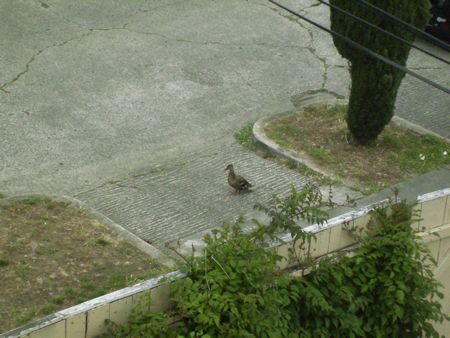
The Mallard who is nesting in the basement stairwell of our building had six ducklings two days ago. Carol has been supplying the mother and her ducklings with water and food (greens and rolled oats), but sometime yesterday two of them died of unknown causes. Just now I heard the mother quacking furiously, and I ran out onto our balcony in time to see a white-and-gray cat scramble up over the fence with two ducklings in its mouth. The mother duck followed the cat out to the street and kept quacking in the direction the cat disappeared.

Carol and I met one of our downstairs neighbors in the yard. We all looked down into the stairwell: the mother duck was there with just two living ducklings, and there was blood on the concrete path at the top of the stairs. While I’m sure the mother duck feels safe down in that cosy little stairwell, staying there means that her babies are (as Carol pointed out) sitting ducks for any cat hunting in the neighborhood.

Post script to cat owners: This was no feral cat that caught the ducklings; it was plump, well-fed, and clean, and obviously someone’s pet. I wish cat owners would keep their pets indoors:– it’s better for the cat, since indoor cats are far less likely to get feline AIDS, or to become coyote snacks;– and it’s much better for the birds of the neighborhood, who won’t become cat chow.

Further update: Carol finally called the Peninsula Humane Society & SPCA, who sent an animal control officer. It was pretty clear that in a neighborhood full of cats, the remaining two ducklings wouldn’t last another day. Olivia-the-Humane-Officer arrived at about seven in the evening; the mother duck flew away (apparently a common occurrence), so Officer Olivia had to take the two ducklings with her. In thanks, we made a donation to the Humane Society in honor of “all humane officers.”