Tonight I made an apple pie for Thanksgiving. It smelled good when it came out of the oven. We went out for a walk, and when we came back it still smelled good, so we each had a slice, and then I had another slice. Why wait until Thanksgiving to eat pie? It is now three eighths gone.
Palindrome day (sort of)
Today is another exciting day for a certain kind of geeky person who uses the U.S. convention of writing dates: a one- or two-digit number for the month, then a one- or two-digit day for writing the date, followed by a two-digit number for the year. Given that convention, today’s date is a palindrome: 11/22/11. There have been eleven other such palindrome dates this year: 1/1/11; 11/1/11 through 11/9/11; and 11/11/11. The last time we had such palindrome dates was in 2001: 10/1/01 through 10/9/01; 10/11/01; and 10/22/01. And of course we’ll have more such palindrome dates next year.
But palindrome days are less interesting than they might be, because they are dependent on conventions for writing dates that vary from place to place. In Europe, the convention for writing dates reverses the month and date. If you’re bored over the Thanksgiving holiday, you can figure out the palindrome dates for 2011 in Europe.
Update: UUpdater offers another way of looking at palindrome dates in a comment.
In case you forget…
2011 is a prime number year, which makes this a prime number year. The next prime number year will be 2017. That means we have just two prime number dates — when day, month, and year are all prime numbers — left this year: 11/23/2011 and 11/29/2011. Then we will have to wait until February 2, 2017, for another prime number date.
I figured I had better tell you in case you wanted to do something special on Wednesday, or a week from Tuesday.
Religious liberals and the Occupy movement
I’ve been reading Prophetic Encounters: Religion and the American Radical Tradition, the new book by Dan McKanan, the professor of Unitarian Universalist studies at Harvard Divinity School. McKanan points out that although we think of abolitionism, the New Deal, and the civil rights movement as separate movements, they are actually part of one continuous tradition of American leftist politics. McKanan also points out that religion has always been intertwined with the American tradition of radicalism — not that established religious institutions have embraced leftist politics in America, for no denomination or broad religious institution has done that, but rather that many American leftists have been deeply religious, and have drawn on their religious tradition for support and inspiration.
With that in mind, I was not surprised to learn that when Occupy Oakland was broken up by the police yet again last week, most of the 32 people who got arrested were at the Interfaith Coalition tent — including Unitarian Universalist ministers Jeremy Nickel and Kurt Kuhwald, and seminarian Marcus Liefert. (Jeremy even made the news in a small way: AP photographer Paul Sakuma snapped Jeremy’s photo as he stood handcuffed and surrounded by three police officers near the Interfaith Coalition tent.) Jeremy has been blogging about his participation in the Occupy movement, and his posts offer a good example of the connection between liberal religion (especially Jeremy’s Unitarian Universalist commitment to democratic process) and his leftist politics — just what Dan McKanan is talking about. Here’s Jeremy’s post about getting arrested — and here’s a follow-up post.
Fall foliage
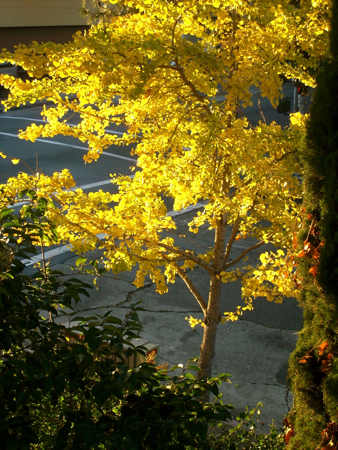
Gingko tree, from one of the windows in our apartment.
Free will and wickedness
Historically, religious liberals have affirmed the presence of free will in humans. For example, Unitarians reacted against the predestination of Calvinism by affirming that humans could choose whether or not to do good, and their choice would affect whether or not they would go to heaven; and, being optimistic folks, chose to believe that humans would mostly choose to do good. In another example, Universalists reacted against Calvinism by declaring that all humans would get to go to heaven — a kind of radical predestination, or determinism, if you think about it — but nevertheless here in this life humans still have the capacity to choose goodness or wickedness; and some Universalists also affirmed that those humans who chose wickedness while alive would undergo a limited period of punishment after death. The details may vary, but religious liberals have long affirmed that humans could chose freely between goodness and wickedness.
During the Social Gospel era, religious liberals came to understand that wickedness could exist outside of the individual in social structures and wider society; sometimes humans do wicked things not because they freely chose to do those wicked things but because they were embedded in a social structure that was wicked. However, the Social Gospelers had no intention of doing away with the possibility of individual wickedness; they merely wished to point out another possible locus of wickedness; they pointed out that there is even more wickedness in the world than we had previously thought before.
Under the influence of the Social Gospel, and later the influence of humanistic psychology, and then liberation theologies, we religious liberals have become increasingly aware of the wickednesses that exist in society. We have been so attentive to social wickedness that we sometimes neglect the possibility for individual wickedness. But wickedness must still exist in individual humans: as long as we affirm a belief in in free will, we humans will have the option, as individuals, to be wicked.
Another stupid church joke
The finance committee of First Unitarian Universalist Church of Aipotu was trying to develop a budget that would finally pull the church out of the red. One member of the committee presented a severe austerity budget. “If we follow this budget,” he said, “we can cut our operating expenses in half.”
The chair of the committee said, “I have an idea how we can live on less than that.”
“How?” everyone asked.
“Live on two budgets.”
Nah, couldn’t be…
A member of the our congregation forwarded a photograph his daughter took in her local WalMart. In the background of the photo you can see a nice ham, and in the foreground there’s a sign that reads:
Delicious for Chanukah
Boneless Smoked Ham
$6.29/lb
Oy gevalt.
A prolegomenon to ethics
Agatha Christie’s famous fictional detective Miss Marple once said:
“…The truth is, you see, that most people … are far too trusting for this wicked world. They believe what is told them [by other people]. I never do. I’m afraid I always like to prove a thing for myself.” — The Body in the Library by Agatha Christie
Miss Marple is not quite correct. In order to get along in the world, we simply have to trust that the way other people present themselves is basically truthful; it is too time consuming to do otherwise. Nevertheless, the world is a wicked place — there is a great deal of wickedness, from big systemic problems like the lack of morals in our financial institutions, to small personal problems like the way one individual can be hurtful to another without even thinking about it.
I don’t want to deny that there is much goodness in the world, but neither do I want to deny that wickedness is exists, and is widespread.
Major changes at the last minute
Excerpt from my teaching diary
The traffic sign over Highway 101 displayed an unwelcome message: “Left 3 Lanes Closed at Willow Rd Seek Alt Routes.” I sought an alternate route off the freeway, and arrived at church half an hour later than my planned arrival time, and only twenty minutes before class began. The goal of today’s lesson plan was to tell the children a little about the history of the flaming chalice, the unofficial symbol of Unitarian Universalism, and the lesson plan called the children to make flaming chalice of their own out of very small flowerpots. I went to where I knew we had a stash of very small flowerpots — and there weren’t any flowerpots there. Uh oh. Continue reading “Major changes at the last minute”