Another approach to fundraising

Looking for some new inspiration around fundraising? Amy pointed me to an article on the Nonprofit Hearts Web site titled “Asking Kindred Spirits for Money.” The author, Rich Snowdon, works as a coach for nonprofit leaders.

His approach to nonprofit fundraising aligns well with the approach to congregational fundraising set forth by Ed Landreth in his consulting practice, and in his book Fundraising with a Vision. As a former salesman, it’s what I’d call a soft-sell approach, emphasizing relationship-building over the long term, rather than squeezing the most money possible out of people in the short term.

The most useful part of Snowdon’s article may be the many hypothetical fundraising conversations he writes — what do you say to different kinds of donors? — where might those conversations go? It’s a long article, but definitely worth reading — to read it, click here.

Why UU youth programs suck

Our model for youth ministry in Unitarian Universalism sucks. The reasons why it sucks begin in our recent history, and in our current responses to the social changes going on all around us.

History first: Our model of youth ministry is an amalgam of three old models; none of the older models is particularly relevant to today’s world.

(1) First, there is the core model of youth ministry dating back to around 1900, when the Unitarian and Universalist denominations (along with many other denominations in mainline Protestantism) decided that persons in the age range of about 14 to about 20 had different religious and spiritual needs than adults — they did, that is, if their families were wealthy enough to keep them in school through their mid-teens; and since mainline Protestants were the ruling elite in the United States at that time, many mainline Protestant families were wealthy enough to keep their kids in school up to or even past the age of 16. By contrast, families in the Black churches and “ethnic” Catholic churches were less likely to keep their children in school up into their mid-teens, and those churches were less likely to have youth ministries that looked like mainline Protestant youth ministries.

This first model of Unitarian and Universalist youth ministry is rooted in entitlement and privilege that is based in unconscious membership in a religious elite that ruled the United States to serve its own purposes and values.

(2) The second layer of youth ministry emerged in the 1950s, when mainline Protestantism was at its peak in the United States. Continue reading “Why UU youth programs suck”

The year in review, pt. 1

It has not been a great year in liberal religion.

In one ongoing negative trend, most Unitarian Universalists continue to act as though we are part the ruling elite in this country. Mind you, as recently as the 1950s, Unitarian Universalists actually could claim to be part of the ruling elite. Back then, Unitarians and Universalists were considered mainline Protestants, and the United States was run by mainline Protestants, for mainline Protestants. And while the Universalists were marginal at best by the mid-twentieth century, the Unitarians could claim to have some real influence. Most notably, A. Powell Davies preached to a congregation containing a number of high-level functionaries in the federal government, as well as a few elected officials; and the Washington newspapers supposedly held their Monday morning editions until they could get the text of his Sunday sermons. Also worth noting: Adlai Stevenson II, Democratic presidential nominee in 1952 and 1956, was a Unitarian, as were a number of other politically influential people.

Today, however, the mainline Protestant coalition that long dominated the United States is crumbling, and Unitarian Universalists have moved themselves out of, and been pushed out of, mainline Protestantism. As a result, politicians either don’t care about us, or they can dismiss us since we represent such a tiny minority (about half a percent of the total U.S. population). As a religion, we have no real power or influence.

Yet we continue to act as if we do have political influence. The most blatant example of that was the “Justice General Assembly” in June of this year. A few thousand Unitarian Universalists from across the country went down to Phoenix, Arizona, and protested unjust and discriminatory state law. Sheriff Joe Arapaho of Maricopa County used our presence to bolster his carefully cultivated image with his voters — here come these out-of-state leftist hippies, telling me what to do, but I’m standing up to them! — and I’m sure our interactions with him did nothing to weaken his political position; indeed, our presence in Phoenix probably strengthened his political position. As far as our influence on state politics, I could find no evidence that we were even noticed — OK, we made it into the local newspapers, but honestly who cares about newspapers any more? In short, we’re doing social justice as if it’s 1955. Justice GA made us feel good, but had little positive impact beyond that.

On the other hand, there are some Unitarian Universalists who have moved beyond social justice c. 1955. For example, I continue to be impressed with the organizing efforts of groups like the Unitarian Universalist Legislative Ministry of California (UULMC). But UULMC represents a quite different approach to influencing politics — UULMC is a separate nonprofit organization that employs ministers who are not serving a local congregation, as well as other staffers, to do organizing around specific legislative issues. UULMC can not only build coalitions with other advocacy groups, it can use the skills and abilities of ordained ministers to influence legislators, without those ministers having their time and attention divided between politics and a congregation.

This approach to influencing public policy is significantly different from the 1950s approach in which Unitarians assumed they were part of the ruling elite and deserved special access; it’s also very different from the 1960s model of protest politics, where the grounding assumption was to disrupt the ruling elite. Justice GA remained mired in the 1950s and 1960s — you have to pay attention to us because we’re important! and — we’re going to be angry protestors just like in the 1960s! UULMC have moved forward into the very different realities of the 2010s.

Tomorrow: The year in review continues, with thoughts on why UU ministry to children and youth sucks

Best new song of the season

OK, this song came out on Jennifer Cutting’s 2011 album “Song of Solstice,” so it’s not exactly new. But it’s new to me this year, and I think it’s the best new Yuletide song I’ve heard in a few years.

The song is called “Light the Winter’s Dark,” and below you can find my take on the lyrics, from the singing of Coope, Boyes, and Simpson, the English a capella trio who usually sing traditional tunes. Yeah, the lyrics are a little preachy, but most sacred song is a little preachy. I can’t find the song on Youtube, but you can hear a brief preview of the tune on the CD Universe Web site here; or there’s a longer preview at the iTunes store.

Get the choir in your Unitarian Universalist congregation to sing this song next year…

Continue reading “Best new song of the season”

Moral law

Wayne LaPierre, chief executive officer of the National Rifle Association, offered an interesting statement yesterday in response to the mass murders at the Sandy Hook Elementary School in Newtown, Connecticut, a statement that reveals a coherent moral outlook. According to a report in the New York Times, LaPierre said, “The only thing that stops a bad guy with a gun is a good guy with a gun.” He therefore proposed providing armed security guards in every school in the United States. The report goes on to quote LaPierre as saying

Now I can imagine the headlines — the shocking headlines you’ll print tomorrow…. More guns, you’ll claim, are the NRA’s answer to everything. Your implication will be that guns are evil and have no place in society, much less in our schools. But since when did the gun automatically become a bad word?

This is only a partial exposition of this particular moral outlook. Zane Grey, popular author of Western novels, gave a somewhat more complete exposition of this morla outlook in his 1912 novel Riders of the Purple Sage. Towards the end of the chapter titled “Faith and Unfaith,” the gunman Lassiter is explaining to the heroine Jane Withersteen why he must keep his guns:

“Blind — yes, an’ let me make it clear an’ simple to you,” Lassiter went on, his voice losing its tone of anger. “Take, for instance, that idea of yours last night when you wanted my guns. It was good an’ beautiful, an’ showed your heart — but — why, Jane, it was crazy. Mind I’m assumin’ that life to me is as sweet as to any other man. An’ to preserve that life is each man’s first an’ closest thought. Where would any man be on this border without guns? Where, especially, would Lassiter be? Well, I’d be under the sage with thousands of other men now livin’ an’ sure better men than me. Gun-packin’ in the West since the Civil War has growed into a kind of moral law. An’ out here on this border it’s the difference between a man an’ somethin’ not a man. Look what your takin’ Venters’s guns from him all but made him! Why, your churchmen carry guns. Tull has killed a man an’ drawed on others. Your Bishop has shot a half dozen men, an’ it wasn’t through prayers of his that they recovered. An’ to-day he’d have shot me if he’d been quick enough on the draw. Could I walk or ride down into Cottonwoods without my guns? This is a wild time, Jane Withersteen, this year of our Lord eighteen seventy- one.”

For the character Lassiter, to be a man (not “to be human,” but to be a man) means being able to protect yourself, and implicitly to be able to protect women and children. According to Lassiter’s character, the Civil War caused a kind of moral vacuum — the Civil War meant the destruction of a way of life, the triumph of Northern industrial might over the South’s emphasis on honor and duty. Even “churchmen” carry guns, and kill people, denying that Christianity can offer an alternative moral outlook that effectively competes with the moral outlook that requires a man to carry guns.

Packing a gun continues to be a “kind of moral law” in the United States today. I find it hard to name another moral law in U.S. society today that is as compelling to as many people as packing a gun. LaPierre knows that he isn’t going to convince those of us who hold to a different moral law; but he also knows that his moral law of packing a gun attracts more adherents than any other single moral law.

This clash between moral outlooks, between moral laws, is not going to be over in the near future. And at the moment, the moral law of packing a gun remains stronger than any other alternative.

Decomposition theology

Jack sent Carol and me a link to a wonderful article titled “What if God were a maggot?” which outlines a theology of decomposers:

“You can choose who seems holy to you, godlike, a god even, but I’ll take the bacteria and other decomposers. I’ll take the vultures standing on rooftops and fences, raising their angular wings as if in some unchoreographed tribute to Martha Graham. I’ll take the dung beetle. I’ll even take the maggot. Anybody can celebrate a monkey or a panda; they are easy gods, worthy of a simple sort of worship, one of fences and nature reserves. The decomposers are harder. They are everywhere and they need to be, without them nothing would be reborn. Without them we would all be, like the Australians of yore, knee deep in feces and bodies. Without decomposers even the plants would eventually stop growing. Some gods are clever, some gods are beautiful, some gods — it has been said but not proven — are even merciful. You can have those if you want. As for me, I’ll take the maggot and the vulture. I’ll take the bacteria. I’ll even take the catfish rolling in the shallow stink of Techiman’s market, the catfish whose groping mouth reaches up like the afterlife, that tunnel through which, as the poet Yusef Komunyakaa reminds us, we must pass to get to some other side.” (Rob Dunn, Scientific American blog, “What If God Were a Maggot?” 20 December 2012)

Back in October, I mentioned Carol’s notion of “compost theology” in this blog post. Decomposition theology is compost theology as seen from a biologist’s point of view, where you look at specific species or clades; by contrast, compost theology takes an ecologist’s point of view, where you look at processes, cycles, and interrelationships.

Whichever point of view you take, I see all this as related to Universalist theology. Classic Universalist theology asserts that every human will be saved, i.e., every human will got to heaven after death. Compost theology asserts that every organism gets saved, i.e., every organism will decompose after death and its constituent elements reabsorbed into the Web of Life — and, according to theologian Bernard Loomer, the Web of Life was what Jesus intended when he said “Kingdom of Heaven.”

This, by the way, argues against the theology of Richard Dawkins, who says that immortality is achieved by an organism’s genes (The Selfish Gene). Dawkins takes a taxonomist’s narrow point of view, in which clades or species are most important. Compost theology, by contrast, argues that cycles and ecological relationships are of equal or greater importance to genes. Dawkins is a fundamentalist: it’s all about genes! Whereas we compost theologians are mystics: all is one, everything is part of an ecological unity.

“Innovation is not the holy grail”

A passage from the article titled “Innovation is not the holy grail,” by Christian Seelos and Johanna Mair, in the Fall, 2012 issue of Stanford Social Innovation Review (vol. 10, no. 4), interspersed with my comments:

We believe three oversights contribute to a tendency to concurrently overrate and undervalue innovation and to downplay the difficulties of enabling innovation in social sector organizations.

First, innovation is often perceived as a development shortcut; thus innovation becomes overrated. The tremendous value that is created by incremental improvements of the core, routine activities of social sector organizations gets sidelined. Therefore pushing innovation at the expense of strengthening more routine activities may actually destroy rather than create value.

The core, routine activities of the typical congregation are worship services, religious education for young people, and pastoral care. So for congregations, this would imply that innovations that sideline incremental improvements to these core, routine activities — which may include major building projects, social enterprises (i.e., ventures that make money), cafes, radically innovative worship services — may destroy value. And in fact, we’ve all seen this happen — building projects that result in decreased Sunday morning attendance, social justice projects that take so much energy that pastoral care is degraded, social enterprises that distract from the congregation’s primary mission. Continue reading ““Innovation is not the holy grail””

Five words on what you like about this season

Wynne, chair of the board, asked us each to introduce ourselves by giving our names, our roles, and then by saying “five words about what you like about this season.”

Being Unitarian Universalists who like to talk, none of us kept to the five word limit. Except Louis, who said:

“After apocalypse, days get longer.”

Kraut

A gloomy, rainy, chilly, enervating, soul-sucking December afternoon. Carol and I were sick of being stuck in the house doing chores, sick of short days and long dark nights. We went to Wisnom’s Hardware across the street and spent a long time buying five dollars worth of hardware, just so we could get out of the house. But eventually we had to go back home, and watch the world outside the windows turn ever grayer and darker.

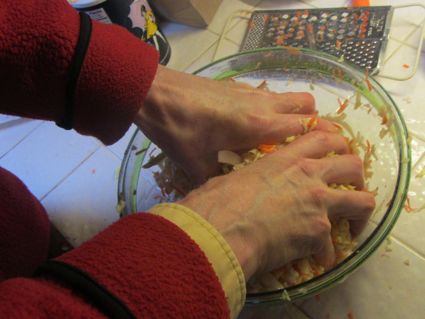
So we decided to make sauerkraut. I chopped a two-pound head of cabbage into thin strips, grated some carrots into the cabbage, and dumped everything into a glass bowl. We grabbed big handfuls of cabbage and carrots and squeezed hard to bruise them and begin to release their liquids (this was the best part; very satisfying):

I added five teaspoons of salt (two for each pound of cabbage plus one far the carrots), and mixed it in. We smushed the mixture down with a plate until the liquid rose up over the vegetables: Continue reading “Kraut”