
Trying to make sense

How do we make sense out of the recent school shootings?

The Unitarian side of our heritage gives us a strong belief that we can control our own destiny. Instead of assuming that God will bail us out of tough situations, we believe it’s up to us humans to make the world a better place. However, this belief seriously challenged by a senseless act of violence: for although the level of violence has been declining steadily in Western societies over the last few centuries, nevertheless horrific acts of violence still occur. We have less control over life than we’d like to believe.

The Universalist side of our heritage gives us a strong belief in the inherent worth and dignity of every person (that’s what universal salvation was all about, that every human is worthy of be saved). But this belief is seriously challenged by mass murderers. Intellectually, we might be willing to assert that yes, even mass murderers have inherent worth and dignity, but emotionally we can’t help thinking that a mass murderer is not quite human, and neither worthy nor possessing dignity.

Another common theological resource we have for making sense of such senseless and horrific events is existentialism: the belief that the world is absurd and senseless, with no inherent meaning or purpose; that whatever meaning or purpose comes from the way we act in the face of life’s absurdities; and even if we do the right thing, our reasonable and moral actions might still lead to evil consequences. For some Unitarian Universalists, existentialism provides no comfort, since it challenges our belief in reason and our belief that we can have quite a bit of control over life. But many Unitarian Universalists over the past seventy or eighty years have appreciated existentialism as confirmation of their perceptions of the world: that it is an absurd world with no inherent meaning, and we do what we can to make meaning out of the absurdity. Continue reading “Trying to make sense”

Xmas jokes

I always need clean Christmas jokes, the kind of thing you can tell to a fifth grader. Philip came through for me in a big way this year. Below are some of the jokes he passed along to me. As the reindeer comedian said, These will sleigh you!

What do elves learn in school?
The elfabet.

How many letters in the elfabet?
Only twenty-five, because of Noel.

What do you get when you cross a snowman with a vampire?
Frostbite.

What do psychiatrists call someone who is afraid of Santa?
Claustrophobic.

Little boy: “Mom, can I have a dog for Christmas?”
Mother: “No, you’ll have turkey like everyone else in the family.”

Mother: “What’s the best thing to put into a Christmas cake?”
Little girl: “Your teeth.”

Little boy: “Teacher, what do you call Santa’s helpers?”
Teacher: “Subordinate Clauses.”

OK, that’s the last joke. You can stop groaning now.

The golden hour

We’ve been having a lot of rain and clouds in the Bay area recently, and Carol and I have really been noticing the effect of the shorter days and longer darkness. By three thirty in the afternoon, we begin to feel a little gloomy, and we get gloomier as sundown approaches.

Some years ago, I was visiting my Aunt Martha and Uncle Bob in the autumn, at the time of year when you really begin to notice that the days are growing shorter. As sunset approached, I mentioned something about not liking the loss of daylight.

Aunt Martha looked out the window, and said, “Your uncle and I call this the Golden Hour.” And indeed, outside the window the sky was becoming golden.

Uncle Bob got up and said, “We usually have tea right about now. Would you like some?”

I helped him in the kitchen. Then we all sat down to tea and snacks while we talked about family and current events and anything else that came to mind. I felt my mood perceptibly lightening.

Earlier this autumn, I happened to remember that visit with Aunt Martha and Uncle Bob, and now I have taken to thinking of that late afternoon hour as the Golden Hour. And if I’m at home with Carol, I’ll turn to her and say, “Want me to make some tea?” She always says yes, so I make some tea. Soon we sit down to tea and snacks, and we both feel our moods perceptibly lightening.

The season of waiting

At the Starr King Unitarian Universalist Church in Hayward, California, the director of religious education, Darcy Baxter, and the parish minister, Katie Kandarian-Morris, recorded a series of short video messages that give a Unitarian Universalist response to this question.

Here’s what they did: Darcy got the children at Starr King to write down their thoughts on how to be patient during Advent. The children wrote these thoughts inside cards, the outside face of which they then decorated. Darcy hung these cards on a bulletin board so that they look like an Advent calendar.

Now Darcy and Katie are recording a video for each day of Advent. Each video begins with Darcy reading one child’s suggestion of how to be patient. Katie and Darcy talk briefly about the suggestion, and then Katie reads a prayer or mediation for the day. Each video is only about two minutes long, but taken together they form a sort of video Advent calendar.

My favorite suggestion of how to have patience: clean the house. This is in fact what I do when I am trying to be patient. What a great way to utilize social media to extend the reach of a congregation’s ministries!

Advent reflection for December 6:

Continue reading “The season of waiting”

Jingle Bells

So James Pierpont, the guy who wrote “Jingle Bells,” was a Unitarian, and worked as the music director at the Unitarian church in Savannah, Georgia, before the Civil War — and before that church has to close down because it leaned strongly Abolitionist. But “Jingle Bells” is not in any Unitarian Universalist hymnal. If you want to sing it during a Sunday service, here’s an arrangement laid out on a half-letter-size sheet, that you can stick into the typical order of service:

Jingle Bells (PDF)

(This arrangement is from an early edition of Pierpont’s sheet music, available online at the Library of Congress.)

Supreme Court will hear Prop 8 appeal

The Supreme Court has announced that it will hear the appeal regarding the lower court decision to strike down Proposition 8, which repealed same-sex marriage in California.

So there will be no free weddings at the Unitarian Universalist Church of Palo Alto — at least not until June, 2013, assuming the Supreme Court upholds the lower court’s ruling.

73 DE W1CUA

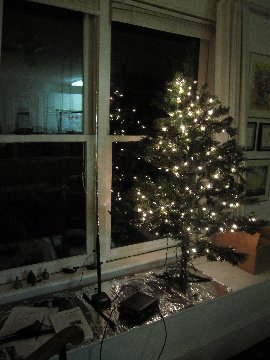
Here’s Dad’s Christmas tree:

This requires a bit of explanation. The aluminum foil under the tree is a nice Christmas-y touch, looking a little like ice and/or snow. But it’s also the ground plane for the vertical antenna for Dad’s 2 meter rig 40 meter rig — you can see the antenna sparkling in the lights just to the left of the tree.

This is about as cool as Christmas decorations can get.

Free weddings in Palo Alto, if Prop 8 goes down!

If the Supreme Court declines to hear the appeal on the lower court’s ruling overturning Proposition 8, same-sex marriage will be legal again in California. And if that happens, the Unitarian Universalist Church of Palo Alto (www.uucpa.org) will offer free weddings for one day about a week after the Supreme Court announcement — we’re saying about a week afterwards, because it’s unclear how long it will take Santa Clara County clerks to issue marriage licenses. The deal goes for opposite-sex couples, too.

We can’t set a firm date yet, for obvious reasons. In the mean time, please help spread the word — if Prop 8 goes down, we’ll do free weddings for a day!

Quotation on congregational decline

I ran across the following in the notebook we hand out to Committee on Ministry members.

Staffing for growth

1 program professional for every 100 active members [active members defined as average Sunday attendance]
1 support FTE [full time equivalent] for the first program professional; 1/2 FTE for each subsequent professional
Ministerial interns don’t count in the equation

“If you staff below maintenance level, I can promise you that you will decline. And if you staff above the staffing for growth level, you will probably decline as well. Not having enough to do leads to low performance levels.”

Unfortunately, the quotation is given without an attribution. Search engines don’t turn up anything with quite this wording. Anyone have any idea where this comes from? I’d love to know, because it’s such an interesting assertion — that your congregation will decline if you have too many program and support staff.

Did God really say THAT?!

Chris Schriner has started writing a new blog titled “Did God Really Say THAT!? A Blog about the Bible.” Chris decided he wanted to take on Biblical literalism, so that’s what he’s writing about on his new blog. Chris is learned, funny, and provocative. He’s also a former psychotherapist, and a humanist who is sympathetic to theists. Who better to write such a blog? In his most recent posts, he’s been taking on capital punishment in the Bible, like the following words spoken by God in Exodus 20.15: “Whoever strikes his father or his mother shall be put to death.” Wait, did God really say that? If so, as Chris points out in one post, then there are going to be a lot of toddlers on death row.

So what are you waiting for? Go join the fun by clicking here.