Persephone and Demeter Meet Again

The fourth and final installment of the story of Demeter and Persephone.

Rich-haired Demeter still sat apart from all the blessed gods, wasting with yearning for her daughter Persephone. She caused a most dreadful and cruel year for humankind all over the earth.

The farmers and their oxen plowed the fields in vain. Farmers sowed seeds of the white barley, but the ground would not let the seed sprout. It seemed that Demeter would destroy the whole human race with cruel famine. And without humankind, the gods and goddesses who dwell on Mount Olympus would no longer receive the gifts and sacrifices that meant so much to them.

Zeus knew he must do something. First he called for golden-winged Iris, the goddess of the rainbow, to bring Demeter to Mount Olympus. Iris sped with swift feet to Eleusis, and found dark-cloaked Demeter in her temple.

“Demeter,” said Iris, “father Zeus, whose wisdom is everlasting, calls you to come join the tribes of the eternal gods. Come and do not ignore the command of Zeus, who rules over all the gods and goddesses.”

But Demeter’s heart was not moved, and she refused to go with Iris.

Then Zeus sent forth each of the gods and goddesses. They went to Demeter one after the other, offering many beautiful gifts, and godly rights and privileges.

But Demeter was still full of anger, and none of them could persuade her to go to Mount Olympus. Demeter said she would never set foot on fragrant Olympus, nor would she let food grow from the ground, until she saw her daughter again.

When all-seeing Zeus heard this, he called for Hermes, messenger of the gods, god of trickery and travelers and thieves. Zeus sent Hermes to the underworld, to convince Hades with soft words to allow Persephone come up from the misty gloom of the underworld, so that her mother Demeter might see her with her own eyes.

Hermes straightaway flew down to the underworld. He found Hades in his house, seated upon a couch, and his shy wife Persephone with him. Continue reading “Persephone and Demeter Meet Again”
What Doso Did with the Baby

Some years ago, I started working on a version of the story of Demeter and Persephone. For part one, click here. For part two, click here.

Doso immediately began her duties as a nurse, taking care of Demophoon, the infant son of Metaneira and Celeus. With Doso as his nurse, the child grew like some immortal being. This was because during the day, when no one was watching, Doso secretly anointed him with ambrosia, one of the foods of the gods. And as she held him at her breast, she breathed sweetly on him, and that too helped him to grow like an immortal.

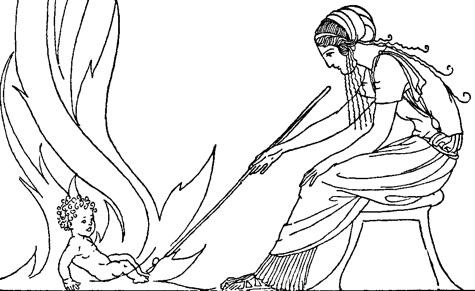
At night, when Metaneria and Celeus were fast asleep, Doso did something that required even more secrecy. She went to the hearth, where the fire burned all night, and placed Demophoon in the fire. Because she was a goddess, the fire did not hurt the baby. Instead, the fire worked a great wonder in the child, and he grew beyond his age, and his face looked like the face of one of the gods.

Not only that, but if a goddess can hold a mortal child in the fire night after night, eventually that child can become immortal, too. Doso loved the little boy, and hoped to hide Demophoon in the fire night after night, until he became deathless and unaging, just like her.

Demeter and Demophoon, by Willy Pogany

Demeter holding Demophoon in the fire, as imagined by artist Willy Pogany (public domain) Continue reading “What Doso Did with the Baby”

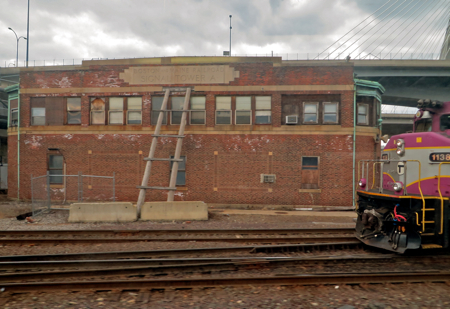
Signal Tower A, near North Station, Boston

Signal Tower A, Boston

I’m in the Boston area for my dad’s 90th birthday. While taking the train out to South Acton from Boston, I took this photo of the old Boston and Maine Railroad Signal Tower A near North Station. At right, you can see the nose of MBTA locomotive 1138 — one of the T’s many EMD GP40s — pulling a commuter train out from North Station, probably headed to Rockport (the Rockport train departed at the same time as the South Acton train).

More on Multimedia Era curriculum kits

I’ve been trying to figure out why I’ve grown so interested in the multimedia curriculum kits produced by the Unitarian Universalist Association from 1964 to about 1990. I was first attracted by the integration of texts, audio recordings, and visual materials. But I realized I am also attracted by the existential educational philosophy. And I am attracted by the experimental nature of many of the curriculum kits.

First, some historical background: Continue reading “More on Multimedia Era curriculum kits”

“Multimedia” curriculum

I’m on study leave, in the archives of Meadville/Lombard Theological School, looking at curriculum kits published by the Unitarian Universalist Association under the editorship of Hugo “Holly” Holleroth, during the so-called “Multimedia Era” (c. 1968-1987).

Multimedia Era curriculum kits were packaged in attractive cardboard boxes, which contained the expected leader’s guides, but also included other materials such as audio recordings (long-playing records in the earlier units, cassette tapes in the later units), visual resources (including film strips and photographic slides in earlier kits, videos tapes in one 1989 kit, posters, etc.), written or text resources (including story books, resource books, etc.), and other materials (games, pamphlets, etc.). The earliest Multimedia Era curriculum kit dates from about 1968, and kits were still being published in the late 1980s.

I’m interested in curriculum kits from the the Multimedia Era for three main reasons:
(1) They incorporated audio, visual, textual, and interactive components — not unlike today’s Web-based curriculum
(2) They were developed in a time of rapid social change, and time that questioned organized religion — not unlike the rapid social changes we face today
(3) Many of the kits were founded on an educational philosophy quite different from the usual essentialist or progressive educational philosophies of so much UU curriculum development Continue reading ““Multimedia” curriculum”

Travel and me

Chris Walton, editor of UU World magazine, knew that sometimes I would take the train or drive rather than fly to General Assembly. He asked me to explain why in 500 words, and the result is published in the latest issue of UU World here.

Some trivia that didn’t make it into the published essay:

Yes, I have taken long-distance trains, but it’s only worth it if I’m traveling alone. If you drive a car that gets at least 30 mpg on the highway, and you travel with at least one other person, driving releases fewer greenhouse gases than taking the train. Don’t believe it? If you want to check this for yourself, read Pablo Paster’s 2008 salon.com column on this question. Paster’s column includes a link to the Greenhouse Gas Protocol, an online accounting tool that helps you perform your own calculations on transit efficiency.

Yes, I will be flying to GA in Providence, R.I., this year. I feel I can justify the trip (barely), mostly because I’m also going to visit my father and and other family members, and partly because I’ll be giving a workshop on teaching at the Star Island Religious Education Conference. Even then, I wish I didn’t have to fly, but this year I can’t schedule in the extra time it would take to drive or take the train across the country. Continue reading “Travel and me”

Stupid joke

Hannah and I were standing on the patio greeting people as they arrived. Usually, there’s an audio recording of the bell that is played when it’s time to go into the Main Hall for the service. But the bell recording wasn’t working today, so Chaz had to come out and tell people it was time for the service. A couple of us more childish types started imitating bells by saying, “Dong! Dong! Dong!”

Which reminded me of a stupid joke, which I immediately had to tell. “Hannah,” I said, “What’s brown and sounds like a bell?”

She thought for a moment. “I don’t know,” she said.

“Dung!” I said.

She laughed. But I was kind and refrained from telling her another bell joke: What’s pinches and sounds like a bell? Tongs!

Oh, that explains it

I’ve been reading about the meltdown of the Mt. Gox bitcoin exchange in the mainstream media. It all sounds so Serious and Mysterious — Was it outside thieves or insider embezzlement? — What will this do to online finances? — And, whither the future of bitcoin and similar currencies?

It’s not serious or mysterious, it’s actually stupidity. Charlie Stross, science fiction author and former computer programmer, points out that “MtGox” stands for “Magic: the Gathering Online Exchange.” Then he goes on to add:

“C’mon, folks. Mt. Gox was a trading card swap mart set up by an amateur coder and implemented in PHP! And you expected NSA-levels of trusted computing security, so you trusted your money to it?”

Now that I know all this, the whole story just seems Sad and Sordid. A few Magic card freaks move into amateur banking. A bunch of credulous people trust way too much money to the Magic card freaks. As happens all too often in human affairs, stupidity bred disaster.

I think there’s theology in here somewhere: Something about the essential fallibility of humans. And (more importantly) something about the way humans need to pretend that stupid human mistakes are actually Serious and Mysterious.