If you spend any time with kids, you likely know the song “Down by the Bay”:
Down by the bay, where the watermelons grow,
Back to my home I dare not go,
For if I do, my mother will say:
“Did you ever see a….”
Then you improvise a last line with the name of an animal, and something absurd that rhymes with the animal: “Did you ever see a fly, wearing a tie?”
We’re going to sing this song at camp this summer, so I wanted lots of verses, subject to the following rules:
1. The verses had to be kid-friendly (i.e., no cheetahs drinking margaritas).
2. Only one verse per animal
3. No repeating rhymes (i.e., once you rhyme frog with dog, you cannot rhyme dog with frog)
4. Try to have as many different verbs as possible
I now have 48 verses, from various sources (Web, oral tradition, writing a few new ones). Your mission, should you choose to accept it, is to add even more verses, subject to the above rules. Note that the verses below are listed in alphabetical order by animal.
1. an ant, eat an elephant?
2. a beagle, flying with the seagulls?
3. a bear, combing his hair?
4. a bee, with a sunburnt knee?
5. a beetle, threading a needle?
6. a bunny, eating milk and honey?
7. a cat, swing a baseball bat?
8. a chicken, do some guitar pickin’?
9. a chimp, flying in a blimp?
10. a cockatoo, playing a kazoo?
11. a cow, with a green eyebrow?
12. a crab, drive a taxicab?
13. a deer, throwing a spear?
14. a dog, chopping a log?
15. a duck, in a pickup truck?
16. an eagle, married to a beagle?
17. a fish, do a hula in a dish?
18. a fly, wearing a tie?
19. a fox, hiding in a box?
20. a frog, hopping on a dog?
21. a giraffe, who really made you laugh?
22. a goat, in a ferry boat?
23. a goose, kissing a moose?
24. a hawk, knitting a sock?
25. a hog, going out to jog?
26. a horse, on a golf course?
27. a kangaroo, tying her shoe?
28. a lizard, dressed for a blizzard?
29. a llama, wearing striped pajamas?
30. a lobster, shooting at a mobster?
31. a mink, at the skating rink?
32. a moose, drinking apple juice?
33. a mouse, build a great big house?
34. a mule, swimming in a pool?
35. an octopus, who liked to swear and cuss?
36. an owl, drying on a towel?
37. a pig, dancing a jig?
38. a platypus, in a shuttle bus?
39. a rat, with a great big hat?
40. a seal, on a Ferris wheel?
41. a sheep, driving a jeep?
42. a slug, give a bug a hug?
43. a snail, with a dinner pail?
44. a snake, baking a cake?
45. a spider, drinking apple cider?
46. a turkey, who liked to eat beef jerky?
47. a whale, with a polka-dotted tail?
48. a yak, doing jumping jacks?
(N.B.: If you post an additional verse on Facebook, I’ll assume you give me permission to repost on my blog.)
By 1956, my mother, then in her early thirties, had spent most of the previous decade as a school teacher in the Wilmington, Delaware, public schools. But after a difficult end to a love affair she left Delaware to take a job in Weston, Massachusetts. I’m not sure where my mother lived, but she saw a lot of her parents, who lived in Peabody.
My mother once showed me my grandfather’s diary entries from January and February, 1956. I don’t remember much from that diary, except that he was a member of the Board of the Salem church, and that he went to Sunday services regularly, often accompanied by his granddaughter Anne. He made the last entry on February 27, the day after his sixty-fifth birthday. The rest of the diary was blank.
On Tuesday morning, February 28, 1956, a snowy winter day, my grandfather set off for the Peabody train station, to take the train in to Boston. My mother said he had just started a new job; she remembered being struck by how excited and nervous he was about it. At the Peabody station, he boarded Boston and Maine train no. 2406. The train consisted of four Buddliners, self-propelled railcars that needed no locomotive. My grandfather took a seat in the front of the first car, and the train headed south through the blowing snow.
The train joined the main line after the Salem station, and headed towards Swampscott. Thick, heavy snow was coming down fast, and blowing so that it covered the lenses of the signals. That meant the engineer would have been unable to see whether the signals shone red or green. Train 2406 was not equipped with a radio, and when the signals were not visible engineers were supposed to stop the train and contact the dispatcher. But the engineer of train 2406 did not stop. He knew there was another train, train no. 214 with a locomotive and six passenger cars, heading south on the same line just ahead of him; if he had stopped to call the dispatcher, he would have learned that train 214 had stalled on the tracks a quarter of a mile from the Swampscott station. But he just kept going.
When train 214 stalled, a member of the crew was sent to walk back along the track to signal any approaching trains. Train 2406 came out of the snow, going between 40 and 50 miles an hour, and the man from train 214 held up a red flare as a signal. But for whatever reason — operator error, excessive speed for the conditions, lack of familiarity with a new brake system — train 2406 did not even slow down.
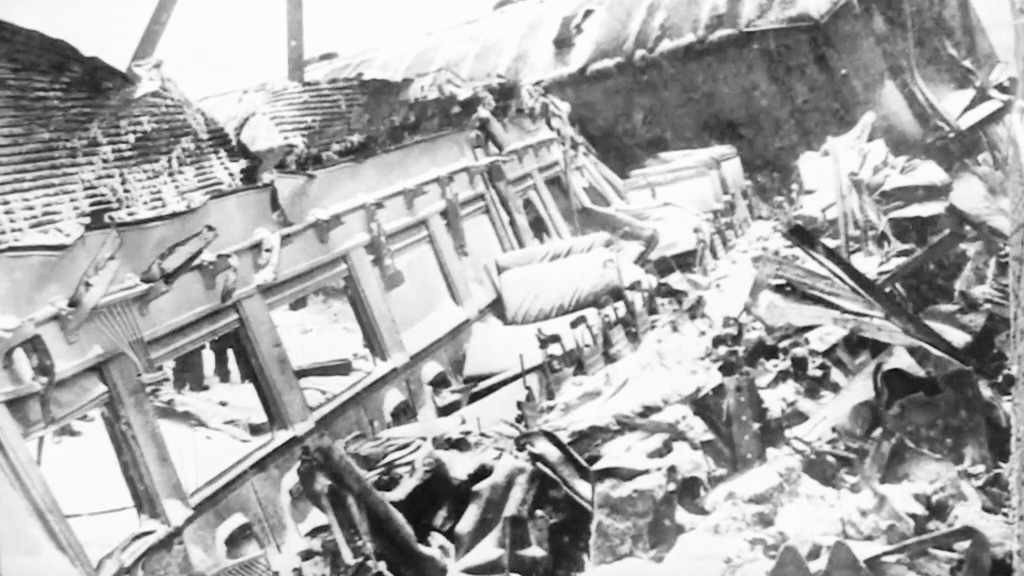
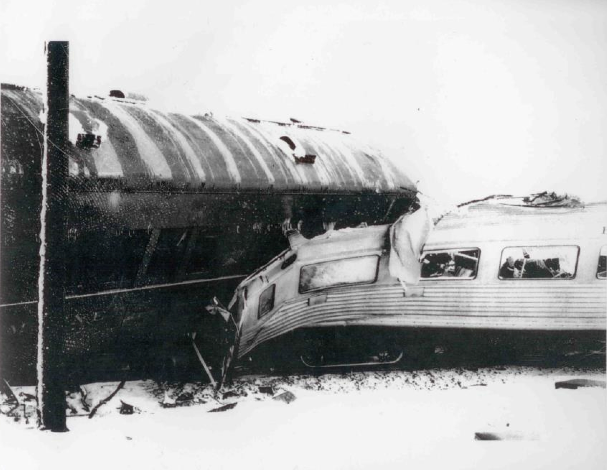
Train 2406 hit the rear of the stalled train, hitting with such violence that it shoved the train 214 some fifty feet down the tracks. The photographs of the wreck show an appalling scene. One photo in the collection of the Swampscott Fire Department shows that the first Buddliner in train 2406, the car my grandfather was sitting in, went under the rear car of the stalled train. The front of that first Buddliner became a mass of crushed metal; the roof of that first car was torn off, the left and right sides flattened outwards, and the seats torn off the floor.
Thirteen people died, among them my grandfather; all those who died were in the front Buddliner, car number 6150. Many of those who died were reportedly decapitated or cut in half. The engineer was one of those who died, so we’ll never know exactly why he didn’t stop his train.
A year ago, when my sisters and I were cleaning out my father’s condo after he went into an assisted living facility, I came across a box with a label, written in my mother’s neat schoolteacher handwriting, saying that the box contained some of my grandfather’s personal effects from the day he died. In the box lay grandfather’s gold watch, watch chain, penknife, and gloves; presumably my mother had gotten them from her mother, and had kept them together.
Nine months after the train wreck that killed her father, in the fall of 1956, my mother met a nice electrical engineer named Bob Harper, and nine months after that, in June, 1957, the couple were married out of the Salem Unitarian church — married out of the same church that had held her father’s memorial service nine months earlier.
If you ever find yourself in the Swampscott commuter rail station, look for the low stone monument that lists the names of all those who died in the crash. The victims are listed in alphabetical order; my grandfather, Walter D. Allen, is the first name on the list.
Revised July 15, 2018.
Addenda:
A. How the families of victims were notified:
My cousin Nancy says our grandmother learned about her husband’s death when a newspaper reporter came to the house, knocked on the door, and asked for background information on our grandfather.
According to the Salem News, Richard Trask and his family learned about his father’s death from television news reports: “We heard the news he was dead from television reports, and I can still recall the cry-out of my mother and grandmother when it was broadcast.”
B. An excerpt from Walter Allen’s obituary in the Framingham News of February 29, 1956:
Walter D. Allen
Train Wreck Victim
Services Thursday in Salem Church
The funeral of Walter D. Allen, 65, of 44 Andover street, Peabody, the husband of the former Marion Congdon of Framingham, will take place Thursday afternoon at 2 o’clock with services in the First Church (Unitarian) in Salem.
Mr. Allen was one of the 13 person killed in the Swampscott train wreck Tuesday morning.
Survivors are his wife, a son, Richard of Cincinnati, and two daughters, Nancy of Peabody and Mrs. Martha Farwell of Lexington. He was a native of Nantucket, the grandson of a whaling captain. Mr. and Mrs. Allen formerly resided on Warren road [in Framingham]. …
Later he came to Boston where he was with Stone and Webster and the A. L. Hartridge Co. From 1933 to 1935 he was a special assistant to the building commissioner of the City of Newton. He left that post to become chief engineer for the A. C. Lawrence Co. in Peabody. He went on vacation three weeks ago and was scheduled to retire at its conclusion.
SWAMPSCOTT, Mass. UP — Investigators said today a railroad engineer who died with 12 others in the wreckage of two Boston & Maine commuter trains was responsible for the smashup.
Sixty persons were injured when the Silver Budd Highliner smashed into the rear of a nine car diesel passenger train in a blinding snowstorm.
A B&M investigating board said the Budd Highliner engineer, Ernest Toutellotte, 55, of Winchester. raced his train past two signal lights and a franticallywaving flagman moments before crashing into the halted diesel.
They termed it a “human failure.”
The aluminum-sheathed Highliner’s first car split apart, the twisted metal shrieking under the impact as it upended two rear coaches. The two trains were jammed with about 1,000 passengers.
Bodies were strewn on both sides of the tracks. A few were trapped in the wreckage. Tourtellotte’s mangled body was found alongside the fireman, Raymond F. Jones, 28, of Lynn.
Called Worst Wreck
Officials, who called it the worst wreck in 38 years in New England, said the engineer had violated a railroad operating rule in running past the signal lights. Both were operating, a spokesman said, but were obscured by the blinding snow.
Both trains were on the B&M’s main line which passes through this small North Shore town, 12 miles from Boston. The wreck occurred about a quarter of a mile north of the Swampscott station.
D. A photo of the wreck, courtesy of the Swampscott Fire Department Facebook page:
E. Links to more information on the wreck of Trains 2406 and 214:
Since at least the 1970s and the birth of the modern environmental movement, theologians and scholars of religion have paid a good deal of attention to how religion can support environmentalism and environmental justice. An important part of this scholarly attention has been directed at interpreting sacred texts and narratives to support environmentalism and environmental justice. (1) Both I, and the local faith community I serve, sometimes use this scholarly work to help inform and shape our response to the environmental crisis.
As much as I appreciate the scholarly work that has been done on this topic, I find a gap between this scholarly work and the work we do in our local congregation. Most people in our congregation have little time for reading sacred texts, let alone reading scholarly works. Our lives are filled with family and personal matters—raising children, going to school or working at jobs or coping with unemployment, caring for aging parents or declining spouses, etc. Many of us are also active in social justice work—our congregation is particularly concerned with homelessness and affordable housing, peacemaking, and managing the global environmental crisis, but we also are fighting racism, working to end modern slavery, dealing with the immigration problem, etc. As a minister of religious education, I myself have little time to read scholarly work, given the demands of teaching children’s classes, advising youth groups, managing volunteers, administering programs, fundraising, counseling people in crisis, etc.
Teaching, managing, administering, and counseling; caring, coping, working, and handling family responsibilities—these leave little time for reading or study. From one point of view, these mundane human relationships crowd out the divine. From another point of view, this is where the divine thrives, growing in the midst of mundane relationships. The poet Marge Piercy, in a poem we sometimes read in our worship services, says:
Weave real connections, create real nodes, build real houses.
Live a life you can endure: Make love that is loving.
Keep tangling and interweaving and taking more in,
a thicket and bramble wilderness to the outside but to us
interconnected with rabbit runs and burrows and lairs. (2)
We could try to clear a straight path through the thickets and brambles of ordinary life, to cut through the thickets that lie between sacred text and our lives. I have attempted to do just this in conducting religious education classes for children and teens: to try to develop straight-line connections between sacred texts and young people’s lives. But trying to make direct connections in religious education has never worked as well as “tangling and interweaving and taking more in.” With that in mind, I decided to document the existing “rabbit runs and burrows and lairs” of our congregation’s religious education program, with its interconnections spreading like tangled rhizomes of plants—to document how a real-world congregation resists “an artificial unity” and instead celebrates “the messiness of becoming.” (3)
Those of us who do documentary work don’t really fit into the scholarly world. Documentarians tend to use language that is “too subjective” for scholarly articles; we tend to write in the first person singular, not in the scholarly passive voice. (4) We are writers, and also photographers and filmmakers, attempting “to ascertain what is, what can be noted, recorded, pictured,” and we try to figure out “how to elicit the interest of others, and how to provide a context, so that an incident, for instance, is connected to the conditions that informed and prompted its occurrence.” (5) Documentary work may seem wordy, non-linear, and overly passionate; documentarians have been accused of avoiding firm conclusions. But documentarians prefer to work this way in order to preserve the tangled messiness of what they have witnessed.
In documenting religious education programs in my congregation, I have protected the privacy of those whom I document, except where I asked for permission to quote someone directly. I have changed names and personal details, and sometimes combined identities to provide additional privacy.
(1) One notable example: Mary Evelyn Tucker and John Grim, series ed., Religions of the World and Ecology Series (Cambridge, Mass.: Harvard University Press, 1998-2004). Our congregation has the complete ten volume series in our library, though it appears to be little used.
(2) Marge Piercy, “The Seven of Pentacles,” Circles on the Water: Selected Poems (New York: Knopf, 1982), 128.
(3) Michael Mikulak, “The Rhizomatics of Domination: From Darwin to Biotechnology,” Rhizomes: Cultural Studies in Emerging Knowledge 15: Deleuze and Guattarri’s Ecophilosophy (2007): 17, accessed April 1, 2016 http://www.rhizomes.net/issue15/mikulak.html.
(4) Robert Coles, Doing Documentary Work (Oxford: Oxford University Press, 1997), 28-30.
(5) Ibid., 20.
(6) Footnote 6 was moved to the main body of the text.
Is the famous song “This Little Light of Mine” an African American spiritual? Or was it composed by Harry Dixon Loes and Avis B. Christiansen around 1920?
Attributions to the African American tradition
Many hymnals and songbooks attribute “This Little Light of Mine” to “African American Spiritual,” or more generally to “Traditional.”
An influential source: Lift Every Voice and Sing II: An African American Hymnal, ed. Horace Clarence Boyer (New York: Church Publishing, 1993), has the following attribution: “Words: Traditional. Music: Negro spiritual, adapt. William Farley Smith (b. 1941)”. The melody of this version resembles the melody collected in 1939 by Alan Lomax, as sung by Doris McMurray of Huntsville, Texas.; this recording is available online here.
An equally influential source is Sing for Freedom: The Story of the Civil Rights Movement Through Its Songs by Guy and Candie Carawan (Montgomery, Ala.: NewSouth Books, 1963/2007). The Carawans give a somewhat different melody, and attribute this as “Traditional song” (p. 21). They provide documentary evidence that indicates the song was included in the “Highlander Song Book” (p. 25), a songbook that would date from the 1930s. Incidentally, the Carawans provide a bridge that is not included in the hymnals I’ve consulted.
In addition to the audio recording by folklorist Alan Lomax in 1939 (see above), “Let hit shine” was collected by Ruby Pickens Tartt, and published in “Honey in the Rock”: The Ruby Pickens Tartt Collection of Religious Folk Songs from Sumter County, Alabama (Mercer University Press, 1991, p. 5; words only). Note that like the Lomax version, this version was probably collected in the 1930s. The editors do not provide any guidance as to when Tartt collected this particular song, but they provide the following editorial comment, without documentation: “Widely performed by choirs and gospel groups during the 1930s, a favorite on gospel radio shows, ‘Let hit shine’ is now also in white folk tradition.”
The words to “This Little Light” are collected by Steven Gould Axelrod, Camille Roman, and Thomas J. Travisano, in their book The New Anthology of American Poetry: Modernisms, 1900-1950 (Rutgers University Press, 2005), on p. 605. The editors add the following editorial comment: “Harry Dixon Loes (1892-1965) wrote and composed this song with Avis B. Christiansen (b. 1895). The pair also wrote the hymns ‘Blessed Redeemer’ and ‘Love Found a Way’.” This attribution, coming as it does from a well-regarded university press, carries some weight; however, the attribution is not documented.
Typical of the stories told about the song is that told by Ace Collins, in his book Music for Your Heart: Reflections from Your Favorite Songs (Nashville: Abingdon Press, 2013), p. 191: “During his studies [at the Moody Bible Institute], Loes was struck by the significance of three different references to light in the New Testament…. Using light as an inspiration and coupling it to a melody that carried the feel of a spiritual, Loes wrote ‘This Little Light of Mine.’ Yet the song, which is today almost universally known, took a while to take off. Although written in 1920, it would be in the days just before World War II that churches began to adopt ‘This Little Light of Mine’ as a part of Sunday school programs. Within a decade, Loes’s song was translated into scores of languages and sung all over the globe.” Collins provides no documentation whatsoever for any of these assertions.
Although the song was supposedly composed c. 1920, I was unable to find a reference to it in the Catalog for Copyright Entries for the years 1920 and 1921; however, Loes might have copyrighted the song later than 1920.
Hymnary.org shows no publications in hymnals prior to about the late 1930s; see graph here. However, Hymnary.org does not include every single U.S. hymnal from the twentieth century.
Wikipedia attributes the song to Loes, but does not document the source for this attribution. The Wikipedia page was created July 26, 2007, and many online sources (and probably many print sources) unquestioningly accept the Wikipedia attribution in spite of the lack of documentation; therefore, be wary of any source published 2007 and later that attributes the song to Loes.
The Web site Hymntime.com does NOT list “This Little Light” as one of Loes’s compositions. Note that Hymntime.com gives Loes’s dates as October 20, 1892 to February 9, 1965; the birth year is different from the birth year given by Wikipedia.
Conclusion and questions
The fact that folklorists collected the song after Dixon’s purported composition date of circa 1920 indicates that the song could have passed quickly into the folk repertoire soon after composition. However, assuming Loes did indeed write the song (or if Loes co-wrote it with Christiansen), where and when was it first published?
If Loes wrote the melody, what was his original version? Similarly, if the melody is an African American spiritual, what is the earliest recorded version of the melody?
Loes was white, so if he wrote the song, how did it become associated with the African American tradition?
In the absence of firm answers to these and other questions about the origins of this tune, the most careful attribution for this song would be “Unknown.”
Carol and I are experimenting with low-water irrigation systems for the garden. I’ve been using porous hose irrigation for years, purchasing porous hose made from recycled rubber tires, and burying the hose a few unches under the surface of the soil. David Bainbridge’s book Gardening with Less Water: Low-Cost, Low-Tech Techniques shows other highly efficient irrigation systems, including buried clay pots.
A buried clay pot is about as simple as an irrigation system can get: take a terracotta pot, put a cork in the hole in the bottom, bury it almost all the way in the soil, fill with water, then cover with a terracotta saucer.
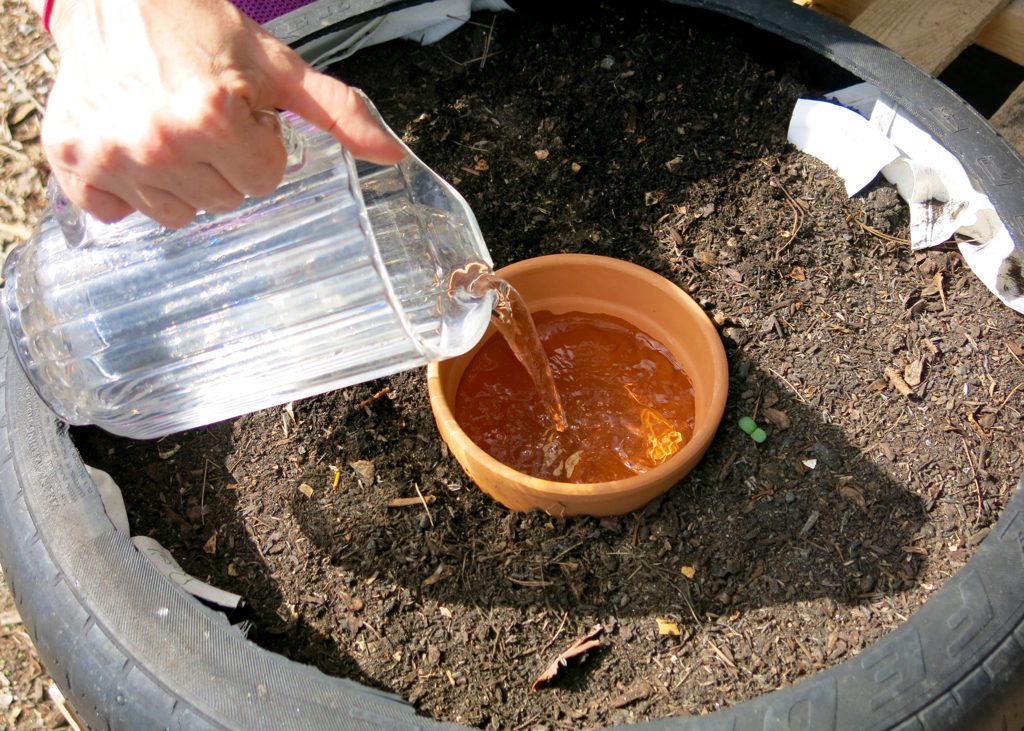
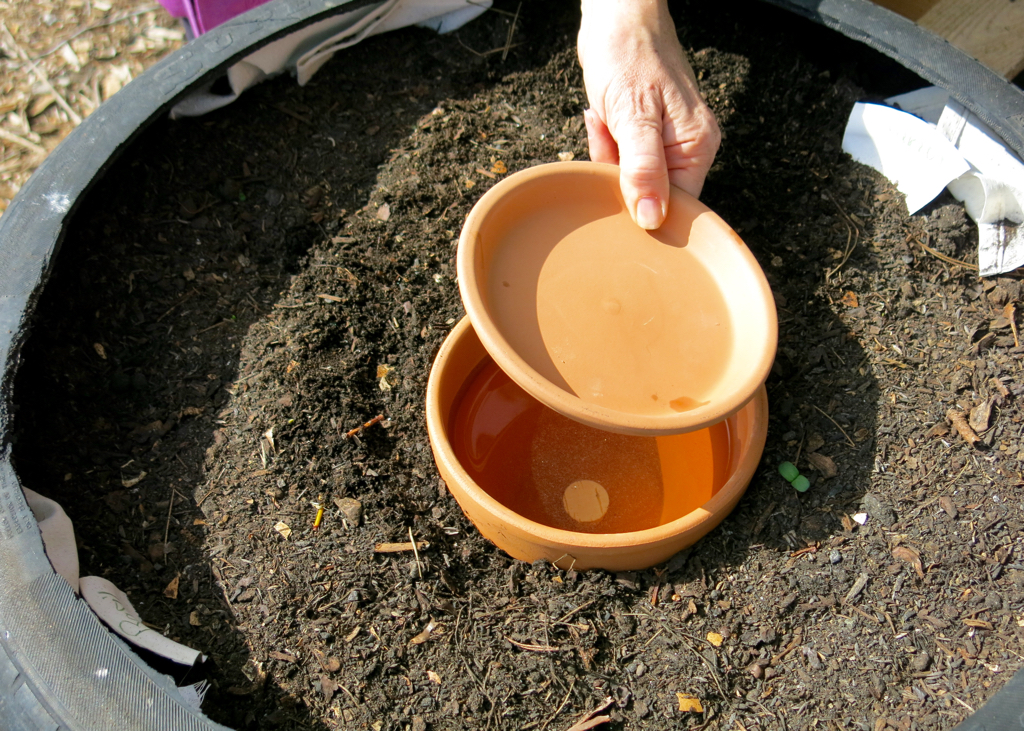
In the photo above, we’ve buried a clay pot in the tire garden built by our congregation’s ecojustice class, and Carol is filling it with water. In the next photo, Carol is about to put a lid on the buried clay pot; you can see the cork down in the bottom of the pot.
Bainbridge suggests placing buried clay pots about every 24-36 inches in a standard garden. So we figure that one buried clay pot is probably enough for one tire garden. It will be interesting to see how often we have to fill the clay pot.
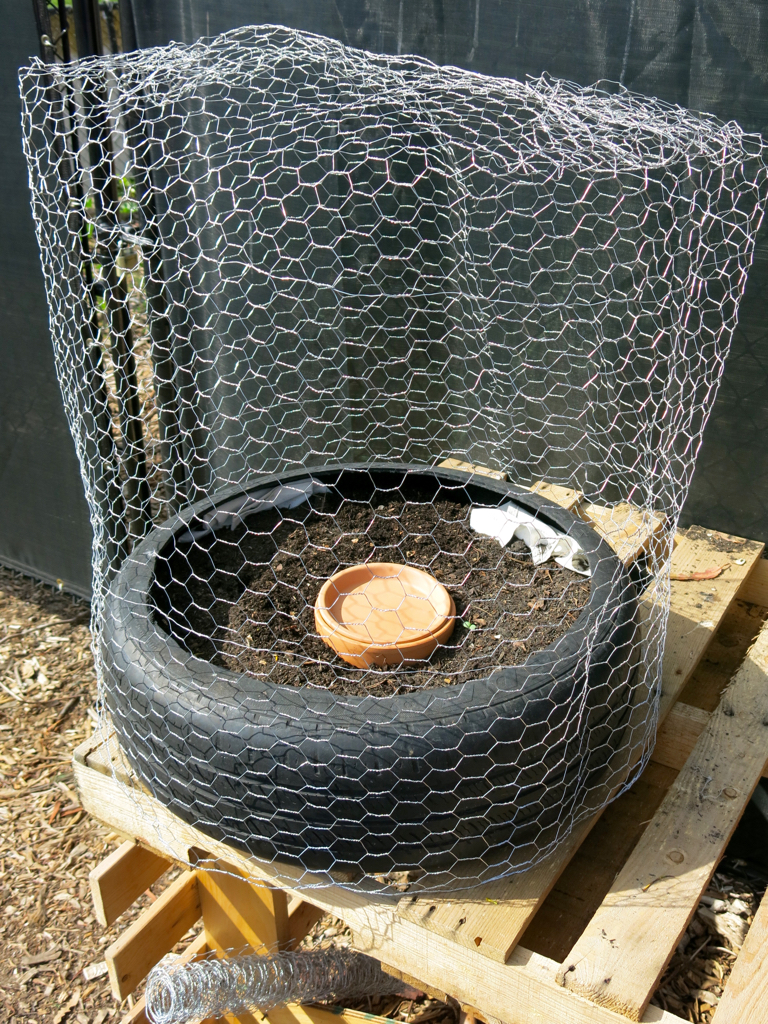
In our garden at home, we’re planning to try a somewhat more complicated version of this system: a porous terracotta capsule, fed by a hose. Until we get that to work, here’s a photo of the tire garden with the buried clay pot in the middle, and the squirrel-proof cage in place:
Carol has decided to experiment with hugelkultur in the garden this year. A hugelkultur garden bed consists of decaying wood and other compostable material from plants. This technique is supposed to create more fertility in the soil, and improve water retention. Given the ongoing drought here in northern California, improved water retention alone makes this technique worth trying.
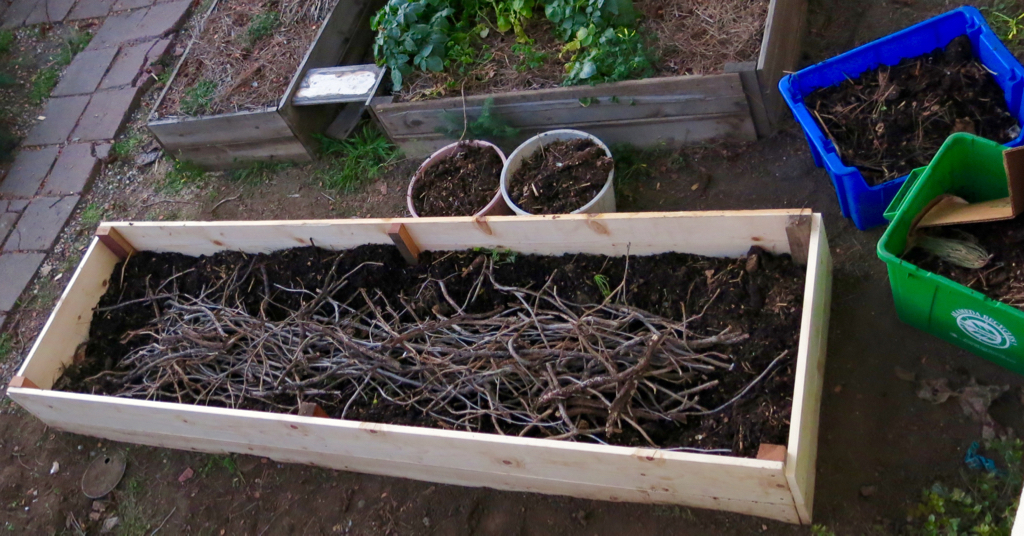
Rather than build up a mound of decaying material, as is typical with hugelkultur, Carol got me to make a raised garden bed; with the tiny amount of space we have for our garden, this seemed to make the most sense. We got some cheap boards from a lumberyard, I scrounged some scrap wood for the corners, and in about an hour we put together a bed 96 inches long and 25 inches wide. Then we put in some partially finished compost, along with twigs and small branches.
In the photo above, we’ve put down a layer of partially finished compost; the two buckets behind the raised garden bed are more compost waiting to go in. Carol has started laying some twigs and branches on the compost. After this, she put down another layer of compost, and then added a layer of potting soil we purchased from the hardware store across the street.
Carol is also planning to set up a greywater system (she is something of an expert on the topic). We already collect greywater — we have to run about two and a half gallons of water before the water in the shower gets hot, so we collect this and use it for watering the garden. Given how bad the drought is, that wasn’t enough water, so she is looking at other easily accessible sources of greywater that we can use without annoying our very nice landlord.
If you look closely at the photo, you’ll see potatoes growing in the raised bed behind the new bed. Today they started wilting a little. The National Weather Service predicts “dry weather and above average temperatures are likely to persist into the first half of next week”; we’re going to have to start watering the garden now, right in the middle of the winter-wet season. This is global climate weirdness happening in front of our eyes; maybe hugelkultur is one small way to help restore some balance to an out-of-balance world.
Above: The bed with more twigs and branches, and more bins of partially finished compost ready to go on top (photo credit: Carol Steinfeld).
In the fall of 2014, the ecojustice class (gr. 6-8) at our congregation made “bee houses” to provide potential nesting sites for Mason Bees. We kept watch on the bee houses through spring of 2015, but neither I nor the teens observed any nesting activity. (Mason Bees are solitary, and do not nest in hives like the more familiar Western Honeybee.)
But when this year’s ecojustice class checked on the bee houses last Sunday, it looked like some of the holes are now or had recently been occupied by insects:
Since Mason Bees use mud and soils to plug up their nesting holes, and these holes do not look like they have mud in them — the color of the plugs is not the color of any of the nearby soils — I’m not convinced that Mason Bees are nesting here. Nevertheless, some organism has definitely moved in to these holes; perhaps further observation will reveal what that organism might be.
One of the best things about being part of a typical UU congregation is that you get to hear other people’s stories. If you join a men’s group or women’s group, if you become a Sunday school teacher, if you simply open yourself to others during social hour, you will hear people’s stories: “When I first met my life partner…” someone will say; or, “When I was in eighth grade…”; or, “When I lived in Virginia….” So begin the little stories about someone else’s life.
No one is going to publish a big fat biography of an ordinary person’s life. Usually, the only time we get to hear the story of someone’s whole life is after they die, at their memorial service. Mostly we hear little pieces of other people’s lives; but if you listen long enough, over the course of years, you will hear enough to piece together — not a biography, but a sort of patchwork quilt of that person’s life.
We can also piece together something of the lives of ordinary people of the past: people who are not powerful, famous, male, white, and highly educated all at the same time. With such ordinary people, we mostly can know only pieces of their stories. But we can fill in the holes between the pieces with questions, and stitch it together, like a quilt, into a whole.
This, then, the story of Nathan Johnson, a Black Universalist who lived from 1795 to 1880.
About Nathan Johnson’s early life, we can only ask questions. Who were his parents? Was he born free, or did he emancipate himself from slavery? How did he learn to read? How did he get to the north? He was born about 1795, perhaps in Virginia; [1] or perhaps in Philadelphia, either enslaved or free. [2] The first real fact we know about Nathan Johnson’s life is in 1819, when he was in his twenties, he got married in New Bedford, Massachusetts.
New Bedford in that time was a city with a surprisingly enlightened racial outlook. The Quaker residents of the city had been helping enslaved persons run to freedom since at least the 1790s. [3] The city was a terminus for the Underground Railroad. And in New Bedford, a person of color could do quite well financially: by about 1800, one black man, Paul Cuffee, of African and Wampanoag descent, had amassed a small fortune through shipping and international trade. [4] Continue reading “A Black Universalist in the 1830s”
NOTE: See the update below for a brief biography of Windom.
I’m trying to track down Aaron Bash Windom, a mid-twentieth century composer of gospel music from St. Louis. One of his better-known songs was “Let Us Sing Till the Pow’r of the Lord Come Down,” often known as “Now Let Us Sing.”
My best guess is that Windom was born in 1910, and died in 1981. The Catalog of Copyright Entries, Third Series, vol. 2, part 5A, number 1, Published Music, January-June 1948 (Washington, D.C.: Copyright Office, Library of Congress, 1948) reveals that his name is Aaron Bash Windom, that he was born in 1910, and that he was the sole owner of A. B. Windom Studio, St. Louis, Mo. The Find-a-Grave Web site has a photo of a grave stone of Aaron Bash Windom who died in March, 1981, at age 70; the grave stone is in Saint Peter’s Cemetery, Normandy, St. Louis County, Missouri.
Windom is mentioned in passing in Horace Clarence Boyer’s The Golden Age of Gospel ([University of Illinois Press, 1995], p. 138): “Two other S. Louis natives who were important figures in gospel between 1945 and 1955 were Martha Bass and A. B. Windom. … Windom, a one-time accompanist for Mother Smith, composed several gospel songs: her ‘I’m Bound for Canaan Land’ and ‘I’ve Got the River of Jordan To Cross” became gospel standards.'” Several other sources indicate that he taught piano; in a couple of places he is referred to as “Professor A. B. Windom,” though I don’t know if he was affiliated with a school or college, or if he, like many other music teachers, was accorded the honorary title lf “Professor” by his students and local community.
The gospel song “Let us sing till the pow’r of the Lord come down” was published in St. Louis, Mo., and is copyright 1948 by A. B. Windom Studio. If you look around online, you can find recordings of it by various musicians. Some online discographies seem to indicate that he made some recordings of his own music, but I can’t confirm that.
But I have no idea if he was white or black; if he played anything besides gospel music; to what extent he made his living as a performer, a teacher, and/or a composer. I cannot find him in the 1930 or the 1940 U.S. Census. Was he married? Did he have children?
If anyone out there knows anything about him, I’d love to hear.
Update, Feb., 2023
Here’s my best effort at a brief biography for Aaron Bash Windom, based on the information listed below, plus information from the comments. Some of this is a little bit speculative, but given how little information we have, this will have to do.
Aaron Bash Windom, known as A. B. Windom, was born on September 11, 1910, in Missouri. Nothing is known about his early years. By 1941, he was publishing his own compositions in St. Louis, often under the imprint “Studio of A. B. Windom.” In addition to being a gospel composer, he also taught music, and his students called him Professor A. B. Windom. He was also a performer, and both sang and played piano.
On February 17, 1949, he married Selma B. Hurd. Born c. 1903, Selma was from East St. Louis, Ill., across the river from St. Louis, and was the daughter of Baptist minister Rev. B. M. Hurd.
Although all his published compositions were gospel music, Windom taught classical piano. As one of his students remembers, “He was very well versed in music theory as well. Gospel music is not all he knew. He was a light-skinned Black man, [and] eccentric. I still miss him.” At least one of his students went on to become a professional musician, the gospel composer Rev. Robert Mayes (1942-1992).
Windom served for forty years as the minister of music at Christ Pilgrim Rest Baptist Church in St. Louis, circa 1940 until his death. In 1966, he served on the Devotional Literature Commission of the Progressive National Baptist Convention.
His gospel compositions were recorded most notably by Mahalia Jackson, and also by less well-known performers such as Martha Bass, the Golden Harmoneers, the Clara Ward Singers, etc. His 1948 composition “Let Us Sing Till the Power of the Lord Come Down” (a.k.a. “Now Let Us Sing”) has been recorded a number of times and is widely sung by church choirs. “This song has even entered the folk tradition to the point where”Now Let Us Sing” has entered the oral tradition, passed from singer to singer; unfortunately in the process Windom’s authorship has sometimes been forgotten.
Windom died on February 28, 1981. He had turned over his school at 3905 Evans Street, St. Louis, to Professor Lee Cochran, Jr., who continued to teach music there. Selma, A. B.’s wife, died on February 26, 1994. They are buried together in St. Peter’s Cemetery, Normandy, St. Louis County, Missouri.
Research notes:
(1) Be sure to read the comments. There is some material there from people who knew him.
(2) I’ve found some genealogical information about Aaron Bash Windom. I assumed that the birth year listed in his copyright entries (1910) was correct. Beyond that, “Windom” is an unusual spelling.
(a) I was not able to find him in the 1920, 1920, 1940, or 1950 U.S. Census. That doesn’t mean he’s not there; sometimes names get horribly mangled by the census takers. But I was unable to track him down.
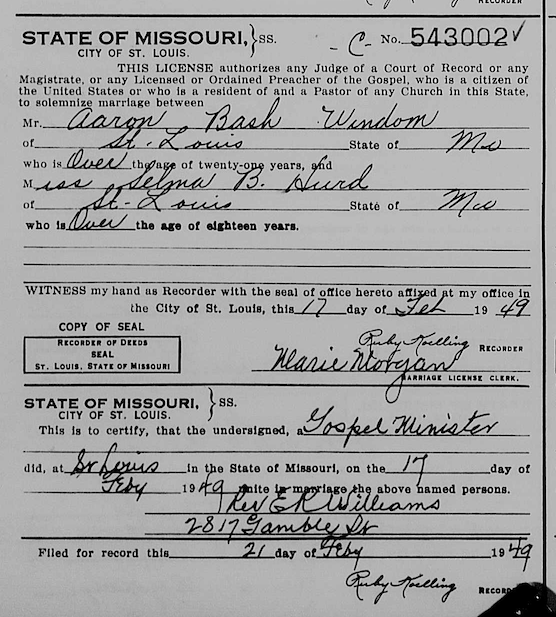
(b) Aaron Bash Windom and Selma B. Hurd were married on February 17, 1949, in St. Louis, by Rev. E. R. Williams. See attached photostat of the marriage record (from Familysearch.org). With such an unusual name, spelled exactly as it appears on his copyright records, this is pretty definitely our A. B. Windom.
(c) Aaron Bash Windom is in the Social Security Death Index, found via Familysearch.org. Date of birth, September 11, 1910; date of death, February, 1981 (no day given). Since he was buried in early March (see below), I’d assume he died in late February.
(d) According to Find-a-Grave, Aaron Bash Windom died in March, 1981 (though actually, this was probably the burial date; see above for a Feb. date), and he was buried in St. Peter’s Cemetery, Normandy, St. Louis County, Missouri. Interment.net summarizes the interment record as follows: “WINDOM, Aaron Bash, age: 70, burial: 03/07/1981, Section: 28, Block: O, Lot: 28.00, Grave: 1.”
This source (which collates public records) has the following information: “WINDOM, AARON was born 11 September 1910, received Social Security number 498-14-7067 (indicating Missouri) and, Death Master File says, died February 1981 [Source: Death Master File (public domain)….] WINDOM, AARON B. died 28 February 1981 in Missouri, U.S.A. Special thanks to Reclaim the Records.” Given the dates of death, I feel pretty confident that both these entries are for our A. B. Windom.
(e) Selma died in 1994, according to Find-a-Grave (this corresponds to the information in the comments below) and she is also buried in St. Peter’s Cemetery. Interment.net lists her as “WINDOM, Selma B., age: 91, burial: 2/26/1994, Section: 28, Block: O, Lot: 28.00, Grave: 2”; in other words, she’s buried next to A.B. (but darn it, I wish they’d given her full middle name). This also gives Selma’s approximate birth year as 1903. That means she was about 46 years old when she married A.B. Windom; thus it’s no surprise that they didn’t have children together. Another source gives her date of death as February 19, 1994 (using information found on reclaimtherecords.org).
Once I knew Selma’s approximate birth year, I could do more research on her life. Our Selma is probably (but not definitely) the Selma B. Hurd born in 1903, and found in the 1910, 1920, and 1930 U.S Census, living with her parents in East St. Louis, Illinois, right across the river from St. Louis, Mo. Her parents were B. M. Hurd (born in Georgia; first name also given as Morgan) and Lusette Hurd (born in Alabama; first name may be Lucetta, Luretta, or Susetta). B. M. was minister of a Baptist church, and is listed in the American Baptist Yearbook for 1910 (p. 151); he is probably the B. M. Hurd who died in 1937. Lusette doesn’t appear in the 1930 Census; she is probably the Lucetta Hurd who died in 1922 and is buried in the same cemetery, in the exact same section, as B. M. Hurd. Note that Selma was Lusette’s second child, for the 1910 census shows she has two living children, though only Selma is living with Lusette in that year (Lusette was about 40 when she had Selma); also note that Lusette married B. M. circa 1901, and this was her second marriage. Also, the 1920 Census lists Selma, Lusette, and B.M. as black.
Given this information on Selma, we might be able to go a little further. A woman named Selma Hurd of East St. Louis, Ill., married Carl L. Jamerson, also of East St. Louis, on September 22, 1930 — there may have been two women named Selma Hurd in East St. Louis in 1930, but I’m betting that it’s the same woman; and if this is the same Selma who married A. B. Windom, then it was her second marriage. However, note that A. B. Windom did not marry Selma Jamerson; which could mean that these are not the same woman, or it could mean that Selma took back her maiden name after her marriage with Jamerson ended.
Be cautious with any of this information about Selma. I found no definite connection between the Selma Hurd of East St. Louis, Ill., and the Selma Hurd of St. Louis, Mo., who married A. B. Windom. They’re probably the same woman (it’s a somewhat unusual name), but they’re not definitely the same woman.
(3) A. B. Windom is mentioned in the minutes of the “First Annual Midwinter Planning Session” of the Progressive National Baptist Convention, Inc., January 19-20, 1966, held at Christ Pilgrim Rest Baptist Church, St. Louis, Missouri: “Professor A. B. Windom of the host church sang a solo, ‘Come unto Jesus'” [for the Thurs. morning, Jan. 20, session]; he was also listed as a member of the “Devotional Literature Commission.” These minutes are bound with the Minutes of the Fourth Annual Session of the Progressive National Baptist Convention, Sept. 7-12, 1965 (p. 165).
(4) I found a number of copyright listings and publication listings for A. B. Windom, but did not have the patience to go through all those listings looking for bits good information (e.g., where the copyright holder resides, etc.). Below is what my quick search turned up for sheet music publications. These are of interest because they place Windom in St. Louis in the 1940s, and show that he published his own music. It also shows that he had connections to Chicago.
1941: “The First Started Burning in My Soul” (27458 Cass, St. Louis: A. B. Windom) 1942: “You’ve Got the River of Jordan To Cross,” with P.D. Johnson and Theodore Frye (Chicago: Theodore Frye) 1945: “There’s Rest for the Weary” (St. Louis: A. B. Windom Studio) 1947: “I Got To Run to the City Four Square (St. Louis: A. B. Windom Studio) 1948: “Let Us Sing Till the Power of the Lord Come Down” (St. Louis: A. B. Windom Studio) 1949:”Oh Lord Remember Me” (St. Louis: A. B. Windom Studio) 1949:”You Got To Stand Your Trial in Judgment” (St. Louis: A. B. Windom Studio) 1954: “Peace, Peace in Jesus” (St. Louis: A. B. Windom Studio) (Sources: Emory Univ.; eBay listings; U.S. Copyright listings)
(5) A. B. Windom is mentioned in a few published reminiscences about the mid-twentieth century gospel music scene — search Google Books — but most of this material either is not available on Google Books, or says little more than “I remember A. B. Windom.”