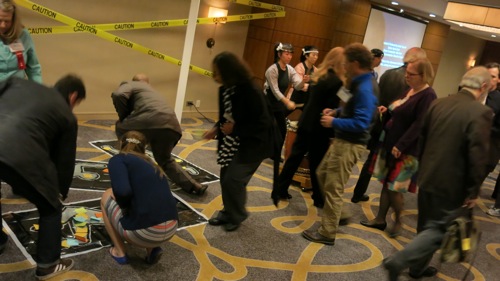
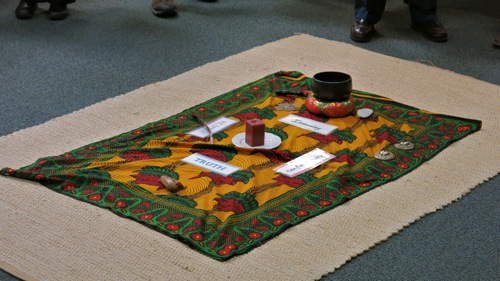
45 sec. of video of the taiko drummers at the opening plenary of the Religious Education Association 2014 conference.
Category: Religious education
REA: Tending your digital presence
Mary Hess of Luther Seminary presented the first pre-conference session, on “Creating and Tending Your Digital Presence as a Scholar,” at the Religious Education Association annual conference. Although I’m a minister of religious education, not a scholar of religious education, I figured I would hear much that was applicable to me — and I did.
Hess began by making an important point by referring to research on (a href=”http://mediatedcultures.net/youtube/context-collapse/>context collapse done by cultural anthropologist Michael Wesch. Hess told us that tending one’s digital presence is a way to intentionally build context in the face of context collapse. “I don’t think it’s a choice any longer,” she said, to tend one’s digital presence.
One problem faced in tending your online presence is figuring out how to uniquely identify yourself — especially challenging for those of us with common names. Hess introduced us to ORCID, a registry of unique researcher identifiers for scholars. (As a minister in a numerically small denomination, I already have a unique identifier — search for “dan harper unitarian” and you’ll find me.)
Hess reviewed some social media sites aimed at academics, including academia.edu, Mendeley as a useful digital repository or archive, and Merlot for sharing teaching resources.
Hess said that for her, Slide Share has actually been more useful at getting her work out than any sites dedicated to academics.
Turning to what she called “popular publication,” Hess spoke briefly of popular Web sites such as the Huffington Post, Religion Dispatches, and Odyssey Networks. Hess feels that it is critically important for religious education scholars (and practitioners!) to break out of the boundaries of our narrow intellectual speciality.
“I think in my more cynical moments that as higher education focused on production of certain kinds of knowledge, it has removed people from public life,” she said. She contrasted this attitude with the attitude of John Dewey, one of the founding intellects of the Religious Education Association. Dewey, she said, was a public intellectual. She added that the question of what it means to be a public intellectual is critically important.
Attitudes towards religious diversity
A paper published in the May-June, 2014, issue of Religious Education: The Journal of the Religious Education Association explores attitudes towards religious differences among adolescents in the United Kingdom. The authors used standard social science techniques and statistical analysis to find out if adolescents who attend faith-based schools, that is, day schools run by organized religions. They pose this research question: “whether students educated in schools with a religious character are more or less conducive to life in a religiously diverse society,” as compared to students in secular schools.
Their study indicates that the “individual religiosity” of adolescents, and other personal factors, has more influence on their attitudes towards religious diversity than the school they attend. Some of their findings:
— females have a more positive attitude towards religious diversity than males
— neuroticism correlates with a positive attitude towards religious diversity, and psychoticism with a negative attitude
— adolescents who pray regularly have a more positive attitude towards religious diversity
— adolescents who attend religious services regularly have a more positive attitude towards religious diversity
— however, “none of the variance in … attitudes toward religious diversity can be attributed to attending schools with a religious character.”
The paper is “Church Schools Preparing Adolescents for Living in a Religiously Diverse Society: An Empirical Enquiry in England and Wales,” by Leslie J. Francis and Andrew Village (in Religious Education, vol. 109 no. 3, May-June 2014, pp. 264-283).
Francis and Village address a fairly narrow question, in a cultural context different from most regions of the U.S.; I don’t think it would be wise to try to apply their findings to a U.S. context, or to try to draw larger conclusions from the findings. Nevertheless, I think this paper does suggest some interesting possibilities for research in the U.S. Wouldn’t it be interesting to research attitudes towards diversity among adolescents who are affiliated with mainline churches, evangelical churches, non-Christian faith communities, etc.?
And wouldn’t it be really interesting if the Unitarian Universalist Association or one of our seminaries funded similar research of adolescents who are affiliated with Unitarian Universalist congregations? If I were conducting such research, I think my initial hypothesis would be that a board sampling of Unitarian Universalist adolescents would not have significantly more positive attitudes towards religious diversity than adolescents affiliated with other faiths; though based on Francis and Village’s paper, I would definitely look for evidence that religious adolescents in general have a somewhat more positive attitude towards religious diversity than secular adolescents.
Classrom dynamics
(At the Pot of Gold religious education conference today, I led a workshop on classroom dynamics. As promised to participants, here are three key concepts from the workshop:)
When we talk about classroom dynamics, we are talking about managing the relationships in a group of learners (i.e., classroom management). One of the key issues facing any teacher is the issue of classroom management — which is a nice way of saying, helping the participants behave well. To help minimize behavior problems, here are three key concepts to consider:
(1) Make sure each child (or teen, or adult) is noticed and is heard. We did this today in the opening: everyone said their name, and told a little bit about themselves. Especially when new to a class, kids need to feel that they are noticed, that their voice can be heard, and that they belong.
(2) Make sure all participants at least hear each others’ names. They don’t have to memorize all the names (though that would be best). They don’t have to be best friends with everyone (though having one friend is good). But they at least have to know the barest minimum about who else is in the room.
(3) Be clear about the purpose of the class. It makes a big difference if everyone knows why they are there. (For example, I did this in today’s workshop by stating the purpose of the workshop at the very beginning.) If there’s a stated purpose, most participants will buy into it — and those who don’t will at least understand when you reprimand them for deviating from the purpose.
Other notes from today’s class: Rules of the Grocery Store Game may be found here. Rules for Zip, Zap, Zoop may be found here. (Scroll up and down on this same Web page for more icebreakers.)
Star Island RE handouts
Below are the handouts from the workshop on teaching I led at this summer’s Star Island religious education conference. (Yes, it took me almost two months to proofread these handouts and finally post them — this gives you an indication of how very busy this year’s church start-up has been.) These handouts are aimed at more experienced Sunday school teachers, religious education committee members, and religious education professionals.
Developmental stage theory handout
Educational philosophies handout
20 years
Twenty years ago this month, I began working as a Director of Religious Education (DRE) in a Unitarian Universalist congregation. During the recession of the early 1990s, I had been working for a carpenter/cabinet-maker, so I had been supplementing my income with part-time work as a security guard at a lumber yard. Carol, my partner, saw an advertisement for a Director of Religious Education at a nearby Unitarian Universalist church. “You could do that,” she said. So I applied for the job, and since I was the only applicant, I got it.

Above: Carol took this Polaroid photo of me sitting at my desk at my first DRE job. The computer in the left foreground is a Mac SE, and I have a lot more hair. It was a long time ago.
Over the past twenty years, I worked as a religious educator for sixteen years — full-time for six of those years, part-time for nine years — and as a full-time parish minister for four years. Since I was parish minister in a small congregation where I had often had to help out the very part-time DRE, I feel as though I’ve worked at least part-time in religious education for twenty continuous years.
Sometimes I wonder why I’ve stuck with it so long. Religious education is a low-status line of work. Educators who work with children are accorded lower status in our society, because working with children is “women’s work,” and ours is still a sexist society. And religious educators are sometimes looked down upon by schoolteachers and other educators, because we’re not “real” educators. In addition to being low-status work, religious educators get low pay, and the decline of organized religion means our pay is declining, too, mostly because our hours are being cut, or paid positions are being completely eliminated.
“Excellence in Teaching” handout on philosophy
Here is a handout on educational philosophies, which I will distribute tomorrow to participants in the “Excellence in Teaching” workshop at the Star Island religious education conference:
“Excellence in Teaching” handouts
I’m currently leading a workshop called “Excellence in Teaching” at the Lifespan Religious Education Conference, held at Star Island Conference Center in New Hampshire. The class itself is experiential, and I won’t be able to translate it to this blog. But here are two handouts that may be useful to others:
Handout: Developmental stage theory for UU religious education
Children and fantasy
Quote from yesterday’s New York Times, “Urban Legends Told Online” by Farhad Manjoo, p. B7:
“Jacqueline D. Woolley, director of the Children’s Research Lab at the University of Texas at Austin, has found that children are far more capable at distinguishing reality from fiction than perviously thought. ‘By the time they’re 9, they’re at adult levels,’ she said.”
That tallies with my observations of children in religious education settings. Children as young as 6 begin to be able to make distinctions between fact and fiction, and yes, by 9 years old they are probably at adult levels.
Peacemaking and the REA
I just learned that the “Call for Papers Committee” of the Religious Education Association (REA) has accepted my proposal to present a workshop on our Peace Experiments program at the annual REA conference in November, 2014. The REA is an international, interfaith association of scholars and practitioners of religious education — it’s exciting that this prestigious association is interested in what our UU congregation has been doing with Peace Experiments.
While I’m all too well aware of the weaknesses of our “Peace Experiments” program, I think what we’re doing does have some interesting features. In particular, while most of the peacemaking curricula that I know about these days tend towards an essentialist educational philosophy (i.e., there are certain essential peacemaking skills that children must learn), our peacemaking program is grounded in an existentialist educational philosophy: we are trying to get children to define themselves as peacemakers, and to help them realize that who they are and the choices they make will shape the world around them.