Another in a series of stories for liberal religious kids. This is a story about selfishness, and it also gives an insight into the supposed magical powers of Daoist priests. Source: Pu Songling, trans. Herbert A. Giles, Strange Stories from a Chinese Studio (London: Thomas De La Rue & Co., 1880).
One day in the marketplace, a man from the countryside was selling pears he had grown. These pears were unusually sweet with a fine flavor, and so the countryman asked a high price for them.
A Daoist priest, dressed in a ragged old blue cloak, stopped at the barrow in which the countryman had displayed these lovely pears.
A Daoist priest. (Adapted from a public domain image from The Dragon, Image, and Demon by Hampden C. DuBose, New York: Armstrong & Son, 1887)
“May I have one of your pears?” he said.
The countryman said to him, “Get away from my barrow, so that paying customers may buy my pears.” For the countryman knew that the priest expected him to give him one for nothing. But when the priest did not move, the countryman began to curse and swear at him.
The priest said, “You have several hundred pears on your barrow. I ask for a single pear, the loss of which you would not feel. Why then, sir, do you get angry?”
Several people who were standing around told the countryman to give the priest a pear that was bruised, or which had some sort of blemish, a pear that he could not sell anyway. If he would only do that, then the priest would go away. But the countryman was stubborn, and he refused to give the Daoist priest anything at all.
The beadle of the town, who was charged with keeping the peace and maintaining order, came over to see what was going on. This beadle saw that things were getting out of hand, so he purchased a pear from the countryman, and presented it to the Daoist priest.
The priest bowed low to the beadle, thanking him for the pear. Then the priest turned to the crowd who had gathered round, and said, “Those of us who are Daoist priests have left our homes and given up all wealth. So when we see selfish behavior, it is hard for us to understand it. Now as it happens, I have some pears with a very fine flavor, and unselfishly I would like to share them with you.”
Someone in the crowd called out, “But if you have pears of your own, why didn’t you just eat one of them? Why did you have to have one of the countryman’s pears?”
“Because,” said the priest, “I wanted one of these seeds to grow my pears from.” So saying, he ate up the pear that the beadle had given him. When he had finished eating, he took one of the seeds, unstrapped a pick from his back, and bent down to make a hole in the ground, four inches deep, with the pick. Then he dropped the seed into this hole, and filled it in with earth. Turning back to the crowd, he said, “Could someone bring me a little hot water, please, with which to water the seed?”
One among the crowd who loved a joke went into a neighboring shop and fetched him back some boiling water.
The priest poured the boiling water over the place where he had made the hole. Everyone watched closely, for though it seemed like a joke, Daoist priests were supposed to have knowledge of alchemy and magic and the mystical arts.
Suddenly the people in the crowd saw green sprouts shooting up out of the ground, growing gradually larger and larger until they became a tree. This pear tree — for it was, indeed, a pear tree — quickly grew in the spot, and sprouted green leaves, and then put forth white flowers. Bees were heard buzzing among the flowers, then the petals dropped, and before long the tiny hard green fruits had grown and ripened into fine, large, sweet-smelling pears which hung heavy on every branch.
The priest picked these fine pears and handed them around to everyone in the crowd. When at last everyone had a pear, and all the pears had been picked from the tree, the priest turned and with his pick he hacked away at the tree until, after a long time, he cut it down. Picking up the tree and throwing it over his shoulder, leaves and all, he walked quietly away.
Now this whole time, the countryman had been standing in the crowd, straining his neck to see what was going on, and forgetting all about his own business. When the priest walked away, he turned back to his barrow and discovered that every one of his pears was now gone. He then knew that the pears that old fellow had been giving away were really his own pears. And when the countryman looked more closely at his barrow, he saw that one of its handles was missing, for it had been newly cut off.
Boiling with anger, the countryman set off after the Daoist priest. But as he turned the corner where the priest had disappeared, there was the lost wheel-barrow handle lying next to a wall. It was, in fact, the very pear tree that the priest had cut down.
But there were no traces of the priest — much to the amusement of the crowd in the market-place, who watched the countryman’s rage as they finished eating their sweet, juicy pears.
Another in a series of stories for liberal religious kids, this one from Central Africa. I like this story because of the differences between Nzambi Mpungu and the Christian Jehovah, and the different reasons Spider and Prometheus have for stealing the heavenly fire. The character of Spider is probably related to Anansi the Spider of West Africa myth, and probably to other African tricksters such as Tortoise of Yoruba myth. This story is adapted from Richard Edward Dennett, Notes on the Folklore of the Fjort (French Congo), London: Folk-lore Society, 1898, pp. 74-76 and 131-135.
First you must understand who Nzambi Mpungu is. He is the father of all things, and lives a happy life above the sky, where he has a many wives and beautiful children. He spends very little time thinking about us people here on earth, and since he is a good being there is no use in offering him worship or sacrifices. True, there are lesser gods and goddesses who can hurt us people here on earth, and to them we might offer worship and sacrefice, but Nzambi Mpungu will not mind, for he is not in the least jealous.
Now you may question whether Nzambi Mpungu actually exists. But there is a man still living, near the town of Loango, who says that one day, when it was thundering and lightning and raining very heavily, and when all the people in his village, being afraid, had hidden themselves in their houses, he alone was walking about. Suddenly, and at the moment of an extraordinarily vivid flash of lightning, after a very loud peal of thunder, he was seized and carried through space until he reached the roof of heaven, when it opened and allowed him to pass through to where Nzambi Mpungu lives. There the man met Nzambi Mpungu, who cooked some food for him, and then showed the man his great plantations and rivers full of fish. Then Nzambu Mpungu left the man, telling him to help himself whenever he felt hungry. The man stayed there two or three weeks, and never had he had so much good food to eat. At last Nzambi Mpungu came to him again, and asked the man whether he would like to remain there always, or whether he would like to return to the earth. The man said that he missed his friends, and would like to return to them, and Nzambi Mpungu sent him back to his family. So you see, Nzambi Mpungu does indeed live above the sky.
Nzambi, on the other hand, is Mother Earth. Some say she is Nzambi Mpungu’s first child. She is the great princess, a mighty ruler who governs all on earth. She has the spirit of rain, lightning, and thunder for her own use. She is a stern judge, and a fearsome ruler.
Now we can begin the story of how Spider almost married Nzambi’s daughter.
For Nzambi had a most delightful daughter whom anyone would have wanted to marry. But Nzambi swore that no earthly being should marry her daughter, unless they could bring her the heavenly fire from Nzambi Mpungu, who kept it somewhere in the heavens above the blue roof of sky.
The people all wondered who could ever bring the heavenly fire down to earth.
Then Spider said, “I will bring the heavenly fire to earth, but I will need help.”
“We will gladly help you,” said all the people, “if you will reward us for our help.”
So Spider climbed up to the blue roof of heaven, and dropped down again to the earth, leaving a strong silken thread firmly hanging from the roof to the earth below. Then he called to Tortoise, Woodpecker, Rat, and Sandfly, and bade them climb up the thread to the blue roof of sky.
When they got there, Woodpecker pecked a hole through the roof, and through this hole they all entered into the realm of Nzambi Mpungu, who, as it happens, was very badly dressed. Nzambi Mpungu received them courteously, and asked them what they wanted up there.
“O Nzambi Mpungu of the heavens above, great father of all the world,” they said, “we have come to fetch some of your heavenly fire, to bring it down to Nzambi who rules upon earth.”
“Wait here then,” said Nzambi Mpungu, “while I go to my people and tell them of the message you bring.” But Sandfly followed Nzambi Mpungu without being seen, and heard all that was said. While Sandfly was gone, the others talked among themselves, wondering if it were possible that someone who went around so badly dressed could be so powerful.
At last Nzambi Mpungu returned to them. “My friend,” he said to Spider, “how can I know that you have really come from the ruler of the earth, and that you are not impostors?”
“Nay,” said Spider and all the others, “put us to some test so we may prove our sincerity to you.”
“I will,” said Nzambi Mpungu. “Go down to this Earth of yours, and bring me a bundle of bamboos, so I can make myself a shed.”
Tortoise climbed all the way down to Earth, leaving the others where they were, and soon returned with the bamboo.
Nzambi Mpungu then said to Rat, “Get beneath this bundle of bamboo, and I will set fire to it. If you escape I shall surely know that Nzambi sent you.”
Rat did as he was told, and hid under the bundle of bamboo. Nzambi Mpungu set fire to the bamboo, and lo! when it was entirely consumed, Rat came from amidst the ashes completely unharmed.
“Ah!” said Nzambi Mpungu. “You are indeed sent from Nzambi on Earth. I will go and consult my people again.”
Spider, Rat, Woodpecker, and Tortoise sent Sandfly after him once again, bidding him to keep well out of sight, to hear all that was said, and if possible to find out where the lightning was kept. Sandfly soon returned and told them all that he had heard and seen.
When Nzambi Mpungu came back a little later, he said, “Yes, I will give you the heavenly fire you ask for. But only if you can tell me where it is kept.”
Spider said, “Give me then, O Nzambi Mpungu, one of the five cases that you keep in the hen-house.”
“Truly, you have answered me correctly, O Spider!” said Nzambi Mpungu. “Take this case, and give it to your Nzambi.”
Tortoise carried the heavy case containing the heavenly fire down to the earth. When they got to Nzambi’s house, Spider presented the fire from heaven to her. True to her word, Nzambi agreed to let Spider marry her delightful daughter.
But Woodpecker grumbled, saying, “Surely your daughter is mine, for I was the one who pecked the hole through the roof, without which the others never could have entered the kingdom of the Nzambi Mpungu.”
“No, she is mine,” said Rat. “For I risked my life among the burning bamboo.”
“Nay, O Nzambi, she is mine,” said Sandfly. “For without my help the others would never have found out where the fire was kept.”
And Tortoise complained that he was the one who had to return to Earth to fetch the bamboo, and then had to carry the heavy case down to Earth, so of course the daughter should be married to him.
After listening to them all, Nzambi said: “Nay, Spider was the one who planned how to bring me the heavenly fire, and he has indeed brought it. By rights, my daughter should be married to him. But I know you others will make her life miserable if I allow her to marry Spider. Since she cannot marry all of you, I will not allow her to marry any of you. But I will give you her value” — for the people Nzambi ruled customarily gave presents when one of their children married.
Nzambi then paid fifty bolts of cloth each to Tortoise, Rat, Woodpecker, Sandfly, and Spider.
As for the daughter, she never married, and had to wait on Nzambi for the rest of her days.
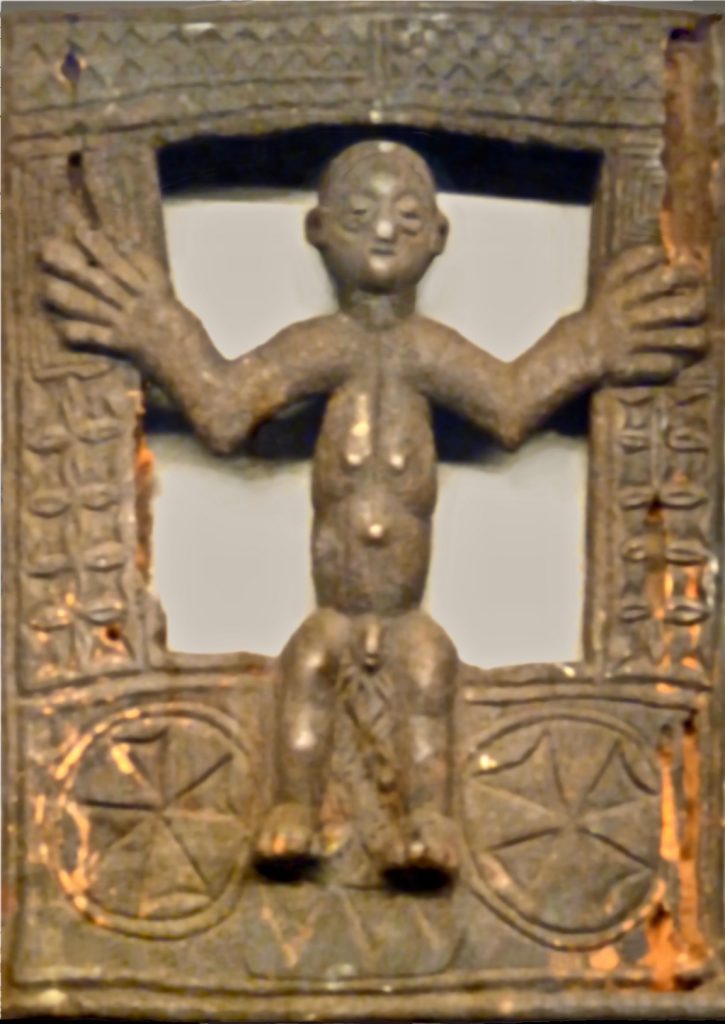
Nzambi Mpungu as imagined by an African artist of perhaps a hundred years ago. This artist was a follower of the Kongo religion. The Kongo religion is related to several religions in the Americas including Haitian Vodoun and Brazilian Candomblé. Musée royal de l’Afrique centrale, original photo CC-BY-SA 3.0 Ji-Elle.
While watching the mass of the Abyssinian Orthodox church in Debra Lanos in 1930, during the coronation of Ras Tafari as emperor of Abyssinia, Evelyn Waugh noted that the liturgy was “quite unintelligible.” As a Roman Catholic, he had thought that the “canon of the Mass would have been in part familiar, but this was said in the sanctuary behind closed doors.” This observation led him to reflect on the exoteric (as opposed to esoteric) nature of Western Christianity:
“I had sometimes thought it an odd thing that Western Christianity, alone of all the religions in the world, exposes its mysteries to every observer, but I was so accustomed to this openness that I had never before questioned whether it was an essential and natural feature of the Christian religion. Indeed, so saturated are we in this spirit that many people regard the growth of the [Christian] Church as a process of elaboration — even of obfuscation; they visualize the Church of the first century as a little cluster of pious people reading the Gospels together, praying and admonishing each other with a simplicity to which the high ceremonies and subtle theology of later years would have been bewildering and unrecognizable….”
Parenthetically, I would note that this last observation captures the beliefs of many Unitarian Universalists: that early Christianity, in the days before the Nicene Creed — or Paul, or whomever one believes to be the bogeyman who spoiled true Christianity — was pure and simple. But let us continue with Waugh’s meditation:
“At Debra Lanos I suddenly saw the classic basilica and open altar as a great positive achievement, a triumph of light over darkness consciously accomplished, and I saw theology as the science of simplification by which nebulous and elusive ideas are formalized and made intelligible and exact. I saw the Church of the first century as a dark and hidden thing: as dark and hidden as the seed germinating in the womb; legionaries off duty slipping furtively out of the barracks, greeting each other by signs and passwords in a locked upper room in the side street of some Mediterranean seaport; slaves at dawn creeping from the grey twilight into candle-lit, smoky chapels of the catacombs. The priests hid their office, practising trades; their identity was known only to initiates; they were criminals against the law of their country. … And I began to see how these obscure sanctuaries had grown, with the clarity of Western reason, into the great open altars of Catholic Europe, where Mass is said in a flood of light, high in the sight of all, while tourists can clatter round with their Baedeckers, incurious of the mystery.” (Evelyn Waugh, “A Coronation in 1930,” When the Going Was Good [Penguin Books, 1946/1976], pp. 118-119)
Waugh, in 1930, was a recent and fervent convert to Roman Catholicism, and a good part of what he wrote here may be classed as Catholic apologetics directed at his Church of England readers. And some of what he wrote came from the fanciful imagination of the novelist, which is not to say that it is untrue, but it isn’t careful and dry academic discourse. And there is a core of truth in what he wrote: the mainstream of Western religion tends towards the exoteric, rather than the esoteric. This is as true of Protestantism and newer forms of Christianity as it was of Waugh’s Roman Catholicism. When the Pentecostal receives the baptism of the Spirit and speaks in tongues, it happens in front of the gathered congregation, and videos may be taken of the event and posted on Youtube. When the Unitarian Universalist minister delivers a highly intellectual sermon, everyone is welcome to come and listen to it, though you may need an advanced degree to keep up with the literary allusions and verbal footnotes.
Geographer Richard A. Walker, in his 2018 book “Portrait of a Gone City: Tech and the Dark Side of Prosperity in the San Francisco Bay Area,” writes:
“The Great Recession has been calamitous. The official U.S. government designation of a two-year lapse in growth 2008-2010 minimizes the reality….things are worse than that. The Great Recession won’t go away — regardless of the soaring stock market and falling unemployment. By any measure, recovery from the Great Recession was the slowest from any crisis on record, including the Great Depression of the 1930s [emphasis mine]. U.S. productivity remains poor overall, aggregate demand is weak because wages have barely budged, and corporations are not investing with any gusto. Loose talk of full employment by mid-decade ignores the fact that so many Americans have dropped out of the labor force entirely.” (pp. 64-65).
Two conclusions for congregations: (1) Expect fundraising to be an ongoing challenge, since many households have not recovered from the Great Recession. (2) Expect the need for congregationally-based social services such as food pantries and supporting homeless shelters will continue to be robust. In other words, we will have to continue to do more with fewer resources.
For some time, I’ve been thinking about making a lightweight portable stove that burns biomass instead of fossil fuels. Search the Web, and you’ll turn up lots of plans for such stoves — tin can rocket stoves, Canadian candle stoves, etc. But most of the plans I looked at seemed overly complicated and not particularly elegant. Then I stumbled on a video titled “How To Make a Wood Gasifier Stove”: it showed how to make a stove that was simple, even elegant. So tonight I made one.
The basic principle for the “wood gasifier stove” is the same as for a rocket stove: the solid biomass fuel (wood) burns at the bottom of the stove, with another combustion area higher up where rising gases are enabled to burn further. This is supposed to extract more heat from the fuel, and additionally the more complete combustion should result in less crud going into the air and into your lungs. However, where the rocket stove has been tested for greater efficiency by scientists, I know of no such studies for this design; we’ll just take it on faith that this design is probably more efficient than an open fire.
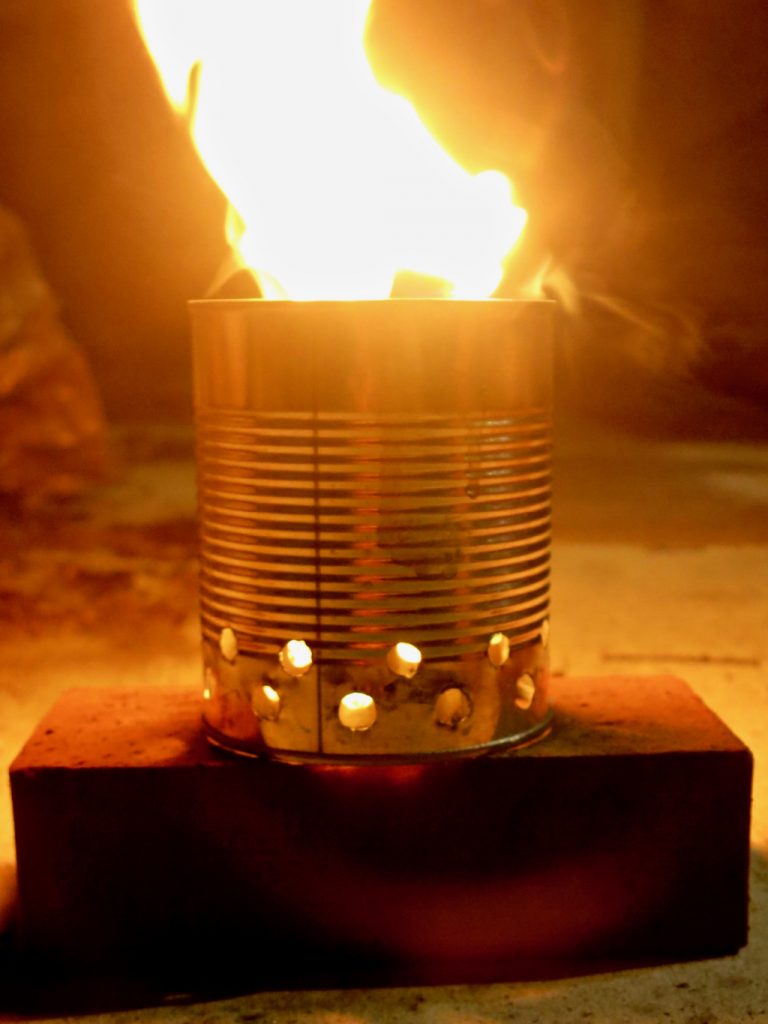
The biomass-burning stove with a fire in it
The stove requires two “tin” cans, one larger than the other: I got a 15 oz. can of pears, and a 29 oz. can of peaches. The smaller can, nested inside the larger can, is where you build the fire. Ventilation holes at the bottom of the larger, outer, can line up with ventilation holes at the bottom of the smaller, inner, can. The smaller can also has a row of ventilation holes near the top; this is where additional air is injected so to make rising gases can burn. If you look carefully at this photo of the stove I made, you can see the upper ventilation holes, with jets of flame coming out where the injected air is igniting rising gases.
Upper ventilation holes in the lit stove
I completed the basic stove in about an hour (including the time it took to eat the pears). The stove is reasonably practical, particularly for car campers or ordinary backpackers (i.e., not those crazy ultralight backpackers). And the stove is environmentally responsible: it’s made with recyclable materials, and it burns biomass instead of fossil fuels like white gas, butane, or propane. Plus, since it’s homemade, it doesn’t feed consumer consumption; and consumerism is a major contributing cause to the pending global environmental disaster.
I still have to make a potholder, to keep the cooking pot a couple of inches above the flames, where the greatest heat should be — but I have to wait until I eat another can of pears. Once I get the potholder made, I’ll post a photo showing something cooking on the stove (and I’ll add a sketch showing how to make one).
Drew asked about a “family tree” for the Unitarian Universalism, and as it happens I had drawn one back in 2003, so I revised it and sent it to him. It might be of interest to others:
Simplified family tree of the Unitarian Universalism
This family tree is based on a revisionist interpretation of Unitarian Universalist history, and therefore some explanation is in order.
First, this family tree shows Transylvanian Unitarianism as quite separate from North American Unitarianism. This is based on my reading of Earl Morse Wilbur’s history of European Unitarianism; Wilbur dearly wanted to connect Transylvanian and North American Unitarians, but the few connections he documents may be summed up as: maybe a few English-speaking Unitarians read a few books about Transylvanian Unitarianism. When you look at the two Unitarian groups today, some of the differences are more pronounced than the vague theological similarities: the Transylvanians have bishops, their religion seems more narrowly ethnic, etc. Thus, I depict the two groups as quite separate.
I understand North American Unitarianism and Universalism as being reactions against aspects of Calvinism. Thus I show both groups as having roots in Calvinism.
North American Unitarians came in large part from the New England Standing Order churches; there wasn’t enough room to show the small but important influence of Joseph Priestley and a few other early Unitarians who brought their Unitarianism from England, rather than getting it from Boston. Thus I show the major event in the beginning of North American Unitarianism to be the split between the conservatives — people like Jonathan Edwards — and the liberals — people like Charles Chauncy, a split which took place after the Great Awakening. However, the first openly Unitarian congregation in North America was King’s Chapel; originally affiliated with the Church of England, it became Unitarian in 1785, long before any of the Standing Order churches openly declared themselves to be Unitarian.
The beginnings of North American Universalism are a little more tangled. John Murray and George DeBenneville brought their Universalist beliefs from England when they came to live in the coastal cities of the New World; that history is well known. But there’s another history, well documented by scholar Stephen Marini and others, of how Universalism also arose in central New England, often in formerly Baptist churches. Thus I show Universalism as having some roots in Baptist traditions; this is perhaps most evident in the institutional structures (or lack thereof) of early Universalism. Then too, it is important to mention John Murray’s marriage to Judith Sargent; she came from a prominent and wealthy New England family, and both her family connections and her own intelligence contributed a great deal to John’s eventual success as a Universalist standard-bearer.
By about 1825, both Unitarians and Universalists were well established in North America. But the boundaries of both denominations remained somewhat porous. In the early nineteenth century, Unitarians sometimes cooperated with the Christian Connexion denomination (not show in the family tree). In the late nineteenth century, a small group of ministers split from the Unitarians to form the Free Religious Association, and in a few cases they brought their congregations with them; some of those congregations reportedly never rejoined the Unitarian denomination (though I’ve never been able to document that myself). Then around 1900, some Icelandic Lutheran churches in the prairie provinces of Canada switched to the Unitarian denomination; at least one other formerly Lutheran church, Nora Church in Hanska, Minnesota, also joined the Unitarians.
However, Unitarian boundaries were not completely porous. When William Jackson, an African American Baptist minister, tried to join the American Unitarian Association in 1860, bringing his congregation with him, he was carefully kept out.
In Universalism, the porous boundaries become most evident in the late nineteenth century, a time when many Universalists became enamored with spiritualism. Then spiritualism became an organized religion, and some Universalists, such as minister John Murray Spear, left Universalism to become Spiritualists. But again, the boundaries of Universalism were not completely porous. A splinter group of Primitive Baptists (Baptists who, among other things, refuse to have musical instruments in church, relying instead on a capella singing) adopted Universalist beliefs, probably after having read books by Hosea Ballou, the great Universalist theologian. But there has been very little interest in exploring the commonalities between Primitive Baptist Universalists (PBU) and Universalists, or for that matter Unitarian Universalists (the PBU-UU connection between may seem more robust theologically than the connection between Transylvanian and North American Unitarians; but the class difference is far greater).
As for the racial boundaries of Universalism, they were slightly more porous than those of the Unitarians. The Universalists accepted Joseph Jordan, an African American and former Baptist minister, into fellowship and ordained him in 1889. However, the racial boundaries were not all that porous: there remained little denominational support for African American Universalists outside of a couple of congregations in Virginia, and individual Universalist congregations in the South remained explicitly segregationist up into the mid-1960s.
The late nineteenth century saw a growing number of connections between Unitarians and Universalists ; this is symbolized on the family tree by Eliza Tupper Wilkes; she was ordained a Universalist minister, but worked for both groups at different times, and founded both Universalist and Unitarian congregations. There were also strong connections between both the Unitarians and the Universalists with the Congregationalists. During the early twentieth century, there were Universalist congregations that merged into Congregationalist congregations, and both Universalist and Unitarian congregations that federated with Congregationalist congregations. Some of the federated congregations still exist; they are one congregation in real life, but on paper they also exist as two separate congregations, and when you join a federated congregation you decide if you’re joining as, e.g., a Congregationalist or a Unitarian.
In 1961, the Unitarians and the Universalists consolidated (the legal term is “consolidated,” not “merged”). This now seems inevitable to us here in North America, but groups like the Khasi Hills Unitarians in India, or the Universalist churches in the Philippines, had no corresponding group to merge with.
Finally, it is worth remembering that several features of contemporary North American Unitarian Universalism which today seem diagnostic in helping to identify who’s a Unitarian Universalist are actually recent innovations. The “seven principles,” the widespread use of the flaming chalice in worship services, the water communion service — all these grew out of the feminist revolution of the 1980s, a revolution led by people like Natalie Gulbrandsen. Feminist theology has helped drive us further away from groups like the Primitive Baptist Universalists, while driving us closer to the United Church of Christ (UCC), a very liberal Christian group that is the inheritor of the old conservative New England churches from which the Unitarians split in the early nineteenth century. The UCC and the UUA today are close religious relatives, sociologically, politically, and demographically. The UCC and the UUA cooperated to produce the innovative “Our Whole Lives” comprehensive sexuality education program; politically, UCC churches are often to the left of UU churches; demographically both groups a dominated by white college-educated professionals. The only big difference today is that more UCC members believe in God than do Unitarian Universalists; though that too may be changing, as a friend of mine who’s a UCC minister says that most of the children and teens in her church are professed atheists.
Another in a series of stories for liberal religious kids, this one from the Mahabharata. Adapted from The Indian Story Book: Containing Tales from the Ramayana, the Mahabharata, and Other Early Sources, by Richard Wilson (London: Macmillan & Co., 1914).
One day, near the end of their long exile in the forest, King Yudhisthira and his four brothers were searching for a mysterious deer which had stolen the wooden blocks which a Brahmin needed so he could light the sacred fire. The king and his brothers wandered deeper and deeper into the forest trying to find the deer. They grew more and more thirsty, but they were unable to find water. At last they all sat down, exhausted, beneath a tall tree.
“If we do not find water soon, we shall surely die,” said Yudhisthira He turned to his brother Nakula. “Brother,” he said, “climb the tree for us and see if you can spot water nearby.”
Nakula quickly climbed the tree, and in a few moments called down, “I see trees which only grow near running water, and there I hear the sound of cranes, birds which love the water.”
“Take your quiver,” said Yudhisthira. “Go fill it with water, and bring it back to quench our thirst.”
Nakula set out, and quickly found a small stream which widened into a pool of clear water with a crane standing on the far side.
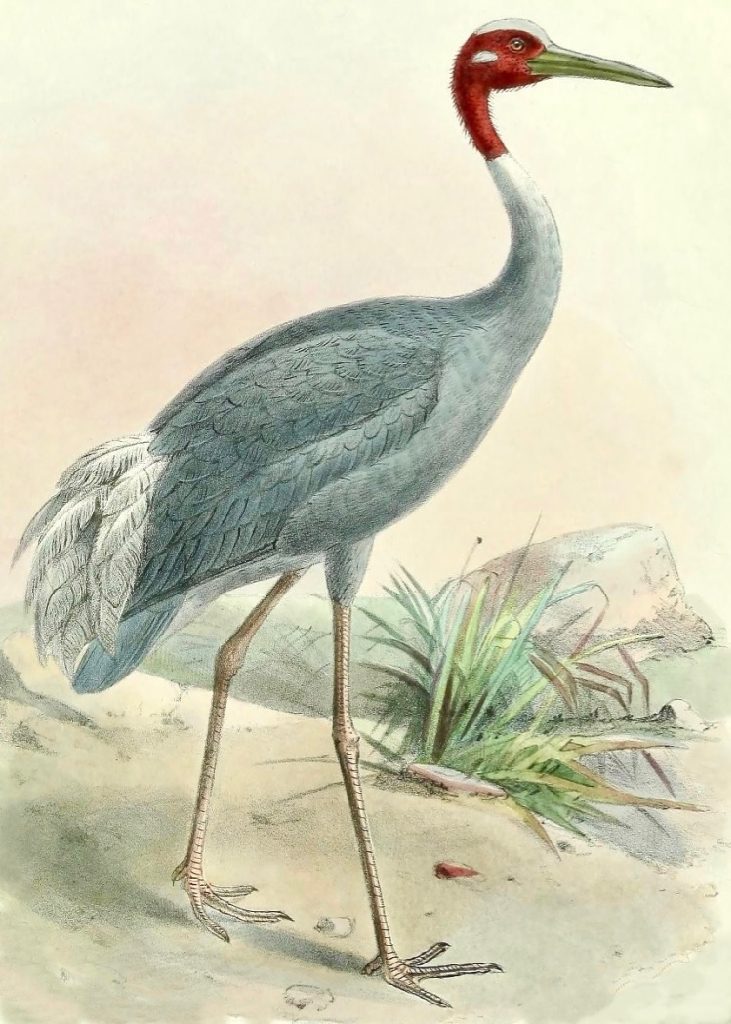
A Sarus Crane (Antigone antigone). Public domain image.
Nakula knelt down at the edge of the pool to drink. Suddenly a stern Voice spoke: “Do not drink, O Prince, until you have answered my questions.”
Nakula was so thirsty he ignored the Voice, and drank eagerly from the cool water. In a few moments he lay dead at the edge of the pool.
The other four brothers waited patiently Nakula’s return. At last Yudhisthira said, “Where can our brother be? Go, Sahadeva, find your brother, and return with a quiver full of water.”
Sahadeva walked off through the forest. Soon he found Nakula lying dead at the edge of the pool. But he was so thirsty that he did not stop, but knelt down at the pool to drink.
The stern Voice spoke: “Do not drink, O Prince, until you have answered my questions.”
But Sahadeva had already drunk from the water, and lay dead at the edge of the pool.
Once again the remaining brothers waited patiently. At last Yudhisthira spoke to his brother Arjuna, the mighty archer. “Go, Arjuna,” he said, “find our brothers, and return to us with a quiver full of water.”
Arjuna slung his bow over his shoulder, and with his sword at his side walked to the pool. When he saw his brothers lying dead among the reeds, he fitted an arrow to his bow while his keen eyes pierced the darkness of the forest searching for the enemy who had killed them. Seeing neither human nor wild beast, at last he knelt down at the edge of the pool to drink.
The stern Voice spoke: “Do not drink, O Prince, until you have answered my questions.”
Prince Arjuna looked about him. “Come out,” he cried, “and fight with me.” He shot arrows in all directions, but the Voice only laughed at him, and repeated its command.
But Arjuna ignored the Voice, knelt and drank, and soon lay dead at the edge of the pool.
Yudhisthira waited patiently, but when Arjuna did not return, the king turned to Bhima. “Go,” he said, “find our brothers, and return with them and a quiver full of water.”
Bhima silently rose, walked to the pool, and found his brothers lying dead. “What evil demon has killed my brothers,” he thought to himself, looking around. But he was so thirsty he knelt to drink.
Again the stern Voice spoke: “Do not drink, O Prince, until you have answered my questions.”
Bhima had not heard the Voice, and so he lay dead next to his brothers.
Yudhisthira waited for a time, then went himself to find water.
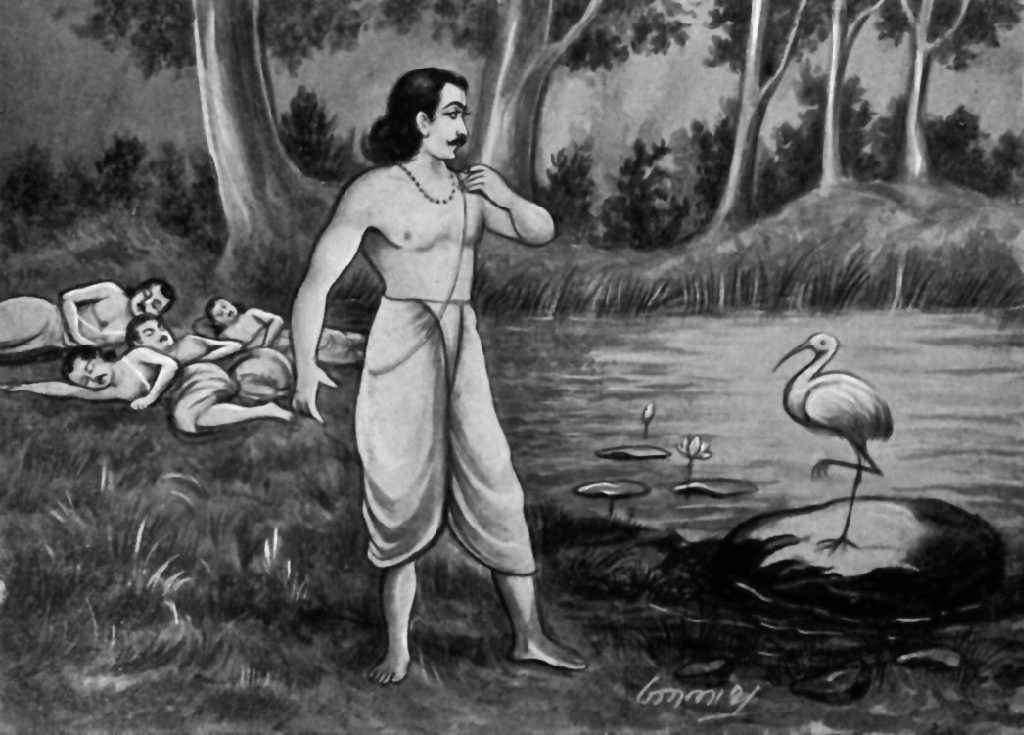
When he came to the pool, he stood for a moment looking at it. He saw clear water shining in the sunlight, lotus flowers floating in the water, and a crane stalking along the edge of the pool. And there were his four brothers lying dead at the edge of the pool.
Even though he was terribly weak and thirsty, he stopped and spoke aloud the name of each of his brothers, and told of the great deeds each had done. He spoke out loud his sorrow for the death of each one.
“This must be the work of some evil spirit,” he thought to himself. “Their bodies show no wounds, nor is there any sign of human footprints. The water is clear and fresh, and I can see no signs that they have been poisoned. But I am so thirsty, I will kneel down to drink.”
Yudhisthira and the crane (public domain image)
As King Yudhisthira knelt down, the Voice took the shape of a Baka, or crane, a gray bird with long legs and a red head. The Baka spoke to him in a stern voice, saying:
“Do not drink, O King, until you have answered my questions.”
“Who are you?” said Yudhisthira boldly. “Tell me what you want.”
“I am not a bird,” said the Baka, “but a Yaksha!” And Yudhisthira saw the vague outlines of a huge being above crane, towering above the lofty trees, glowing like an evening cloud.
“It seems I must obey, and not drink before I answer your questions,” said the king. “Ask me what you will, and I will use what wisdom I have to answer you.”
So the questioning began:
The Yaksha said: “Who makes the Sun rise? Who moves the Sun around the sky? Who makes the Sun set? What is the true nature of the Sun?”
The King replied: “The god Brahma makes the sun rise. The gods and goddesses move the Sun around the sky. The Dharma sets the Sun. Truth is the true nature of the Sun.”
The Yaksha asked: “What is heavier than the earth? What is higher than the heavens? What is faster than the wind? What is there more of than there are blades of grass?”
The King replied: “The love of parents is both heavier than earth and higher than the heavens. A person’s thoughts are faster than the wind. There are more sorrows than there are blades of grass.”
The Yaksha asked: “What is it, that when you cast is aside, makes you lovable? What is it, that when you cast it aside, makes you happy? What is it, that when you cast it aside, makes you wealthy?”
The King replied: “When you cast aside pride, you become lovable. When you cast aside greed, you become happy. When you cast aside desire, you become wealthy.”
The Yaksha asked: “What is the most difficult enemy to conquer? What disease lasts as long as life itself? What sort of person is most noble? What sort of person is most wicked?”
The King replied: “Anger is the most difficult enemy to conquer. Greed is the disease that can last as long as life. The person who desires the well-being of all creatures is most noble. The person who has no mercy is most wicked.”
The questions went on and on, but Yudhisthira was able to answer them all, wisely and well.
At last the Yaksah stopped asking questions, and revealed its true nature: the Yaksha was none other than Yama-Dharma, the god of death, and the father of Yudhisthira.
Yama-Dharma said, “It was I who took on the shape of a deer and stole the wooden blocks so the Brahmin could not light the sacred fire.
“Now you may drink of this fair water, Yudhisthira! And you may choose which of your four brothers shall be returned to life.”
“Let Nakula live,” said Yudhisthira.
“Why not Bhima or Arjuna or Sahadeva?” said Yama-Dharma.
“My brother Nakula is the son of Madri,” said the King, “while Arjuna, Bhima, Sahadeva and I are the sons of Kunthi. If Nakula returns to life, then both my mothers, both Madri and Kunthi, will have a living child. Therefore, let Nakula live.”
Then Yama-Dharma spoke kindly as he faded away. “Truly you are called ‘The Just,” he said. “Noblest of kings and wisest of all persons, for your wisdom and your love and your sense of justice, I shall return all of your brothers to life.”
More riddles — Here are two dozen more of the riddles that Yama-Dharma asked of Yudhisthira:
1. How may a person become secure? — A person becomes secure through courage. 2. How may a person become wise? — A person gains wisdom by living with people who are wise 3. What is best for the Brahmans (those who pursue learning as their life’s work)? — Studying the Vedas, the holy books, is best for the Brahmans. 4. What is best for the Kshathriyas (those who are the warriors and defenders)? Weapons are best for the Kshathriyas. 5. What is best for farmers? — Rain is best for farmers. 6. Who does not close their eyes when sleeping? — Fish do not close their eyes when sleeping. 7. What does not move even after birth? — Eggs do not move even after birth. 8. What does not have a heart? — A stone does not have a heart. 9. What grow as it goes? — A river grows as it goes to the sea. 10. Who is the guest who is welcome to all? — Fire is the guest who is welcome to all. 11. Who travels alone? — The Sun travels alone. 12. Who is born again and again? — The Moon is born again and again. 13. What container can contain everything? — The Earth can contain everything. 14. Out of all things, what is best? — Out of all things, knowledge gained from wise people is best. 15. Out of all blessings, what is best? — Out of all blessings, good health is best. 16. Out of all pleasures, what is best? — Out of all pleasures, being contented is best. 17. Out of all just actions, which is best? — Out of all just actions, non-violence is best. 18. What must a person control in order to never be sad? — A person must control their mind in order to never be sad. 19. What will a person never be sad to leave behind? — A person will never be sad to leave behind anger. 20. What should a person leave behind to become rich? — A person should leave behind desire in order to become rich. 21. What should a person leave behind to be have a happy life? — A person should leave behind selfishness to have a happy life. 22. By what is the world covered? — The world is covered by ignorance. 23. Why doesn’t the world shine brightly? — Bad behavior keeps the world from shining brightly. 24. What is surprising? — It is surprising that we think of ourselves as stable and permanent, when every day we see beings dying.
Illustrations are from the following public domain sources (accessed through the Internet Archive): Sarus Crane, H. E. Dresser, “A History of the Birds of Europe,” London: 1871-1881. Yudhistira and the crane, Mahabharata, Gorakhpur, India: Geeta Press, n.d.
Veronika sent a photo of hymn number 736 in Anglican Hymns Old and New, Revised and Enlarged (Great Britain: Kevin Mayhew, 2008). The hymn is titled “The Wolrd Is Full of Smelly Feet.” Of course I thought it was a faked photo, but a little bit of Web searching reveals that it is, in fact, a real hymn with text by by Michael Forster, and music by Christopher Tambling.
I suppose if one is in a Christian church with a liturgical heritage, and one is looking for a contemporary praise-song-type hymn to sing during footwashing, one might consider having the congregation sing this; although it’s hard to imagine.
But then my Web searching revealed that this hymn is included in a collection for junior choirs, and that boggled my mind. If the junior choir I was in sang this song — which we wouldn’t have, since it was a Unitarian Universalist church — but if we had been told to sing that song, my buddy Barry and I would have been laughing so hard we probably would have been unable to sing. Maybe some of the serious older girls would have sung it, but I can’t even imagine them getting through the lyrics with a straight face.
I am sometimes annoyed by some of the hymns in the Unitarian Universalist hymnals. It is good to know that we, at least, do no have a hymn to smelly feet.
For educational purposes, and in the spirit of Maundy Thursday, I’ll include the chorus and two of the verses here. I think you’ll especially enjoy the unexpected rhyme between “toes” and “nose.”
Chorus: The world is full of smelly feet, Weary from the dusty street. The world is full of smelly feet, We’ll wash them for each other.
Jesus said to his disciples, ‘Wash those weary toes! ‘Do it in a cheerful fashion, ‘Never hold your nose!
We’re his [Jesus’] friends, we recognise him In the folk we meet; Smart or scruffy, we’ll still love him, Wash his smelly feet!
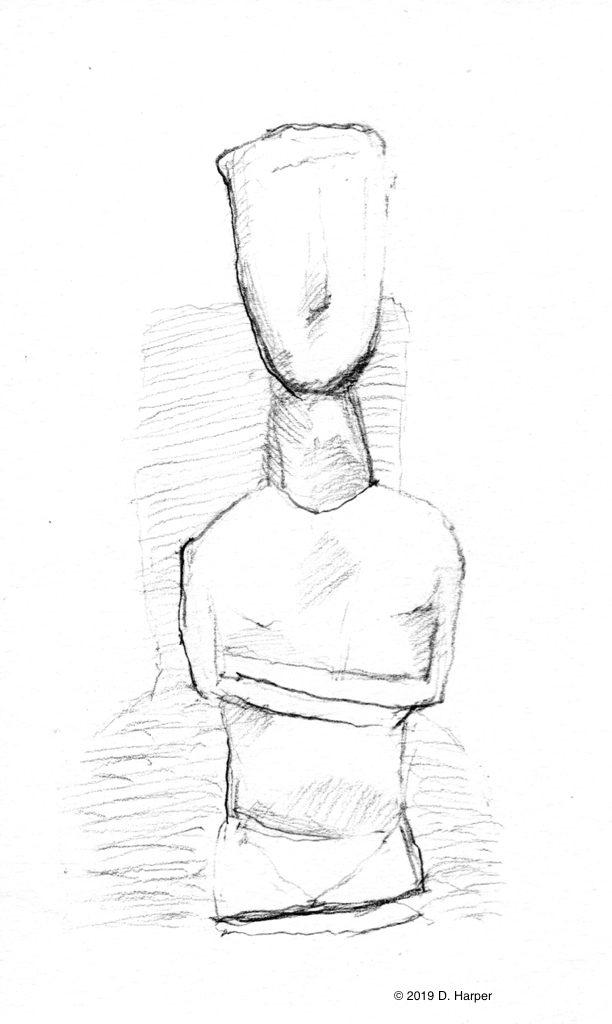
The DeYoung Museum in San Francisco has a number of Cycladic figures made thousands of years ago in what is now Greece. I was attracted to one of these figures, labeled as “Cycladic Figure, Early Cycladic II, Spedos variety,” dating to perhaps 2500 BCE, so I made a quick sketch of it:
This is a typical Cycladic figure of a woman with her arms crossed; it is made of white marble, though originally it would have been “painted with mineral-based pigments—azurite for blue and iron ores, or cinnabar for red.” There are those who assert that this type of figure represents a deity, perhaps the Great Goddess who may have been the chief deity of the ancient Greek world.
But of course there’s really no way to know what this figure represents. Is it a deity, or just a human figure? Or maybe something in between? Perhaps we would tend to call it a deity because the shape is so satisfying to look at; when we like looking at a piece of art it is tempting to think of that art as representing something beyond the mundane.
Alex, a friend who works at Health Initiatives for Youth (HI4Y) in San Francisco, told me about their Risk Reduction Resource Kits. These kits contain resources to help teens teens learn about sexuality and safer sex. Alex knows about the OWL comprehensive sexuality education program, and has heard me describe our youth programs, and based on that he encouraged me to put in an application for the last remaining Risk Resource Reduction Kit, and Carol and I went in to JI4Y’s offices to pick up the kit on Monday.
The whole point of the kit is that it’s supposed to be placed where teens can access it without adult supervision, to encourage them to explore the materials on their own. The kit was designed to accompany a sexuality education curriculum developed by HI4Y, but be accessible both to teens taking the curriculum and other teens. So for our congregation, it’s a prefect accompaniment to the OWL unit for gr. 10-12; for those taking OWL the kit will reinforce the curriculum; and it can also serve as an educational resource for those not taking OWL.
The Curriculum Subcommittee of our congregation met the day after I picked up the kit, and we devoted the meeting to talking about the kit. The Curriculum Subcommittee has been exploring ways to be more intentional about our congregation’s implicit curriculum, asking ourselves: How can we structure intentional learning opportunities that are not part of the explicit curriculum, the formal educational programs? We agreed that the kit is a solid addition to our implicit curriculum: Not only does it educate teens about specific sexuality topics, it provides a larger lesson that information about sexuality should be easily accessible and shared without shame or guilt.
Beyond educational theory, we also talked about how best to implement this aspect of our implicit curriculum. Alex had warned us that sometimes the kits get forgotten, and stowed in some obscure corner. So we’re going to provide orientation to the kit for key adults (youth advisors, OWL leaders, ministers, and others) to increase the chance that adults will remember to make the kit accessible. In addition, we’re also going to provide a brief orientation to the kit to teens — both to youth group members, and participants in OWL gr. 10-12 — showing them what’s in the kit, and telling them where it will be located. (When we offer OWL for gr. 7-9 next year, we’ll do another orientation.)
But the real strength of the kit is what it contains. HI4Y came up with some excellent youth-friendly resources, including comics, zines, books, and samples — I’m putting a complete list of what’s in the kit below. The materials are housed in a wheeled nylon case, like airline luggage (actually, it’s a scrapbooking case HI4Y bought from Michael’s art supply). A highlight of the kit is contraceptives samples that youth can examine: condoms of course, but also dental dams, female condoms, and lubricant; HI4Y even has some grant money left to replenish samples when they get depleted. There’s both a penis model (made of wood, not plastic!) for trying condoms, and a vulva/vagina model for trying female condoms. We were able to add one very important thing to this kit: our congregation has a ten thousand dollar bequest that we can use to put books in the hands of children and teens, so we are able to provide copies of the book “S.E.X.” by Heather Corinna that youth can take for their own.
We would not have been able to afford to put this kit together ourselves, and we are grateful to HI4Y for writing the grant and assembling the kit, and to the federal government for providing the grant money. Just in case your UU congregation can find the funding, I’m going to provide a complete list of all the resources in the kit below; at the very least, this list of resources might spark ideas for you.
The Risk Reduction Resource Kit (we added the sign at top).
Here’s what’s in the kit:
Birth control samples and examples: Dental dam samples Female condom samples Female Contraceptive Model (to practice inserting female condoms) Lubricants samples Male condom samples Penis model (to practice with male condoms) IUD model The Ring model The Pill model The Implant info card Plan B info card Birth Control Patch info card “How Well Does Birth Control Work” info card
Home test kits: Pregnancy test kits HIV Home Test Kit information (actual kit is stored separately, per instructions from Health Initiatives for Youth)
Handouts and Miscellaneous: “Pre-Exposure Prophylaxis” handout Individual Drug Fact Cards (handouts) Drug Fact Cards set Chlamydia Plush Toy HIV Plush Toy Youth Clinic Youth Guide to San Francisco and Silicon Valley (list of local clinics that serve youth; includes 1-page summary of California law on youth’s right to treatment) (We also added handouts from the nearest Planned Parenthood Health Center)
Publications: “Dr. Rad’s Queer Health Show: Self Exams & Check-Ups” zine by Rad Remedy and Isabella Rotman “You’re So Sexy When You Aren’t Transmitting STIs” comic zine by Isabella Rotman “Not on My Watch: Bystander’s Handbook for Prevention of Sexual Violence” comic zine by Isabella Rotman “100 Questions You’d Never Ask Your Parents” book by Elisabeth Henderson and Nancy Armstrong “S.E.X.” book by Heather Corinna “LGBTQ: The Survival Guide” book by Kelly Huegel Madrone “Birth Control Top Picks” magazine by Bedsider.org