Behind the scenes

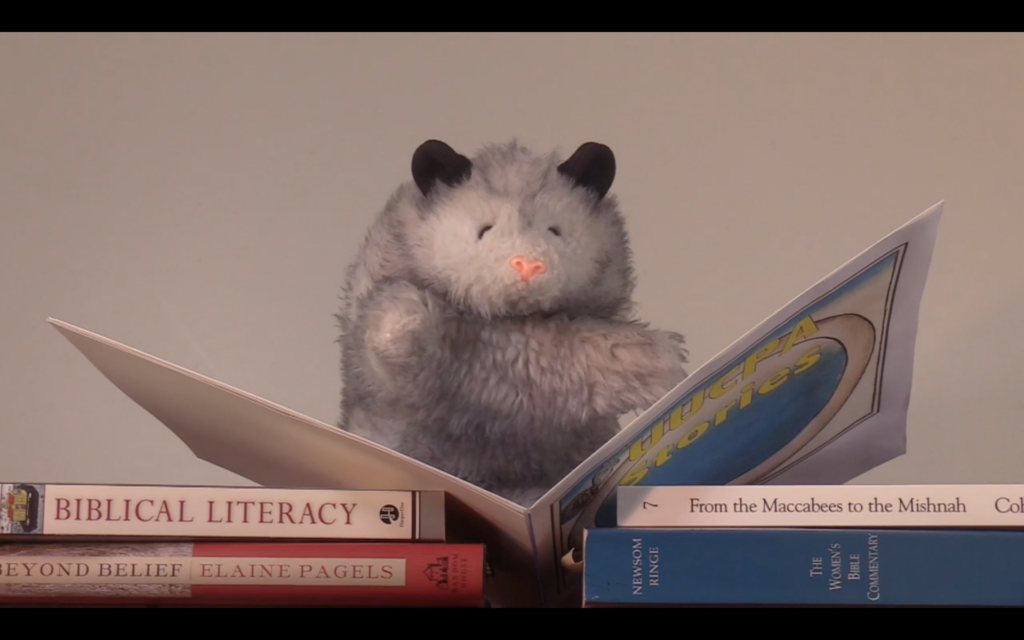
Since 2020, I’ve been filming stories-for-all-ages in a puppet studio I put together in the nursery at the Palo Alto church. We’re about to resume infant and toddler care, so it’s only a matter of time before I have to remove the puppet studio from the nursery. But I managed to take some behind-the-scenes photos of puppets and puppeteers in action while filming a few last videos.

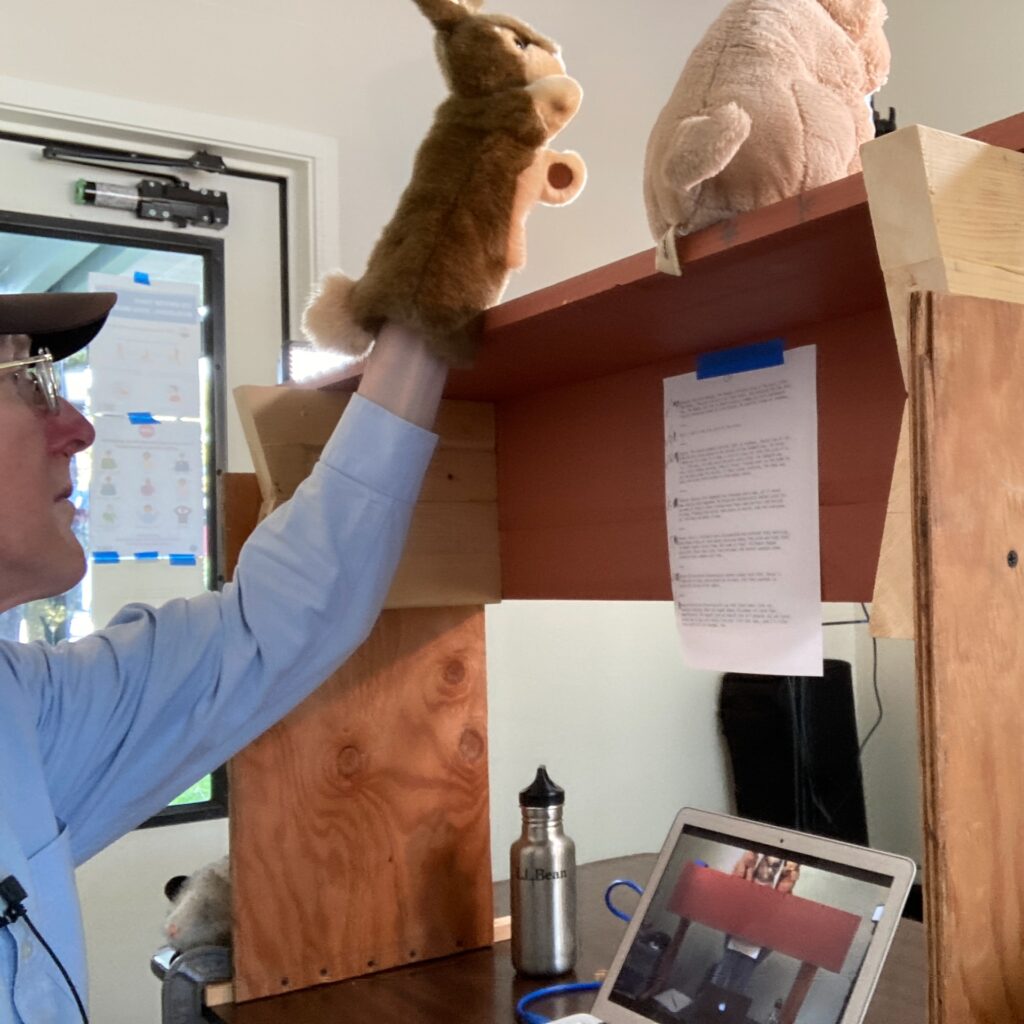
When we’re filming, the puppeteers mostly watch the action on the computer screen. Sometimes looking at the screen is disorienting and we have to look up at the puppets. We tape the script to the back of the puppet stage at our eye level. Puppets who are not in the current scene lie on the table next to us (you can see Possum in the lower left corner of the photo.)

Puppeteer view

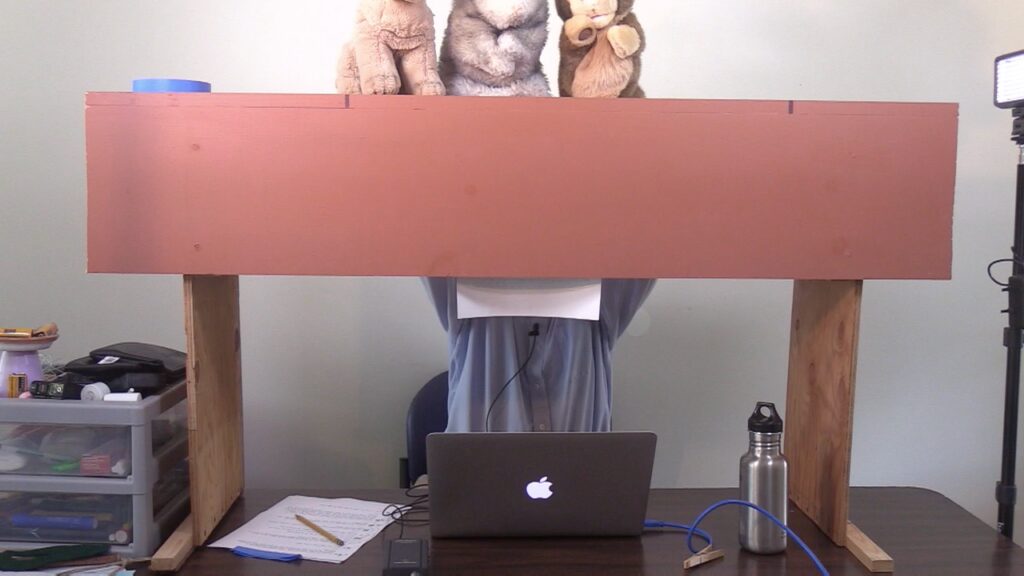
This is what the camera sees when the zoom is set to the widest angle:

Camera view

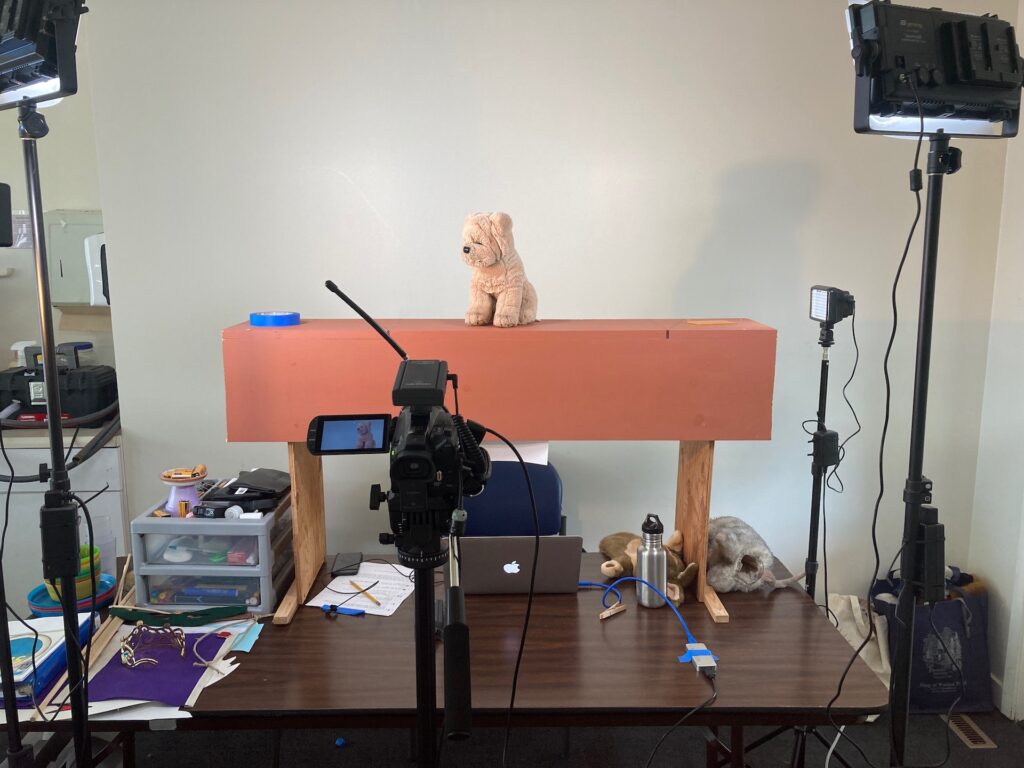
A wider view, from behind the camera. We sometimes have up to seven lights aimed at the stage. Props are laid out on the table to the left of the puppet stage. When not needed in the current scene, the puppets stay in cloth bags, and you can see Rolf’s head poking out of the dark blue bag in the lower right corner of the photo.

View from behind the camera

I’ll miss the puppeteer studio when it’s gone. But I won’t miss sweating in that small room on hot days, with the doors closed to keep outside sound out. I won’t miss having to reshoot a scene because a helicopter went overhead, or someone started talking on their phone right outside the door, or the cello class started up unexpectedly, ruining the sound. I won’t miss having a carefully-constructed set suddenly decide to fall over in the middle of filming. I won’t miss spending fifteen minutes trying to level the camera, only to find that somehow, mysteriously, the stage has gone out of level. I won’t miss shooting video on a tight deadline with little margin for error. But… I will miss bringing Sharpie and Possum and the other characters to life.

Webpage with links to all videos, plus “Meet the Stuffies”

Ecojustice Class curriculum now online (finally)

We’ve been teaching Ecojustice Class — a hands-on environmental justice curriculum for gr. 6-8 — since 2014. But much to the frustration of the teachers, there has never been a written curriculum for the class — until now.

Here’s the general curriculum plan for Ecojustice Class. There should be enough material there to fill approximately two dozen sessions over the course of a school year.

However, you won’t find a completely scripted curriculum, because that’s just not possible due to the nature of the program. This is a hands-on curriculum that gets the participants outdoors as much as possible. That means you have to have back-up plans in case weather doesn’t allow you outdoors. And you have to adjust the program to your specific climate and seasons.

I still have a few more successful lesson plans that I haven’t had time to put online yet. So expect minor upgrades to the curriculum over the next few months.

(And thanks to the many talented Ecojustice Class teachers who contributed to the class over the years, including Carol Steinfeld, Francesca Finch, Emma Grant-Bier, Ed Vail, Lorraine Kostka, Buzz Frahn, Mark Erickson, and others. I’m especially grateful to Francesca and Emma, who grew up taking the class and then went on to teach it.)

Reopening

Here in Palo Alto, it feels like people are starting to return to church. It’s not like the pandemic has gone away. Here in Palo Alto, the Omicron surge has died down, but now we’re seeing a slight uptick in cases, probably caused by BA.2. Or caused by the lifting of indoors restrictions on masks. Or caused by hundreds of other random variables that we’re not aware of.

At the same time, we’re also becoming more aware of another public health problem — an increase in mental health issues among teens and children. Teen mental health problems began rising around 2009, but the pandemic prompted even more teen mental health issues. One probable cause: a rise in screen time. More screen time leads to more mental health problems. And the pandemic led to even more screen time.

I feel that our congregations are in a balancing act right now. On the one hand, we want to help control the virus, and we also want to remain accessible to people who are vulnerable to the virus. On the other hand, we know that our in-person programming can support positive mental health outcomes in children and teens. So we need to reopen to support good mental health, and we also need to promote COVID safety.

Right now, the Palo Alto congregation where I serve is reopening as fast as we can, while staying safe. We just figured out how to start offering child care for infants and toddlers once again. As the weather warms up, we’re seeing more preschoolers show up for outdoor play time — we had six preschoolers on campus this past Sunday, the first time we’ve had more than two since the pandemic began. We’re still not up to pre-pandemic attendance, but we’re getting there. And we’re still offering most of our programming outdoors, or in large rooms with small numbers of kids.

Reopening is a lot of work. But I don’t mind. It feels great having more people showing up in person again.

Obscure Unitarians: Burt Estes Howard

[An excerpt from my forthcoming book on Unitarians in Palo Alto:]

A minister and a professor at Stanford University, Burt Estes Howard was born February 23, 1863, in Clayton, N.Y. He went to school at Shaw Academy, Cleveland. He graduated from Western Reserve University in 1883, received a masters’ degree from Lane Theological Seminary, and was ordained a Presbyterian minister in 1886. He served as a Presbyterian minister in Michigan and Ohio from 1887 to 1892.

He married Sarah Gates 1890, and they had three children: Grenville (b. 1891), and twins Graeme and Emily (b. 1896). Sarah was a college graduate, having received her A.B. from Vassar in 1869.

He became the pastor of First Presbyterian Church, Los Angeles, in 1892, moving his wife and infant son to California. He only remained a pastor of that church for three years. In 1895, Burt was convicted of “insubordination” by the Los Angeles Presbytery, on what some considered to be trumped-up charges. The presbytery stripped him of his ministerial authority. Burt and his supporters appealed the conviction to the judiciary commission of the Presbyterian Synod in San Jose, which reversed the local decision. But then he was brought up on charges of heresy and insubordination again a few months later. On January 25, 1896, the Los Angeles Herald reported in a page two story:

“The Rev. Howard is to be charged with high crimes and misdemeanors innumerable. The bill of particulars, it is said, will allege that he has been guilty of denying the atonement. It will furthermore be alleged that he also questioned the integrity of the scriptures. This is not all. It will be claimed that the doughty pastor has advanced, stood by and defended the doctrine of evolution. He will also be accused, in all probability, of pantheism. This is something new, but it means that he has enunciated that all nature is good. Not content with this, an endeavor will be made to show that Mr. Howard has stood up for Unitarianism. These charges will be made, so it is claimed, by some of the members of Mr. Howard’s congregation. The congregation split, and those who withdrew formed another church.”

This second heresy trial finally drove him away from Presbyterianism. In 1897, while also serving as a lecturer in professional ethics at Los Angeles Law School, he organized the Church of the Covenant, a congregation independent of any denomination. He served as the minister of that congregation for three years.

Continue reading “Obscure Unitarians: Burt Estes Howard”

Baseball and religion are both in decline

Religion News Service reports:

“Tom Johnson loves baseball. And he loves the [Christian] church. Both, said Johnson, a former Minnesota Twins pitcher turned pastor, are in trouble. They’ve lost touch with their past and with ordinary people. They’ve become too much of a show, their leaders too disconnected from their audience, he said. Both religion and baseball see the people in the pews and the fans in the seats as sources of revenue rather than valued partners or supporters. They’ve betrayed the people’s trust, he said, and trust is hard to regain.”

The article goes on to talk about how boring baseball has become “boring and joyless.” That’s one of the reasons I no longer follow baseball — it’s not longer a game, it’s all about algorithms and analytics. My reaction to the postponement of Opening Day — yawn.

As for organized religion, in addition to religious leaders becoming disconnected from the people in the pews, Johnson offers this pointed critique:

“‘The [Christian] church has shot itself in the foot by not adhering to the values that have attracted it to people down through the centuries — that is, caring about the poor and those who are on the margins,’ said Johnson….”

Johnson may be on to something here. Organized religion does sometimes feel as boring and joyless as baseball, with leaders who only see the people in the pews as sources of revenue. This is even true for non-Christian religions like Unitarian Universalism. All too often, I’ve heard UU leaders saying, “We need to grow our congregation in order to increase revenue.” All too often, I’ve seen UU congregations very concerned with their own bottom line, yet with little energy left over to help unhoused persons find food and shelter.

Maybe this is the real reason behind the rise of the Nones (those with no religious affiliation) — religion has become too much like baseball.

Wait, what?!

A new study from Public Religion Research Institute (PRRI) looks into religious affiliations of QAnon devotees. QAnon devotees believe that governments, media outlets, and world finances are in the control of pedophiles who worship Satan. They also believe that there’s some kind of big convulsion coming that will get rid of all the powerful elites, allowing the world’s true leaders (like Donald Trump) to return to their rightful positions of power. And QAnon devotees believe that real American patriots are gonna have to get their guns and use violence to save America.

41 million Americans believe in QAnon — roughly 16% of the population. We usually think of QAnon devotees as white Protestant evangelicals. But you can find QAnon devotees in many different religious groups. For example, 17% of all QAnon believers are “Nones,” religiously unaffiliated Americans.

PRRI also looked at specific religious groups to determine what percentage of each religious group were QAnon devotees. So while 17% of QAnon devotees are Nones, only 11% of Nones are QAnon devotees. Hispanic Protestants had the highest percentage of QAnon devotees, at 27%. Interestingly, 17% of all Buddhists are QAnon devotees, whereas only 14% of white mainline (non-evangelical) Protestant Christians were QAnon devotees. And 7% of Unitarian Universalists are QAnon devotees.

Wait, what?!

7% of us are QAnon devotees. So if there are roughly 200,000 Unitarian Universalists, that means there are 14,000 Unitarian Universalists who are QAnon devotees. Well, I guess we can take comfort that there’s only one group — Jews — with a smaller percentage of QAnon devotees (5%).

But still….

The UUA really needs to do this

Within the past couple of hours, Religion News Service has posted an article titled “Reform movement publishes extensive report on sexual misconduct in its youth programs.” The Union for Reform Judaism (URJ) commissioned an outside law firm to investigate sexual misconduct in their movement’s youth programs and summer camps over the past half century. Then URJ published the report in its entirety, with no redactions whatsoever, on their website.

I’m impressed that URJ has both commissioned this investigation, and that they’re being completely open and transparent about the results. Really impressed. Really, really impressed. Mind you, this investigation didn’t extend to individual congregations; that would have been a much more difficult task. Nevertheless, by commissioning this investigation, the URJ has set the standard for individual congregations.

It’s time for the Unitarian Universalist Association to commission a similar investigation into our denominational youth ministries. I was very active in denominational youth activities in the late 1990s and early 2000s, and I heard enough stories back then to make me think that an investigation would turn up more sexual misconduct than anyone would feel comfortable with.

If the UUA were to commission a law firm to carry out this kind of investigation, what should we look for? We should look for exactly what the URJ looked for: sexual misconduct by adults (anyone over age 18) against minors (anyone under age 18); sexual misconduct between minors; and sexual misconduct between adults at youth activities. As I look back 50 years to 1972, at a minimum the following programs should be investigated: “ConCon,” the former continental youth conference; district youth conferences; and any other programs or summer camps run by Liberal Religious Youth (LRY) or its successor Young Religious Unitarian Universalists (YRUU).

The UUA doesn’t have a great track record of investigating and publicly admitting the sexual misconduct that’s happened in our denomination. This is a grand opportunity for us to do the right thing. I hope our denominational leaders will follow the shining lead of the Reform Jews.

Not OK

Someone pointed out to me that Star Island has posted an interesting job opening. Star Island, for those of you who aren’t familiar with it, is a retreat center off the coast of New Hampshire that was founded by Unitarians and liberal Congregationalists, and remains affiliated with the United Church of Christ and the UUA.

The position, titled “Island Minister/Beloved Community Project Manager,” will “work to further Star Island Corporation’s Beloved Community Project — a diversity, equity, and inclusion initiative that is a core strategic priority of the Star Island Corporation (SIC).” This is a laudable goal, and it’s simply amazing that a nonprofit would hire a full-time year-round staffer to oversee diversity, equity, and inclusion.

There’s just one problem. The job posting does not list the salary range. Instead, applicants are told to submit their “salary requirements.”

I call bullshit.

The reason I call bullshit — and the reason that I use such a strong word to describe their action — is that refusal to include a salary range in a job posting is in itself a discriminatory act. In fact, in some jurisdictions, it is now illegal to post a job with no salary range: BBC news recently reported that Colorado now requires all job posting to include the hourly wage or the salary range. Similarly, SHRM recently reported that New York City will require all job posting in the city to include salary ranges. Why? Manhattan Councilwoman Helen Rosenthal says, “Failure to include a salary range would be considered a discriminatory practice.” That’s right, a discriminatory practice.

BBC has also reported: “Research shows that the pay gap, which is well documented, partly stems from the ‘ask gap’: the difference in salary expectations between groups, which undercuts women and minorities in particular. Closing this gendered and racialised ‘ask gap’ can pay major dividends for careers, reducing long-term salary inequality.”

Star Island is engaging in a discriminatory hiring practice — a practice that’s illegal in Colorado and New York City — in order to hire a staffer who will oversee diversity, equity, and inclusion. Oh, the irony. If you’re someone who has connections to Star Island (especially if you make donations to them), please contact their board and CEO and call them out on this racist, sexist practice.

We also need to call out all the UU congregations that post jobs with no salary range. Some day if I ever have time, I’m going to go through the job postings on the UUA “Jobs Board” and the LREDA employment postings and make a list of all the congregations that post jobs with no salary range — a sort of “Hall of Shame,” showing which congregations have racist, sexist hiring practices.

This is an equity issue that’s easy to fix. Let’s fix it.

In memoriam: Thich Nhat Hanh

Thich Nhat Hanh, a Vietnamese Buddhist monk known for popularizing the concept of “Engaged Buddhism,” has just died. (He died Jan. 22 in Vietnam, on the other side of the International Date Line, which was Jan. 21 here in the U.S.) He had been incapacitated by a stroke in 2014, and in 2018 finally received permission from the Vietnamese government to return to his home temple to spend his final days. His name is more properly rendered as Thích Nh?t H?nh, but I’ll use the more common romanization without tonal indications.

Thich Nhat Hanh is probably best known for his series of popular books on Buddhism. Worldcat lists the following titles as the five “most widely held works” in libraries: The Miracle of Mindfulness; Living Buddha, Living Christ; Peace Is Every Step: The Path of Mindfulness in Everyday Life; Anger: Wisdom for Cooling the Flames; and Being Peace. Nhat Hanh arguably did more than anyone else to popularize the concept of mindfulness in the West.

The book of his that I found most interesting, though, one to which I’ve returned a number of times, is The Sutra of the Full Awareness of Breathing (Parallax Press, 1988). This book includes Nhat Hanh’s translation of the ?n?p?nasati Sutta, along with his commentary on the text. This Sutra is no. 118 of the “medium length” sutras that have been collected into the Majjhima Nik?ya. (A later revised version of his translation is now freely available on the website of his Plum Village Buddhist community here.) Nhat Hanh translated the text into French, which was then translated into English; I found the English translation to be lucid, readable, and non-technical. I also liked his The Heart of Understanding: Commentaries on the Prajnaparamita Heart Sutra; I find Buddhist scriptures difficult to understand, and Nhat Hanh’s commentary helped me understand a little bit about this complex text.

But I think Thich Nhat Hanh’s real impact as a writer and teacher was through his many popular books which give good sound advice for living life. I’ve read a little bit in some of his many books on mindfulness, and was impressed by the good common-sense tone of these books. Unfortunately, mindfulness grew into a fad, and big corporations have learned how to use mindfulness as an opiate to drug their workers into submission. But what Nhat Hanh said about mindfulness had nothing to do with submission to a corporate overlord. Quite the contrary: Nhat Hanh’s writings are permeated with the spirit of Engaged Buddhism, and mindfulness connects one fully with the fate of all beings; instead of quietism and retreat from the world, Nhat Hanh’s mindfulness moves us to become engaged in seeking justice.

If your corporate overlord forces you to do mindfulness — or if your school forces you to do mindfulness — try reading Nhat Hanh’s The Miracle of Mindfulness. You’ll find out that mindfulness is not a drug forcing you to submit to your employer or your school. Nhat Hanh used mindfulness as a way to advocate for peace during the long-running war in Vietnam. Mindfulness helped empower him to criticize both South Vietnam and North Vietnam, and also to stand up against U.S. involvement in Vietnam, at great personal cost. Mindfulness helped bring Nhat Hanh to the U.S. in 1966, where he helped convince Martin Luther King, Jr., to speak out against the injustices of the Vietnam War. In short, unlike the mindfulness that corporations and schools teach, which seems designed to ensure passive compliance with tyranny, Nhat Hanh’s mindfulness is designed to resist tyranny, oppression, and injustice.

I’m less interested in Nhat Hanh’s teachings on mindfulness — personally, mindfulness does nothing for my spiritual self — and far more interested in him as a teacher. Everyone I’ve talked to who saw him in person has said he was a riveting teacher. Apparently, his English skills weren’t great — I’m told Vietnamese and French were his main languages — but even through an interpreter his teaching was compelling. I get the sense that it was his presence as a teacher that most impressed those who went to hear him. This has been true of the best teachers I’ve known: there’s something about the way they move, the way they hold their bodies, it is their very being that teaches us. The best teachers, I think, cultivate their persons — or as we might say in the West, cultivate their souls — and it is this cultivation of the person which shines through in their teaching. While I never experienced Nhat Hanh in person, I can catch glimpses of this cultivated soul in his writings. I would unhesitatingly call him a brilliant teacher.

Our troubled world needs brilliant teachers like him, teachers who can empower us to stand up for justice and peace. Thich Nhat Hanh will be sorely missed.